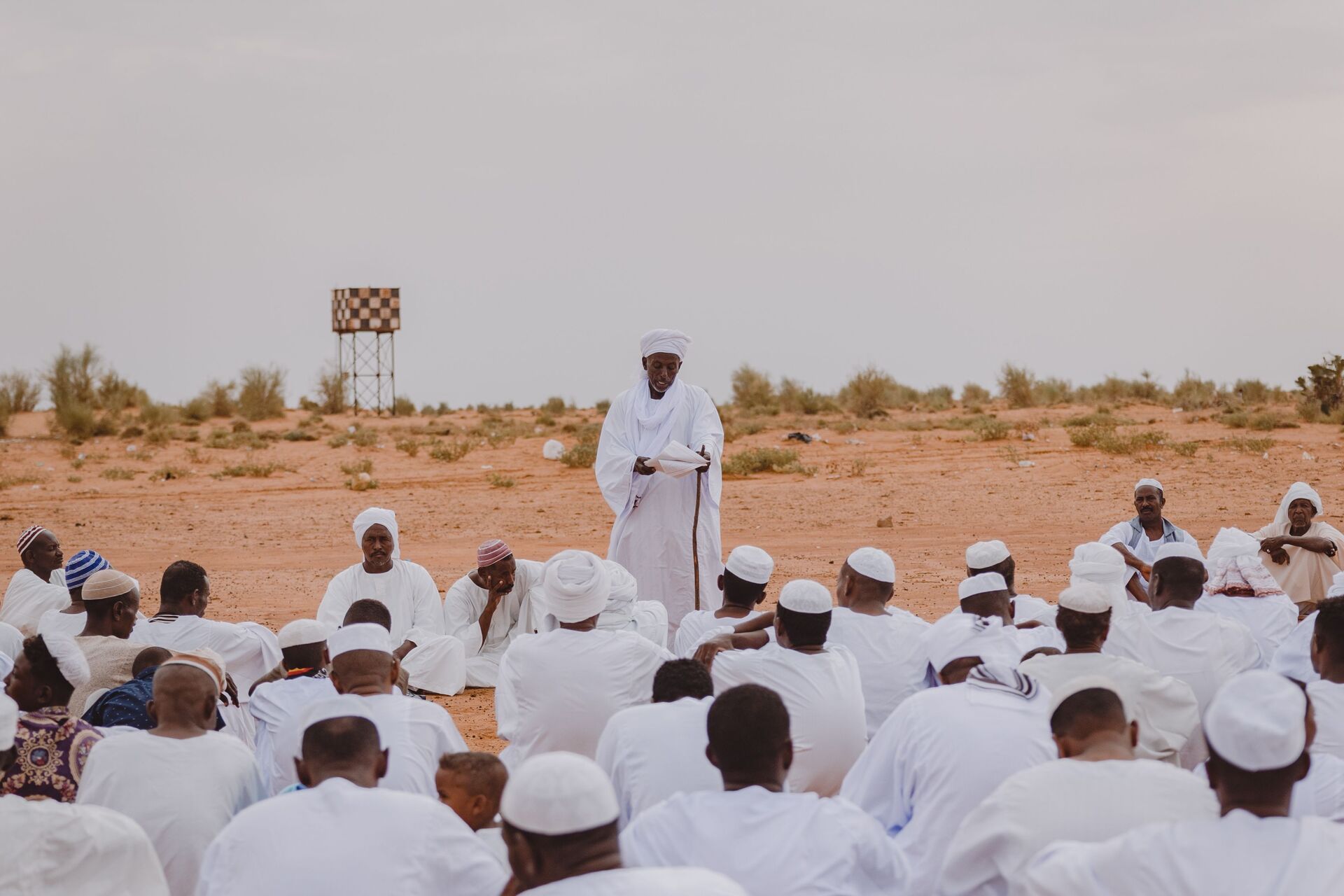
Sudan, and the people
Independence Day: 1 January 1956. Sudan's capital is Khartoum, where the Blue Nile and the White Nile meet. It was the largest country in Africa until South Sudan left in 2011. It became independent peacefully, by a vote of its own parliament, and has since lived through more than a dozen coup attempts, two civil wars with the south, a genocide in Darfur, a popular revolution, and, since April 2023, a war that has become the largest humanitarian catastrophe on earth.
Most African independence stories end in a clear before and after. Sudan's does not.
Sudan was never a simple colony. It was ruled first by Egypt, which was itself under Ottoman rule, and then jointly by Britain and Egypt. Its independence came not from a liberation war but from a vote. And its people have done something few peoples anywhere have managed: three times, in 1964, 1985 and 2019, unarmed Sudanese brought down a military government through protest.
And three times, the soldiers came back.
Long before anyone drew a border here, the Nile valley north of Khartoum was home to one of the great civilisations of the ancient world.
The Kingdom of Kush, with its early capital at Kerma, traded and fought with Egypt for centuries. Around the eighth century BCE, Kushite kings conquered Egypt and ruled it as its Twenty-Fifth Dynasty, the so-called Black Pharaohs.
Later, at Meroë, the Kushites built a city of iron-working and trade, a written language of their own, and pyramids. Sudan has more pyramids than Egypt, hundreds of them, steeper and smaller, standing in the desert where few tourists ever reach. Meroë and Gebel Barkal are UNESCO World Heritage Sites.
After Kush came the Christian Nubian kingdoms of Nobadia, Makuria and Alodia. In the seventh century, Makuria fought off the Arab armies that had just conquered Egypt, and the two sides signed a treaty, the baqt, which kept the peace for some six hundred years.
Then came the Islamic sultanates: the Funj Sultanate of Sennar on the Blue Nile from the early sixteenth century, and the Sultanate of Darfur in the west, which survived until 1916.
Sudan, and the people
In 1821 the army of Muhammad Ali, the Ottoman ruler of Egypt, conquered northern Sudan. Sudanese remember this period as the Turkiyya.
Egypt wanted two things: gold and slaves, above all slaves for its army. The raids into the south and west, described on the South Sudan page of this site, began here. Heavy taxes crushed the northern farmers.
In 1881 Muhammad Ahmad, a religious teacher, declared himself the Mahdi, the redeemer expected by many Muslims. His movement swept the country.
On 26 January 1885 the Mahdists took Khartoum and killed the British general Charles Gordon, who had been sent to evacuate it. The Mahdi died a few months later, and his successor, the Khalifa Abdallahi, ruled an independent Mahdist state for thirteen years.
It is one of the few cases in the nineteenth century of an African movement driving out an imperial power and ruling for years. It was also a harsh state, which fought famine, rebellion, and its neighbours.
On 2 September 1898, at Omdurman, a British and Egyptian army under Herbert Kitchener destroyed the Mahdist army. Machine guns and artillery killed around 10,000 Sudanese fighters in a morning; British losses were a few dozen. Many wounded were killed where they lay. Kitchener had the Mahdi's tomb blown up and his bones thrown into the Nile; the skull was reportedly kept for a time as a trophy. A young Winston Churchill rode in the battle.
From 1899 Sudan was governed as the Anglo-Egyptian Condominium. In name, Britain and Egypt ruled together. In practice, Britain ran it.
The British developed the Gezira cotton scheme between the Niles, one of the largest irrigation projects in the world, and ran the north through a small elite of Sudanese officials and religious families. The south was kept separate and neglected, as described on the South Sudan page.
In 1924, the White Flag League, led by the officer Ali Abd al-Latif, called for unity of the Nile valley with Egypt and organised protests and a mutiny. Britain crushed it and expelled Egyptian troops from Sudan.
From the 1940s two camps shaped northern politics. One, around the Khatmiyya religious order and Ismail al-Azhari, wanted union with Egypt. The other, the Umma Party, around the Mahdi's son Abd al-Rahman al-Mahdi, wanted a Sudan for the Sudanese.
In 1953 Britain and Egypt agreed that Sudan would decide its own future. Elections that year were won by al-Azhari's party, on a platform of unity with Egypt.
Then something unexpected happened. Once in office, al-Azhari and his party chose full independence instead. On 19 December 1955 the Sudanese parliament declared independence unanimously.
On 1 January 1956 the flags of Britain and Egypt were lowered in Khartoum, and Sudan became a sovereign republic.
There was no liberation war. But in the south the war had already begun: the Torit mutiny of August 1955 came four months before independence.
What followed was a cycle that has shaped Sudan ever since.
Bashir's regime turned Sudan into an Islamist state. It purged the army and civil service, tortured opponents in secret detention houses known as "ghost houses," and escalated the war in the south into a religious campaign.
Sudan hosted Osama bin Laden from 1991 to 1996. In 1993 the United States listed Sudan as a state sponsor of terrorism. In 1998, after the bombings of its embassies in Kenya and Tanzania, the US destroyed the al-Shifa pharmaceutical factory in Khartoum, claiming it produced chemical weapons; the evidence for that claim was never convincing, and the factory had made a large share of the country's medicines.
From 1999 Sudan exported oil, almost all of it from the south and the borderlands, and the regime used the money to fund its wars.
In 2003 rebels in Darfur, from the region's non-Arab communities, took up arms against a government that had long neglected them.
Khartoum answered by arming Arab nomadic militias, the Janjaweed. Together with the army and air force, they burned villages, killed and raped civilians, and drove millions from their homes. The UN estimated that around 300,000 people died. In 2004 the United States called it genocide.
In March 2009 the International Criminal Court issued an arrest warrant for Omar al-Bashir, the first against a sitting head of state; genocide charges were added in 2010. He travelled abroad for years without being arrested.
The Janjaweed did not disappear. From 2013 they were reorganised as the Rapid Support Forces (RSF), under a commander from the Darfur Arab Rizeigat, Mohamed Hamdan Dagalo, known as Hemedti. They became Bashir's personal counter-coup force, grew rich on gold mines in Darfur, and sent fighters to the Saudi- and UAE-led war in Yemen.
In July 2011 South Sudan became independent, taking with it around three-quarters of Sudan's oil. The economy began to collapse.
In December 2018 the price of bread tripled. Protests began in the city of Atbara and spread across the country.
What followed was one of the great peaceful uprisings of the century. Young women were at its front; the image of Alaa Salah, in white, leading chants from the roof of a car, went around the world. Doctors, lawyers and teachers organised through the Sudanese Professionals Association. From April, hundreds of thousands camped outside army headquarters in Khartoum.
On 11 April 2019 the army removed Omar al-Bashir.
But the generals did not leave. The new military council was led by army chief Abdel Fattah al-Burhan, with Hemedti as his deputy.
On 3 June 2019 security forces, led by the RSF, cleared the sit-in by force. More than a hundred people were killed; bodies were thrown into the Nile. It is remembered as the Khartoum massacre.
The protesters kept going. In August 2019 the military and civilians agreed to share power, with the economist Abdalla Hamdok as prime minister. In December 2020 the United States removed Sudan from its terrorism list, after Khartoum paid compensation to American terror victims and agreed to recognise Israel.
On 25 October 2021 Burhan and Hemedti, together, overthrew the civilian government and arrested Hamdok. Protesters returned to the streets week after week, and more than a hundred were killed.
The two generals had taken the revolution together. They soon fell out over the question every Sudanese government has faced: who controls the guns. A plan to fold the RSF into the regular army set a timetable that Hemedti would not accept.
On 15 April 2023 fighting broke out in Khartoum between the army and the RSF. The capital became a battlefield. Its airport, ministries, hospitals, banks and universities were destroyed or looted. Foreign embassies evacuated. The army-led government moved to Port Sudan on the Red Sea.
In West Darfur, the RSF and allied militias attacked the Masalit people of El Geneina in 2023. UN experts estimated that between 10,000 and 15,000 people were killed in that city alone. In January 2025 the United States determined that the RSF had committed genocide and sanctioned Hemedti. It also sanctioned Burhan, over the army's conduct of the war.
In March 2025 the army retook Khartoum. After being pushed out, the RSF concentrated on Kordofan and on El Fasher, the army's last stronghold in Darfur.
On 26 October 2025 the RSF captured El Fasher, after a siege since May 2024 that had caused famine in the displacement camps around it. The RSF killed people as they fled and committed sexual violence. A UN fact-finding mission concluded that the RSF and its allies had used starvation as a weapon of war, which is a war crime. The army, too, bombed residential areas, including a market near El Fasher and neighbourhoods in Nyala with unguided bombs.
The numbers are almost impossible to take in. By September 2025 more than 11.8 million people had been displaced, 7.4 million inside Sudan and 4.2 million in neighbouring countries. Estimates of the dead vary widely and are certainly incomplete; some put the number of civilians killed at more than 150,000.
The RSF also declared a parallel government in the areas it controls, and Sudan is now divided along the front line, with the army holding the Nile valley and the east, and the RSF holding most of Darfur.
This is the part of the page that is still happening.
Since the fall of El Fasher, the war's centre has moved to Kordofan. In December 2025 the RSF seized Heglig, Sudan's largest oil field, in West Kordofan, and a deal involving the army, the RSF and South Sudan led to South Sudanese troops being deployed there, to keep the oil moving that both countries depend on.
In South Kordofan the RSF and an allied faction of the SPLM-North besieged the cities of Kadugli and Dilling, creating famine conditions. A UN-backed assessment had already confirmed famine in Kadugli. In early 2026 the army broke the sieges with drone strikes. Reporting by the BBC indicates the army uses drones from the Turkish firm Baykar, while the RSF is widely believed to use Chinese-made drones supplied through the UAE; Ankara and Abu Dhabi both deny direct involvement. Dilling was besieged again in April 2026, until the army reopened the route on 19 May.
The fighting is now closing in on El Obeid, the capital of North Kordofan. On 12 August 2026 the RSF launched simultaneous kamikaze drone attacks on El Obeid, Atbara, Omdurman and Khartoum. Strikes on power and fuel stations have forced hospitals and water stations to shut. In late July the army launched a major ground offensive in North Kordofan.
The world has largely looked away. The UN halved its 2026 global appeal because of donor fatigue, and the World Food Programme warned it would have to cut rations by 70 per cent in communities already facing famine. By early 2026 diplomatic attention had shifted almost entirely to the war between the US, Israel and Iran.
Because Sudan is the country that answers the question "who is to blame?" with the most uncomfortable answer.
The British and Egyptians built a state with a neglected south and a periphery ruled by force, and left it without solving that. Outside powers, from the Soviet Union and the United States in the Cold War to the Gulf states, Egypt, Turkey and Iran today, have armed Sudanese armies and militias for their own purposes.
But Sudan's own people have shown, three times, that they know exactly what they want: civilian government. Each time, Sudanese generals took it away from them.
The war today is not a war between peoples, or between north and south, or between Arabs and Africans, although it has fed on all of those divisions. It is a war between two men who together overthrew a civilian government in 2021, and who now each want the whole country.
For Britain: the Condominium left Sudan with a cotton economy, a divided country, and a south handed over without consent. The slaughter at Omdurman, and the desecration of the Mahdi's tomb, are still taught as a triumph in some British histories.
For Egypt: for more than a century, Cairo treated Sudan as its own backyard, first as a source of slaves and soldiers, then as part of the "unity of the Nile valley." Its support for the army in today's war is not neutral.
For the Gulf states: the RSF's gold has flowed largely through the United Arab Emirates, and the UAE is widely accused of arming the RSF, which it denies. Sudan brought a case against the UAE at the International Court of Justice; the court dismissed it in 2025 for lack of jurisdiction, without ruling on the facts.
For the West: for years, Western governments and the EU worked with Khartoum to stop migration toward Europe, at a time when the RSF was patrolling Sudan's borders. After the 2019 revolution, the promised support for the civilian government came slowly, and when the generals seized power in 2021, the response was weak.
For the Sudanese political class: the civilian parties of the 1950s and 1960s failed to end the war in the south or to share power with the periphery. The Islamist movement brought Bashir to power and kept him there for thirty years. And the generals, Bashir, Burhan and Hemedti, are Sudanese. Darfur, the Khartoum massacre, El Geneina and El Fasher were carried out by Sudanese forces against Sudanese civilians.
And for the rest of Africa: the world's largest humanitarian crisis is on this continent, and it receives a fraction of the attention given to wars elsewhere.
There are the pyramids of Meroë, more numerous than Egypt's, visited by almost nobody.
There is the plain of Karari outside Omdurman, where some ten thousand men were killed in a morning in 1898.
There is the parliament that voted for independence on 19 December 1955, unanimously.
There is the gallows where Mahmoud Mohamed Taha was hanged in 1985, aged seventy-six, for what he believed.
There is the ruin of the al-Shifa medicine factory.
There are the burned villages of Darfur, and an arrest warrant for a former president that has never been served.
There is a photograph of a young woman in white, standing on a car in Khartoum in April 2019.
There is the Nile, where bodies were thrown on 3 June 2019.
There are the camps of Zamzam and the city of El Fasher.
There is a capital, Khartoum, retaken in March 2025, whose ministries and museums were looted and whose people are only beginning to return.
And there is a city, El Obeid, under drone attack as this page is written.
Updated and fact-checked: 17 September 2026.
How this page was checked. Recent events were verified against the sources listed above; the historical record was checked against standard reference works on Sudanese history. The Egyptian conquest of 1821, the fall of Khartoum on 26 January 1885, the Battle of Omdurman on 2 September 1898, the Condominium agreement of 19 January 1899, the conquest of Darfur in 1916, the 1924 uprising, the declaration of independence by parliament on 19 December 1955, independence on 1 January 1956, the coups of 17 November 1958, 25 May 1969 and 30 June 1989, the popular uprisings of October 1964 and April 1985, the execution of Mahmoud Mohamed Taha on 18 January 1985, the ICC arrest warrant for Omar al-Bashir in March 2009, the independence of South Sudan on 9 July 2011, the removal of Bashir on 11 April 2019, the Khartoum massacre of 3 June 2019, the coup of 25 October 2021, the outbreak of war on 15 April 2023, the US genocide determination of January 2025, the army's recapture of Khartoum in March 2025, the fall of El Fasher on 26 October 2025 and the drone attacks of 12 August 2026 are as recorded. Casualty and displacement figures are estimates and are given as approximate where they are disputed: deaths at Omdurman (around 10,000 Sudanese fighters); deaths in Darfur from 2003 (around 300,000, UN estimate); deaths in El Geneina in 2023 (10,000 to 15,000, UN experts' estimate); civilian deaths since April 2023 (estimates vary widely, some above 150,000); displacement (more than 11.8 million by September 2025, per Human Rights Watch citing UN figures). The UAE denies supplying the RSF, and Turkey denies directly supplying the army; both denials are recorded. This page makes no allegation against any living person beyond matters already on the public record.
Written and researched by Remo Kurka · africanindependence.com
We strive to unify diverse narratives from across Africa, showcasing the continent's shared heritage and unique stories.
Our mission is to honor and preserve the history of African cultures and independence movements for future generations.
We provide a platform for innovative exchange of ideas, resources, and insights, understanding that knowledge should be accessible to all.