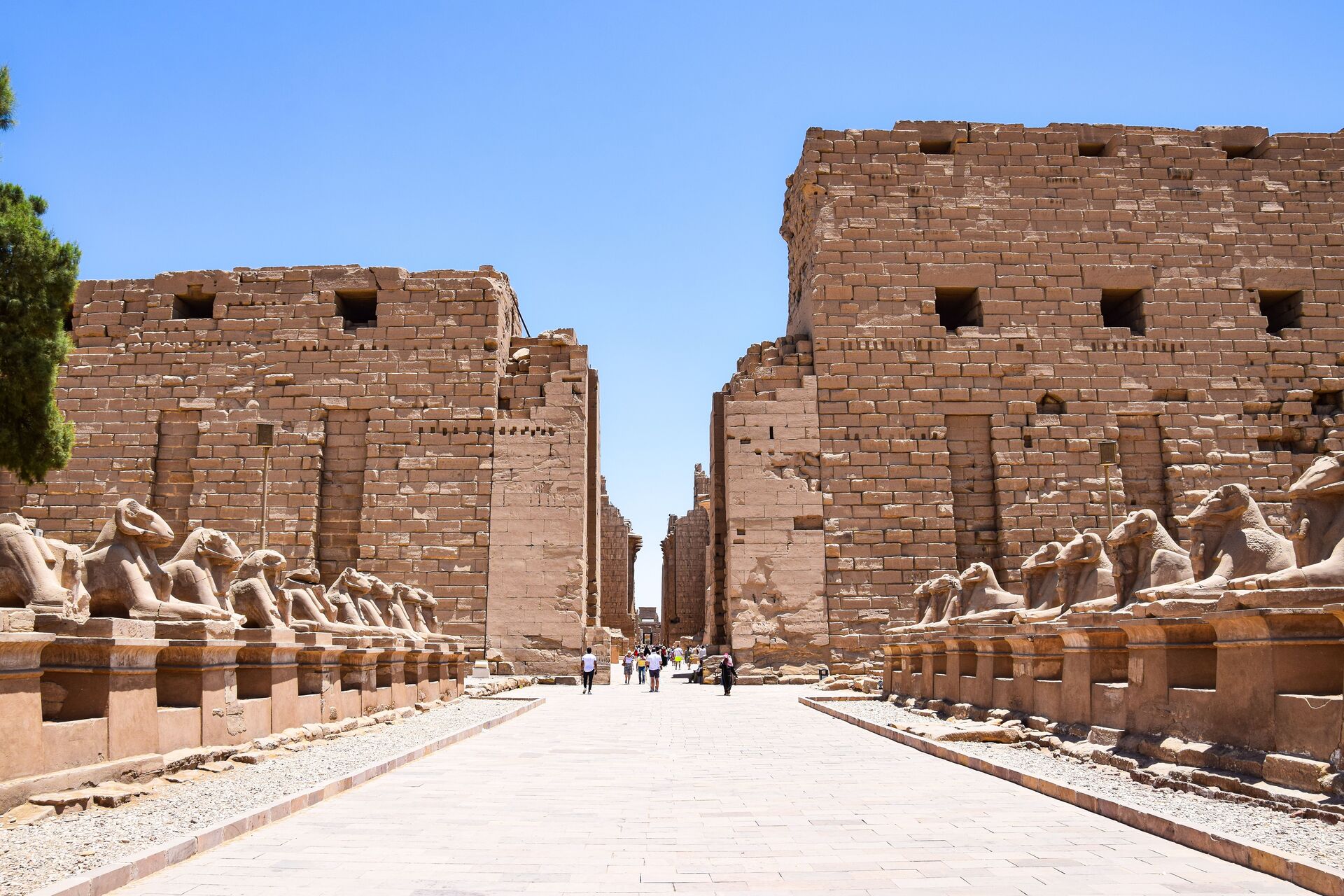
Egypt and the Karnak Temple area
Independence Day: 28 February 1922 — on paper. Britain invaded in 1882 announcing that it would withdraw shortly, and said so repeatedly for the next seventy-four years. The last British soldier left in June 1956. Four months later Britain came back with an army and lost its empire doing it.
It is on the continent. It is a founding member of the Organisation of African Unity. Its longest border is with Sudan and its lifeline river rises in Ethiopia, Uganda and Burundi.
And yet Egypt is routinely left out of African history — by European writers, by African writers, and frequently by Egyptians themselves, many of whom identify as Arab and Mediterranean first.
That omission is a mistake, and this page exists to correct it, for one specific reason.
Almost everything Europe later did to the rest of Africa, it did to Egypt first — and tested here. Debt as the mechanism of control. An occupation announced as temporary and maintained for three generations. Independence granted with the important powers removed. A resource declared too strategic to leave in local hands.
Egypt is the prototype. And in 1956 it became the country that broke the model.
From 1805, Muhammad Ali governed Egypt as a nominally Ottoman province and in practice as his own state. He built an army, a navy, factories, schools, a medical college and a modern bureaucracy, and he sent students to Europe.
His successors continued. Under Khedive Ismail in the 1860s and 1870s, Egypt built railways, a telegraph network, ports, irrigation works, Cairo's new boulevards, an opera house — and the Suez Canal.
All of it was financed on European credit at punitive rates.
And the Canal was dug by Egyptian corvée labour — forced, conscripted, unpaid. Tens of thousands of Egyptians died building the waterway that Europe would then take.
When the canal opened in 1869 Egypt held a large share of it. By 1875 Ismail was bankrupt, and Britain bought Egypt's shares in the company that owned the canal running through Egyptian territory.
Then came the instrument.
In 1876, with Egypt unable to service its debts, European creditors established the Caisse de la Dette Publique — a commission of foreign officials with authority over Egyptian state revenue.
Britain and France installed ministers inside the Egyptian cabinet. Egyptian taxes were collected to pay European bondholders. Public spending was cut. Officials were dismissed. Army officers went unpaid while debt service was maintained.
In 1879, at European insistence, the Khedive Ismail was deposed.
Read that again. Before a single British soldier landed, Egypt had already lost control of its budget, its ministries and its ruler — to a committee representing creditors.
That is the machinery this website encounters again in the 1980s and 1990s under a different name, and again in the debt-for-minerals arrangements of the 2020s. It was built here, in the 1870s, and it worked.
Egypt and the Karnak Temple area
The Egyptian response was a nationalist movement in the army, led by Colonel Ahmed Urabi, an Egyptian-born officer in a service where the senior ranks were Turkish and Circassian.
His slogan was Egypt for the Egyptians. His demands were a constitution, parliamentary control of the budget, and the removal of foreign control. He had wide popular support.
Britain called it anarchy.
On 11 July 1882 a British fleet bombarded Alexandria for ten hours, firing some three thousand shells into the city.
British forces then landed, defeated Urabi at Tel el-Kebir in September, and occupied the country.
Urabi was tried, sentenced to death, and exiled to Ceylon.
Britain announced that the occupation was temporary and that it would withdraw once order was restored.
It repeated that undertaking, in one form or another, dozens of times over the following four decades.
From 1882 to 1914 the arrangement had no legal basis whatsoever. Egypt remained formally an autonomous Ottoman province. Britain simply governed it, through a consul-general who was in practice the ruler of the country. Historians call it the veiled protectorate — occupation without even the paperwork of empire.
In 1914, when the Ottoman Empire joined the war on the other side, Britain declared a formal protectorate, deposed the khedive, and made the fiction official.
Egyptians were conscripted into labour corps for the war effort. Animals and grain were requisitioned. Prices collapsed and then soared.
At the end of the war, a delegation of Egyptian notables led by Saad Zaghloul asked to travel to the Paris Peace Conference to put Egypt's case for independence — in a war fought, according to its winners, for the self-determination of nations.
Britain refused, and then deported Zaghloul and his colleagues to Malta.
What followed was the 1919 revolution: a genuine national uprising. Strikes by lawyers, students, civil servants, transport workers and tram drivers. Railway lines cut. Demonstrations in every province.
And — for the first time in modern Egyptian history — women marched in the streets in large numbers, led by figures including Huda Sharawi, which changed Egyptian public life permanently.
British forces killed hundreds of Egyptians putting it down. The commonly cited figure is around eight hundred.
The delegation — al-Wafd in Arabic — became the Wafd Party and dominated Egyptian politics for a generation.
Britain concluded that direct rule had become unaffordable.
Britain issued a unilateral declaration ending the protectorate and recognising Egypt as an independent sovereign state.
Unilateral. Egypt was not a party to it.
And it reserved four matters absolutely to British discretion:
Imperial communications — meaning the Suez Canal.
The defence of Egypt — meaning the British army stayed.
The protection of foreign interests and minorities — meaning British courts and privileges continued.
And Sudan — which Egypt claimed and Britain kept.
Everything that makes a state a state was withheld. Egypt received a flag, a king and a parliament.
That is why Egypt's national day is not 28 February. It is 23 July — the anniversary of the 1952 revolution. A country that was granted independence in 1922 does not celebrate the grant, because everybody involved understood what it was.
The 1936 Anglo-Egyptian Treaty revised the terms, and confirmed that British troops would remain in the Canal Zone.
One more scene, because four young Egyptian officers were watching it.
In the middle of the Second World War, with Rommel advancing on Egypt, Britain wanted a government in Cairo it could rely on. King Farouk hesitated.
On 4 February 1942, British tanks surrounded the Abdeen Palace in Cairo and the British ambassador entered with an armed escort and gave the King of Egypt a choice: appoint the government Britain wanted, or abdicate.
Farouk complied.
It was the most public humiliation possible — the sovereign of an supposedly independent country, in his own palace, under British guns.
Among the officers who took the lesson were Gamal Abdel Nasser and Anwar Sadat.
Then came the 1948 war in Palestine, which Egypt lost, and in which Egyptian officers found their men equipped with defective weapons bought through corrupt contracts.
By 1951 the Wafd government had abrogated the 1936 treaty outright and the Canal Zone had become a guerrilla theatre. Around eighty thousand British personnel were garrisoned there, and Egyptian volunteers attacked them while workers withdrew labour and supplies.
On 25 January 1952, a British force surrounded the police headquarters at Ismailia and demanded surrender. The Egyptian policemen — ordered by their own interior minister not to yield — refused. Around fifty were killed.
The next day Cairo burned. Black Saturday: crowds destroyed the foreign-owned hotels, cinemas, bars and department stores of the European quarter. The old regime never recovered.
On 23 July 1952, the Free Officers took power in a bloodless coup. General Muhammad Naguib was the public face; Colonel Nasser was the organiser and the real leader.
Farouk abdicated and sailed away three days later.
In June 1953 Egypt became a republic. In 1954 Nasser pushed Naguib aside, and signed the Anglo-Egyptian Agreement for British withdrawal.
In June 1956, the last British troops left Egyptian soil — seventy-four years after they had arrived to restore order for a few months.
The United States and Britain had offered to finance the Aswan High Dam, Nasser's central development project. Then they discovered he was buying weapons from the Soviet bloc, and withdrew the offer.
On 26 July 1956 — the fourth anniversary of the revolution — Nasser announced from a podium in Alexandria that the Suez Canal Company was nationalised, and that the revenues would build the dam.
As he spoke, Egyptian forces were already taking control of the canal offices. The signal was a code word in the speech: the name de Lesseps, the Frenchman who had built it with Egyptian forced labour.
Britain and France, with Israel, went to war.
Israel attacked in late October. Britain and France issued an ultimatum demanding both sides withdraw from the canal — a pretext they had agreed in advance with Israel at Sèvres — and then bombed Egyptian airfields and landed at Port Said.
Militarily it worked. Politically it destroyed them.
The United States — which had not been consulted — refused to support the pound and threatened Britain's financial position directly. The Soviet Union made threats of its own. The United Nations General Assembly condemned the operation.
Britain and France withdrew in humiliation. Anthony Eden resigned as prime minister.
Egypt had lost the battles and won everything.
Across Africa, in 1956, colonial subjects watched two European great powers be forced out of an African country by international pressure, three months before Ghana's independence and four years before the wave of 1960.
Nasser became, overnight, the most famous man in the developing world.
Here is the part this website exists to record.
Accra was one address of African liberation. Conakry was another. Cairo was the third, and it was the largest.
Nasser's Egypt gave African liberation movements offices, passports, money, weapons, training and broadcasting. Radio Cairo transmitted in Swahili, Amharic, Hausa and other African languages across the continent. African students were given scholarships, including at Al-Azhar, one of the oldest universities in the world. The African Association in Cairo housed exiles from a dozen territories.
Egypt backed the Algerian FLN throughout its war against France — which is a large part of why France joined the attack in 1956. It supported movements in the Portuguese colonies, in Kenya, and in southern Africa. Nelson Mandela came to Cairo in 1962 during the African tour on which he sought training and support.
Nasser co-founded the Non-Aligned Movement with Nehru, Tito and Sukarno, and stood alongside Nkrumah in it.
And Cairo hosted the third All-African People's Conference in 1961 — the same series that had begun in Accra in December 1958.
Egypt was a founding member of the OAU in 1963.
For about fifteen years, Egypt was one of the three or four most important states in the African independence project, and it is almost never described that way.
The Aswan High Dam was built with Soviet money and Soviet engineers after the West withdrew. It was inaugurated on 15 January 1971, three months after Nasser's death, by Anwar Sadat.
It gave Egypt electricity, flood control and irrigation, and it transformed the country. Egyptians who remember oil lamps do not argue about whether it was worth building.
It also drowned Nubia.
The reservoir — Lake Nasser — flooded the homeland of the Nubian people, who had lived on that stretch of the river for thousands of years. Tens of thousands of Egyptian Nubians were displaced, and a comparable number in Sudan; totals for both countries are commonly given at around a hundred thousand. They were resettled far from the river, in places that were not theirs, and their villages, their farmland and their cemeteries are under the lake.
An international campaign moved the temples at Abu Simbel, stone by stone, to higher ground. It was one of the great feats of modern archaeology, and it was conducted for monuments while the people who lived among them were being moved and largely forgotten.
And there is a third thing about the dam that matters more today than it did then.
To fill it, Egypt needed Sudan's agreement. The 1959 Nile Waters Agreement allocated 55.5 billion cubic metres to Egypt and 18.5 billion to Sudan.
It did not mention the other nine countries of the Nile basin at all. Ethiopia, from which most of the water comes, was not a party.
That agreement was itself built on a 1929 arrangement made by Britain on behalf of its colonies, which gave Egypt a veto over upstream construction.
Egypt's legal claim to the Nile rests on agreements drawn up by a colonial power that excluded the African countries upstream. That is the uncomfortable centre of the dispute that now dominates Egyptian foreign policy.
Nasser died in September 1970, aged fifty-two, exhausted and broken by the catastrophic defeat of 1967.
Anwar Sadat turned the country round completely: expelled the Soviet advisers in 1972, fought the October war of 1973, opened the economy to the West, and signed the Camp David accords and then peace with Israel in 1979. Egypt was suspended from the Arab League for a decade. Sadat was assassinated by Islamists at a military parade on 6 October 1981.
Hosni Mubarak then governed for thirty years under an emergency law that was renewed continuously.
And Egypt turned its back on Africa. Analysts of Egyptian foreign policy describe the forty years of Sadat and Mubarak as a period of near-indifference to sub-Saharan Africa. After Islamists attempted to assassinate Mubarak in Addis Ababa in 1995, he withdrew further still.
The country that had broadcast to the continent in Swahili stopped looking south for a generation — and Ethiopia announced its dam in 2011, in the weeks after Mubarak fell.
On 25 January 2011 Egyptians occupied Tahrir Square. Eighteen days later Mubarak resigned.
In 2012, Mohamed Morsi of the Muslim Brotherhood became the first freely elected president in Egypt's history. His year in office was divisive, and enormous crowds demanded his removal.
On 3 July 2013 the army removed him.
On 14 August 2013, security forces cleared the sit-in at Rabaa al-Adawiya Square in Cairo. At least 817 people were killed in a single day, and the true figure is very likely above a thousand. Human Rights Watch concluded that the killings were planned at senior levels and likely amounted to a crime against humanity.
Abdel Fattah el-Sisi has governed since 2014, re-elected in 2018 and 2023. Constitutional amendments in 2019 extended presidential terms and allow him to remain until 2030. Human rights organisations report tens of thousands of political prisoners.
The economy has been through repeated currency crises, heavy external debt and successive IMF programmes, alongside enormous state construction projects including a new administrative capital.
And Sisi has done one thing that reverses forty years: he has travelled in Africa more than any Egyptian leader since Nasser, building relationships across the continent — because of the dam.
Ethiopia announced the Grand Ethiopian Renaissance Dam in 2011, began filling it in 2020, and inaugurated it in September 2025.
Ethiopia's argument is the argument Nasser made about Aswan: a poor country with a young and growing population has the right to use its own river for power and development.
Egypt's argument is that it is a desert country in which almost the entire population lives along one river, that it has almost no rainfall, and that any sustained reduction in flow is existential.
Both arguments are true, and there is no agreement.
Ten years of negotiations have failed. Egypt has pursued alliances across the Horn to build pressure on Addis Ababa, with limited success.
Because Egypt is where the instruments were made.
The debt commission of 1876 is the template for every subsequent arrangement in which African budgets were written abroad.
The occupation of 1882, announced as temporary and maintained for seventy-four years, is the template for every promise of eventual self-government that Europe made and did not keep.
The declaration of 1922 — independence with defence, communications, foreign interests and territory reserved — is the template for the CFA franc, for the base agreements, for every arrangement on this website in which a country received a flag and not much else.
And 1956 is the moment it was broken. An African country nationalised the asset Europe had declared too strategic to leave in local hands, absorbed an invasion by two European great powers and Israel, and was still standing when they left.
Ghana became independent four months later.
That sequence is not a coincidence, and it is the reason Egypt belongs at the front of any account of African independence rather than in a separate chapter marked Middle East.
Nasser's Egypt was a police state. The Communist Party was suppressed and strike leaders were executed. Trade unions became organs of the state. The Muslim Brotherhood was crushed and its members tortured. There was no free press and no opposition. He was a soldier who took power in a coup and never held a contested election.
The Nubians were moved so that the dam could be built, and their case has never been properly settled. Egypt's own Nubian citizens have been campaigning for the right of return for sixty years.
The 1959 Nile agreement ignored nine African countries, and Egypt has spent six decades defending a position originally drafted by Britain for its own imperial convenience. An African country's principal foreign policy dispute today rests on a colonial instrument.
Egypt's engagement with Africa was real and generous under Nasser, and then it simply stopped for forty years, and has returned now because of a dam.
And Rabaa happened. Whatever one concludes about Morsi's year in office, more than eight hundred people — probably well over a thousand — were killed in one square in one day, and nobody has been held responsible.
None of that cancels Suez. All of it belongs on the same page.
There is a canal, dug by forced Egyptian labour, whose shares were bought by Britain from a bankrupt khedive and which is now Egyptian.
There is a commission of European creditors from 1876 that took control of a country's budget before any army arrived, and which has been reinvented under other names ever since.
There is a bombardment of Alexandria on 11 July 1882, three thousand shells in ten hours, that began an occupation described as temporary.
There are temples at Abu Simbel that were lifted stone by stone to save them, above a lake covering villages whose people were moved.
There is a square in Cairo where at least eight hundred people were killed in a day in August 2013.
There is a dam in Ethiopia inaugurated in September 2025, and a Nile agreement from 1959 that never mentioned Ethiopia.
And there is one afternoon in July 1956 when a colonel announced that a waterway running through his own country now belonged to it — and two European empires went to war about it and lost.
Updated and fact-checked: 11 September 2026.
How this page was checked. Dates and events were verified against the sources listed above. The opening of the Suez Canal in 1869, Britain's purchase of Egypt's canal shares in 1875, the establishment of the Caisse de la Dette Publique in 1876 and the deposition of Khedive Ismail in 1879, the Urabi movement and the British bombardment of Alexandria on 11 July 1882 with some three thousand shells fired over ten hours, the veiled protectorate of 1882–1914 and the formal protectorate declared in 1914, the 1919 revolution following Saad Zaghloul's deportation, the unilateral declaration of independence on 28 February 1922 with four reserved matters, the Anglo-Egyptian Treaty of 1936, the Abdeen Palace incident of 4 February 1942, the killing of Egyptian police at Ismailia on 25 January 1952 and the burning of Cairo the following day, the Free Officers' coup of 23 July 1952, the declaration of the republic in June 1953, the Anglo-Egyptian Agreement of 1954 and the completion of British withdrawal in June 1956, the nationalisation of the Suez Canal on 26 July 1956 and the Anglo-French-Israeli invasion and withdrawal that followed, the 1959 Nile Waters Agreement allocating 55.5 and 18.5 billion cubic metres to Egypt and Sudan without reference to upstream states, the inauguration of the Aswan High Dam on 15 January 1971, Sadat's assassination on 6 October 1981, the revolution of January and February 2011, the election of Mohamed Morsi and his removal on 3 July 2013, the Rabaa dispersal of 14 August 2013, and Ethiopia's inauguration of the Grand Ethiopian Renaissance Dam in September 2025 are as recorded. Casualty and displacement figures are estimates and are given as such: deaths in the 1919 revolution are commonly put at around eight hundred; the number of Nubians displaced by the Aswan reservoir is variously given, with figures around one hundred thousand across Egypt and Sudan combined; Human Rights Watch documented at least 817 deaths at Rabaa on 14 August 2013 and concluded that the true figure was likely above one thousand, and that the killings likely amounted to a crime against humanity. That conclusion is the finding of that organisation and is rejected by the Egyptian government; both positions are recorded. Deaths during the building of the Suez Canal under corvée labour are not precisely established and no single figure is given here. This page describes the positions of Egypt and Ethiopia on the Nile without adjudicating between them. This page makes no allegation against any living person.
Written and researched by Remo Kurka · africanindependence.com
We strive to unify diverse narratives from across Africa, showcasing the continent's shared heritage and unique stories.
Our mission is to honor and preserve the history of African cultures and independence movements for future generations.
We provide a platform for innovative exchange of ideas, resources, and insights, understanding that knowledge should be accessible to all.