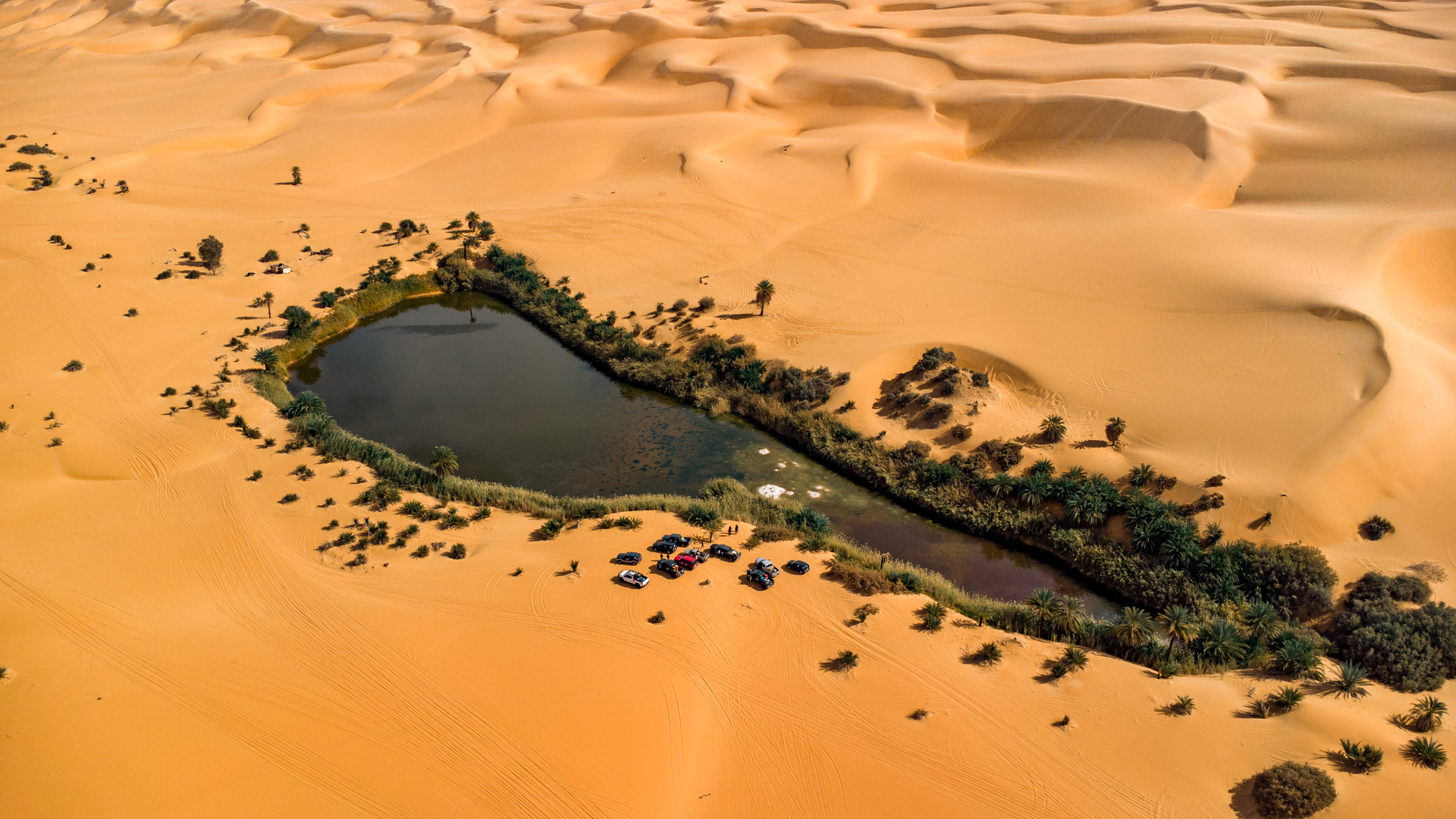
Landscapes of Chad, desert oasis
Independence Day: 11 August 1960. A dictator armed and funded by Washington and Paris ran seven secret prisons in his own capital. His files were found in a derelict building forty years later, and his victims spent twenty-five years putting him in prison for the rest of his life.
France assembled Chad out of two things that had almost nothing in common.
The north and east — Saharan and Sahelian, Muslim, Arabic and Toubou-speaking, historically part of trans-Saharan kingdoms like Kanem-Bornu and Ouaddaï, with their own aristocracies and their own long-distance trade.
The south — wetter, agricultural, populated by Sara and other groups, largely non-Muslim, which is where the cotton was.
France governed accordingly. It concentrated its schools, its missions, its administration and its cotton economy in the south, and treated the north as a military district to be pacified and otherwise ignored. Northern regions were still under military administration into the 1960s.
So at independence, virtually every educated Chadian, every civil servant and every officer was southern. Not because southerners were more capable, but because France had built schools in one half of the country and forts in the other.
That single fact is the engine of everything since.
François Tombalbaye, a Sara trade unionist and teacher from the south, became the first president.
He dissolved all parties but his own PPT by 1963 and required every member of the National Assembly to belong to it. The party and the army were dominated by his own ethnic group.
In 1965, tax collection in Mangalmé in the centre-east provoked riots that were put down with force. The following year exiles founded FROLINAT, the National Liberation Front, in the north.
The civil war that began then has, with intervals, never entirely stopped.
Tombalbaye's response to losing legitimacy was to invent more of it. In 1973 he launched a campaign of authenticité — dropping his French first name for Ngarta, renaming towns, and then compelling civil servants and army officers to undergo yondo, the initiation rites of his own Sara people.
Muslims and Christians alike were forced through the ceremonies of one southern ethnic group in order to keep their jobs. Officers who refused were imprisoned.
It is difficult to think of a faster way to convince a divided country that the state belongs to one part of it.
On 13 April 1975 the army killed him.
Félix Malloum took over and lasted four years.
Landscapes of Chad, desert oasis
Meanwhile Libya had moved in. Gaddafi occupied the Aouzou Strip along the northern border in the early 1970s, claiming it under a treaty that had never been ratified, and backed factions inside the Chadian wars.
On 12 February 1979 full civil war reached N'Djamena itself. What followed, between 1979 and 1982, was the effective collapse of the Chadian state — no functioning government, the capital divided among armed factions, ministries abandoned, and eleven factions signing agreements nobody kept.
Out of that came Hissène Habré, a northerner, a Toubou, a former FROLINAT commander with a degree in political science from Paris. He took N'Djamena in June 1982.
This is the part that must not be softened.
Habré ruled Chad from 1982 to 1990 with United States and French backing. That is not an accusation from his opponents; it is the standard formulation in the human rights literature.
The reasoning was Gaddafi. Washington wanted a Chadian government that would fight Libya, and Habré would. Under the Reagan administration Chad received covert and overt assistance — money, weapons, training. France provided military support against Libyan forces.
And Chad did fight Libya, effectively. In the Toyota War of 1987, Chadian columns mounted on pickup trucks with anti-tank missiles destroyed a far larger, Soviet-equipped Libyan force and drove it out of the country. Militarily it is one of the most studied African campaigns of the century.
The Aouzou Strip was eventually awarded to Chad by the International Court of Justice in 1994.
That was what Habré was for. What he did at home was the price his backers accepted.
The Direction de la Documentation et de la Sécurité was Habré's political police. It reported directly to him.
It ran seven secret prisons in N'Djamena alone, including one inside the grounds of the presidential palace.
The most notorious was called La Piscine — the swimming pool. It was a colonial-era swimming pool that had been divided into cells and roofed over with a concrete slab.
People were held underground, in the dark, in the heat, in a pit built for recreation by the French.
Habré's government was responsible for widespread political killings, systematic torture, thousands of arbitrary arrests, and successive waves of ethnic targeting — against the Hadjerai in 1987, the Zaghawa in 1989, and southerners before them.
The DDS received training and support from the United States, which had helped to establish it.
Habré was overthrown in December 1990 by Idriss Déby, his own army commander-in-chief, and fled to Senegal — reportedly with a large part of the treasury.
For a decade nothing happened.
Then in 2001, investigators from Human Rights Watch entered an abandoned DDS building in N'Djamena and found tens of thousands of documents lying on the floor: death certificates, interrogation reports, lists of detainees, daily situation reports sent to the president.
The regime had kept records.
From those files, researchers extracted the names of 1,208 people who were killed or died in detention, and 12,321 victims of human rights violations.
Those are not estimates. Those are names, written down by the people who did it.
What happened next is, by some distance, the most encouraging story in this entire series.
Habré's victims decided to prosecute him — a former head of state, living comfortably in another country, with money and political protection.
They were led by survivors, and by a Chadian lawyer, Jacqueline Moudeina, who was nearly killed by a grenade attack in 2001 while representing them, and who kept going for another fifteen years. The campaign was supported over decades by Reed Brody of Human Rights Watch, whom the victims called the dictator hunter.
It took twenty-five years.
Habré was first indicted in Senegal in 2000 and the case was blocked. Belgium pursued him under universal jurisdiction. In 2012 the International Court of Justice ruled in Belgium v. Senegal that Senegal was obliged under the UN Convention against Torture either to prosecute Habré or extradite him.
In February 2013, Senegal and the African Union inaugurated the Extraordinary African Chambers within the Senegalese court system, to try those most responsible for crimes committed in Chad between 1982 and 1990.
Habré was arrested in Dakar. He refused to recognise the court and had to be carried into it.
On 30 May 2016, the Extraordinary African Chambers convicted Hissène Habré of crimes against humanity, war crimes, and torture, including sexual slavery and rape, and sentenced him to life imprisonment.
The appeal chamber upheld the conviction on 27 April 2017 and awarded 82 billion CFA francs — about US$150 million — to 7,396 named victims.
It was the first time a former head of state had been convicted of crimes against humanity by the courts of another country — and it was done in Africa, by an African-mandated court, with survivors at the centre of the case.
Separately, in March 2015, a Chadian court in N'Djamena convicted twenty former DDS agents of murder, torture, kidnapping and arbitrary detention, and awarded 75 billion CFA francs to 7,000 victims, ordering the state to pay half.
Habré died in Senegal in August 2021, of COVID-19, after eight years in custody.
Nothing.
The appeal court mandated an African Union Trust Fund to find Habré's assets and raise the money. The African Union never established a functioning fund. Years after the judgment, campaigners reported that not one victim had received a single franc.
The Chadian government, ordered by its own court to pay half of the domestic award, has not begun to execute the decision.
So the record stands like this: the victims won the legal argument completely, twice, in two countries, against a former head of state — and were paid nothing by anybody.
That is worth stating plainly, because the case is frequently cited as a triumph of international justice, and the triumph is real and it is also incomplete in a way that the people involved live with daily.
Meanwhile the man who overthrew Habré stayed.
Idriss Déby Itno governed Chad from December 1990 until April 2021 — thirty years and four months.
Oil began flowing in 2003 through the Chad–Cameroon pipeline, under a World Bank scheme designed to ring-fence the revenue for development. The government dismantled the arrangement within a few years and spent the money on the army and on itself.
Déby became indispensable to the West on the same logic Habré had been. Chadian troops were the most effective force in the region against Boko Haram in the Lake Chad basin and against jihadist groups in Mali. In exchange, very little was said about how he governed.
Chad recorded its first Boko Haram attacks in 2015.
Constitutional term limits were removed and reinstated as convenient. Protests were suppressed. The alliance Wakit Tamma — civil society, unions and opposition — organised against his sixth term in 2021 and was broken up by force.
Idriss Déby was killed at the front, visiting troops fighting the FACT rebel column advancing from Libya.
He was a serving head of state who died in combat. There is no other recent case like it.
What happened in the following hours mattered more.
Under the constitution, the speaker of the National Assembly should have taken over. Instead the army dissolved the constitution and parliament and installed Déby's son, Mahamat Idriss Déby, then thirty-seven, as head of a Transitional Military Council.
It was a coup, carried out by the army in favour of the dead president's son, and France's president attended the funeral and stood beside him.
An eighteen-month transition was announced.
In October 2022, after a National Dialogue conveniently ruled that Mahamat could stand in future elections, protesters took to the streets. Security forces killed demonstrators in what Chadians call Black Thursday. Published death tolls vary widely — from around fifty to at least a hundred and twenty-eight.
The opposition leader Succès Masra fled into exile.
In February 2024, Yaya Dillo — Mahamat's own cousin, and regarded as his most serious potential rival — was killed by security forces at his party headquarters.
Masra returned, was appointed prime minister on 1 January 2024, then ran for president against the man who had appointed him.
On 6 May 2024, Mahamat Déby won with 61 per cent. Masra took 18.5 per cent, disputed the count, and resigned as prime minister. Déby was sworn in on 23 May 2024.
Parliamentary elections in December 2024 — the first in thirteen years — were boycotted by more than ten opposition parties. Turnout was low. The ruling MPS took 144 of 188 seats.
In February 2025 Mahamat Déby was elevated to the rank of Marshal.
The Déby family has now held Chad for thirty-six years.
And then Chad did something nobody expected.
In November 2024 it terminated the 1976 defence cooperation treaty with France. French troops completed their withdrawal in January 2025, ending a forty-eight-year military presence in a country that had been the anchor of France's entire Sahel posture.
That is the same France that fought Libya alongside Habré, that maintained bases here for decades, and that flew its president to N'Djamena in 2021 to stand beside the son.
Chad ended it, and Paris left.
Since April 2023, more than a million refugees from Darfur have crossed into eastern Chad, into one of the poorest and driest regions on the continent, in what is one of the largest displacement emergencies in the world.
United Nations experts have accused the United Arab Emirates of using Chadian airstrips to supply the Rapid Support Forces fighting in Sudan. Chad denies any complicity.
So a country still owed reparations for the crimes of the 1980s is now hosting the victims of a war next door, while being accused of hosting the supply line for the people causing it.
Two reasons, and they pull in opposite directions.
Because of what was done, and who helped. Habré's secret police tortured and killed thousands of Chadians in seven prisons in one city, including a swimming pool with a concrete lid. He was armed, funded and trained by the United States and supported by France, because he would fight Gaddafi. That is not a conspiracy theory; it is the settled account, and Washington and Paris have never faced any consequence for it.
And because of what the victims did about it. They pursued him for twenty-five years — across a border, through the International Court of Justice, into a court that had to be invented for the purpose — and they won. A former African head of state is convicted of crimes against humanity, in Africa, by Africans, with survivors leading the case.
Every other page on this website records impunity: no conviction for Lumumba, none for Rwagasore, none for Olympio, none for Um Nyobè, none for Boganda, none for the Ikiza, none for Adibo.
Chad is the exception. It is proof that it can be done, and the proof cost twenty-five years of one lawyer's life and the persistence of people who had been tortured.
The conviction did not change Chad.
The man who overthrew Habré ruled for thirty years and handed the country to his son through an army coup. The son won an election with 61 per cent after his main rival was shot at his party office and the opposition boycotted the parliamentary vote.
The domestic court that convicted twenty DDS agents in 2015 also ordered the Chadian state to pay reparations, and the Chadian state has not paid.
A country can convict its former dictator and remain a dictatorship. Justice for the past is not the same thing as accountability in the present, and Chad demonstrates the gap precisely.
And the West's calculation has not altered either. Habré was useful against Libya. Idriss Déby was useful against Boko Haram and in Mali. Mahamat Déby is useful in the Sahel and next to Sudan. The name of the threat changes; the arrangement does not.
There is a swimming pool in N'Djamena with a concrete slab over it.
There are tens of thousands of pages of secret police files, found on the floor of an abandoned building in 2001, naming 1,208 dead.
There is a life sentence served in full in a Senegalese prison by a man who refused to recognise the court and had to be carried into the room.
There is a judgment awarding about US$150 million to 7,396 people, and a trust fund that was never created.
There is a lawyer in N'Djamena, hit by a grenade in 2001, who spent the next quarter of a century on the case.
There is a family that has governed for thirty-six years.
And there is no longer a French garrison, for the first time since before independence.
Updated and fact-checked: 9 September 2026.
How this page was checked. Dates and figures were verified against the sources listed above, principally the documentation of Human Rights Watch and Amnesty International. Independence on 11 August 1960 under François Tombalbaye, the establishment of single-party rule by 1963, the founding of FROLINAT in 1966, the *authenticité* campaign of 1973, Tombalbaye's killing on 13 April 1975, the outbreak of full civil war in N'Djamena on 12 February 1979, Hissène Habré's capture of the capital in June 1982 and his rule to December 1990 with United States and French backing, the operations of the DDS and its seven secret prisons in the capital, the recovery of the DDS files by Human Rights Watch in 2001 naming 1,208 people killed or dead in detention and recording 12,321 victims, the International Court of Justice ruling in Belgium v. Senegal in 2012, the inauguration of the Extraordinary African Chambers in February 2013, the conviction of 30 May 2016 and its confirmation on 27 April 2017 with an award of approximately US$150 million to 7,396 victims, the March 2015 conviction of twenty DDS agents in N'Djamena, Habré's death in custody in August 2021, the death of Idriss Déby on or about 19 April 2021 and the army's installation of his son, the election of 6 May 2024 and the parliamentary elections of December 2024, and the termination of the French defence treaty in November 2024 with withdrawal completed in January 2025 are as recorded. The death toll of the October 2022 protests is disputed and is given here as a range, with published figures running from around fifty to at least a hundred and twenty-eight. Allegations that Chadian airstrips have been used to supply forces in Sudan are made by United Nations experts and denied by the Chadian government; both positions are recorded. Reparations awarded by the Extraordinary African Chambers and by the Chadian court of 2015 remain unpaid as of the most recent reporting available. This page makes no allegation against any living person beyond matters already on the public record.
Written and researched by Remo Kurka · africanindependence.com
We strive to unify diverse narratives from across Africa, showcasing the continent's shared heritage and unique stories.
Our mission is to honor and preserve the history of African cultures and independence movements for future generations.
We provide a platform for innovative exchange of ideas, resources, and insights, understanding that knowledge should be accessible to all.