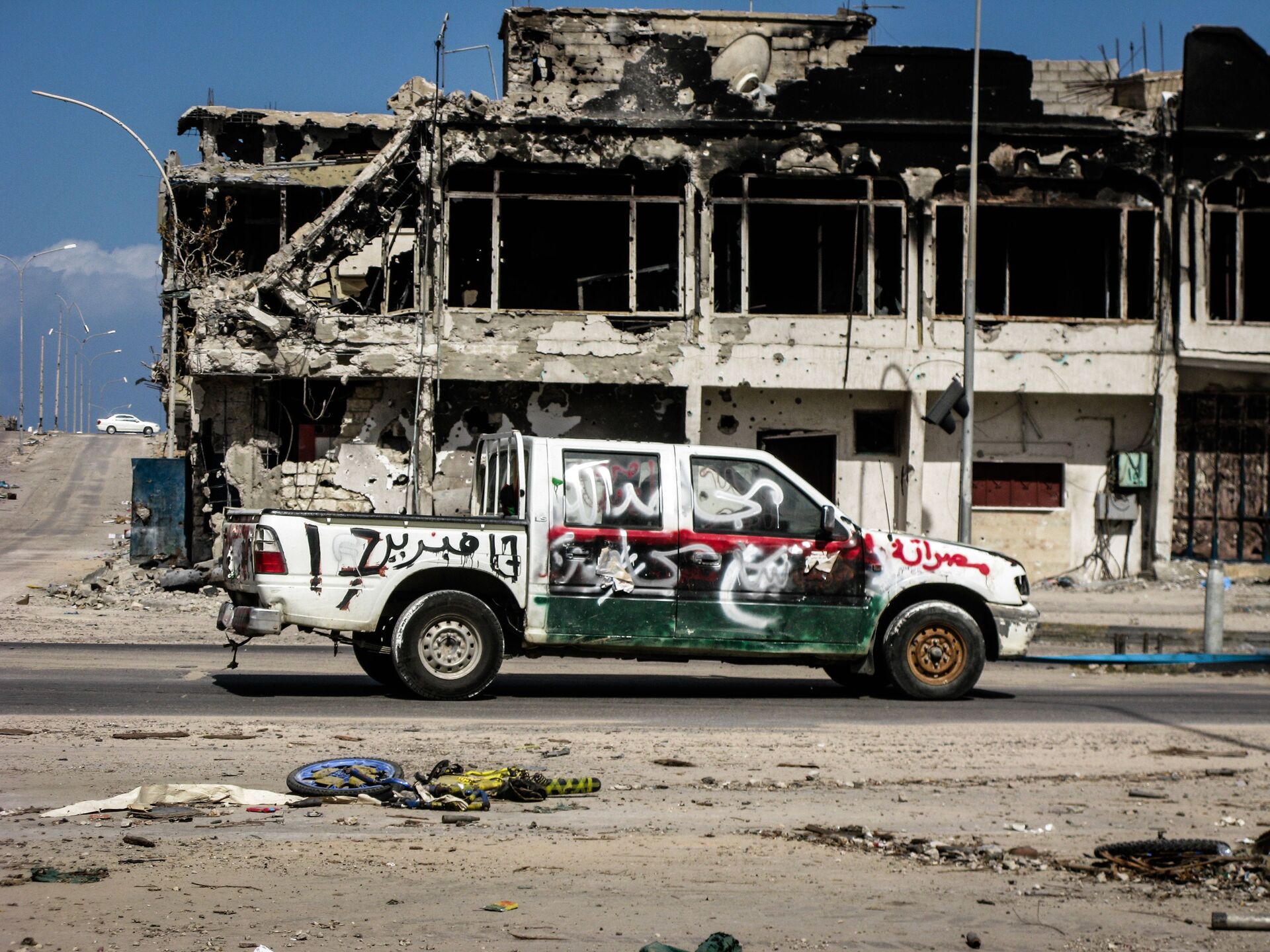
Sirte, Libya and the war destruction
Independence Day: 24 December 1951. Libya is the only state in the world that came into existence by a resolution of the United Nations General Assembly. Sixty years later, a resolution of the United Nations Security Council authorised the air campaign that ended the state that had grown out of it. This page is about what happened in between, and it is the page in this series that requires the most care — because almost everything most Europeans believe about Libya after 2011 has since been corrected, in public, by a committee of the British Parliament.
Every page on this site tries to hold two things at once. This one has to hold four.
Libya suffered one of the worst colonial crimes committed anywhere in Africa, at Italian hands, and almost nobody in Europe knows anything about it.
Muammar Gaddafi's government delivered real, measurable improvements to the lives of Libyans — literacy, health, housing, water, and the highest human development ranking in Africa — and funded African institutions on a scale no other state matched.
That same government ran a police state that hanged students on live television, murdered its own exiles abroad, and killed hundreds of prisoners in a single afternoon.
And the 2011 intervention that removed it was based on claims that a British parliamentary inquiry later found were not supported by the evidence, exceeded the mandate it was given, ended in a killing that Human Rights Watch classified as a war crime, and left behind a country that fifteen years later still has two governments, no election, and a currency that has been devalued twice in a year.
Anyone who can only hold one or two of those is not describing Libya. They are describing their own politics.
Sirte, Libya and the war destruction
Start here, because it is the foundation and it is missing from almost every account.
Italy invaded Ottoman Libya in 1911. Resistance never stopped, and in the 1920s, under Mussolini, Italy set out to end it permanently.
The campaign in Cyrenaica between 1923 and 1932 was conducted by Marshal Rodolfo Graziani — the same officer who would later order the Addis Ababa reprisals described on the Ethiopia page of this site.
Italy built a barbed-wire barrier along the Egyptian frontier to cut the resistance off from supply. Then it moved the civilian population of Cyrenaica — the entire semi-nomadic society that sustained the fighters — into concentration camps in the desert: El Agheila, Soluch, Sidi Ahmed el-Magrun and others.
They were held behind wire, with their herds confiscated, on starvation rations, in the open. Disease did the rest. Estimates vary and the record is incomplete, but the scholarly consensus is that a very large share of the Cyrenaican population died — figures commonly given range from tens of thousands to around a third of the entire population of the region. Italian aircraft also used chemical weapons against Libyan populations, as they would later in Ethiopia.
Omar al-Mukhtar, a Quran teacher in his seventies who had led the resistance for two decades, was captured in September 1931 and hanged at Soluch camp on 16 September 1931, in front of some twenty thousand internees brought to watch.
This is a genocide by any reasonable use of the word, and it is not taught in European schools. Germany has had a partial reckoning with what it did in Namibia. Belgium has had one about the Congo. Italy has had almost none about Libya, and it is the least-known major atrocity of the entire colonial period in Africa.
Hold that in mind for what follows, because it explains a great deal about how Libyans, and Gaddafi personally, spoke to Europe.
After the Second World War, the powers could not agree on what to do with Italy's former colony. Britain held Tripolitania and Cyrenaica, France held the Fezzan, and nobody wanted to hand it to anybody else.
So the question went to the United Nations General Assembly, which in November 1949 resolved that Libya should become independent by 1 January 1952.
On 24 December 1951 the United Kingdom of Libya was proclaimed, a federation of the three provinces under King Idris al-Senussi, head of the Senussi religious order that had led the resistance to Italy.
No other country on earth was created this way. Libya's independence was not won in a war of liberation, not negotiated at a constitutional conference — it was voted into existence in New York.
And it was, at that moment, among the poorest countries in the world: no industry, no agriculture to speak of, a literacy rate in the low double digits, and an economy so thin that Britain and the United States paid rent for their airbases because there was no other meaningful revenue.
Then, in 1959, oil was found, and everything changed — for the state, and not much at all for most Libyans, since the concessions were on terms written by the companies and the wealth pooled at the top.
A group of young officers removed King Idris while he was abroad. Their leader was a twenty-seven-year-old signals captain from a Bedouin family in the Sirte desert, whose relatives had been in the Italian camps: Muammar Gaddafi.
The country he took over had foreign military bases on its soil and foreign companies setting the price of its only export.
Within a year he had closed them. The American Wheelus Air Base — one of the largest US installations outside America — was evacuated in June 1970. The British bases went too. The remaining Italian settler community was expelled and its property confiscated, and the date of the evacuation became a national holiday.
Then he took on the oil companies, and won. Libya demanded higher prices and a larger share, and — by negotiating with the smaller independents that could not afford to lose Libyan production — broke the united front of the majors. The 1970 Libyan settlement is one of the reasons the oil price shifts of the 1970s happened at all. Gaddafi changed the terms of trade for oil producers everywhere, and producers across the developing world knew it.
Nationalisation followed through the 1970s.
This section exists because it is routinely deleted, and deleting it makes the rest of the page unbelievable.
Literacy rose from roughly a fifth of the population at independence to around ninety per cent. Education was free through university, and Libyans were sent abroad on state scholarships in large numbers — women among them.
Healthcare was free. Life expectancy rose from the fifties to the mid-seventies. Infant mortality fell dramatically.
Housing was a declared right, and a very large housing programme was built.
The Great Man-Made River — begun in the 1980s and largely self-financed — is the largest irrigation project in the world: thousands of kilometres of pipe bringing fossil water from the Nubian Sandstone aquifer under the Sahara to the coastal cities. Whatever one thinks of drawing down an aquifer, it was conceived and paid for by Libya, without loans from anybody.
Women's position improved sharply on most measurable indicators — education, employment, legal rights within marriage — relative to the region and to Libya's own past.
By 2010, Libya had the highest Human Development Index ranking in Africa, and one of the highest GDP per capita figures on the continent, with no external debt to speak of.
And Gaddafi paid for Africa. He funded the African Union at a level no other member came close to, at times covering a substantial share of the whole budget and the dues of poorer members. He financed the pan-African satellite system that cut African telecoms costs, capitalised African development institutions, and pushed — obsessively, and mostly unsuccessfully — for a United States of Africa. The Sirte Declaration of 1999, which converted the OAU into the AU, was made in his home town.
Read the Ethiopia and Gambia pages on this site and note who paid for the buildings and who paid the arrears.
Now the other column, and it is not shorter.
The Green Book and the Jamahiriya. From 1977 Libya was declared a state of the masses, governed by popular committees, with Gaddafi holding no formal office at all — a construction that made him unaccountable rather than powerless.
Political parties were banned. Membership of one carried the death penalty under a 1972 law. The Revolutionary Committees operated outside the legal system with powers of arrest, trial and execution.
Public hangings were broadcast on state television. The killing of the student Sadiq Hamed Shwehdi in a Benghazi basketball stadium in 1984, filmed and shown nationally, is the single image most Libyans of that generation carry.
Exiles were hunted abroad. In the 1980s Libya conducted an assassination campaign against dissidents in Europe and the Middle East — the "stray dogs" — killing a number of Libyans in London, Rome, Athens and elsewhere.
Abu Salim, June 1996. After a prisoner protest at the Tripoli prison, security forces killed a very large number of inmates in a matter of hours. The figure that entered the record is around 1,270.
Here the page has to be precise, because this is where propaganda and fact have been tangled together for fifteen years.
The mass grave announced in 2011 was not what it was said to be. On 25 September 2011 the transitional authorities announced they had found the grave containing the 1,270 bodies. A CNN team taken to the site with other media found only what appeared to be animal bones, and a senior official of the transitional justice ministry publicly conceded that the bones were larger than normal human remains and that the site "could be something else." No excavation had taken place. The claim went round the world within hours; the correction did not.
But the massacre itself is documented by other means entirely. It rests on survivor and former-guard testimony gathered over years, and — decisively — on the fact that Gaddafi's own government eventually admitted it: from 2008 the state acknowledged deaths at Abu Salim and began compensating families, and Saif al-Islam himself publicly acknowledged the killings.
The families' fifteen-year campaign for the truth is what started the 2011 uprising. On 15 February 2011, the arrest in Benghazi of Fathi Terbil, the lawyer representing the Abu Salim families, brought people into the street.
And abroad. Libya's support for armed groups was extensive and included the IRA and Abu Nidal's organisation. Libya was found responsible for the Lockerbie bombing of Pan Am 103 in 1988 (270 dead) and was widely held responsible for UTA Flight 772 in 1989 (170 dead) and the 1986 La Belle discotheque bombing in Berlin. In 2003 Libya accepted responsibility for Lockerbie and paid $2.7 billion to the families. Libya also fought a long war in Chad over the Aouzou Strip, and lost it. And it held five Bulgarian nurses and a Palestinian doctor for eight years on a fabricated charge of infecting children with HIV, extracting confessions by torture.
Both columns are true. A government can build a water system across the Sahara and hang a student on television in the same decade. Libya did.
By 2003 Gaddafi had decided the cost was too high. Libya surrendered its chemical and nuclear programmes, paid the Lockerbie compensation, and was welcomed back.
The queue formed immediately. Tony Blair's "deal in the desert" in 2004 came with a BP exploration agreement. Silvio Berlusconi signed the Treaty of Benghazi in 2008 — under which Italy agreed to pay five billion dollars over twenty years in acknowledgement of the colonial period, in exchange for cooperation on migration. It is the largest colonial reparations settlement any African country has ever obtained, and Gaddafi obtained it by being useful to Europe on migration.
And Nicolas Sarkozy received Gaddafi in Paris in December 2007 with a tent on the grounds of a state guesthouse.
Note that date. In September 2025, Nicolas Sarkozy was convicted by a French court of criminal conspiracy in connection with the alleged Libyan financing of his 2007 presidential campaign, and imprisoned. He denies wrongdoing and is appealing.
The French president who led the campaign to remove Gaddafi in 2011 was later convicted in connection with Libyan money from 2007. That is not a theory. It is a judgment of a French court, and it belongs on this page as plainly as anything else.
The uprising began on 15 February 2011 in Benghazi and spread. It was met with force, and by early March government columns were advancing east.
Security Council Resolution 1970 referred the situation to the ICC and imposed an arms embargo. Resolution 1973, adopted on 17 March 2011, passed ten votes to zero with five abstentions — Russia, China, Germany, Brazil and India. It authorised a no-fly zone and "all necessary measures" to protect civilians, and it explicitly excluded a foreign occupation force.
The resolution was lawfully adopted. What is seriously contested is what was done with it.
And the strongest critique does not come from Moscow or from the internet. It comes from the Foreign Affairs Committee of the British House of Commons, whose September 2016 report on Libya concluded, in substance:
The committee found the result to be political and economic collapse, inter-militia and inter-tribal warfare, humanitarian and migrant crises, widespread human rights violations, the spread of Gaddafi's weapons across the region, and the growth of Islamic State in North Africa.
That is a British parliamentary committee reporting on a British government's war.
Two further corrections belong here. Amnesty International's field researcher in eastern Libya, Donatella Rovera, found no evidence for two of the claims that did most to build the case for intervention — the mass distribution of Viagra to troops for systematic rape, and the aerial bombing of protesters in the early days. She said so at the time.
And Africa was ignored. The African Union had its own roadmap — ceasefire, humanitarian access, negotiations, transition — and an AU high-level panel was repeatedly prevented from flying into Libya. South Africa, which voted for 1973, said afterwards that the resolution had been abused. The continent's own institution, the one Gaddafi had largely paid for, was pushed aside in favour of an air campaign.
NATO flew roughly 9,700 strike sorties over seven months. By August, Tripoli had fallen.
Gaddafi was found in Sirte after a NATO aircraft struck his convoy.
He was captured alive. Human Rights Watch's investigation and video evidence establish that he was beaten, abused — including with a bayonet — and then killed in custody. His son Mutassim was also captured alive, filmed alive in detention, and killed. At the Mahari hotel in Sirte, between sixty-six and one hundred and three captured people were executed by fighters from Misrata.
These are war crimes, and nobody has ever been prosecuted for any of them.
The body was displayed in a commercial freezer in Misrata for days while people queued to photograph it.
And on the same day, in a television interview, the United States Secretary of State was told the news and said, laughing, that they came, they saw, and he died.
Whatever one thinks of Muammar Gaddafi — and this page has set out at length what there is to think — a head of state was lynched on camera, and the response from the government that had done most to bring it about was a joke to a news crew. That moment did more damage to Western credibility across Africa than any speech any adversary has ever given, and Western officials still do not appear to understand why.
There is no short version that is not bleak.
No functioning state. Libya has been split since 2014 between the internationally recognised Government of National Unity in Tripoli under Abdul Hamid Dbeibah, and an eastern Government of National Stability under Osama Hammad, backed by the House of Representatives and by Field Marshal Khalifa Haftar's forces.
No election. The vote scheduled for December 2021 never happened. As of 2026 the two sides remain deadlocked over the legislation that would permit one, with talk of late 2026 or early 2027.
Foreign powers everywhere. Turkey backing Tripoli, Russia and others backing the east, with Egypt, the UAE and now renewed American involvement. Haftar's fourteen-month assault on Tripoli in 2019–20 failed only after Turkish intervention.
Islamic State held Sirte in 2015–16 — Gaddafi's home town, taken by a group that could not have existed there before 2011.
Weapons from Libyan arsenals armed the Sahel. The collapse pushed fighters and materiel south, and it is a direct cause of the war in Mali that began in 2012 and has not ended.
Migration became an industry. Libya is the main corridor to Europe across the central Mediterranean. Migrants are held in detention centres in conditions that a UN fact-finding mission concluded amount to crimes against humanity. CNN filmed a slave auction in Libya in 2017. The European Union funds and equips the Libyan coastguard that returns people to those centres.
Derna, September 2023. Storm Daniel broke two dams above the city that had not been properly maintained in the years of division. A wall of water took a quarter of Derna into the sea. The death toll is put between roughly 4,300 and over 11,000, and thousands were never found. Reports warning that the dams would fail had been filed and ignored. This is what state collapse costs, measured in one night.
The currency has been devalued twice within a year, and the head of the UN mission has warned publicly of rising poverty.
And on 3 February 2026, Saif al-Islam Gaddafi was assassinated in Zintan by four masked gunmen, along with three other people. He was 53, and he was a candidate for the presidential election scheduled for April 2026. Polling in 2021 had placed him among the leading contenders. Libyan analysts have described the killing as political and asked openly who benefits, coming as it did while reconciliation initiatives were gaining ground. No one has been charged.
Since this page has been honest about Gaddafi's crimes, it will be equally honest about what happened to his children, because parts of it are indefensible on any view.
Saif al-Arab was killed in a NATO airstrike on a residential building in Tripoli in April 2011, together with three of Gaddafi's grandchildren, all young children. NATO said it had struck a command-and-control facility.
Khamis was killed in fighting in August 2011. Mutassim was captured alive and killed in custody in Sirte. Saif al-Islam was captured, held for years by a militia in Zintan, sentenced to death in absentia by a Tripoli court in a trial that international observers found did not meet basic fair-trial standards, released in 2017, barred from the 2021 election, and shot dead in February 2026.
Hannibal Gaddafi has been held in Lebanon since 2015 — seized from Syria and imprisoned in connection with the disappearance of the cleric Musa al-Sadr in 1978. Hannibal was about two years old in 1978. He has been detained for over a decade, largely without trial. Human Rights Watch has described the detention as arbitrary and called for his release; he went on hunger strike over it. Whatever one believes about his father, no legal system anywhere holds a man for what happened when he was a toddler, and the point about this is simply correct.
Saadi was extradited from Niger in 2014, held in Tripoli for years, acquitted and released in 2021.
Aisha, a lawyer who had been part of Saddam Hussein's defence team, lives in Oman, where she has been reported as subject to restrictions on speaking publicly, and has exhibited artwork.
Because Libya is where the two halves of this website meet and grind against each other.
The colonial crime here was among the worst on the continent, and Europe has neither taught it nor atoned for it — except in one treaty signed with a dictator, which the intervention of 2011 then made irrelevant.
The post-colonial regime was both of the things this series keeps finding: a genuine anti-colonial project that delivered real material gains, and a police state that murdered its own people and could not be voted out.
And the international intervention was the clearest case anywhere of a rescue that destroyed what it came to save — not as a matter of opinion, but as the finding of the parliament of one of the countries that carried it out.
The honest conclusion is uncomfortable for everyone. Libyans had every right to want Gaddafi gone, and many of them did, and the Abu Salim families had waited fifteen years for a reason. And the manner of his going was decided elsewhere, on a case that did not survive examination, by powers who had been drinking his coffee four years earlier and one of whose leaders has since been convicted over his money.
Fifteen years later Libya has two governments, no election, a broken currency, a drowned city, slave auctions on film, and a dead presidential candidate.
There is no reading of that record in which the outcome was better for Libyans. Saying so is not a defence of Muammar Gaddafi. It is arithmetic.
Gaddafi could not be voted out. There was no mechanism, by design, for forty-two years. Anybody arguing that 2011 should simply not have happened has to answer what the alternative route was, and there was not one — that was the point of the system.
He killed Libyans, in Abu Salim, in the stadiums, and in flats in London and Rome. His victims' families are Libyan, they are still alive, and they are not agents of anybody.
He backed campaigns that killed civilians abroad, and Libya paid $2.7 billion in acknowledgement of one of them.
And the case for the intervention was overstated by people who knew it was overstated, the mandate was exceeded, the African Union's plan was brushed aside, the man was lynched on camera, and the country was then largely abandoned.
Both of those paragraphs are true at the same time. The people who can only say the first are the ones who produced the catastrophe. The people who can only say the second are asking Libyans to forget their own dead.
There is a barbed-wire fence along the Egyptian border, built to starve a people out of a desert.
There are camps at Soluch and El Agheila that Europe has no memorial to.
There is a seventy-year-old Quran teacher hanged in front of twenty thousand prisoners on 16 September 1931.
There is a resolution of the United Nations General Assembly that made a country out of three provinces nobody wanted.
There is an airbase the Americans left in June 1970, and a holiday to mark it.
There is an oil settlement from 1970 that changed the price of energy for everyone on earth.
There is a pipeline under the Sahara carrying water that fell as rain before there was a Sahara.
There is a basketball stadium in Benghazi, and a student, and a live broadcast.
There are 1,270 names from a single afternoon in June 1996, and a field of animal bones that the world reported as their grave.
There is a lawyer arrested in Benghazi on 15 February 2011 for representing their families.
There is a resolution passed ten to zero with five abstentions, and a British parliamentary report explaining what was done with it.
There is a drainage pipe in Sirte, and a phone camera, and a laugh in a television studio.
There is a freezer in Misrata with a queue outside it.
There are two dams above Derna that everyone knew would fail.
There are detention centres on the coast funded by Europe, and a filmed slave auction.
And there is a man shot dead in Zintan on 3 February 2026, two months before an election he might have won.
Updated and fact-checked: 14 September 2026.
How this page was checked. Recent events were verified against the sources listed above; the colonial and Jamahiriya periods were checked against standard reference works and against the published reports of Human Rights Watch, Amnesty International and the UK House of Commons Foreign Affairs Committee. The Italian invasion of 1911, the reconquest of Cyrenaica between 1923 and 1932 with its wire barrier, desert internment camps and use of chemical weapons, the execution of Omar al-Mukhtar on 16 September 1931, the UN General Assembly resolution of November 1949 and independence on 24 December 1951, the discovery of oil in 1959, the coup of 1 September 1969, the evacuation of Wheelus Air Base in June 1970, the oil price settlements of 1970 and the subsequent nationalisations, the declaration of the Jamahiriya in 1977, the televised executions of the 1980s, the Abu Salim killings of June 1996, the detention and torture of the Bulgarian medical staff between 1999 and 2007, Libya's acceptance of responsibility for the Lockerbie bombing and the payment of $2.7 billion in 2003, the Treaty of Benghazi of 2008, the protests beginning on 15 February 2011, Security Council resolutions 1970 and 1973, the NATO campaign, the deaths of Saif al-Arab Gaddafi and three grandchildren in April 2011, the killing of Muammar Gaddafi and Mutassim Gaddafi on 20 October 2011, the division of the country from 2014, the Derna dam failures of September 2023, and the assassination of Saif al-Islam Gaddafi on 3 February 2026 are as recorded. Casualty figures are estimates, are disputed, and are given as ranges: deaths in the Italian camps of Cyrenaica are variously estimated from tens of thousands to around a third of the regional population; the Abu Salim dead are generally given as approximately 1,270; the Mahari hotel executions as between 66 and 103; the Derna dead as between roughly 4,300 and over 11,000, with thousands never recovered. On the 2011 mass grave claim: a CNN team taken to the announced site found what appeared to be animal bones, and a senior official of the transitional justice ministry stated publicly that the remains were larger than normal human remains and that the site might be something else; no excavation had then taken place. That specific claim is therefore recorded here as unverified. The occurrence of the 1996 Abu Salim killings rests on separate evidence, including survivor testimony and the Libyan government's own acknowledgement and compensation of victims' families from 2008. Findings that the 2011 intervention rested on flawed intelligence and drifted into regime change are those of the Foreign Affairs Committee of the UK House of Commons in its September 2016 report, and are contested by the governments concerned; both positions are recorded. Findings that Muammar Gaddafi and Mutassim Gaddafi were captured alive and killed in custody are those of Human Rights Watch; no person has been charged in relation to either death, or in relation to the killing of Saif al-Islam Gaddafi in 2026. Nicolas Sarkozy was convicted in France in September 2025 of criminal conspiracy in connection with alleged Libyan financing of his 2007 campaign; he denies wrongdoing and has appealed, and the conviction is not final. Hannibal Gaddafi has been detained in Lebanon since 2015 and has not been convicted of any offence. This page makes no allegation against any living person beyond matters already on the public record.
Written and researched by Remo Kurka · africanindependence.com
We strive to unify diverse narratives from across Africa, showcasing the continent's shared heritage and unique stories.
Our mission is to honor and preserve the history of African cultures and independence movements for future generations.
We provide a platform for innovative exchange of ideas, resources, and insights, understanding that knowledge should be accessible to all.