African Independence · Lost Digital Heritage
A Museum Made of Light — Gabon and the First Virtual Museum in the World
On 30 November 2006 Gabon opened a museum at UNESCO in Paris that had no walls, no roof and no address. Five rooms, more than 250 objects, fifteen ethnographic films nobody had seen before, and a guide called Owali who was a real woman filmed and set into a three-dimensional forest. Two hundred thousand people walked through it in its first year. It was built in Flash, and today there is nothing left of it — no site, no archive, no playable copy. Thirty-four screenshots were rescued from the Internet Archive. On this page they have been put back into their rooms, so that the museum can be walked through one more time.
Start with what the visitor actually saw, because that is the part no description does justice to. You arrived not at a home page but in a forest. Trees closed over you. A river ran somewhere below. There were bird calls, the noise of animals, and polyphonic singing layered underneath. You crossed a rope bridge strung over a drop, and the drop was convincing enough that people remembered it years later. On the far side stood a building of steel and glass that existed nowhere on earth, set into the equatorial forest as though someone had cleared a space for it. A young woman was waiting. Her name was Owali, and she was your guide.
That was the Musée Virtuel des Arts et Traditions du Gabon, and it lived at gabonart.com. It was inaugurated at the headquarters of UNESCO in Paris on 30 November 2006, presented by President Omar Bongo Ondimba and the Gabonese Ministry of Culture, Arts and Popular Education. The press releases of the time called it a world first, and for once the claim stood up: no other country had put its national collection of arts and traditions on the internet as a navigable three-dimensional space. Gabon, a country of then roughly a million and a half people, with its capital at Libreville on the Atlantic coast, did it before France, before Britain, before the United States.
It ran on Adobe Flash. Everything below follows from that sentence.
Walk the museum
Choose a room. Tap any image to open it full size; use the arrow keys or the buttons to move through the room. Every image is a screen capture of the original site, made before it disappeared.
The forest and the pavilion
No visitor was allowed straight into the collection. Gabon is around eighty-five per cent forest, and the museum made you cross it first. Only then did the pavilion appear — glass, steel, a flat roof, standing in trees where no such building has ever been built.
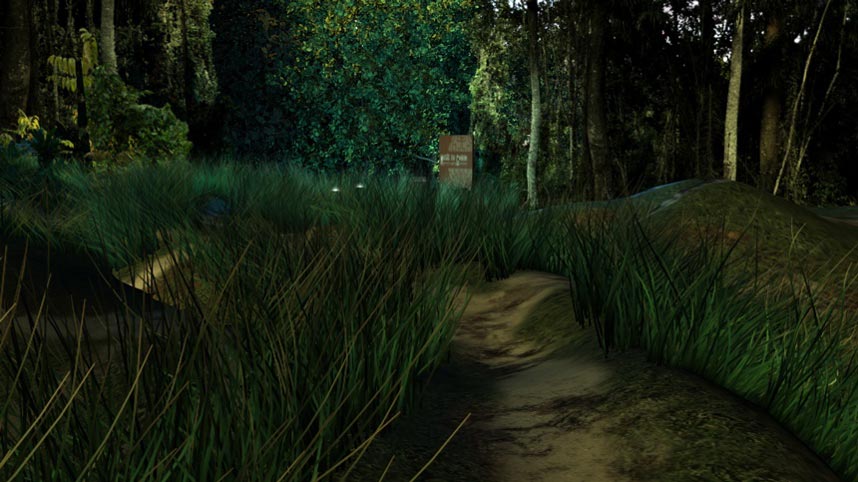
The forest sequence that opened every visit. 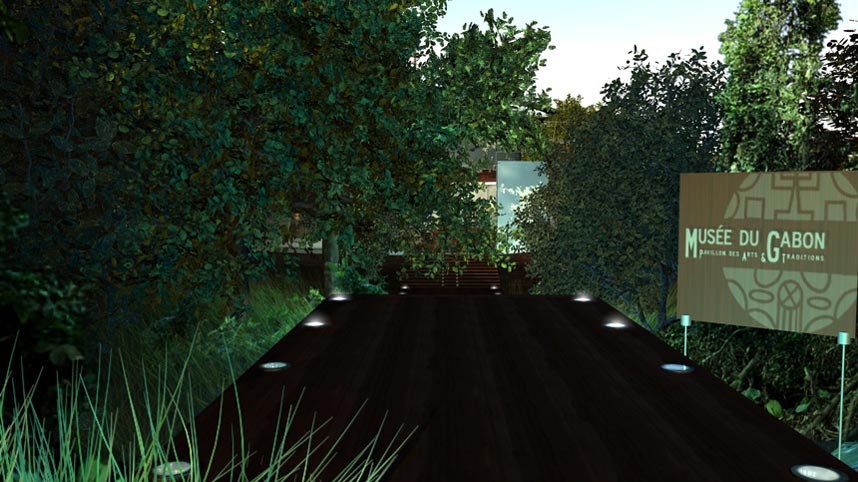
The second stage of the approach. Sound, not image, carried most of it. 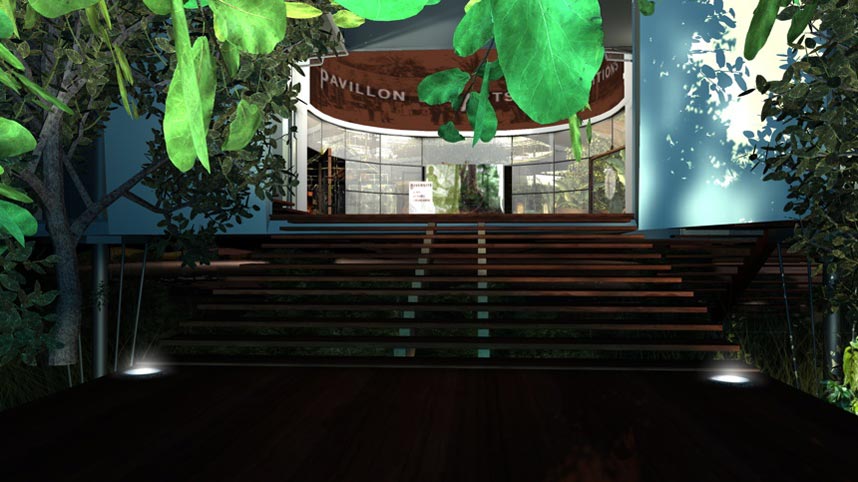
The pavilion, first view. 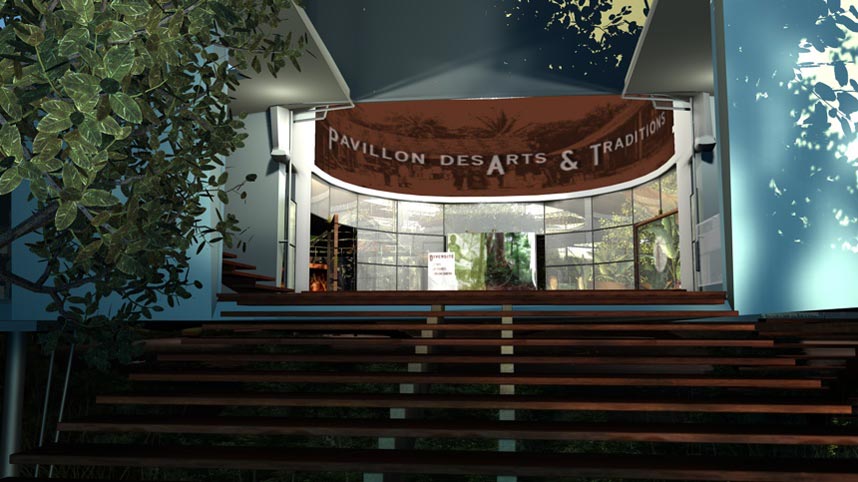
The pavilion, second view. 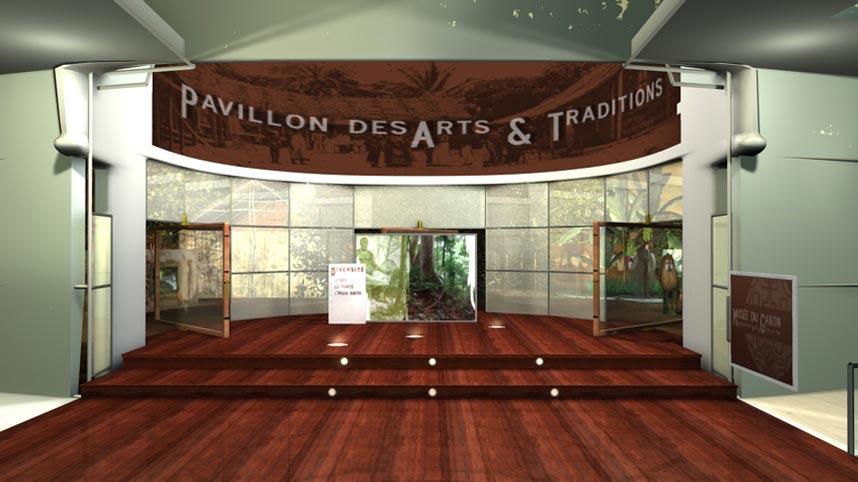
The pavilion, third view. 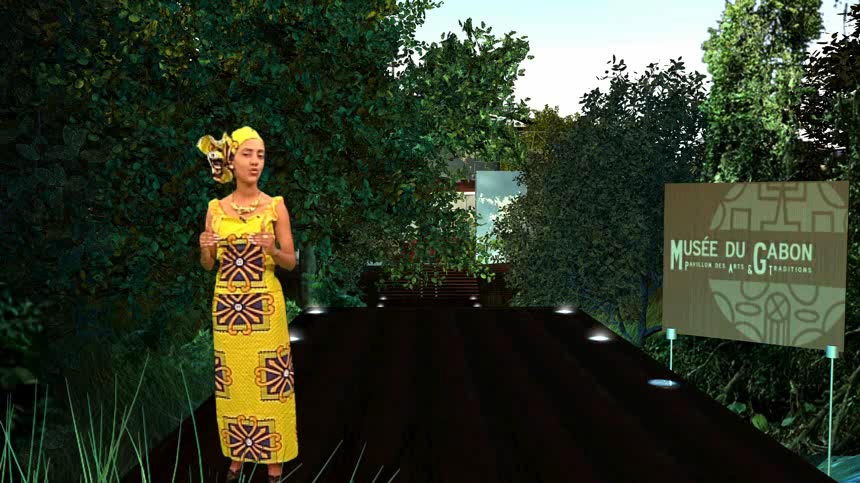
The pavilion, fourth view. 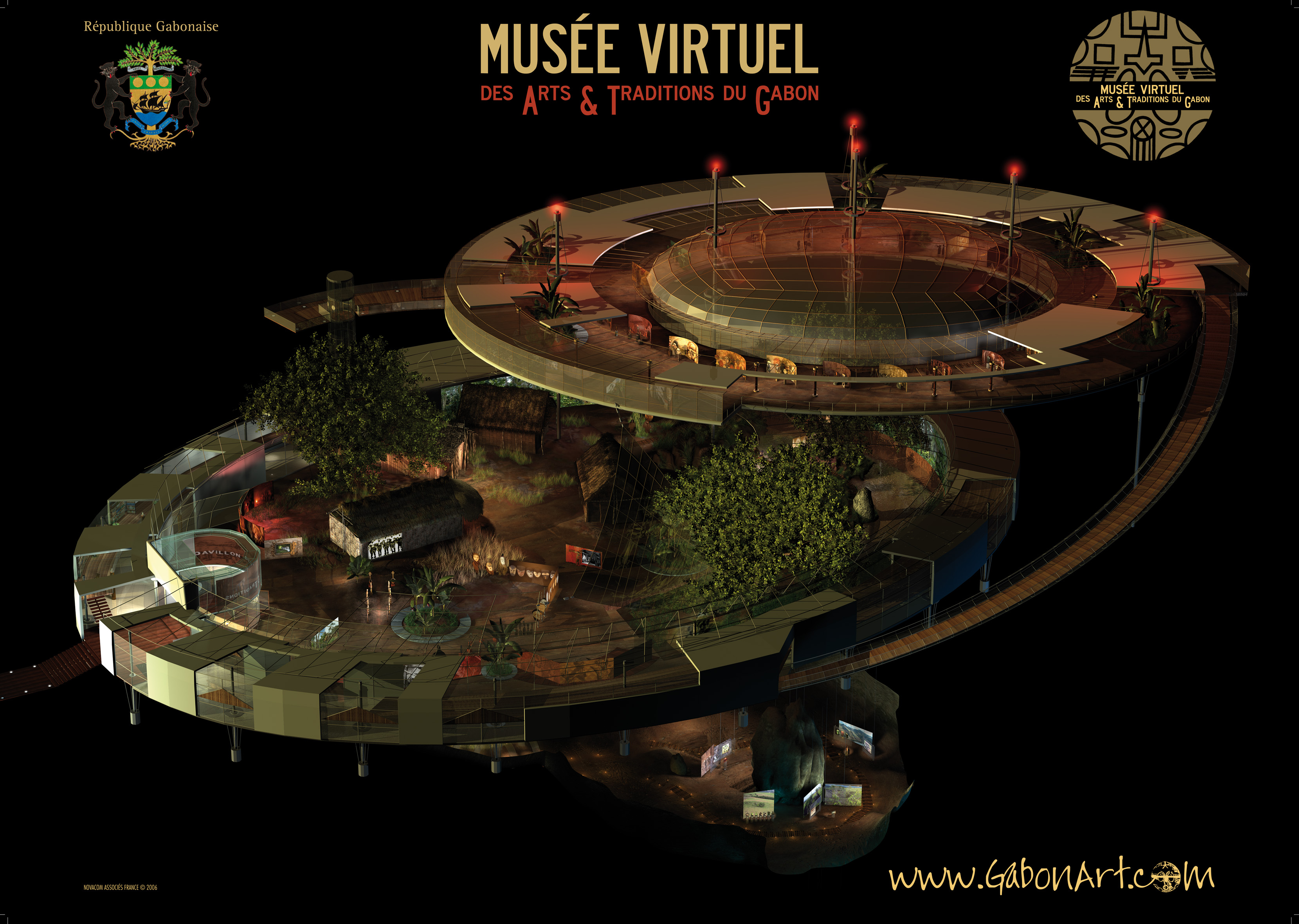
The floor plan — the only architectural drawing of a building that never existed.
Origins
The peoples and cultures of Gabon, set out before a single object was shown. The museum began with who, not with what.
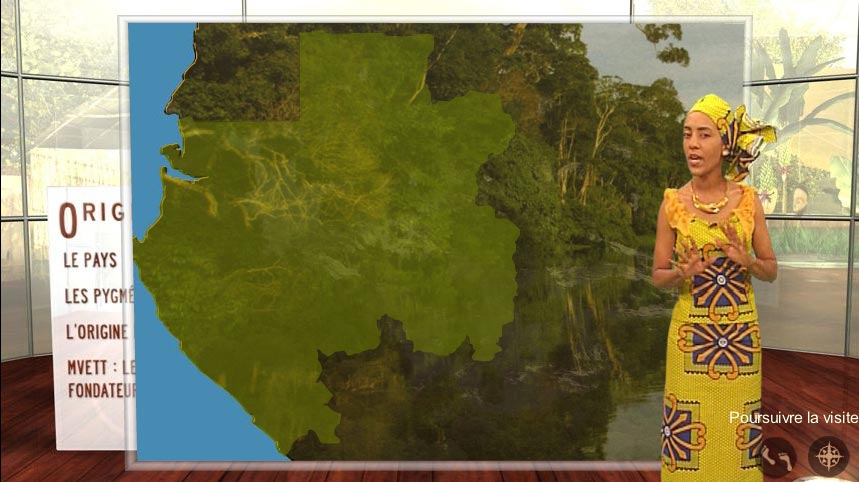
The Origins room.
Archaeology
You did not walk into this room, you descended into it — a digital zoom into a cave lit from the floor, with the sound of a spring beneath everything. Stone Age, early Iron Age, later Iron Age. Gabon put its prehistory before its masks, which almost no museum of African art does.
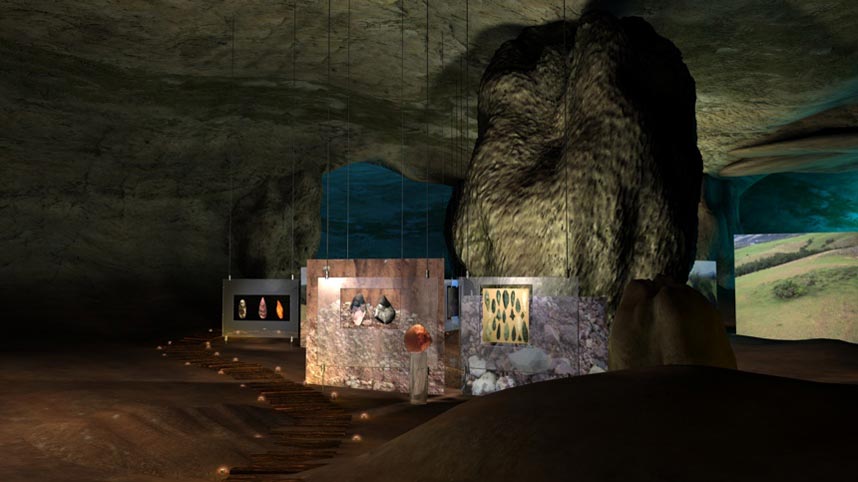
Arrival in the Archaeology room. 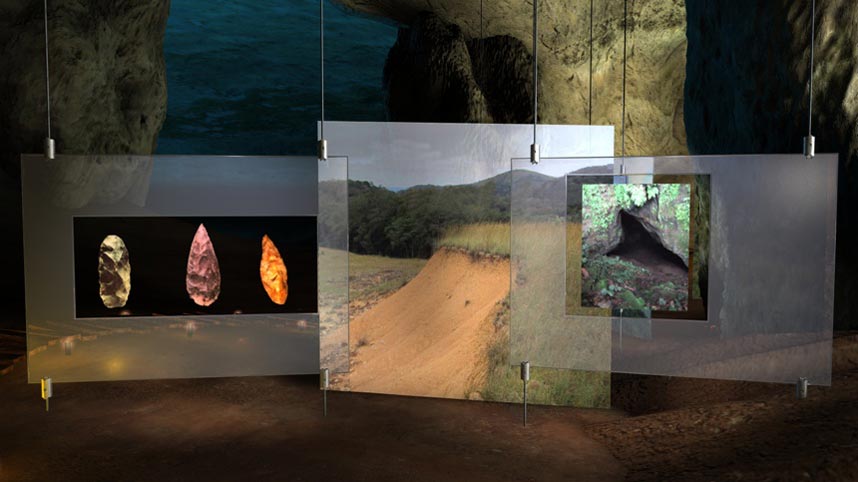
The Stone Age section. 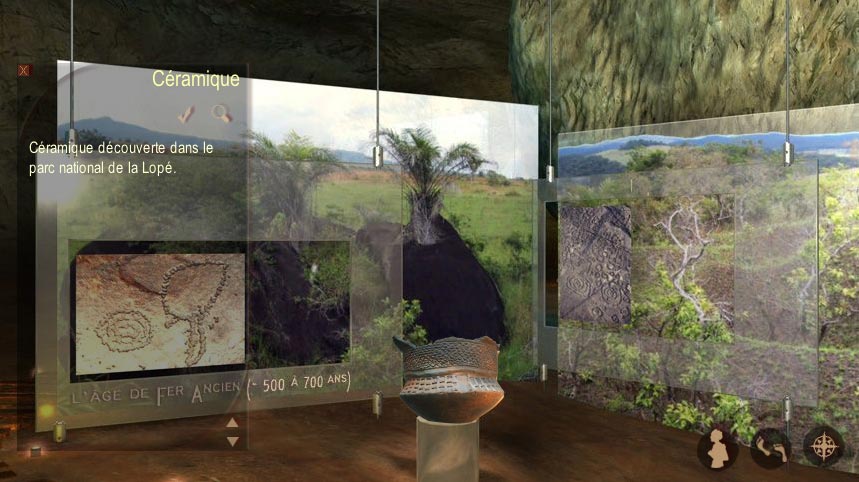
The early Iron Age section. 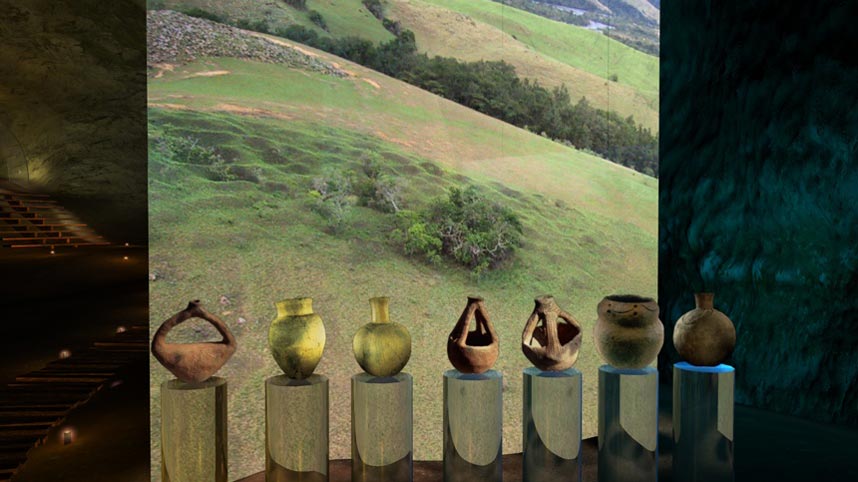
The Iron Age section.
Rites
The largest room, and the most careful. Bwiti and Dissoumba given space rather than reduced to the iboga plant, as outsiders have done for a century. Masks, the Okukwe, the ngombi harp with its own film, a village, and initiation ceremonies shown on video — some of that footage more than fifty years old and never published before.
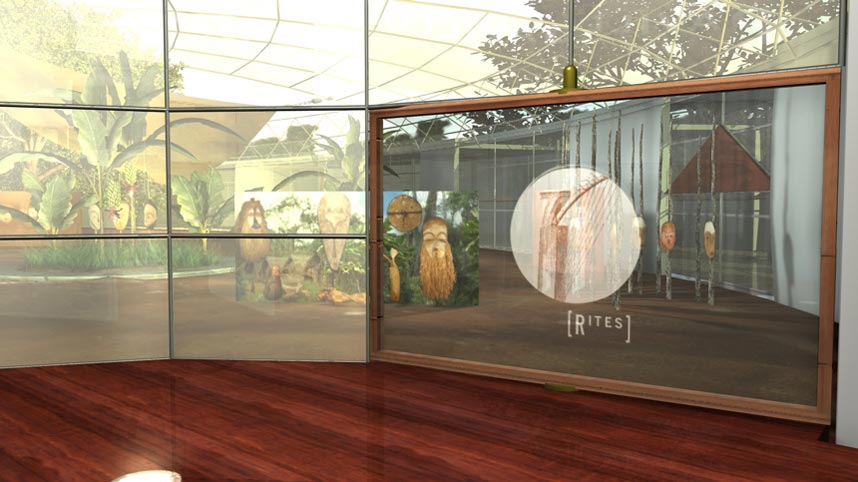
Entering the Rites room. 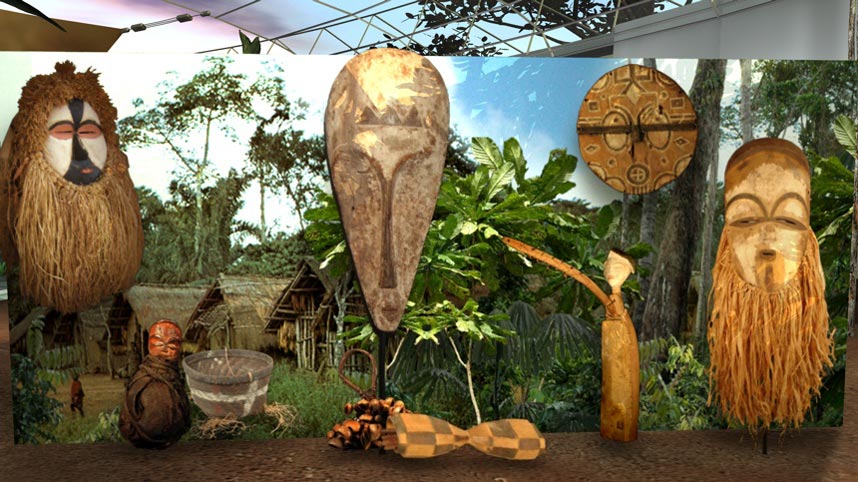
Rites, introduction, first panel. 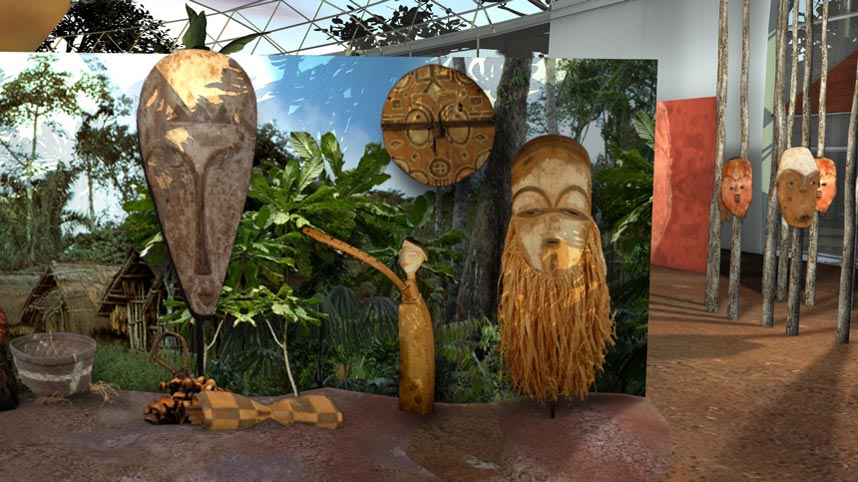
Rites, introduction, second panel. 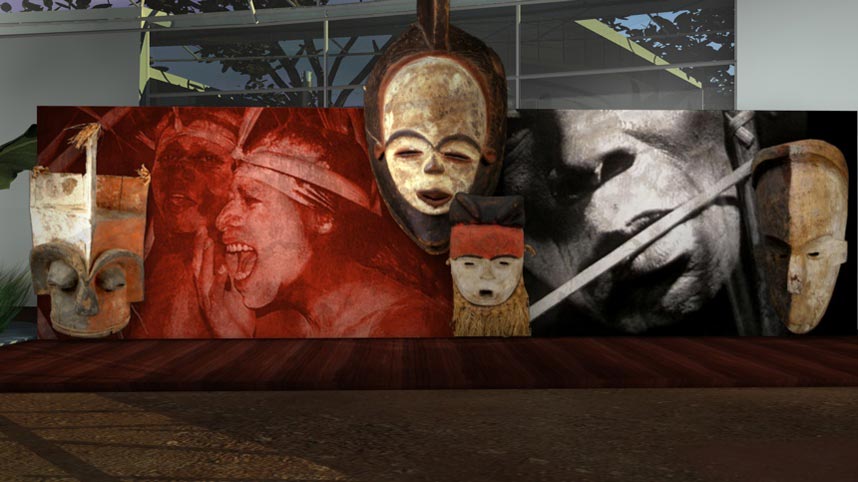
Bwiti, first view. 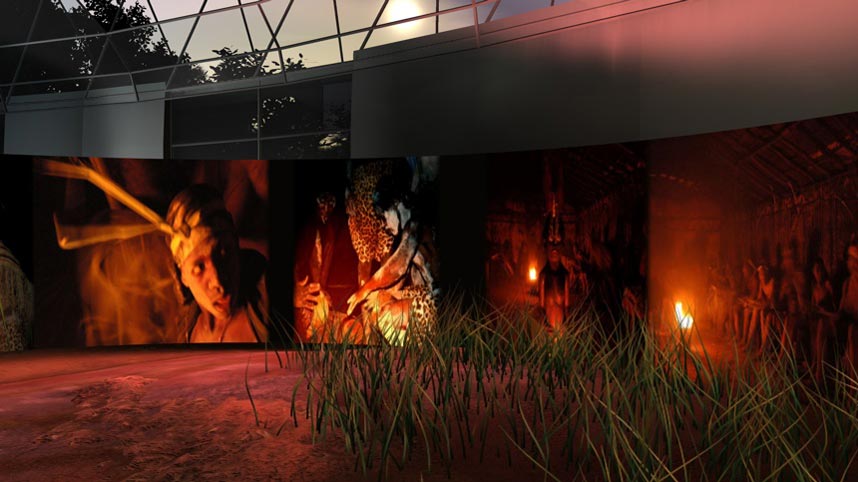
Bwiti, second view. 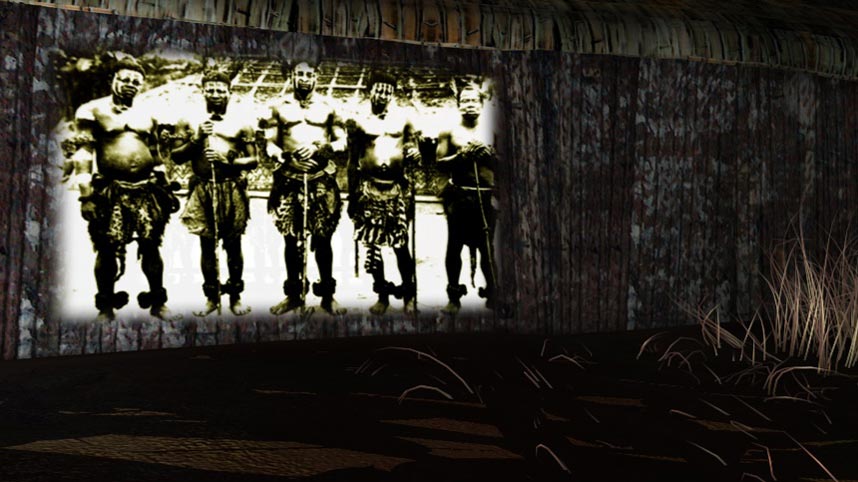
Bwiti, third view. 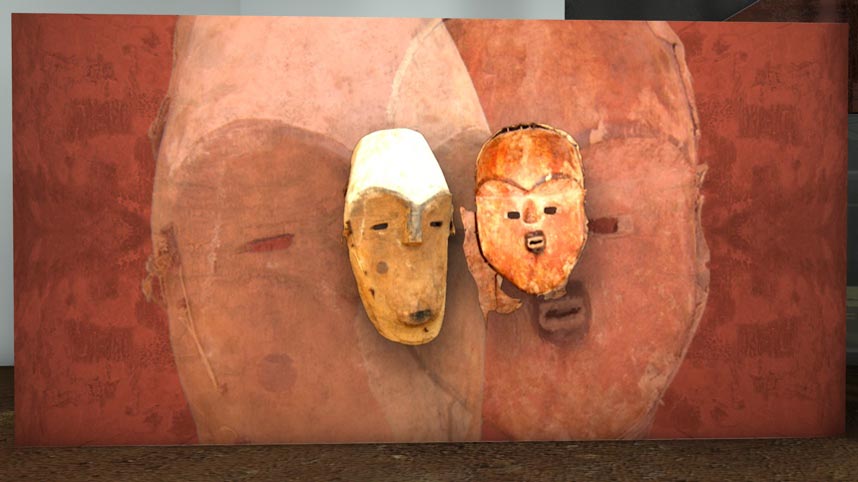
Dissoumba. 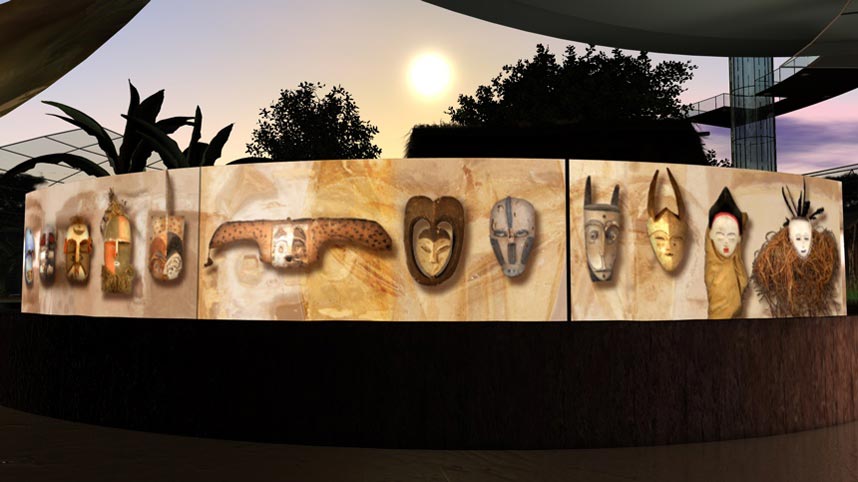
Masks. 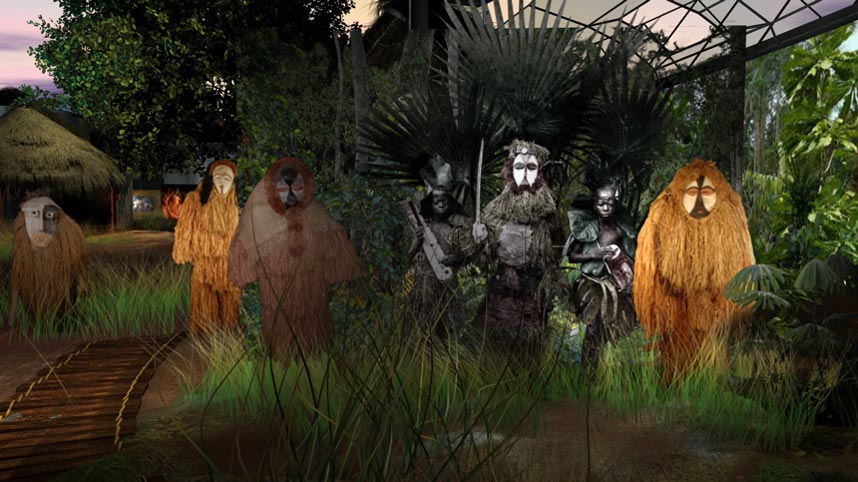
Okukwe. 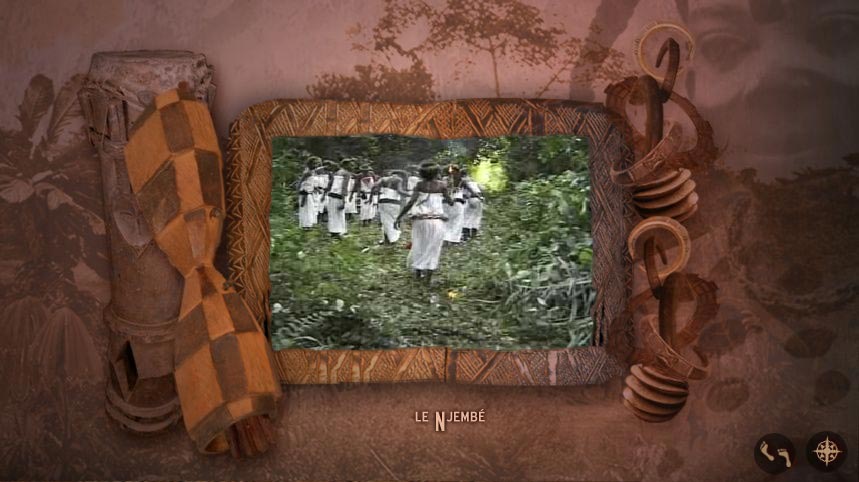
Njembe. 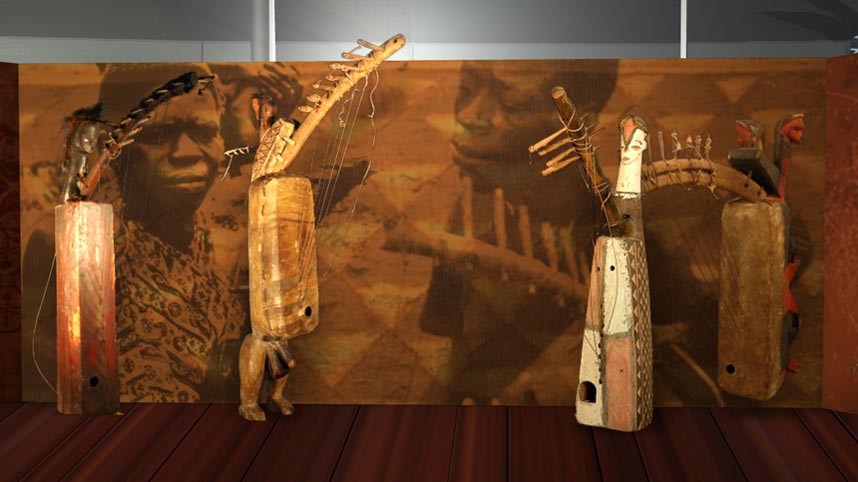
The harps. 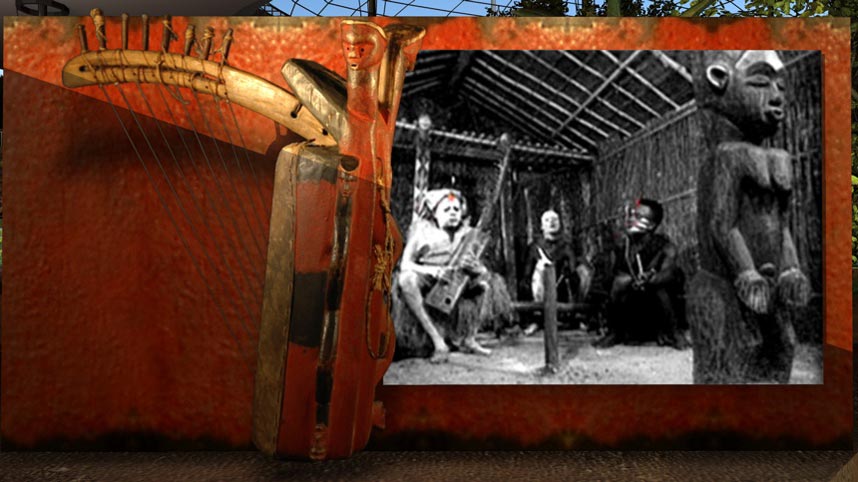
The harp film — among the material now lost. 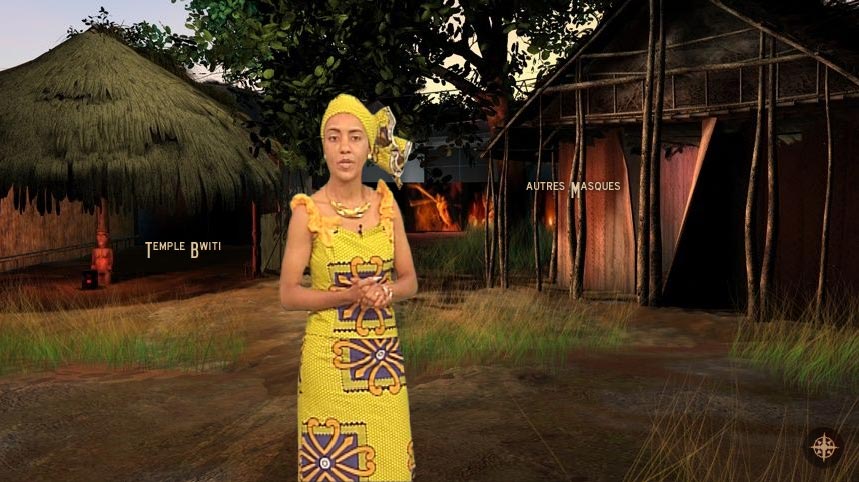
The village.
Ancestor worship
Reliquary figures grouped not by shape or by collector, but by people — Fang, Obamba, Tsogho. Anyone who has stood in a European gallery reading a label that says "Gabon, wood, nineteenth century" knows exactly what that difference is worth.
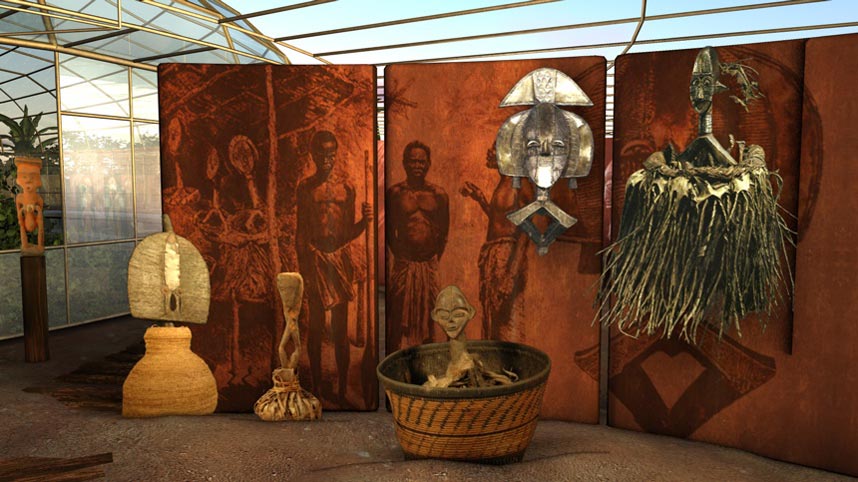
The Ancestor Worship room. 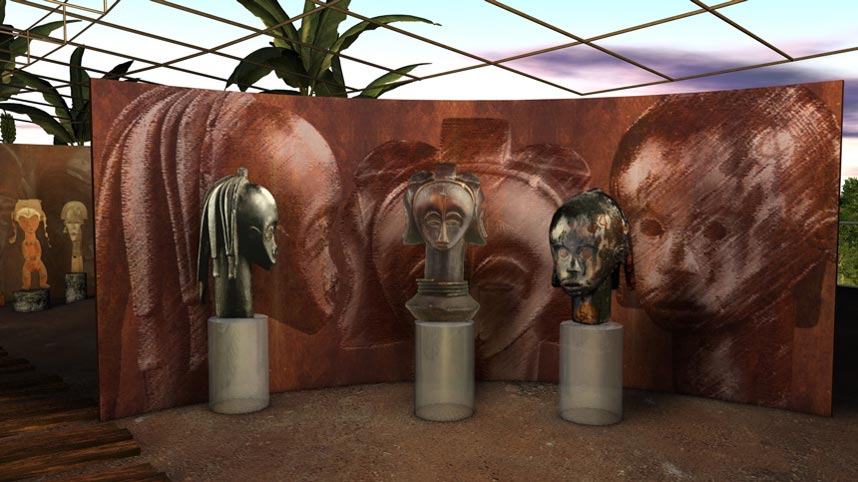
The Fang. 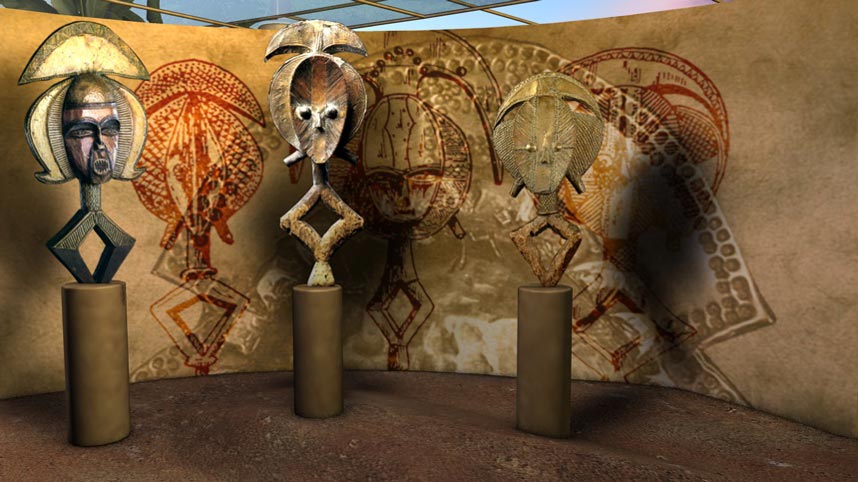
The Obamba. 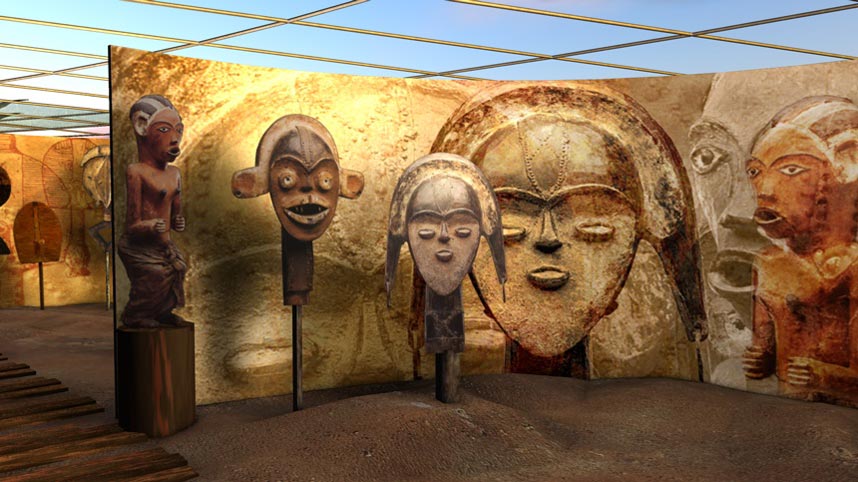
The Tsogho. 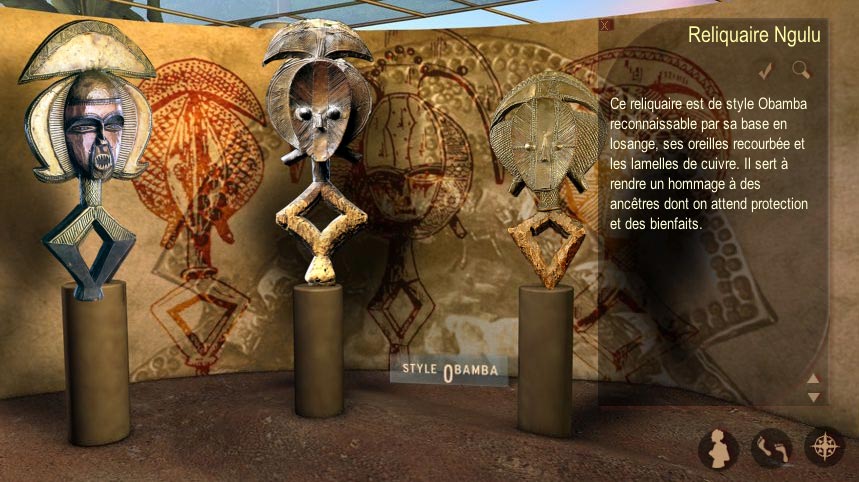
A reliquary. Objects could be approached, enlarged and read about.
Everyday life
The last room, and the one that made the rest make sense: what people wore, carried and used, rather than only what they venerated.
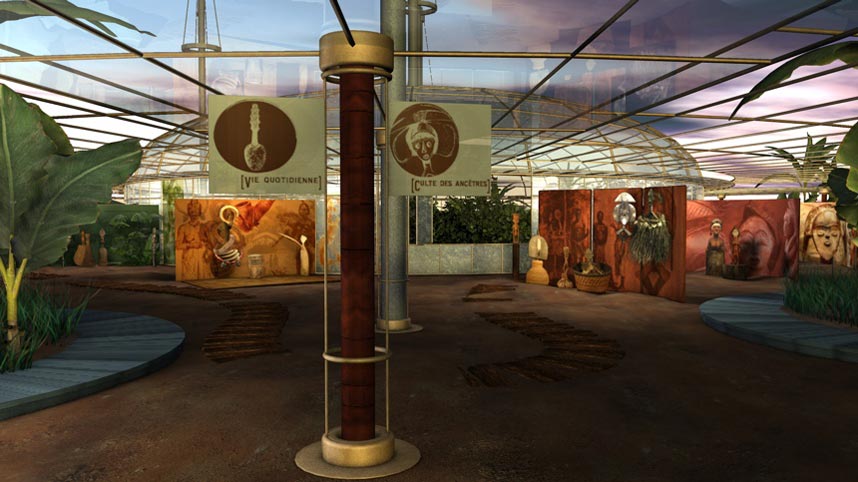
Entering Everyday Life. 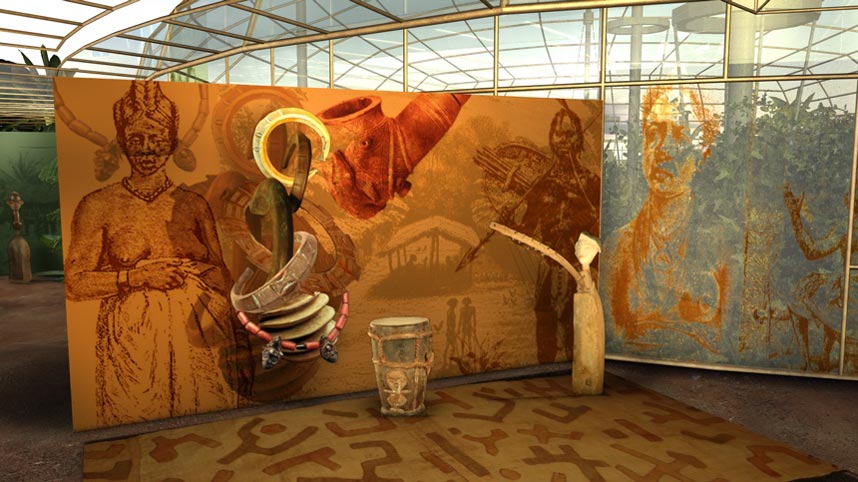
Everyday Life, introduction. 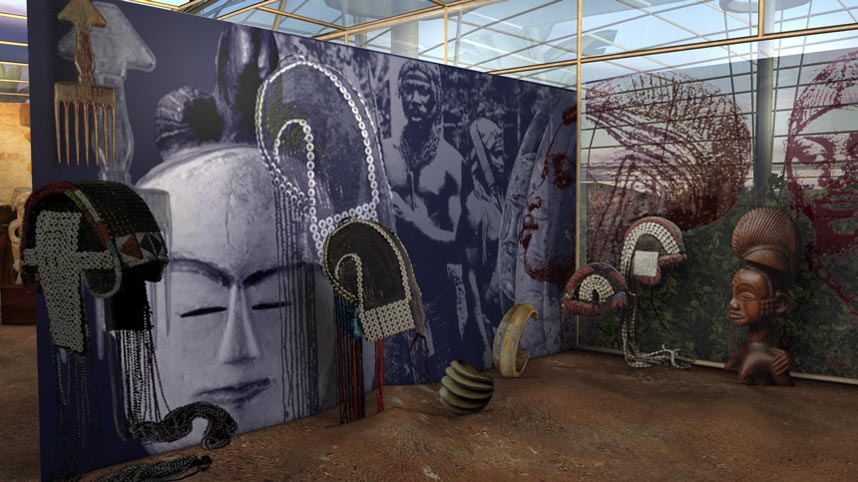
Adornment.
The makers
Every museum has a plaque by the door. This was gabonart.com's: a national telecoms operator, a mobile network and an oil company, with production by a French multimedia agency.
Financial partners: Gabon Telecom, Libertis, Total Gabon. Realisation: Novacom.
All thirty-four images on this page are screen captures of the Musée Virtuel des Arts et Traditions du Gabon, produced by Novacom Associés for the Ministry of Culture, Arts and Popular Education of Gabon, recovered from the Internet Archive and reproduced here to document a cultural project that can no longer be reached by any other means. They are not the work of this site and are not presented as such.
Where the objects actually were
Now the part that deserves to be better known than it is.
The 250-odd works in the virtual museum did not all come from Libreville. The core came from the holdings of the National Museum of Arts and Traditions of Gabon. The rest came from private collectors — and from the Musée de l'Homme in Paris and the Museo Nacional de Antropología in Madrid.
Read that again. In 2006 Gabon assembled, at its own initiative, a single collection containing its own objects held in French and Spanish institutions, and put it online where any Gabonese schoolchild could reach it. The stated aim, written into the project documents of the time, was to encourage the return of Gabonese works scattered around the world — in the first instance in digital form — and to create what was called a new right to culture for future generations.
The date is the point. The Sarr–Savoy report on the restitution of African cultural heritage, the document that opened the European debate in earnest, was delivered to the French president in November 2018. Gabon had built and shipped a working digital response twelve years earlier, and framed it in almost the same language.
It did not solve restitution and it did not claim to. An image of a reliquary is not a reliquary. But it was the first serious attempt by an African state to act on the problem with the tools it actually had, rather than waiting for a European ministry to grant permission.
The mask that sold for 5.9 million euros
Six months before the museum opened, in June 2006, a Fang Ngil mask was sold at auction at Drouot in Paris for 5.9 million euros — a world record for so-called premier art, reported everywhere. The Fang are a people of Gabon, Equatorial Guinea and southern Cameroon; one contemporary press agency report of the period muddled this and left Gabon off the list entirely, which tells you something about how carefully the continent was being read even in the coverage of its own record-breaking objects.
In June a single Gabonese mask changed hands in Paris for 5.9 million euros. In November Gabon put 250 works online and charged nobody anything to see them.
Both of those things are true, both happened in the same year, and no comment is required.
Who built it, and who paid
The museum was an initiative of the President of the Republic, delivered through the Ministry of Culture, Arts and Popular Education. Production and realisation were handled by the French interactive multimedia agency Novacom Associés. Nine months of work went into it, including a thousand hours of digitisation alone. The sponsors named on the site were Gabon Telecom, Libertis and Total Gabon.
No total cost has ever been made public, and this page does not invent one. What can be stated is what was delivered and in what time: five rooms, more than 250 objects, fifteen previously unpublished ethnographic films, a filmed guide, a full 3D environment, French and English versions, and a companion interactive travel book — inside nine months, on 2006 bandwidth.
A year of success, and then the promises
It worked. In the first year more than 200,000 people visited, from every part of the world, and the operators counted a million minutes of viewing. The coverage was heavy and serious: television on TV5, radio on RFI, France Inter and Africa 1, print across Géo, Le Nouvel Observateur, La Croix, La Vie and Grands Reportages. Teachers wrote about it. Web-design journals wrote about it.
It also came off the screen. In the summer of 2007 an exhibition called "Gabon – Passions" ran at the municipal museum in Le Touquet, with private collectors, the photographer Patrice Konrad, the museum of Boulogne-sur-Mer and the heritage group 2P2M. The idea was to rebuild the rooms of the virtual museum in a real building. Around ten thousand people came.
And then the announcements, all of which sound familiar to anyone who has watched a government cultural platform enter its second year:
A media library inside the museum: visitors would build and share their own visit catalogue, and the Libreville documentary archives would go online alongside the work of museographers, ethnologists and collectors. The public was invited to contribute photographs and the histories of their own objects.
A DVD of the museum, in French and English, to be distributed to schools across Gabon and sold from the site.
A Virtual Park for Culture and Ecotourism: a CICIBA pavilion on Bantu civilisations, a Contemporary Arts of Gabon pavilion, and a Parks pavilion offering "eco-surfing" through all thirteen of Gabon's national parks — the sounds of the forest, the wildlife, a night in a hide.
None of it exists. Not one of those pavilions can be visited today, by anyone, anywhere.
What actually killed it
Flash. The whole museum was built as Shockwave Flash. That was the correct engineering choice in 2006 — nothing else could deliver 3D navigation with synchronised audio and video in a browser. It became a death sentence later. Adobe ended support at the end of 2020 and browsers stopped running it. Anything not rebuilt before then simply switched off.
The patron. Omar Bongo Ondimba died in June 2009. The museum was his personal initiative, named as such on every press release. Projects that belong to one man tend to end with him, and the pavilions announced for 2010 were never built.
Nobody archived it. The Internet Archive holds pages from the site, but a Flash museum is not a page. It is a shell file that loads other files — further Flash modules, XML, video streams — and those were never captured. The shell survives. The museum does not. Emulators such as Ruffle can sometimes revive a lone Flash file; they cannot revive one whose contents were never saved. The fifteen ethnographic films are not known to exist anywhere in public today.
A museum with no building does not burn down. It just stops opening, and no one hears anything.
What Conakry is doing differently
Guinea is now building a virtual museum of its own, and the comparison runs in both directions.
In September 2026 the National Museum of Guinea hosted the closing ceremony of the "chantier des collections", a key stage of the Musée Virtuel de Guinée project: eleven months of intensive work financed by French cooperation through Expertise France. For the first time in the history of Guinean heritage institutions, more than thirty staff were brought together from the National Museum, the National Archives, the National Library, the IRLA, the Mory Kanté Higher Institute of Arts at Dubréka, the Army Museum and ONACIG. Supervised by preventive conservation experts, the team worked methodically through 2,240 objects — condition reports, cleaning, weighing, marking, registration in a central database. A memorandum of understanding was signed between museum, archives and national library. Digitisation missions with the firm Small3D produced 476 objects in 2D and 13 emblematic pieces in 3D, among them the heritage houses of Kankan. The company Global Itec presented the model of the digital platform, with full launch set for 2026–2027. Separately, the physical renovation of the National Museum is backed by the Agence Française de Développement to the tune of 16 million euros.
The project management has put the overall budget of the virtual museum component at two million euros, covering inventory and conservation, training, content production and the platform — not the website alone. That distinction matters and is stated plainly here, because the comparison is often made carelessly.
Set them side by side. Gabon, in 2006, delivered in nine months a finished, navigable museum: 250 objects, fifteen ethnographic films, a filmed guide, two languages. Guinea, after eleven months, has 2,240 catalogued objects, 476 digitised in 2D, 13 in 3D, thirty trained staff across seven institutions, and a platform still at model stage.
On delivered spectacle, Gabon wins and it is not close.
But the obvious conclusion is the wrong one. Guinea is doing precisely what Gabon did not. Gabon built a magnificent surface over a collection that remained institutionally unsecured — no public inventory, no shared database, no trained conservators across its heritage bodies, no plan for the day the technology or the president ran out. When both ran out, everything went at once.
Guinea started at the bottom. A condition report and a catalogue number on 2,240 objects will still be worth something in 2060, when whatever platform is shipped next year has been obsolete for decades. Thirty trained people in seven institutions do not switch off when a browser drops a plug-in. The signed memorandum between museum, archive and library is not glamorous and cannot be screenshotted, and it is the most valuable deliverable in the entire project.
Gabon built the roof first. Guinea is building the foundations. Only one of those two mistakes is recoverable.
The fair warning to Conakry is not about money. It is this: build on open standards, export the database in a format anyone can read, deposit copies outside the ministry, and never let the project depend on one minister, one agency or one vendor. Gabon's museum did not die of poverty. It died of being beautiful, proprietary and alone.
A small museum in Accra, and why this is personal
In 2007 I was sitting in front of gabonart.com, as tens of thousands of other people were. I was already running ghana-net.com, then seven years old. What Gabon had done reframed the whole question for me: a website was not a brochure about a place. It could be the place, or at least the only surviving record of it.
So I built my own, far smaller and far cruder, for the National Museum of Ghana in Accra — photographs I had taken myself, processed into the indexed-colour GIFs that were then the sensible format for a slow connection. It is still online at nationalmuseum.ghana-net.com. The image below is one of those files, made around 2007: a mask from Nigeria, possibly Igbo, which I photographed in the National Museum in Accra.
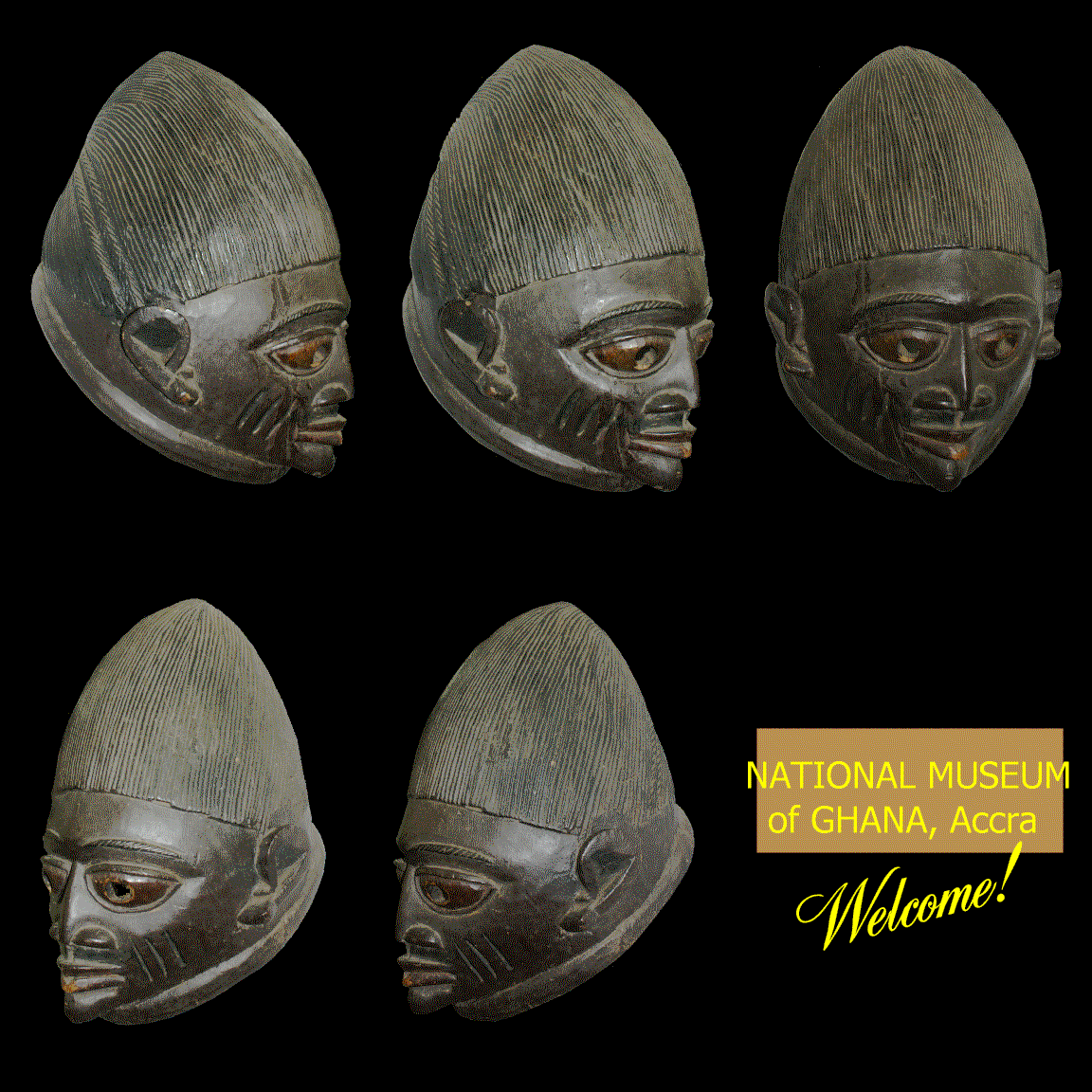
Mask from Nigeria, possibly Igbo. Photographed by the author in the National Museum of Ghana, Accra, around 2007, and prepared as a GIF for the web of that era. The attribution is given as recorded and has not been independently confirmed. Photograph: Remo Kurka.
That object is no longer on display in Accra. Which means the small crude page I built nearly twenty years ago, because Gabon gave me the idea, is now doing exactly what gabonart.com set out to do: holding a record of something the public can no longer walk up to and look at.
What I saw there in February 2026, recorded as my own observation on site and open to correction. The permanent exhibition has been thinned considerably against what was shown in 2007, and almost all of the display cases have gone. The upper level is not closed, but it has been stripped: Kwame Nkrumah's Chair of State now stands up there, fairly alone. It used to be downstairs, where visitors could not reach it. Upstairs, people occasionally sit on it.
Outside, the display of figures is deteriorating, and the historic vehicles of Ghana's heads of state and presidents are deteriorating with them. The hall intended for temporary exhibitions is barely used, and most of the time there is nothing in it at all.
I hold photographs of that museum, taken by me, covering more objects than are currently on its walls. I would be glad to be shown that this has changed, and any correction the museum sends will be published here. The food at the outdoor restaurant, in fairness, is rather good.
Three and a half million dollars, a short drive away
Stay in Accra, because the comparison is right there.
In May 2022 the Kwame Nkrumah Memorial Park was closed for renovation. It reopened on 4 July 2023, rebuilt at a reported cost of around thirty million cedis — put at roughly three to three and a half million US dollars in the reporting of the time. The money came from a forty-million-dollar World Bank loan taken out by Ghana in 2018 through the Ministry of Tourism, Arts and Culture for the development of tourism sites.
What that bought is not in dispute, and I have walked through it. A presidential library. A reception building. A mini-amphitheatre. A restaurant. A Freedom Wall. A digitalised payment and access system. The mausoleum fully refurbished and the tombstone renewed. The museum extended with an audiovisual tunnel. An upgraded VVIP lounge, an enlarged recreational area, a modernised gift shop, and a fountain with synchronised sound and light. Public toilets that work, which in Ghanaian heritage tourism is not a small thing. Before the works, the park drew a little over ninety thousand visitors a year.
It is a good job. That is the point, not the opposite.
The question is not why the Nkrumah Park got it. The question is why the National Museum did not. The same World Bank facility was described by the Ministry of Tourism as covering Osu Castle, Elmina Castle and the Ghana Museums and Monuments Board as well. Same loan, same ministry, same city. One site reopened with a presidential library and a synchronised fountain. At the national collection a short drive away, the founding president's Chair of State stands on a stripped upper floor where visitors sit on it.
No allegation is made here about how any sum was spent. What is recorded is the sequence: the money existed, the priorities were set, and the results are visible to anyone who visits both sites in the same week.
What survives
Thirty-four screenshots and the press texts of 2006 and 2007. That is the whole estate of the first virtual museum in the world.
If anyone holds a working copy — a DVD from the 2007 school distribution, a downloaded Flash archive, the ethnographic films, or material from the Le Touquet exhibition — this site would like to hear from you. Some of it almost certainly still sits in a drawer in Libreville or a cupboard in Paris.
Further reading in this network
- The National Museum of Ghana, Accra — photographed in 2007, including objects no longer on display
- Kwame Nkrumah Memorial Park — the 2023 restoration in full
- Ghana Museums — field reports and open letters on Ghanaian heritage sites
- Guinea — heritage, travel and culture
- The independence timeline — every African country, every date
- African radio, live — the whole continent on one page
Sources and references
- Contemporary press material issued for the museum, 2006–2008, including agency copy of 1 December 2006 and the first-anniversary release.
- Period reviews in the French cultural and technical press, 2006–2007.
- Thirty-four screen captures recovered from the Internet Archive.
- Guinéenews, 16 September 2026, on the closing of the chantier des collections; Guineematin, 11 April 2026, and Ledjely, 10 April 2026, on the two-million-euro budget; Expertise France project documentation.
- Ghanaian press reporting of July 2023 on the commissioning of the Kwame Nkrumah Memorial Park, and the Ministry of Tourism, Arts and Culture on the World Bank facility.
Updated and fact-checked: 20 September 2026.
The opening is dated 30 November 2006; one contemporary account places it on the Friday rather than the Thursday, and the discrepancy is noted rather than resolved. No total project cost for Gabon has been published and none is asserted. Visitor figures and viewing minutes are as published by the project operators and have not been independently audited. Reported costs for the Kwame Nkrumah Memorial Park vary between US$3 million and US$3.5 million against a figure of GH¢30 million; the range is given rather than a single number, and no finding is made as to whether that sum was appropriate. The attribution of the Accra mask is given as recorded and is not confirmed. Observations on the current state of the National Museum of Ghana were made on site by the author in February 2026 and are given as personal observation; corrections from the institution will be published. Screenshots remain the work of Novacom Associés and the Ministry of Culture, Arts and Popular Education of Gabon, and are reproduced for documentation. This page makes no allegation against any living person.