Jacqueline Moudeina: The Lawyer They Threw a Grenade At, Who Put a Dictator in Prison
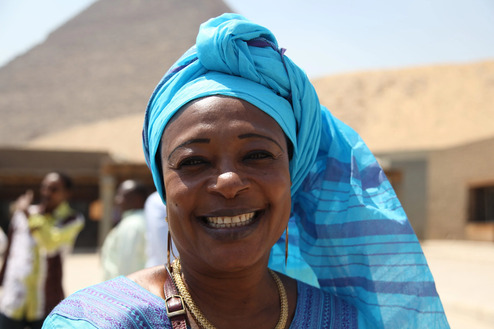
Remarkable Africans · The ones who won
Jacqueline Moudeina: The Lawyer They Threw a Grenade At, Who Put a Dictator in Prison
Every other lawyer in Chad refused the case. She took it in 2000, on behalf of seven victims, against a former head of state living comfortably in another country. A year later a police commissioner she had personally charged with torture had a grenade thrown at her. She spent more than a year in a hospital in France, came home, and carried on for another fifteen years — until he was sentenced to life imprisonment.
Read the rest of this series and a pattern emerges that is hard to look at.
Lumumba: killed, no conviction. Rwagasore: killed, no conviction. Olympio: killed, no conviction. Um Nyobè: killed, archives sealed. Sankara: killed, thirty-five years to a verdict in absentia. Boganda: killed, report never published. The Ikiza in Burundi: a hundred thousand dead or more, nobody charged.
Impunity is not an occasional failure in this history. It is the norm.
There is one clear exception, and it belongs to a woman from Chad who is still alive.
Black September
Jacqueline Moudeina was born in Chad in 1957.
She was studying English at the University of Chad in N'Djamena when the civil war reached the capital in 1979 and the state collapsed. She abandoned her degree and fled to Congo with her husband, who was a leader of a southern Chadian opposition group.
They stayed in exile for more than thirteen years.
Behind them, Hissène Habré took power in 1982 and began the work that his political police would carry out for the next eight years.
What decided her life was Black September 1984 — the peak of the repression in southern Chad. Villages pillaged. And people who had taken refuge inside churches burnt to death as the buildings came down under government fire.
She has said that at that point it became clear that something had to be done.
So, in exile, in a foreign country, having abandoned one degree already, she started again and studied law.
She earned a master's in private law in Congo. She worked with the International League for Human Rights there, with the FIDH, and with the Chadian human rights association operating in exile.
Then, in 1995, she went home.
Starting from nothing, twice
She returned to a country still governed by many of the same people, and registered as a legal intern — among the first women in Chad to do so.
She was thirty-eight years old, beginning at the bottom of a profession in a country where the profession barely existed.
She became a legal secretary, then a lawyer, and worked with the Chadian Association for the Promotion and Defence of Human Rights — the ATPDH — becoming its president in 2004.
And with survivors of the Habré years, she began collecting evidence.
2000: the case nobody would take
By 2000, Hissène Habré had been living in Senegal for ten years, comfortably, with money, under protection, and with no prospect whatsoever of facing a court.
The obstacles were not subtle. He was a former head of state. He was in a different country. The crimes were a decade old. And in Chad itself, a great many of his former security officials had become senior figures in the government of the man who overthrew him.
To bring the case meant accusing people who were currently in power, in the capital where you lived.
Other Chadian lawyers declined.
She filed anyway — in Senegal, on behalf of seven victims, and simultaneously against Habré's security agents in the Chadian courts.
A Senegalese judge indicted Habré for complicity in torture and barbarity and opened an investigation.
A woman who had been a legal intern five years earlier had just got a former African head of state indicted in another country.
The Senegalese courts then blocked it, on the grounds that Senegal had no jurisdiction over crimes committed elsewhere.
That could have been the end. It was the beginning of another sixteen years.
11 June 2001
After the Chadian presidential election of May 2001, women organised a peaceful march in N'Djamena to protest at the conduct of the vote. They intended to deliver a motion at the French embassy objecting to France's role in sustaining autocratic government in Chad.
The security forces dispersed the march with force, and threw grenades.
Jacqueline Moudeina was severely wounded.
The detail that matters.
The officer who commanded the operation was the chief police commissioner of N'Djamena, Mahamat Wakaye — a former official of Habré's political police, and a man Moudeina had personally named in the torture complaints she had filed the previous year.
According to witness testimony reported at the time, she was deliberately targeted.
She had charged him with torture. He commanded the police who threw the grenade at her.
She was flown to France and spent more than a year in hospital and rehabilitation, with shrapnel wounds to her legs.
In March 2002, from her hospital bed, she and six other women lodged a complaint against three police officers over the attack.
On 26 August 2002, she went back to Chad and resumed work.
An international mission accompanied her home, because there was a genuine question about whether she would survive her return. The interior minister gave an undertaking about her safety.
Read that sentence again. Her physical safety in her own country required a foreign delegation to fly in with her.
Fifteen more years
What she did next is the part that has no shortcut and no drama in it.
She kept filing. She kept collecting testimony. She kept representing victims who were poor, scattered, ageing and frightened. She kept naming officials who held office.
She worked with Reed Brody of Human Rights Watch — whom the victims called the dictator hunter — and with the survivors' associations, and with lawyers in Belgium and Senegal, for one and a half decades.
Human Rights Watch investigators find the files of Habré's political police, the DDS, abandoned in a derelict building in N'Djamena. Among the papers are the names of 1,208 people killed or dead in detention and records of 12,321 victims. The case now has documents.
Belgium pursues Habré under universal jurisdiction. Senegal declines to extradite or prosecute. The African Union is asked to find a solution and does not.
On 5 December, Moudeina receives the Right Livelihood Award — the Alternative Nobel — for her work at great personal risk on behalf of the victims of the dictatorship.
The International Court of Justice rules in Belgium v. Senegal that Senegal must either prosecute Habré or extradite him.
Senegal and the African Union inaugurate the Extraordinary African Chambers. Habré is arrested in Dakar.
A court in N'Djamena convicts twenty former DDS agents of murder, torture, kidnapping and arbitrary detention — the case Moudeina had filed in Chad fifteen years earlier.
Hissène Habré is convicted of crimes against humanity, war crimes and torture, including sexual slavery and rape, and sentenced to life imprisonment.
The appeal chamber upholds the conviction and awards about 150 million US dollars to 7,396 named victims.
He refused to recognise the court. He had to be carried into the room.
He died in a Senegalese prison in August 2021, having served the rest of his life there.
What it actually was
The first time a former head of state was convicted of crimes against humanity by the courts of another country. Not by The Hague. Not by a European tribunal. By an African-mandated court inside an African national judicial system, with survivors at the centre of the case.
The legal route it opened has been used since. The reasoning in Belgium v. Senegal — that obligations under the Torture Convention are owed to all states parties, so any of them may sue over non-compliance — later shaped Canada and the Netherlands' case against Syria, and the genocide cases brought by The Gambia against Myanmar and by South Africa against Israel.
A case begun by one Chadian lawyer with seven clients in 2000 helped build the architecture that other countries now use.
Her own explanation of why she did it, given when she received the Right Livelihood Award in 2011, was that impunity is a cancer that stops a society becoming what it could be — and that more than sixty years after Nuremberg it remains easier, in practice, to oppress than to obey the law, and easier to commit violence than to deliver justice.
The part that is not a triumph
And now the thing this website is obliged to say.
Her clients have never been paid.
The appeal chamber ordered the African Union to establish a trust fund, find Habré's assets and raise the money for the 7,396 victims. The fund was never made to work. Years after the judgment, campaigners reported that not one victim had received a single franc.
The Chadian court in 2015 ordered the government to pay half of a separate award to 7,000 victims. The Chadian government has not begun to execute that decision.
So the position, twenty-six years after she filed, is this. She won in Senegal. She won in Chad. She won on appeal. Every judgment stands.
And the people she represented — tortured, imprisoned, raped, bereaved — have received nothing at all, and a great many of them have since died waiting.
She proved that a dictator can be convicted. Nobody has yet proved that his victims can be paid.
And Chad itself did not change. The son of the man who overthrew Habré governs today, after an election his main rival disputed and a parliamentary vote the opposition boycotted. The ATPDH continues to work on prisoners' rights, child herders, women's rights and corruption, in a country that Freedom House rates as not free.
Why she belongs in this series
Because this series is otherwise a record of men who were killed, and of the people who killed them never being punished.
She is the correction. Not a martyr, not a symbol, not somebody's statue — a living lawyer who did the paperwork.
She began her law degree at an age when most people have finished, in exile, in a second country, after abandoning her first degree to a civil war. She came home to a state run partly by the people she intended to prosecute. She took a case that every other lawyer in her country had refused. She was nearly killed for it by a police commander she had accused. She spent a year in a hospital bed in France, and then she went back and did fifteen more years of it.
There is no version of that story in which she was reckless or lucky. It was arithmetic and endurance, sustained for a quarter of a century.
Reed Brody said afterwards that the message to today's dictators is that justice can catch up with them, and to victims everywhere, that they should not give up.
Both halves of that sentence were earned by Chadians, not by anybody in Europe.
What remains
There is a judgment in Dakar that stands.
There is an organisation in N'Djamena with nine staff, ninety volunteers and ten regional chapters, still working.
There are shrapnel injuries from June 2001.
There is a trust fund that was ordered and never built.
And there is a woman, now in her late sixties, who is one of the very few people in this entire series who is still alive to be asked about it.
Connected reading & sources
- Chad — The Dictator Africa Finally Convicted — the full country history behind this case
- Kenya, Mau Mau and the archive Britain hid for fifty years — the other case decided by documents
- Patrice Lumumba — the trial that died with its defendant in May 2026
- Thomas Sankara — a verdict thirty-five years late
- Idi Amin — the dictator who died without facing justice
- Right Livelihood — Jacqueline Moudeina, 2011 laureate
- Martin Ennals Award — Jacqueline Moudeina
- Human Rights Watch — her Right Livelihood address
- Human Rights Watch — Jacqueline Moudeïna, Chad
- Observatory for the Protection of Human Rights Defenders — the 2001 attack and her return
- Human Rights Watch — ten years on, May 2026
- Amnesty International — the reparations that were never paid
Verified: 9 September 2026.
Checked against the records of the Right Livelihood Foundation, the Martin Ennals Award, Human Rights Watch, Amnesty International and the Observatory for the Protection of Human Rights Defenders. Her birth in 1957, her flight into exile in Congo in 1979, her law studies and master's degree in private law in exile, her return to Chad in 1995 and registration as a legal intern, the filing of proceedings against Hissène Habré in Senegal in 2000 on behalf of seven victims, her presidency of the ATPDH from 2004, the Right Livelihood Award of 5 December 2011, the International Court of Justice ruling in Belgium v. Senegal in 2012, the inauguration of the Extraordinary African Chambers in February 2013, the conviction of twenty former DDS agents in N'Djamena in March 2015, Habré's conviction on 30 May 2016 and its confirmation on 27 April 2017 with an award of approximately US$150 million to 7,396 victims, and his death in custody in August 2021 are as recorded. Sources differ on the date of the grenade attack: contemporary reporting by the Observatory for the Protection of Human Rights Defenders places it on 11 June 2001, following the presidential election of May 2001, and that date is used here; some later accounts give 23 February 2001. Sources also differ on whether her Martin Ennals Award was conferred in 2002 or 2003, and no year is stated here for that reason. The statement that she was deliberately targeted, and the identification of the commanding officer, rest on witness testimony reported at the time and on the complaints she and six other women lodged in March 2002; this page records those allegations as allegations. No finding of guilt against any individual in connection with the 2001 attack is asserted here. Reparations awarded to Habré's victims by the Extraordinary African Chambers and by the Chadian court of 2015 remained unpaid as of the most recent reporting available. This page makes no allegation against any living person beyond matters already on the public record.
Header photo: (c) Right Livelihood
Discover More
This remarkable story is only one chapter in the long and often forgotten history of Africa's connections with the wider world. Explore more articles on African kingdoms, Pan-African history, global cultural exchanges and the extraordinary individuals whose lives linked Africa with Europe, Asia and the Americas. Every story opens another door into Africa.