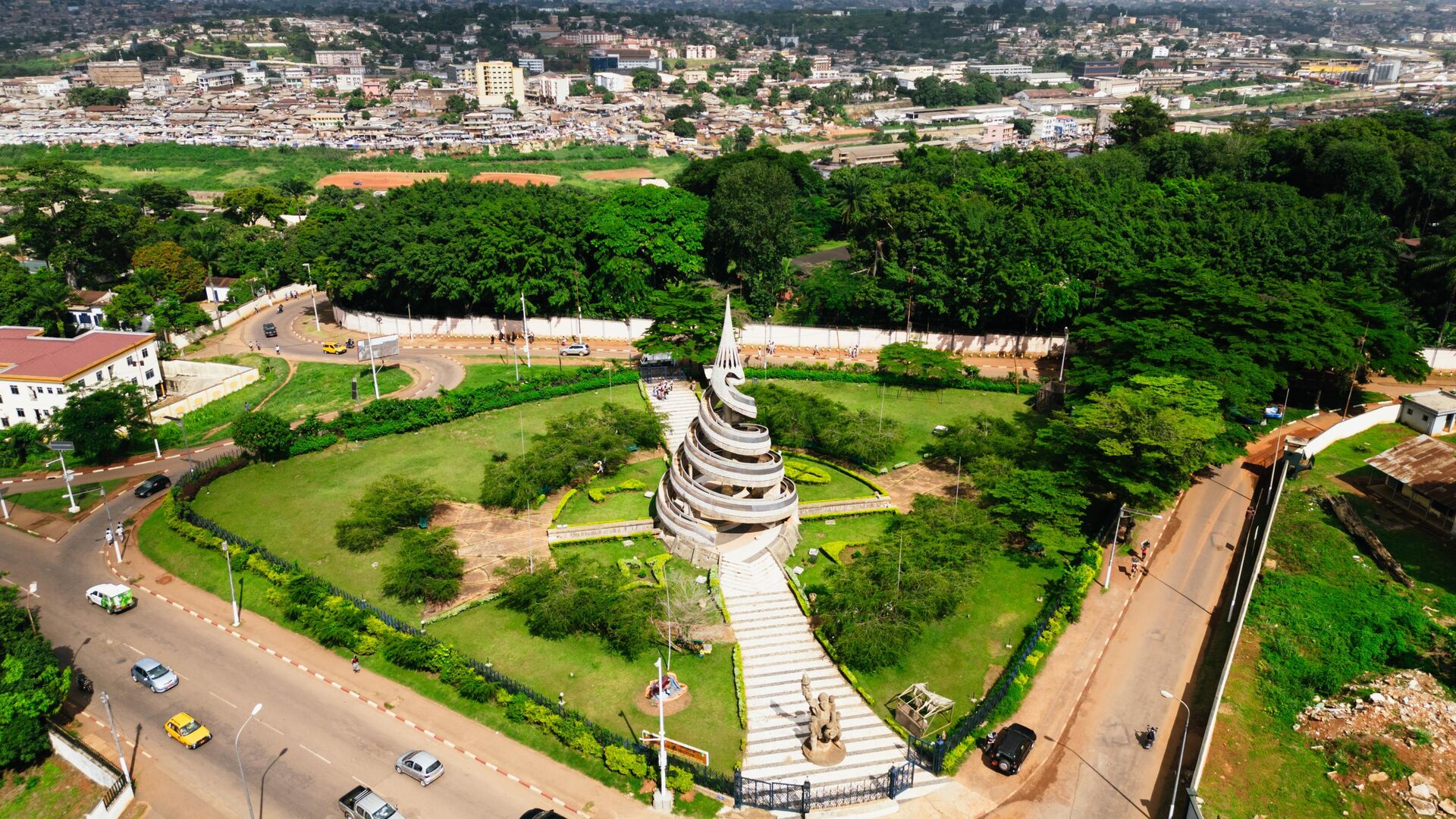
Photo: Reunification Monument Cameroon. Central Africa preserves extraordinary cultural landscapes, powerful kingdoms, rainforest traditions and museums that tell the story of one of Africa's most diverse regions.
"The forests of Central Africa have preserved more than wildlife. They have safeguarded kingdoms, cultures, languages and traditions that continue to shape the heart of the continent."
Central Africa is often introduced through its spectacular rainforests and wildlife.
The mighty Congo Basin, mountain gorillas, forest elephants and vast rivers dominate travel brochures and documentaries.
Yet behind these natural wonders lies another remarkable story.
For thousands of years, Central Africa has been home to sophisticated kingdoms, highly skilled craftsmen, traders, metalworkers, artists and communities whose traditions continue to flourish today.
The region's museums and heritage sites preserve stories of royal courts, ancient migrations, spiritual beliefs, colonial encounters, independence movements and remarkable cultural resilience.
Unlike many parts of the world where history survives mainly in monuments of stone, Central Africa's heritage often lives through people.
Traditional ceremonies, oral history, music, dance and craftsmanship remain central to community life.
To understand Central Africa is to recognise that heritage is not only something preserved behind museum glass.
It is something experienced every day.
Photo: Reunification Monument Cameroon. Central Africa preserves extraordinary cultural landscapes, powerful kingdoms, rainforest traditions and museums that tell the story of one of Africa's most diverse regions.
Many of Central Africa's greatest cultural treasures are not famous worldwide.
That does not make them less significant.
Museums throughout the region preserve archaeological discoveries, ceremonial objects, royal regalia, musical instruments, sculptures and historical records that reveal the remarkable diversity of Central African societies.
They also play an increasingly important role in protecting cultural heritage from conflict, illegal trafficking and environmental change.
Every museum tells a story.
Together, they tell the story of a region that has helped shape Africa for centuries.
Angola's history stretches far beyond its Portuguese colonial period.
Long before European ships reached its shores, powerful kingdoms flourished across the region, developing sophisticated political systems, trade networks and artistic traditions.
Today, Angola's museums preserve the stories of these early kingdoms alongside the country's long struggle for independence and national reconstruction.
Located in Luanda, the National Museum of Anthropology provides one of the finest introductions to Angola's cultural diversity.
Its collections include ceremonial masks, musical instruments, traditional clothing, hunting tools, pottery and sculptures representing communities from across the country.
Visitors quickly discover the richness of Angola's many cultures, including the Ovimbundu, Mbundu, Bakongo, Chokwe and numerous other peoples.
One of Angola's most important historical institutions is the National Museum of Slavery.
Housed in a former colonial chapel south of Luanda, it documents Angola's central role in the Atlantic slave trade.
The museum presents a respectful and often deeply moving account of one of history's darkest chapters while honouring the resilience of those whose lives were forever changed.
Northern Angola formed part of the historic Kingdom of Kongo, one of Central Africa's most influential pre-colonial states.
Founded centuries before European arrival, the kingdom developed complex systems of government, diplomacy and trade.
Its rulers established diplomatic relations with Portugal during the fifteenth century, making the Kingdom of Kongo one of the earliest African states to engage directly with Europe.
Although the kingdom eventually declined, its cultural influence continues to shape communities in Angola, the Democratic Republic of the Congo and the Republic of the Congo.
Across Angola, traditional music, dance and craftsmanship remain vibrant expressions of cultural identity.
The energetic rhythms of semba music, widely regarded as one of the ancestors of Brazilian samba, continue to celebrate community, storytelling and everyday life.
Heritage in Angola is not confined to museums.
It continues to evolve through its people.
Cameroon is often called "Africa in Miniature."
Few countries display such remarkable geographical and cultural diversity within their borders.
Rainforests, mountains, savannahs, volcanic landscapes and Atlantic coastlines provide the setting for more than 250 ethnic communities, each contributing to the country's extraordinary heritage.
Cameroon's museums reflect this diversity while preserving the traditions of powerful kingdoms, Islamic sultanates and forest communities.
Housed within the former presidential palace in Yaoundé, the National Museum introduces visitors to Cameroon's rich cultural mosaic.
Its exhibitions include archaeological discoveries, traditional royal regalia, ceremonial masks, musical instruments, historical photographs and objects representing communities from every region of the country.
The museum provides an excellent introduction to both Cameroon's ancient past and its modern nationhood.
Among Cameroon's most remarkable heritage sites is the Royal Palace of Foumban.
The palace remains the historic residence of the Sultan of Bamum and continues to serve as a centre of cultural life.
Its museum contains royal artefacts, weapons, ceremonial costumes and historical documents illustrating the remarkable history of the Bamum Kingdom.
Visitors also discover the fascinating story of Sultan Ibrahim Njoya, whose innovations included the creation of a unique writing system for the Bamum language, advances in education and efforts to preserve his kingdom's history through written records.
The Bamum Kingdom remains one of Central Africa's most celebrated traditional states.
Rather than existing only in history books, its royal institutions continue to play an important cultural role today.
Festivals, ceremonies and traditional leadership help preserve customs that have survived for centuries.
Although internationally recognised for its exceptional biodiversity, the Dja Faunal Reserve also reflects the long relationship between forest communities and their environment.
For generations, indigenous peoples have developed deep knowledge of the rainforest, demonstrating that cultural heritage and natural heritage are often inseparable.
Throughout Cameroon, festivals celebrate royal history, harvests, music and community life.
Traditional wood carving, bronze casting, weaving and beadwork continue to flourish alongside contemporary artistic expression.
Whether visiting the grasslands of the west, the northern sultanates or the coastal regions, travellers quickly discover that Cameroon's greatest museum is often the country itself.
To many visitors, Central Africa is synonymous with dense forests and extraordinary wildlife.
Yet its human story is equally remarkable.
Long before colonial borders were drawn, kingdoms flourished, trade routes connected distant communities and artisans created works of art admired across the continent.
The museums of Angola and Cameroon remind us that Central Africa's heritage is not hidden.
It simply deserves to be better known.
In the next part of this journey, we continue into the Central African Republic, Chad, the Republic of the Congo and the Democratic Republic of the Congo—countries whose museums and cultural landscapes reveal some of the richest yet least explored chapters of African history.
The Central African Republic is one of Africa's least visited countries, yet it possesses a cultural richness that deserves far greater international recognition.
Situated between the savannahs of the Sahel and the vast rainforests of the Congo Basin, the country has long served as a meeting point for different peoples, languages and trading routes.
Although political instability has affected tourism for many years, the country's heritage remains deeply rooted in its communities.
Traditional music, storytelling, wood carving, weaving and ceremonial customs continue to preserve cultural identities that have existed for generations.
Located in Bangui, the Boganda National Museum is named after Barthélemy Boganda, one of the country's most important political and independence figures.
Its collections introduce visitors to the diverse peoples of the Central African Republic through traditional masks, hunting tools, musical instruments, pottery and ceremonial objects.
The museum also documents the country's colonial history and its journey towards independence.
Unlike many destinations where heritage is centred around monumental architecture, the Central African Republic's greatest cultural treasures are found within its living traditions.
Visitors who have the opportunity to travel beyond Bangui often discover communities where music, dance and oral history remain central to everyday life.
These traditions continue to preserve knowledge that has been passed from one generation to another for centuries.
Chad occupies one of Africa's most fascinating geographical positions.
To the north lies the Sahara Desert.
To the south stretch fertile savannahs and river valleys.
Between them developed cultures that connected North Africa with Central and West Africa through trade, migration and scholarship.
The country's archaeological discoveries continue to reshape our understanding of African history.
Situated in N'Djamena, the National Museum of Chad preserves archaeological collections spanning prehistoric times to the modern era.
Visitors encounter ancient tools, pottery, sculptures, traditional weapons and ethnographic collections representing the country's many cultural communities.
The museum also highlights Chad's remarkable fossil discoveries that have contributed significantly to the study of early human evolution.
Among Chad's greatest historical achievements is the legacy of the Sao civilisation.
Flourishing for many centuries around Lake Chad, the Sao became renowned for their impressive terracotta sculptures, sophisticated metallurgy and well-organised settlements.
Although many aspects of their history remain mysterious, archaeological excavations continue to reveal the remarkable achievements of this ancient civilisation.
Recognised as a UNESCO World Heritage Site, the Ennedi Massif contains spectacular sandstone formations, ancient rock art and dramatic desert landscapes.
Thousands of prehistoric paintings and engravings illustrate the lives of communities that inhabited the Sahara when it was far greener than today.
These remarkable works provide an extraordinary window into Africa's distant past.
For centuries, camel caravans crossed northern Chad carrying salt, textiles and other goods across the Sahara.
Today, the traditions of nomadic communities continue to reflect centuries of adaptation to one of the world's most demanding environments.
The Republic of the Congo is inseparable from the mighty Congo River.
For centuries, this vast waterway has served as one of Africa's greatest transport routes, connecting communities across Central Africa.
Its history reflects powerful kingdoms, European exploration, colonial administration and vibrant modern cultures.
Located in Brazzaville, the National Museum presents archaeological discoveries alongside traditional masks, ceremonial objects, musical instruments and historical collections documenting the country's cultural diversity.
The museum highlights the traditions of communities including the Kongo, Teke and Sangha peoples.
Southern parts of the Republic of the Congo formed part of the historic Kingdom of Kongo, one of Central Africa's most sophisticated pre-colonial states.
Its influence extended across present-day Angola, the Democratic Republic of the Congo and neighbouring regions.
The kingdom developed diplomatic relations with European powers while maintaining complex political and cultural institutions of its own.
Its heritage continues to influence local traditions today.
Often described as one of Africa's most relaxed capital cities, Brazzaville preserves a number of colonial-era buildings alongside museums, churches and cultural institutions that reflect the country's modern history.
The city remains an important centre for music, literature and the arts.
The Democratic Republic of the Congo is one of Africa's largest and most culturally diverse countries.
With hundreds of ethnic communities and one of the world's greatest rainforest ecosystems, it possesses a cultural heritage of astonishing richness.
For centuries, kingdoms flourished along the Congo River while artists produced sculptures, masks and ceremonial objects that today are admired throughout the world.
Opened in Kinshasa with international support, the National Museum represents one of Africa's most modern museum institutions.
Its collections include archaeology, ethnography and contemporary cultural history.
Visitors discover royal regalia, ceremonial masks, musical traditions and everyday objects illustrating the remarkable diversity of Congolese society.
The museum also symbolises a renewed commitment to preserving the country's cultural heritage for future generations.
Like neighbouring Angola and the Republic of the Congo, parts of the Democratic Republic of the Congo formed the historic heartland of the Kingdom of Kongo.
Traditional leadership, ceremonial practices and artistic traditions connected to this remarkable kingdom continue to influence communities today.
The Kuba and Luba kingdoms produced some of Central Africa's most celebrated artistic traditions.
Wood carvings, ceremonial masks, textiles, beadwork and royal regalia reflect sophisticated political systems and remarkable craftsmanship.
Many of these artistic traditions continue to inspire contemporary African artists.
Few countries have influenced African music as profoundly as the Democratic Republic of the Congo.
Congolese rumba became one of the continent's most influential musical styles, shaping popular music across Africa and beyond.
Recognised by UNESCO as Intangible Cultural Heritage, Congolese rumba demonstrates that heritage is not limited to monuments or museum collections.
Sometimes it lives through rhythm, song and dance.
No discussion of Congolese heritage would be complete without recognising the Congo River itself.
For centuries, it has connected distant communities, carried traders and travellers, inspired stories and sustained countless cultures.
It remains both a geographical landmark and a cultural lifeline for Central Africa.
Although these four countries differ greatly in geography and history, they share several remarkable characteristics.
Their rivers have connected communities for centuries.
Their forests have protected cultures found nowhere else.
Their kingdoms developed sophisticated political systems long before colonial rule.
Their artists created masks, sculptures, textiles and ceremonial objects recognised among Africa's finest cultural achievements.
Above all, their heritage continues to live within communities rather than existing solely in museums.
Across Central Africa, history is something people continue to practise, celebrate and pass on to future generations.
Equatorial Guinea is one of Africa's smallest countries, yet its heritage reflects centuries of interaction between mainland Central Africa, Atlantic exploration and diverse cultural traditions.
The country consists of a mainland territory, Río Muni, and several islands, including Bioko and Annobón.
Its history has been shaped by the Fang people of the mainland, the Bubi communities of Bioko, the Ndowe coastal peoples and the unique Creole traditions of the islands.
Located in Malabo, the National Museum preserves collections related to the country's archaeological, ethnographic and historical heritage.
The museum introduces visitors to traditional tools, ceremonial objects, crafts and cultural traditions from Equatorial Guinea's different communities.
It provides an important foundation for understanding a country whose history has often received little international attention.
The capital, Malabo, located on Bioko Island, contains one of the best-preserved examples of Spanish colonial architecture in Central Africa.
Buildings from the colonial period reflect the island's history as a Spanish possession and its role within Atlantic trade networks.
The city's historic centre, with its cathedral, government buildings and colonial streets, provides a window into this complex past.
The Fang people represent one of the largest cultural communities in Central Africa, extending across Equatorial Guinea, Gabon and Cameroon.
Fang traditions are internationally recognised for their remarkable wooden sculpture, especially guardian figures created to protect ancestral remains.
These works influenced European artists in the twentieth century and became important sources of inspiration for modern art movements.
Bioko and Annobón preserve distinctive island cultures shaped by centuries of contact between Africa, Europe and the wider Atlantic world.
Music, language, fishing traditions and local customs continue to reflect this unique heritage.
Equatorial Guinea demonstrates that even small nations can contain extraordinary cultural complexity.
Gabon is one of Central Africa's most environmentally rich countries.
Its vast forests contain some of the most intact ecosystems on Earth, but the country's heritage extends far beyond nature.
For thousands of years, communities have developed deep relationships with the rainforest, creating traditions, artistic expressions and spiritual practices closely connected to their environment.
Located in Libreville, the National Museum of Arts, Rites and Traditions preserves an important collection of Gabon's cultural heritage.
Its exhibitions include masks, sculptures, ritual objects, musical instruments and artefacts representing the country's diverse communities.
Among the most famous artistic traditions are the masks of the Fang, Kota and Punu peoples.
Gabonese art has had a profound influence on global appreciation of African sculpture.
The refined forms of Fang masks and Kota reliquary figures demonstrate extraordinary artistic skill.
These works were collected internationally and influenced artists such as Pablo Picasso and other pioneers of modern European art movements.
However, their original meaning was not simply decorative.
Many objects were connected to ancestors, ceremonies, spiritual protection and community identity.
Before colonial rule, parts of modern Gabon were connected with the historic Kingdom of Loango.
This coastal kingdom developed important trading relationships and maintained sophisticated political structures.
Its heritage forms part of the wider history of Central African kingdoms that connected inland communities with Atlantic networks.
Recognised as a UNESCO World Heritage Site, Lopé combines exceptional natural landscapes with evidence of long human occupation.
Archaeological discoveries reveal thousands of years of interaction between people and the environment.
Ancient rock engravings, traditional knowledge and rainforest ecosystems together demonstrate that cultural and natural heritage are inseparable.
One of Gabon's most distinctive cultural traditions is Bwiti, a spiritual practice associated especially with Fang and related communities.
Through music, dance, ceremony and ancestral knowledge, Bwiti represents a deep connection between communities, nature and spiritual understanding.
While visitors should approach such traditions with respect, they provide important insight into the diversity of African belief systems.
São Tomé and Príncipe may be one of Africa's smallest countries, but its history connects Africa, Europe and the wider Atlantic world.
Located in the Gulf of Guinea, these volcanic islands developed a unique culture shaped by African traditions, Portuguese influence and centuries of plantation history.
Located within the historic São Sebastião Fortress, the National Museum presents the history of the islands from early Portuguese settlement through the plantation era and independence.
Collections include historical objects, religious art, colonial-era materials and cultural artefacts reflecting island life.
Built during the sixteenth century, São Sebastião Fortress is one of the most important historical monuments in the country.
Today it houses the National Museum and provides visitors with insight into the strategic importance of the islands during the Atlantic era.
One of São Tomé and Príncipe's most distinctive forms of heritage is the network of historic plantations known as roças.
During the colonial period, these estates became major producers of sugar, cocoa and coffee.
Many contain impressive architecture, including worker housing, administrative buildings, churches and processing facilities.
Although the plantation system was connected to exploitation and forced labour, these sites are also important historical records that help explain the country's social development.
São Tomé became internationally famous for cocoa production.
The islands' fertile volcanic soils created ideal conditions, and cocoa shaped both the economy and cultural landscape.
Today, efforts to revive high-quality cocoa production connect agricultural traditions with sustainable tourism.
The islands developed unique Creole languages, music and traditions.
São Tomé's rhythms, dances and cuisine reflect centuries of interaction between African and European influences.
The result is a culture unlike anywhere else in Africa.
Central Africa cannot be understood through borders alone.
The Congo Basin connects countries through rivers, forests, migration routes and shared cultural traditions.
The kingdoms of Kongo, Loango and other historic states demonstrate that Central Africa possessed sophisticated political systems long before colonial borders were created.
Its forests preserve ancient knowledge.
Its artists created some of Africa's most influential sculptures and masks.
Its musicians transformed African and global popular culture.
Its communities continue to protect traditions that have survived enormous historical challenges.
Central Africa is often described through what the world sees from the outside:
The rainforest.
The rivers.
The wildlife.
The challenges.
But behind those images lies another story.
A story of kingdoms and royal courts.
Of artists whose creations changed the way the world viewed African art.
Of communities that preserved knowledge through generations.
Of cultures that adapted while remaining deeply connected to their roots.
Museums across Central Africa preserve important objects and memories.
But the greatest museum is the region itself.
It exists in the songs sung along the Congo River.
In the craftsmanship of artisans.
In the ceremonies of communities.
In the languages spoken by millions of people.
To explore Central Africa is to discover one of the continent's deepest cultural landscapes.
Part of the African Independence Knowledge Series — helping visitors discover, understand and explore Africa through its history, heritage, cultures and peoples.
Continue your journey with:
We strive to unify diverse narratives from across Africa, showcasing the continent's shared heritage and unique stories.
Our mission is to honor and preserve the history of African cultures and independence movements for future generations.
We provide a platform for innovative exchange of ideas, resources, and insights, understanding that knowledge should be accessible to all.