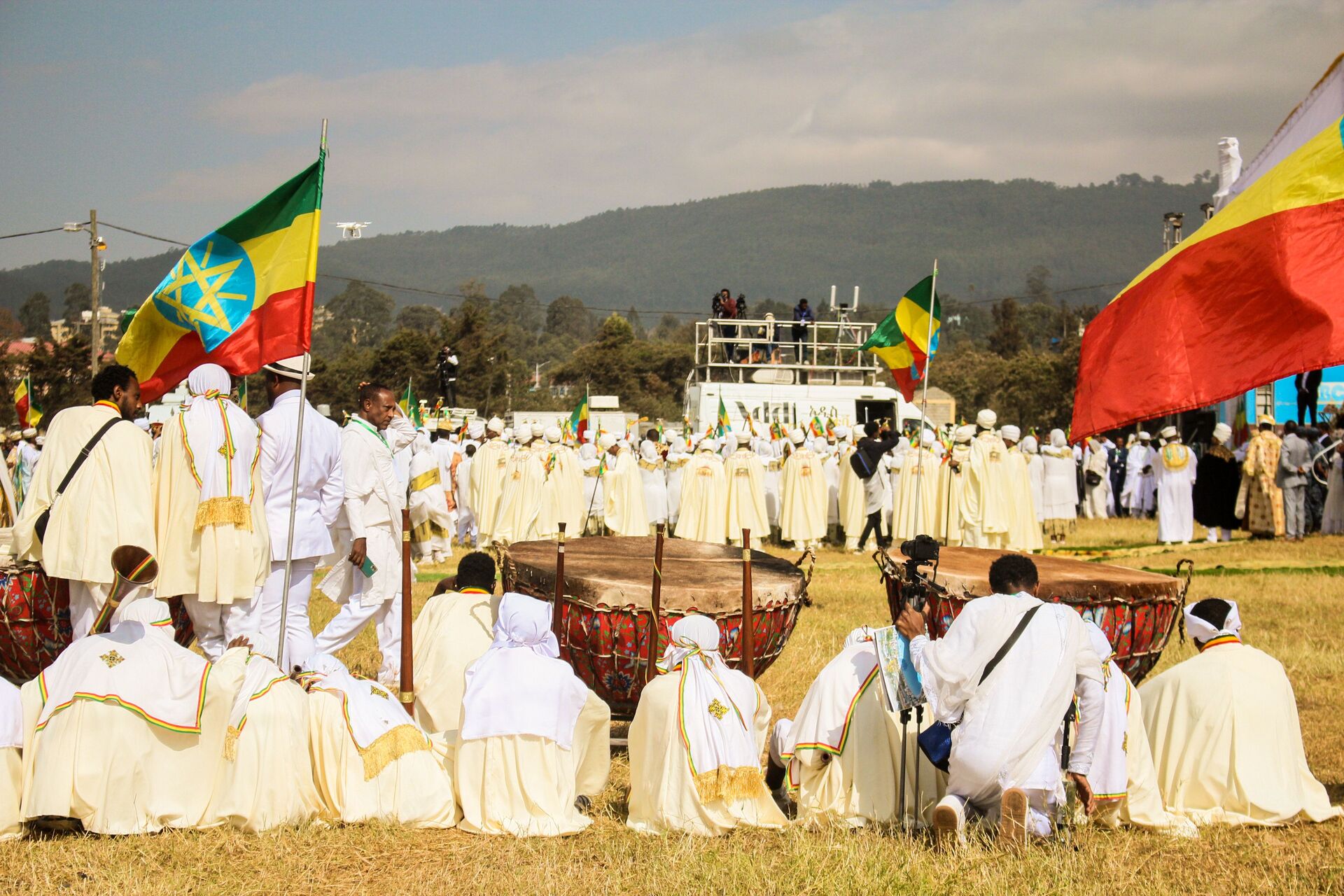
Ethiopia Meskel Festival in Addis Ababa
Liberation Day: 5 May 1941. Ethiopia is the sentence every African schoolbook contains — the one country Europe never took. It is also true, and it is also not the whole truth, because Italy did occupy it for five years, because Ethiopia's own emperors had spent the previous half-century conquering the peoples of the south, and because the sovereignty that was defended at Adwa in 1896 has spent the century since being fought over from the inside.
Every other page in this series begins with a European flag going up and ends with it coming down.
Ethiopia has no such date. There was no colonial administration to negotiate with, no constitutional conference at Lancaster House, no midnight ceremony in a stadium.
What Ethiopia has instead is 5 May 1941 — the day Haile Selassie rode back into Addis Ababa, five years to the day after the Italians had marched in. It is marked as Patriots' Victory Day, for the Arbegnoch, the patriots who never stopped fighting during the occupation.
So the country that was never colonised keeps the one thing colonised countries keep: the anniversary of the foreigners leaving.
And there is a second thing this page has to do, which most accounts of Ethiopia avoid.
Ethiopia was not only a victim of empire. It was one. The state that defended itself so famously at Adwa was, in the same decade, conquering and subjugating peoples to its own south and west, and the consequences of that are the reason Ethiopia is at war with itself in 2026.
Both things are true. This page carries both.
Ethiopia Meskel Festival in Addis Ababa
On 1 March 1896, near the northern town of Adwa, an Ethiopian army under Emperor Menelik II and Empress Taytu Betul destroyed an invading Italian force.
It was not a skirmish. Italy lost thousands of men killed and thousands more captured, in one of the worst defeats any European army suffered in Africa in the entire colonial period. Italy sued for peace and, in the Treaty of Addis Ababa, recognised Ethiopian independence.
Menelik had played the diplomacy as carefully as the battle: buying modern rifles and artillery from France and Russia for years beforehand, exploiting a deliberately mistranslated clause in the earlier Treaty of Wuchale — the Italian text of which made Ethiopia a protectorate while the Amharic text did not — and calling a national mobilisation that brought in regional rulers who had spent the previous decades fighting one another.
The effect of Adwa outside Ethiopia is difficult to overstate. It became the founding reference point of pan-Africanism and of Black consciousness movements from Lagos to Harlem to Kingston. When the Organisation of African Unity chose a headquarters in 1963, it chose Addis Ababa, and the reason was Adwa.
Ethiopia's tricolour — green, yellow, red — is the source of the pan-African colours that appear on flags from Ghana to Guinea to Senegal, on this website and on every one of these pages.
Here is the part that does not appear on the commemorative posters.
In the last quarter of the nineteenth century, Menelik II roughly doubled the territory under Ethiopian control, conquering southward and westward into lands that had never been part of the historic Abyssinian highland state: Arsi, Harar, Wolayta, Sidama, Gurage, the Ogaden, and the kingdom of Kaffa.
He did it with the same modern rifles he would later use at Adwa, and often against people who had none.
What followed the conquest was a system called gabbar: northern soldiers and settlers, the neftenya — "rifle-bearers" — were allotted land and the labour of the people already on it. Conquered populations paid tribute in grain, honey and labour to occupiers who did not speak their language. Amharic and the Orthodox Church came with the garrisons. In places the population collapsed.
Specific episodes are remembered with a precision that outsiders rarely encounter: the mutilations at Anole in Arsi, where Oromo prisoners are recorded in oral tradition as having had hands and breasts cut off, commemorated today by a monument that is itself a live political argument; the near-annihilation of the Kaffa kingdom.
This is the origin of Ethiopia's present crisis, and there is no version of the country's history that works without it. When Oromo nationalists say that Ethiopia is an empire that was never decolonised, they are not making a rhetorical flourish. They are describing the 1880s and 1890s.
And it is also why the word "colonisation" is genuinely contested in Ethiopia rather than merely debated. For Amhara nationalists, Ethiopia is a three-thousand-year state that Europe could not touch.
For Oromo and Somali and Sidama nationalists, the conquest of their grandparents happened at exactly the same time as the Scramble for Africa, with exactly the same rifles, and the only difference is that the coloniser was African.
Both groups are describing something that actually happened.
Italy came back.
Mussolini needed Adwa avenged — it was a standing humiliation in Italian politics — and he needed an empire. In October 1935 Italy invaded from Eritrea and from Italian Somaliland, without a declaration of war.
What followed was not a colonial campaign in the usual sense. Italy used aerial bombardment of towns and hospitals, and chemical weapons — mustard gas sprayed from aircraft over troops, civilians, livestock and water sources, in violation of the Geneva Protocol Italy had signed. Red Cross facilities were bombed.
Ethiopia was a member of the League of Nations.
The League debated. It imposed sanctions that excluded oil, which was the only commodity that would have mattered. Britain and France, whose Hoare–Laval plan proposed handing Mussolini most of what he wanted, were more concerned with keeping Italy away from Germany.
Addis Ababa fell in May 1936, and Haile Selassie went into exile.
On 30 June 1936 the Emperor of Ethiopia stood at the rostrum of the League of Nations in Geneva, while Italian journalists in the gallery jeered at him until they were removed.
He described the gas. He described what it did to children and to cattle and to rivers. He asked the assembled governments what answer he was to take back to his people, and he told them that what had been done to Ethiopia would be done to others, and that it was the fate of all small nations that was being decided in that room.
He was right within three years.
Ethiopia's occupation is the event that demonstrated the League of Nations did not work, and it is the hinge between the first and the second world wars. It is also the moment at which, for most of colonised Africa and for the Black diaspora, the moral claims of European international order stopped being credible at all.
Italy held the country for five years and never controlled it.
On 19 February 1937 — Yekatit 12 in the Ethiopian calendar — a grenade attack was made on the Italian viceroy, Marshal Rodolfo Graziani, in Addis Ababa. He survived.
The reprisal lasted three days. Italian soldiers, colonists and blackshirts were turned loose on the capital: houses burned with the families inside, people shot and clubbed in the streets, mass executions. Ethiopian sources put the dead at around thirty thousand; later scholarship gives figures ranging from several thousand to around twenty thousand. No reliable count exists, and the range itself is part of the history.
In May 1937, on suspicion of sheltering the attackers, Italian forces massacred the monks and deacons of Debre Libanos, the most important monastery in Ethiopia.
The educated class was targeted deliberately — schoolteachers, graduates, young intellectuals — in an attempt to decapitate a future.
And the Arbegnoch fought on: irregular bands in the highlands, ambushing convoys and garrisons, supplied by villages, with women among them — Kebedech Seyoum among the best known — and with a level of popular support that meant the Italians never held more than the towns and the roads between them.
When Italy entered the war in 1940, Ethiopia stopped being a closed Italian problem.
British and Commonwealth forces — with South African, Indian, Sudanese, Kenyan, Nigerian and Ghanaian troops among them — attacked from Sudan and Kenya. Alongside them came Gideon Force, a small unit under Orde Wingate operating with Ethiopian patriot armies inside the country.
The decisive fighting was done by a combination of Commonwealth divisions and Ethiopian irregulars who had never stopped.
On 5 May 1941, Haile Selassie re-entered Addis Ababa, five years to the day after Marshal Badoglio had entered it.
Ethiopia was the first country occupied by the Axis to be liberated.
It then had to spend the next several years getting the British to leave, which took until 1944 and was less straightforward than the official accounts suggest.
Italy's 1947 peace treaty obligations to Ethiopia were largely settled at a level far below the damage, and the wider question of reparations for the gas, the massacres and the occupation has never been properly resolved.
The Obelisk of Axum, looted in 1937 and re-erected in Rome, was promised back in 1947. It went home in 2005 and was re-erected in 2008 — sixty-eight years after it was taken. It is the single clearest object lesson in how long restitution takes when a state has to ask politely for its own property, and it belongs alongside the material still held in German museums that this network has documented elsewhere.
After the war, the fate of the former Italian colony of Eritrea was decided at the United Nations, which federated it with Ethiopia in 1952. Haile Selassie dismantled that federation piece by piece and annexed Eritrea as a province in 1962.
Thirty years of war followed, Eritrea won it, and in 1993 Ethiopia lost its entire coastline.
That decision — made by an emperor who had been restored by the anti-fascist alliance — is the direct cause of the crisis on Ethiopia's northern border in 2026. There is a full account of it on the Eritrea page, and the two pages should be read together.
By the early 1970s Haile Selassie was in his eighties, ruling a country where land tenure in the south was still essentially feudal and where a famine in Wollo in 1973 killed a very large number of people while the imperial government said nothing.
A British television documentary showed the famine to the world, intercut with palace ceremony. It destroyed him.
The army moved in creeping stages through 1974 — a committee, then a junta, then a dictatorship. The Derg deposed the emperor in September 1974. He died in custody the following year in circumstances that have never been officially explained.
Mengistu Haile Mariam emerged on top by 1977, and what followed is one of the worst episodes in twentieth-century Africa.
The Red Terror of 1977–78 was a campaign of political extermination against rival Marxist movements, students and suspected opponents, conducted by neighbourhood committees and security squads. Bodies were left in the streets with placards. Families were charged for the bullets. Estimates of those killed range widely, into the tens of thousands, with hundreds of thousands more imprisoned or displaced.
Then came the 1984 famine — a catastrophe of drought compounded, deliberately and decisively, by war and by policy: food used as a weapon in the north, forced resettlement of hundreds of thousands of people from the highlands, and villagisation. Estimates of the dead run from several hundred thousand to around a million.
It produced Band Aid and Live Aid, and it produced the image of Africa that the entire tourism and heritage side of this network has been arguing against for twenty-five years. One famine, filmed once, became the permanent visual shorthand for a continent of fifty-four countries.
Mengistu fled in May 1991 and lives in Zimbabwe. He was convicted of genocide in absentia by an Ethiopian court in 2007. He has never served a day.
The EPRDF — a coalition dominated by the Tigray People's Liberation Front, founded in 1975 as a Marxist-Leninist movement — took Addis Ababa in May 1991, in the same week the EPLF took Asmara.
Its leader, Meles Zenawi, governed until his death in 2012.
The 1995 constitution restructured Ethiopia as an ethnic federation: regional states drawn on ethno-linguistic lines, each nation and nationality granted, on paper, the right of self-determination up to and including secession.
The intention was coherent. If the imperial state had been an Amhara-dominated machine that suppressed other nations, then the answer was to give those nations their own institutions and their own languages in school and in court.
The effect was that every political question in Ethiopia became an ethnic question, that regional identity cards and regional militias became normal, and that a country of more than eighty peoples was given a constitutional vocabulary for breaking apart — while, in practice, one party from a region holding around six per cent of the population ran the whole thing for twenty-seven years.
It also fought a pointless trench war with Eritrea from 1998 to 2000 that killed somewhere between seventy and a hundred thousand people over a border village.
Years of Oromo and Amhara protest brought the EPRDF down from inside. In April 2018 Abiy Ahmed became prime minister: young, Oromo, a former intelligence officer, and initially remarkable.
He released political prisoners, unbanned opposition movements, invited exiles home, appointed a cabinet half of women, and made peace with Eritrea by accepting the border ruling Ethiopia had refused for sixteen years.
He was awarded the Nobel Peace Prize in 2019.
He also dissolved the EPRDF into a single centralised Prosperity Party, which the TPLF refused to join — and the reform agenda, read from Mekelle, looked exactly like a plan to dismantle ethnic federalism and with it Tigray's position.
Elections were postponed nationally in 2020 on pandemic grounds. Tigray held its own anyway. The federal government declared it illegal. Tigray declared the federal government's mandate expired.
On 3 November 2020 the war began.
Eritrean forces entered on the federal side — the same Eritrean army whose independence the TPLF had helped win in 1991, now fighting alongside Addis Ababa against it.
For two years Tigray was largely sealed off: communications cut, banking cut, aid restricted, and the region starved. Investigators from the United Nations, Amnesty International and Human Rights Watch documented massacres — Axum, Mai Kadra, Dengelat — mass rape used systematically as a weapon by multiple parties, ethnic cleansing in Western Tigray, and pillage. Abuses were committed by federal forces, by Eritrean forces, by Amhara militias, and by Tigrayan forces during their advance into Amhara and Afar.
Estimates of the dead run from around 300,000 to 600,000, counting those killed in fighting and those who died from the deliberate denial of food and medicine. On the higher estimates it is the deadliest war anywhere in the world this century.
The Pretoria agreement of 2 November 2022 ended the fighting. It did not settle Western Tigray, it did not bring the Eritreans out, and it did not deliver accountability for anyone.
The peace lasted about three years.
The Pretoria agreement is dead. In spring 2026 the TPLF under Debretsion Gebremichael reinstated its own pre-war regional government in Mekelle, sidelining the federally backed interim administration entirely. Tigray is outside federal control.
Amhara has been in open insurrection since 2023, when the federal government moved to dissolve the regional special forces. The fragmented Fano militias now hold most of the rural areas, with the national army largely confined to the towns and the main roads. At least twelve thousand people have been killed and vastly more displaced.
Oromia — Abiy's own region — has a continuing Oromo Liberation Army insurgency that intensified again when federal troops were pulled north.
On 1 June 2026, Ethiopia held a general election. Voting did not take place at all in Tigray, and was suspended or cancelled in dozens of constituencies in Amhara and Oromia because of the fighting. Fano had declared that anyone taking part was an enemy of the Amhara people. Abiy Ahmed's Prosperity Party won a large majority.
And the external file is worse than the internal one.
Abiy has made access to the Red Sea a declared national priority, describing it as existential, and has said publicly that Eritrea's port of Assab was lost by mistake. Senior Ethiopian officers have suggested it could be taken by force. Eritrea is backing armed factions inside Ethiopia and has been reinforcing the border. An informal alignment of Eritrea, Somalia and Egypt has formed against Addis Ababa, with Egypt's own grievance being the Grand Ethiopian Renaissance Dam on the Blue Nile, inaugurated in September 2025 after fourteen years of construction financed overwhelmingly by Ethiopians themselves.
A hundred and thirty years after Adwa, the country that proved Africa could defeat a European army is being held together by force in three of its regions at once, and preparing for a possible war with the state it used to contain.
Because it comes up constantly in the comment sections of every article about Ethiopia, and because the confusion is worth clearing up properly.
Tedros Adhanom Ghebreyesus has been Director-General of the World Health Organization since 1 July 2017, re-elected unopposed in 2022. He is a Tigrayan, born in Asmara in 1965, a biologist by training with a doctorate in community health from Nottingham, whose research was on malaria transmission in Tigray.
Three things are true and documented.
He was a senior figure in the TPLF — a member of its central committee, in a party founded in 1975 on explicitly Marxist-Leninist lines. He was a minister in the TPLF-dominated EPRDF government for eleven years: Health Minister from 2005 to 2012, Foreign Minister from 2012 to 2016. And that government's record on human rights — mass detentions, torture of opponents, the shooting of protesters, the use of anti-terrorism law against journalists — is documented by Human Rights Watch and Amnesty International across exactly those years.
Serving at cabinet level for over a decade in such a government is a matter of political responsibility, and it is entirely legitimate to hold it against him. It was raised against him during his WHO campaign in 2017, along with allegations that Ethiopia had under-reported cholera outbreaks as "acute watery diarrhoea" while he was health minister, which he denied.
What is not documented is the rest of what circulates.
He was never a soldier. He has never held any military rank or command in the Ethiopian army or anywhere else. No court, tribunal, commission of inquiry or prosecuting authority has ever charged him with any crime.
The "war criminal" claim traces to a single televised statement on 19 November 2020, in which the Ethiopian army chief of staff, General Birhanu Jula, called him a criminal and accused him of procuring weapons for the TPLF. No evidence was produced then and none has been produced since. It was made sixteen days into a war against Tedros's own region, at a moment when he was publicly calling for humanitarian access to it, by the chief of an army that international investigators would subsequently find responsible for atrocities in that same region. Tedros denied it.
Ethiopia followed up with a formal misconduct complaint to the WHO in 2022, and an Ethiopian financial-intelligence investigation opened during his re-election bid, later reported to have rested on unverified material.
So: a career politician of a former ruling party, with the political record that implies, against whom a wartime government made an uncorroborated criminal accusation while fighting his ethnic group.
That is a serious enough story without improving it. The habit of upgrading "minister in an authoritarian government" to "war criminal" is exactly the habit that makes the documented parts easier to dismiss.
Because Ethiopia is used as the closing argument in every debate about colonialism in Africa, by both sides, and almost nobody who deploys it knows what happened.
It is cited as proof that Africans could defeat Europeans — and that is true, and Adwa is one of the most important battles fought anywhere in the nineteenth century.
It is cited as proof that Africa's problems are not the fault of colonialism, since Ethiopia was never colonised and is poor and at war anyway — and that is the argument this page is built to answer, because it is wrong in an interesting way rather than a stupid one.
Ethiopia was never colonised by Europe, and Ethiopia has spent 130 years dealing with the exact same problem every colonised country deals with: a state assembled by conquest, in which some nations were incorporated by force and have never agreed that they belong. The Scramble for Africa reached the Horn in the 1880s and 1890s, and Menelik took part in it. He simply won.
The difference between Ethiopia and its neighbours is not that Ethiopia escaped the imperial century. It is that Ethiopia's empire was its own, and therefore never had anybody to hand power over to and go home.
There is a great deal to be said for Ethiopia, and it is not consolation-prize material.
Adwa happened, and it changed what people across the world believed was possible. The pan-African colours on the flags of this entire continent come from Addis Ababa, and so does the headquarters of the African Union.
Ethiopia has a written history, a script, a church and a state older than almost anything in Europe — a continuous literate civilisation, with Ge'ez manuscripts, rock-hewn churches at Lalibela, and the stelae of Axum from a kingdom that was one of the great powers of the ancient world.
It defeated fascism on its own soil and was the first Axis-occupied country in the world to be liberated, with its own irregular armies doing a substantial share of the fighting.
It has never had its land or its institutions written for it by a European ministry. Ethiopian law, calendar, alphabet and church are Ethiopian.
And for all the disasters since 1974, Ethiopia has in the last two decades done things that most of this website's other subjects have not: built a dam of that scale with domestic money, expanded health services and life expectancy dramatically, and constructed the infrastructure of a state of a hundred and thirty million people.
None of that answers Anole, or the gabbar system, or the Red Terror, or 1984, or Axum in 2021, or the twelve thousand dead in Amhara.
Two things are true. Ethiopia is the proof that Africa was never destined to be ruled by anybody, and Ethiopia is the proof that being ruled by your own is not the same thing as being free.
There is a battlefield at Adwa where a European army was destroyed by an African one, and a monument at Anole for what the same African army did eight years earlier.
There is a treaty in two languages, with a different meaning in each.
There is a speech in Geneva in June 1936 that was correct, and a hall full of governments that did nothing.
There is mustard gas sprayed from aircraft onto villages and rivers, for which nobody was ever tried.
There are three days in February 1937 in Addis Ababa with no agreed death toll.
There is an obelisk that took sixty-eight years to come home from Rome.
There is an emperor who was buried in an unmarked place, and a dictator living comfortably in Harare with a genocide conviction in absentia.
There is a constitution that gave every nation the right to leave, written by a party from a region of six per cent.
There is a Nobel Peace Prize awarded in 2019, and a war that began thirteen months later and killed somewhere between three hundred thousand and six hundred thousand people.
And there is a port called Assab, which Ethiopia gave away in 1993 and now calls existential.
Updated and fact-checked: 13 September 2026.
How this page was checked. Dates and events were verified against the sources listed above and against standard reference works on Ethiopian history. The battle of Adwa on 1 March 1896, the differing Italian and Amharic texts of the 1889 Treaty of Wuchale, the southern conquests of Menelik II and the gabbar system, the Italian invasion of October 1935 and the use of chemical weapons, Haile Selassie's address to the League of Nations on 30 June 1936, the Yekatit 12 reprisals of February 1937 and the Debre Libanos massacre, the liberation of Addis Ababa on 5 May 1941, the federation of Eritrea in 1952 and its annexation in 1962, the deposition of Haile Selassie in September 1974, the Red Terror of 1977–78, the famine of 1984–85, the EPRDF takeover of May 1991, the 1995 ethnic federal constitution, the 1998–2000 border war, the return of the Axum obelisk in 2005 and its re-erection in 2008, the appointment of Abiy Ahmed in April 2018 and the Nobel Peace Prize in 2019, the Tigray war of November 2020 to November 2022 and the Pretoria agreement, the Fano insurgency from 2023, the collapse of the Pretoria settlement in 2026, and the general election of 1 June 2026 are as recorded. Casualty figures are estimates, are disputed, and are given as ranges: the Yekatit 12 reprisals are estimated by Ethiopian sources at around 30,000 dead and by later scholarship at figures ranging from several thousand to around 20,000; the Red Terror and the 1984–85 famine are estimated in the tens of thousands and in the hundreds of thousands to around one million respectively; the 1998–2000 border war at 70,000 to 100,000; and the Tigray war at approximately 300,000 to 600,000 including deaths from the denial of food and medical care. No independent count exists for any of them. Findings of atrocities during the Tigray war are those of the United Nations, the International Commission of Human Rights Experts on Ethiopia, Amnesty International and Human Rights Watch, and concern multiple parties to the conflict — federal, Eritrean, Amhara and Tigrayan forces; the parties concerned dispute them. Both positions are recorded. Regarding Dr Tedros Adhanom Ghebreyesus: his membership of the Tigray People's Liberation Front and his service as Minister of Health from 2005 to 2012 and Minister of Foreign Affairs from 2012 to 2016 are matters of public record, as is the documented human rights record of the government in which he served. The accusation made against him by the Ethiopian army chief of staff on 19 November 2020 was made without published evidence, was denied by him, and has never resulted in any charge, indictment or finding by any court or tribunal. He has never held any military rank or command. This page makes no allegation against him or against any other living person beyond matters already on the public record.
Written and researched by Remo Kurka · africanindependence.com
We strive to unify diverse narratives from across Africa, showcasing the continent's shared heritage and unique stories.
Our mission is to honor and preserve the history of African cultures and independence movements for future generations.
We provide a platform for innovative exchange of ideas, resources, and insights, understanding that knowledge should be accessible to all.