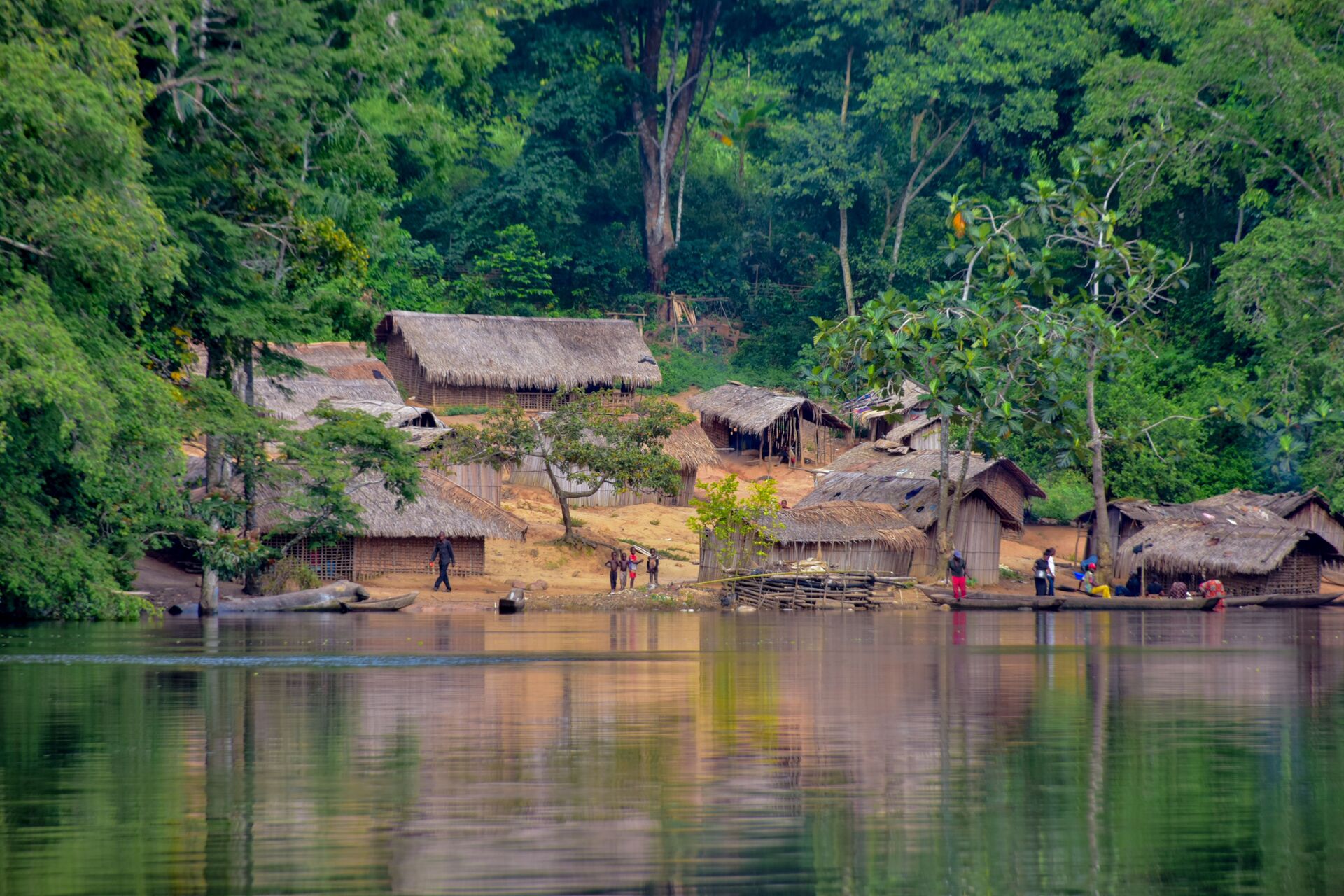
A village in Congo, near Central African Republic
Independence Day: 13 August 1960. The man who founded the country died in a plane crash sixteen months before it existed, with explosive traces in the wreckage and a report that was never published. Everything since has been decided by somebody else.
This is where the story has to start, because it explains why there was almost nothing here to inherit.
From 1899, France leased roughly two-thirds of Oubangui-Chari to about forty private concession companies, granting them near-total rights over the land and the people on it, in exchange for rent and a share of profits.
The companies collected rubber and ivory. They did it through quotas enforced by armed militias, hostage-taking of women and children, flogging, mutilation and killing. Whole regions were depopulated by a combination of violence, forced labour, famine and disease.
This was the French equivalent of what Leopold ran in the Congo, and it was happening at the same time, across the river.
It was not secret. The French writer André Gide travelled through the territory and published Voyage au Congo in 1927, describing what he had seen. There was a scandal in Paris. Some of the worst practices were reined in. The concession system itself continued in modified form.
And between 1928 and 1931 the Kongo-Wara rebellion — the war of the hoe handle — spread across the west of the territory against forced labour and taxation. It was one of the largest anti-colonial revolts in French Africa. It was crushed, and France kept the details out of public view.
France then built the Congo–Ocean railway with conscripted labour from across French Equatorial Africa, including this territory. The death toll on that project is among the worst of any colonial construction anywhere.
By 1960, the Central African Republic had almost no schools, no industry, no trained administration and no functioning economy — not because it was poor in resources, but because sixty years of extraction had taken what there was and left nothing behind.
He was born around 1910 at Bobangui to a family of subsistence farmers. He was raised by Catholic missionaries and in 1938 became the first African Roman Catholic priest in Oubangui-Chari.
In November 1946 the missions sponsored him as a candidate for the French National Assembly. He won, against the administration's preferred candidate, and went to Paris as the territory's deputy.
What he found there radicalised him. He saw the gap between the French Republic's stated principles and what its companies were doing on the Ubangi, and he began saying so publicly and repeatedly.
In 1949 he founded MESAN — the Movement for the Social Evolution of Black Africa — and later that year he left the priesthood. He married a Frenchwoman, Michelle Jourdain, in 1950.
His popular support was unmatched by any political figure in the four colonies of French Equatorial Africa. He was anti-colonial without being doctrinaire, and he negotiated with administrators and businessmen when it got him what he wanted.
Here is the part that almost nobody outside the country knows.
A village in Congo, near Central African Republic
Boganda did not want the Central African Republic.
He wanted a United States of Latin Africa — a single federation of Chad, Gabon, Middle Congo and Oubangui-Chari, and eventually of the Portuguese and Belgian territories too. His argument was that the small equatorial territories, taken separately, would be economically unviable and politically defenceless, and that only a large unified state could be genuinely independent.
He was right, and it did not happen. Gabon and Congo refused; they had oil and a port and saw no reason to share. France had no interest in a single strong bloc where it could have four dependent ones.
So on 1 December 1958, Boganda declared the establishment of the Central African Republic — the name he had chosen for the federation, applied now to Oubangui-Chari alone.
He designed the flag himself, and it is the only flag on the continent that says what it means. Four horizontal bands — blue, white, green, yellow — combining the colours of France with the pan-African colours, and a single red vertical stripe cutting through all four, standing for the blood common to everyone and binding Europe and Africa together.
A former priest designing a flag as an argument.
Boganda boarded a light aircraft to fly back to Bangui.
The plane came down. Everyone aboard was killed. He was forty-eight.
On 7 May 1959 the Paris weekly L'Express reported that experts had found traces of explosive in the wreckage.
The French high commissioner in Bangui banned the sale of that edition in the territory.
A full report on the crash was never published.
Suspicion has attached itself, for sixty-seven years, to three quarters: expatriate businessmen from the Bangui chamber of commerce, whose interests Boganda threatened; the French secret service; and his estranged wife, who had taken out a large life insurance policy on him days before the flight, and from whom he was reportedly planning to separate and return to the priesthood.
Nothing has ever been established. This page will not choose between them.
What can be said is this: the founder of the Central African Republic died sixteen months before it came into existence, in an aircraft that may have carried a bomb, and the colonial power suppressed the magazine that reported it and never released the investigation.
Boganda is a national martyr in his own country, and essentially unknown outside it.
David Dacko, a member of the government who claimed a family relationship to Boganda, took over. He was acceptable to Paris.
The Central African Republic became independent on 13 August 1960, with France retaining a role in trade, defence and foreign relations.
Dacko made MESAN the only legal party in 1962, ran unopposed in 1964, filled the state with supporters on salaries the country could not pay, and had the economy near bankruptcy by 1965.
Abel Goumba, who had been Boganda's actual political heir and had briefly served as acting premier after the crash, founded an opposition party and watched it banned.
The army commander, Colonel Jean-Bédel Bokassa, took power on New Year's Eve — the Saint-Sylvestre coup.
He abolished the 1959 constitution, dissolved the National Assembly, and placed all legislative and executive power in his own hands. Accounts of the coup record that he killed his principal rival personally, stabbing him with his own sword.
On 4 March 1972 he made himself president for life.
Bokassa held French citizenship. He had served twenty-three years in the French army, in Indochina among other places, and had been decorated. France knew exactly who he was, and backed him for thirteen years.
On 4 December 1976 Bokassa abolished the republic and declared the Central African Empire, with himself as Emperor Bokassa I.
The coronation took place a year later in Bangui, modelled explicitly on Napoleon's. There was a two-tonne gilded throne in the shape of an eagle. There was a crown with thousands of diamonds. There were sixty Mercedes limousines and horses flown in from Normandy, and the ceremonial was supplied by French couturiers and jewellers.
The cost has been estimated at a very large fraction of the state's annual revenue, in one of the poorest countries on earth.
France co-funded and co-organised it.
That sentence deserves to sit on its own. The French Republic — the republic of 1789, which had removed its own emperor — helped pay for and stage the coronation of an African emperor in 1977, in a country whose people had no schools and no clean water.
Almost no foreign head of state attended. France sent a minister.
In January and April 1979 there were protests in Bangui, initially by schoolchildren and students, against a decree requiring pupils to buy uniforms — from a company owned by the Bokassa family.
Children were arrested and taken to Ngaragba prison. Around a hundred of them were killed there.
An international commission of inquiry established by African jurists investigated and found Bokassa personally implicated in the killings.
That is what ended it. Not the emperorship, not the executions of adults, not thirteen years of rule by decree. Dead schoolchildren, and an inquiry that could not be ignored.
France removed him.
Operation Caban, and the longer Operation Barracuda that followed, flew French paratroopers into Bangui while Bokassa was abroad in Libya, and installed David Dacko — the man Bokassa had overthrown thirteen years earlier — back in the presidency.
French troops then remained to keep Dacko there until 1981.
Read the sequence once more. France backed Bokassa, helped crown him emperor, and then removed him by military operation and put back the president he had deposed. At no point was any Central African asked.
There is a coda.
The satirical paper Le Canard enchaîné revealed that Bokassa had given diamonds to Valéry Giscard d'Estaing, the French president, during his visits to Bangui. Giscard's evasive handling of the affair became a national scandal in France and contributed materially to his defeat by François Mitterrand in 1981.
A French president lost an election partly because of gifts from the emperor his government had helped to crown.
Bokassa returned to the country in 1986, was tried, was sentenced to death, had it commuted, was released in 1993, and died in 1996.
Dacko was overthrown in 1981 by André Kolingba, who ruled for twelve years.
Ange-Félix Patassé won the country's first genuinely competitive election in 1993 and was overthrown in 2003 by François Bozizé, his own former army chief of staff.
Bozizé ruled for a decade.
By the count in the international literature, the Central African Republic has had five successful coups and several attempted ones since independence. Until 1997, France maintained two permanent military bases in the country with 1,400 troops.
In 2013 an alliance of mostly Muslim armed groups from the neglected north-east, calling itself the Séléka, took Bangui and drove out Bozizé. Its leader Michel Djotodia became the country's first Muslim head of state, and quickly lost control of his own fighters.
Bozizé's supporters and local self-defence groups organised as the anti-balaka — "anti-machete" in Sango — and began reprisals.
What followed was among the worst episodes of communal violence anywhere in Africa this century. Villages were burned. Mosques and churches were destroyed. Muslim quarters of Bangui were razed. Populations that had lived together for generations were separated by force.
A United Nations Commission of Inquiry in 2014 concluded that abuses committed by the anti-balaka amounted to ethnic cleansing of the country's Muslim community.
More than 800,000 people were displaced. The economy contracted by 37 per cent in a single year.
Djotodia resigned in January 2014. Catherine Samba-Panza, a lawyer and mayor of Bangui, was appointed interim president — the country's first female head of state. The UN mission MINUSCA deployed in April 2014.
Faustin-Archange Touadéra, a mathematics professor and former prime minister, was elected in early 2016.
He took office controlling less than a third of his own country.
In 2020, with a presidential election approaching, Bozizé was barred from standing on the grounds of UN sanctions and an outstanding arrest warrant for crimes against humanity. He joined a new rebel alliance, the Coalition of Patriots for Change, which advanced on Bangui.
Touadéra won the election with about forty per cent of the country's regions unable to vote at all.
On 13 January 2021 the rebels attacked the capital and were beaten back — by government forces, MINUSCA, Rwandan troops, and the Wagner Group.
Russian mercenaries had been in the country since 2018, initially training the army. After 2021 they became a counter-insurgency force and, in practice, the president's personal guard.
The arrangement is security in exchange for mineral concessions. Gold and diamonds. Companies linked to the Russian operation hold mining rights across the country.
And the record includes atrocities. During operations in the north-east in March 2022, Russian personnel and allied forces are reported to have killed dozens of fighters and possibly hundreds of civilians — artisanal miners, herders and camel drivers from Chad, Niger, Sudan and the Central African Republic — and displaced thousands more.
In 2023 a new constitution removed presidential term limits.
And in March 2026, after Touadéra travelled to Moscow to meet Vladimir Putin, the Russian presence was formally consolidated under the direct oversight of the Russian Ministry of Defence — replacing Wagner with a state structure, on the same terms. Security for the government, minerals for Russia.
Armed groups remain active, particularly along the borders.
Because the Central African Republic is the purest example of the thing this website keeps finding: a country that has never been allowed to decide anything.
France leased two-thirds of it to private companies before it existed. The man who founded it died in an aircraft with explosive traces in it, and the investigation was never published. France installed his successor, backed the officer who overthrew him, helped pay for that officer's coronation as emperor, removed him by paratroop drop when he became embarrassing, reinstalled the first president, and kept troops in the country until 1997.
And now the presidential palace is guarded by Russians who are paid in gold and diamond concessions, under an arrangement renewed in Moscow six months ago.
Sixty-six years of independence, and the actors have changed while the structure has not.
The structure does not do the killing on its own.
Bokassa was Central African. He killed the children at Ngaragba. The Séléka fighters who burned churches were Central African. The anti-balaka who cleansed Muslim quarters of Bangui, whom the UN found had committed ethnic cleansing, were Central African. Bozizé, who took power by coup and then joined an armed rebellion when he was barred from an election, is Central African.
And Touadéra chose Moscow. Nobody imposed Wagner on him; he invited them, because they would do what MINUSCA would not, and because they cost him nothing that he had to pay in money.
The most defensible summary is that colonialism destroyed the state's capacity to exist, and Central Africans have since made choices inside that wreckage — some of them monstrous. Both halves are required. A version with only the first is propaganda; a version with only the second is the thing this website exists to argue against.
There is a flag designed by a priest to mean that European and African blood are the same, flying over a country protected by foreign mercenaries.
There is a plan for a United States of Latin Africa that would have made this country part of something large enough to defend itself, refused in 1958 by neighbours who had oil.
There is an unpublished French report on an aeroplane that came down in March 1959.
There is a two-tonne gilded eagle throne, bought with money the country did not have, at a coronation France helped to organise.
There is a prison in Bangui where about a hundred schoolchildren were killed for protesting about uniforms.
There are mineral concessions signed with a foreign ministry of defence.
And there is a country of around five and a half million people, sitting on gold, diamonds and uranium, which is among the poorest on earth.
Updated and fact-checked: 9 September 2026.
How this page was checked. Dates and events were verified against the sources listed above. Boganda's ordination in 1938, his election to the French National Assembly in November 1946, the founding of MESAN, the declaration of the Central African Republic on 1 December 1958, his death in the crash of 29 March 1959, independence on 13 August 1960 under David Dacko, Bokassa's coup of 1 January 1966, his declaration as president for life in March 1972 and as emperor in December 1976, the coronation of December 1977 with French co-funding and co-organisation, the killing of schoolchildren at Ngaragba in 1979 and the international inquiry that followed, the French Operations Caban and Barracuda of September 1979 onwards, the coups of 1981 and 2003, the Séléka capture of Bangui in 2013, the 2014 United Nations finding of ethnic cleansing against the anti-balaka, the deployment of MINUSCA in April 2014, Touadéra's election in 2016 and re-election in 2020, the battle of Bangui on 13 January 2021, the 2023 removal of term limits and the March 2026 consolidation of the Russian presence under Russian Ministry of Defence oversight are as recorded. Responsibility for Boganda's death has never been established: traces of explosive were reported in the wreckage by L'Express in May 1959 and that edition was banned in the territory, no official report was published, and suspicion has been directed at expatriate business interests, the French secret service and Boganda's wife without proof in any direction. This page names those suspicions as unresolved and does not adjudicate between them. Casualty and cost figures are given without precise numbers where none can be verified: no reliable figure exists for deaths under the concession system, and published estimates of the 1977 coronation's cost vary widely. Reports of civilian deaths during Russian-supported operations in 2022 rest on survivor testimony and investigative reporting and are denied by the parties concerned. Readers should verify the current political position independently; this page reflects the situation as reported to early 2026. This page makes no allegation against any living person beyond matters already on the public record.
Written and researched by Remo Kurka · africanindependence.com
We strive to unify diverse narratives from across Africa, showcasing the continent's shared heritage and unique stories.
Our mission is to honor and preserve the history of African cultures and independence movements for future generations.
We provide a platform for innovative exchange of ideas, resources, and insights, understanding that knowledge should be accessible to all.