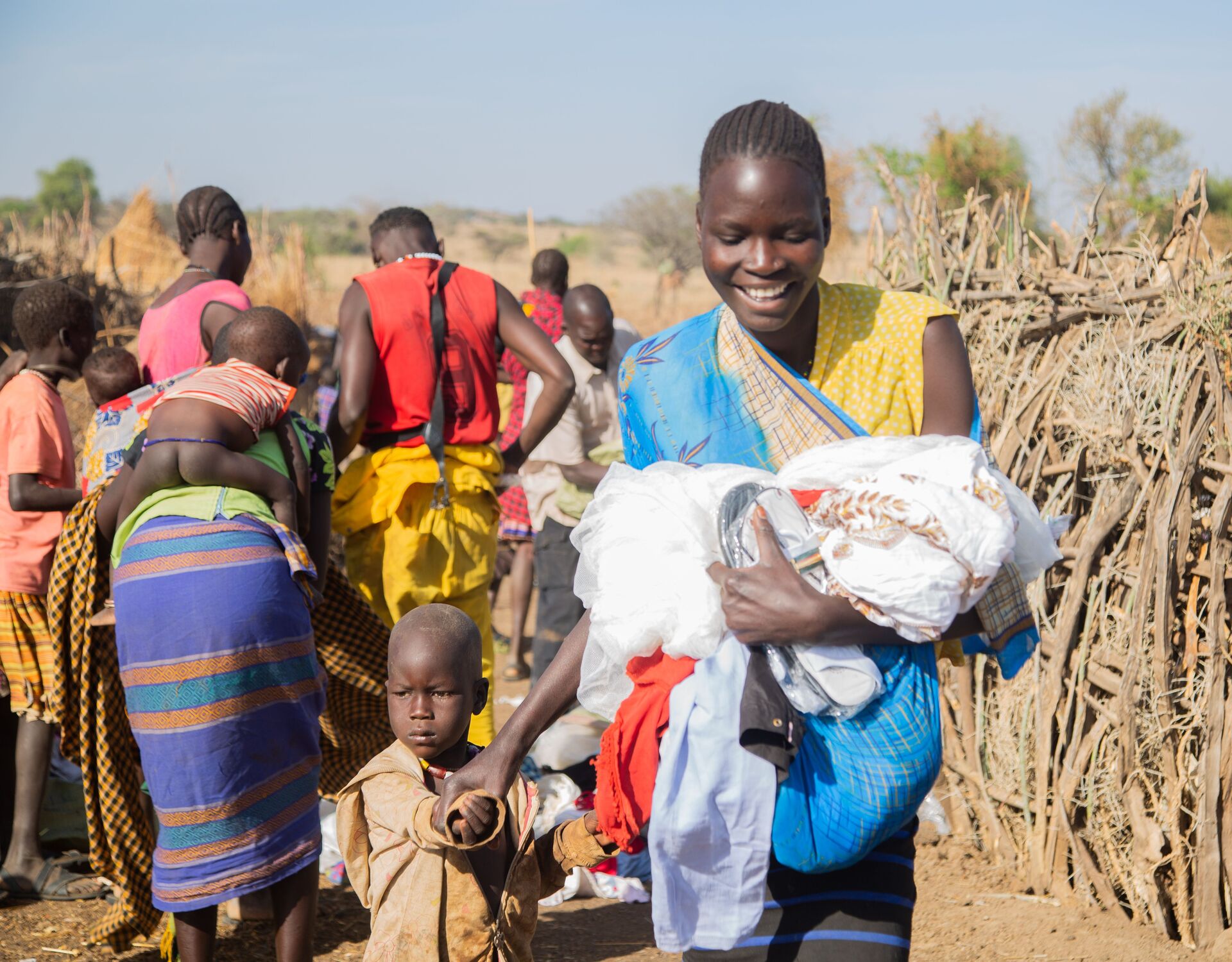
South Sudan, rural area and the people
Independence Day: 9 July 2011. South Sudan is the youngest country in the world. Its capital is Juba, on the White Nile. It became independent after half a century of war with the government in Khartoum and a referendum in which almost 99 per cent voted to leave Sudan. Two and a half years later, its own leaders started a civil war. In the fifteen years since independence, it has never held a national election.
Most countries on this website became independent from a European power. South Sudan became independent from another African country.
It is also the only country on this site whose independence was won almost within living memory of every adult reading this, supported by nearly the whole world, and celebrated as proof that Africa's colonial borders could be changed peacefully when a people truly wanted it.
And it is the country where that celebration turned fastest into catastrophe.
The men who had fought Khartoum for decades took less than thirty months to start killing each other's people.
The south of what became Sudan is the land of the Nilotic peoples, above all the Dinka and Nuer, cattle herders of the great Nile swamps, the Sudd. Alongside them live the Shilluk, whose kingdom has had a line of kings (the Reth) for centuries, the Azande of the western forests, the Bari around Juba, and more than sixty other peoples.
For most of history the Sudd, one of the largest wetlands on earth, protected the south from the north. Boats could barely get through it.
South Sudan, rural area and the people
In 1821 the army of Ottoman Egypt conquered northern Sudan. In the decades that followed, traders from Khartoum pushed south along the Nile once the Sudd was opened.
What they brought was the slave trade. Armed trading companies built fortified camps across the south, raided villages for ivory and people, and sold the captives north to Egypt and the Arabian peninsula. The most powerful of the traders, Zubayr Rahma Mansur, ruled a private empire in Bahr el Ghazal.
This is the deepest root of South Sudan's story. For the peoples of the south, the north was first known as the place the slave raiders came from. That memory never left.
After the Mahdist state was destroyed in 1898, Britain ruled Sudan from 1899, nominally jointly with Egypt, as the Anglo-Egyptian Condominium.
The British governed the north and south almost as two separate countries. Under the Southern Policy, formalised in 1930, northern traders were kept out of the south, Arabic and Islam were discouraged, and Christian missionaries ran what little schooling existed, in English and local languages. The south was left with almost no development at all.
Then, in 1947, at the Juba Conference, Britain reversed course and decided that north and south would become one country. Southern leaders had little say.
When jobs were handed over to Sudanese officials in the run-up to independence, northerners took nearly all of the posts in the south. Southerners concluded that one set of foreign rulers was being replaced by another.
On 18 August 1955, soldiers of the Equatoria Corps mutinied at Torit. The mutiny was put down, but it is usually counted as the start of the First Sudanese Civil War.
Sudan became independent on 1 January 1956. For the south, it was not an independence but a change of masters.
Successive Khartoum governments pushed Arabic and Islam in the south and expelled the foreign missionaries in 1964. The southern guerrilla movement, Anyanya, fought on through the 1960s.
In 1972 the Addis Ababa Agreement ended the war. The south received its own regional government in Juba. Around half a million people are estimated to have died in the seventeen years of fighting.
In 1978 the American company Chevron found oil in the south, near Bentiu. From that moment the south was no longer only a poor periphery to Khartoum. It was where the money was.
In 1983 President Jaafar Nimeiri dissolved the southern regional government, redrew the boundaries to move the oil fields north, and imposed Islamic law across Sudan.
In May 1983 southern troops mutinied at Bor. Colonel John Garang, sent to put down the mutiny, joined it instead. He founded the Sudan People's Liberation Movement and Army (SPLM/A).
Garang did not, at first, fight for southern independence. He called for a united, secular, "New Sudan" for all its marginalised peoples. Many of his fighters simply wanted to be free of Khartoum.
The Second Sudanese Civil War, from 1983 to 2005, was one of the longest and deadliest wars of the late twentieth century. Around two million people are estimated to have died, most of them from famine and disease, and around four million were displaced.
Khartoum armed northern militias, the murahaleen, which raided the south and, in a return of the nineteenth century, took women and children as slaves. It bombed villages and used food as a weapon. Famine in Bahr el Ghazal in 1988 killed an estimated quarter of a million people.
Thousands of boys, separated from their families, walked for months to refugee camps in Ethiopia and then Kenya. The world came to know them as the Lost Boys of Sudan.
The SPLA was no liberation army of saints. It recruited child soldiers, abused civilians and ran its areas by force.
And in 1991 the movement split. Riek Machar, a Nuer commander, broke from Garang, a Dinka. In November 1991 Machar's forces, together with the Nuer White Army, attacked Bor, Garang's home area, and killed around 2,000 Dinka civilians. Garang's forces carried out revenge killings of Nuer. Machar later apologised for Bor, in 2011. The split between Dinka and Nuer at the top of the movement is the fault line along which the country would later break.
On 9 January 2005, in Kenya, the SPLM and Khartoum signed the Comprehensive Peace Agreement. The south got autonomy, a share of the oil money, and a promise: after six years, it could vote on independence.
John Garang became First Vice President of Sudan. On 30 July 2005, three weeks after taking office, he died in a helicopter crash. His deputy, Salva Kiir Mayardit, a Dinka commander, took over.
With Garang died the dream of a "New Sudan." Kiir, and most of the south, wanted to leave.
From 9 to 15 January 2011 southerners voted. The turnout was enormous. 98.83 per cent voted for independence.
On 9 July 2011 the Republic of South Sudan was proclaimed in Juba. Sudan's president Omar al-Bashir, wanted by the International Criminal Court for crimes in Darfur, attended and recognised the new state. On 14 July South Sudan became the 193rd member of the United Nations.
It was one of the most hopeful days in modern African history. It was also the day South Sudan's hardest problems began.
South Sudan began its life with:
In January 2012, in a dispute over pipeline fees, South Sudan shut down its own oil production, cutting off almost all of its own income. In April 2012 its army seized the Heglig oil field from Sudan, and the two countries came close to full war.
Money meanwhile disappeared. In 2012 Kiir himself wrote to dozens of officials asking them to return billions of dollars in stolen funds.
In July 2013 Kiir dismissed his entire cabinet, including Vice President Riek Machar, who had announced he would challenge him for the party leadership.
On 15 December 2013 fighting broke out in Juba between soldiers loyal to Kiir and those loyal to Machar. Within days, government forces and allied militias were going house to house killing Nuer civilians in Juba. Machar fled and formed the SPLM-in-Opposition.
The war spread across the country. In Bor, Malakal and Bentiu, towns changed hands repeatedly, and each time civilians were massacred. In April 2014 opposition forces killed hundreds of people in Bentiu, many of them in a mosque and a hospital, while a radio station broadcast calls for revenge.
The fighting followed ethnic lines, Dinka against Nuer, but it was driven from the top, by two men and the networks around them.
Tens of thousands of people fled into United Nations bases, which became cities in their own right. A study for the London School of Hygiene and Tropical Medicine estimated that around 380,000 people died as a result of the war between 2013 and 2018. In 2017 famine was declared in parts of Unity State.
A first peace agreement was signed in 2015. Machar returned to Juba as First Vice President in April 2016.
In July 2016, as the country marked its fifth independence day, fighting broke out again in Juba. Machar fled on foot, pursued by helicopter gunships, all the way to the Democratic Republic of Congo. Government soldiers stormed the Terrain hotel compound and raped and beat foreign aid workers, and murdered a South Sudanese journalist, while UN peacekeepers nearby did not come.
A second agreement, the Revitalised Agreement (R-ARCSS), was signed in September 2018. In February 2020 Machar was once again sworn in as First Vice President in a unity government.
The core of that agreement, the joining of the rival forces into one national army, a permanent constitution, and elections, was never carried out.
In April 2023 war broke out in Sudan between its army and the Rapid Support Forces. South Sudan, the country that had fled Sudan, suddenly became a refuge for people fleeing it: more than a million people, returning South Sudanese and Sudanese refugees, crossed south. The fighting also disrupted the pipeline on which South Sudan's entire budget depends.
This is the part of the page that is still happening.
In March 2025 fighting broke out in Nasir, in Upper Nile State, between government forces and the White Army, a Nuer militia aligned with Machar's movement. The government accused Machar of orchestrating the attack. He was placed under house arrest, other senior opposition leaders were detained, and the SPLM-IO split. Machar and seven co-accused are now on trial in Juba on charges including murder, treason and crimes against humanity. His party calls the charges a political witch-hunt and the court a kangaroo court. The Machar trial has been marred by due process concerns, with some of the accused saying in statements read in court that they had been kidnapped rather than lawfully arrested.
The consequences go far beyond one man. The Council on Foreign Relations sums it up: the arrest of Machar collapsed the unity government entirely, reignited a conflict that has displaced hundreds of thousands, and pushed the country toward full-scale famine. A UN inquiry found that South Sudan's leaders are "systematically dismantling" the 2018 peace agreement.
Machar sometimes appears in court in a cage. The government has resisted international calls to release him.
Elections. South Sudan's first national elections were due in 2015. They were postponed to 2018, to 2021, to 2024, and now to December 2026. The government says the vote will be held on 22 December 2026 and that there will be no more extensions. Machar's party took no part in the consultations that set that date. Its acting chairman has warned that anyone who comes to register voters or campaign in its territory will be treated as a prisoner of war, adding that the country is at war.
In September 2026 the cabinet approved legal amendments for the vote. The day before, the UN Commission on Human Rights in South Sudan reported that the country lacked many of the safeguards and conditions for peaceful and credible polls, an assessment the government rejected. Analysts at the Institute for Security Studies now argue that credible elections are no longer possible, and warn that Machar, if released, could threaten Kiir's plan to extend his time in power.
Salva Kiir has been president since before the country existed. Since independence, no one in South Sudan has ever voted for a national government.
And South Sudan has also been used by others. In 2025 the United States deported men from several other countries to South Sudan, a country none of them came from, as the Eswatini page on this site also records.
Because South Sudan is the hardest test of what independence means.
Every argument in favour of its independence was right. The south had been raided for slaves from the north, neglected by the British, handed to Khartoum without consent, and then bombed, starved and enslaved again for half a century. Almost 99 per cent of its people voted to leave. Few independences anywhere have been more clearly willed by the people.
And yet independence did not bring freedom. It brought a new government that stole its oil money, a civil war fought along ethnic lines, and a president who has never faced a vote.
The lesson is not that South Sudan should not have become independent. The lesson is that a flag does not build a state, and that a liberation army does not automatically become a government.
There is a great deal of blame to go around, and it has to be shared honestly.
Khartoum and its allies: the raids of the nineteenth century, the broken Addis Ababa Agreement, the bombing and the slave-taking of the 1980s and 1990s, and the oil wars were the work of northern governments. Omar al-Bashir's government armed militias against civilians for years.
Britain: it kept the south undeveloped for half a century, then handed it to the north in 1947 with little regard for what southerners wanted.
The oil companies and their host governments, from Chevron to later Asian and Canadian partners, operated in areas cleared of their populations by force during the second war.
The international community: the United States, Britain and Norway championed South Sudan's independence, poured in money, and then looked away while that money was stolen. In 2016 UN peacekeepers failed to protect civilians and aid workers who were being attacked close to their bases.
But the war since 2013 was started by South Sudanese leaders, against South Sudanese. The massacres in Juba in December 2013 were carried out by government forces. The massacre in Bentiu in April 2014 was carried out by opposition forces. The Bor massacre of 1991 was carried out by a faction led by the same man who is on trial today. The theft of the public money that should have built schools and roads was carried out by the new country's own elite. And the elections that were due in 2015 have been postponed four times by the government in Juba, not by anyone in Khartoum or Washington.
South Sudan's people were betrayed first by Khartoum, then by the world, and most painfully by the men who had fought in their name.
There is the Sudd, still one of the largest wetlands on earth.
There are the old trading camps of the nineteenth-century slave raiders, long gone, and the memory of them, which has not gone.
There is a grave in Juba, where John Garang was buried in 2005, three weeks into the peace he had negotiated.
There are the ballots of January 2011, almost all of them marked for separation.
There is a planned new capital at Ramciel, announced soon after independence, which was never built.
There are UN camps that became towns, and towns that were destroyed three times.
There is a first vice president, in a cage, in a courtroom in Juba.
And there is a date, 22 December 2026, set for the first election in the country's history, in a country whose largest opposition movement says it is at war.
Updated and fact-checked: 17 September 2026.
How this page was checked. Recent events were verified against the sources listed above; the historical record was checked against standard reference works on Sudan and South Sudan. The Egyptian conquest of 1821, the Anglo-Egyptian Condominium from 1899, the Southern Policy of 1930, the Juba Conference of 1947, the Torit mutiny of 18 August 1955, Sudanese independence on 1 January 1956, the Addis Ababa Agreement of 1972, the discovery of oil in 1978, the Bor mutiny and founding of the SPLM/A in 1983, the SPLA split and Bor massacre of 1991, the Comprehensive Peace Agreement of 9 January 2005, the death of John Garang on 30 July 2005, the referendum of January 2011, independence on 9 July 2011, UN membership on 14 July 2011, the outbreak of civil war on 15 December 2013, the peace agreements of 2015 and 2018, the unity government of February 2020, the Nasir fighting and Machar's arrest in March 2025 and the scheduled elections of 22 December 2026 are as recorded. Casualty figures are estimates and are given as approximate where they are disputed: deaths in the First Civil War (around half a million); deaths in the Second Civil War (around two million) and displacement (around four million); deaths in the 1988 Bahr el Ghazal famine (around 250,000); deaths in the Bor massacre of 1991 (around 2,000); and deaths attributable to the 2013–2018 war (around 380,000, from the London School of Hygiene & Tropical Medicine estimate). The charges against Riek Machar are recorded as charges; his party rejects them, and no verdict had been reached at the time of writing. This page makes no allegation against any living person beyond matters already on the public record.
Written and researched by Remo Kurka · africanindependence.com
We strive to unify diverse narratives from across Africa, showcasing the continent's shared heritage and unique stories.
Our mission is to honor and preserve the history of African cultures and independence movements for future generations.
We provide a platform for innovative exchange of ideas, resources, and insights, understanding that knowledge should be accessible to all.