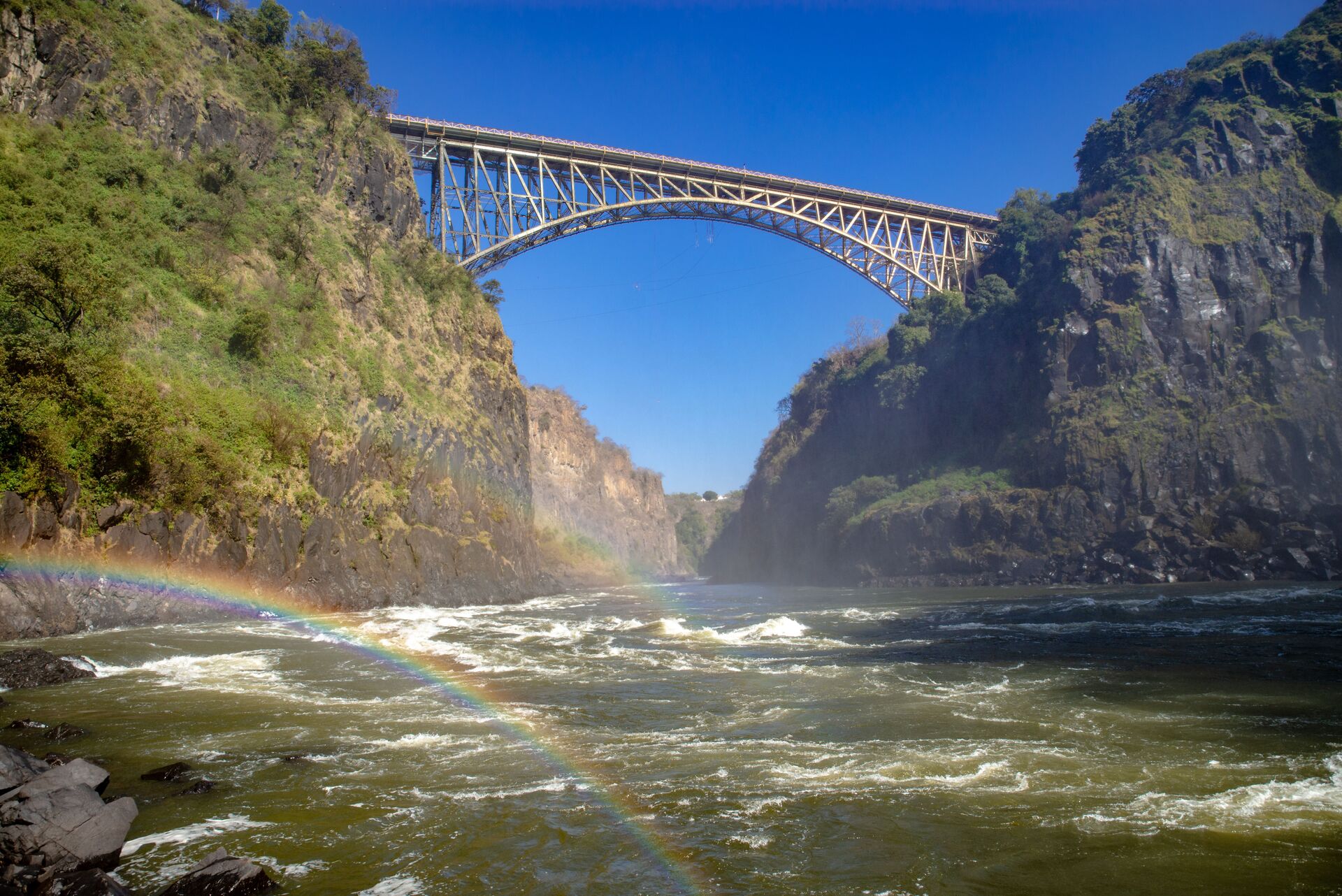
Zambia, Victoria falls bridge
Independence Day: 24 October 1964, from Britain. The capital is Lusaka; before 1935 the colonial capital was Livingstone, beside Victoria Falls. Zambia took its name from the Zambezi. At independence it was one of the richest countries in Africa, with a higher income per head than South Korea, because it sat on one of the greatest copper deposits on earth. Within twenty years it was one of the most indebted countries in the world. And unlike almost every country on the pages either side of this one, it has thrown out sitting presidents at the ballot box, three times, and the losers went home.
This website is full of countries where independence was followed by a coup, a war, or a family that never left.
Zambia has had none of that. No successful coup in sixty-two years. No civil war. Seven presidents, and three of them removed by voters while in office.
What Zambia has instead is the other African story, the economic one: a country that was handed a single enormous asset and then discovered that a single asset is not an economy. Everything on this page runs on copper, including the politics.
The land between the Zambezi and the Congo watershed has been settled for thousands of years, and the rock art at Kasama and elsewhere is far older than that.
By the eighteenth and nineteenth centuries it held a set of strong states. The Lozi kingdom, or Barotseland, on the Zambezi floodplain, moved its whole capital by boat each year as the river rose, a ceremony, the Kuomboka, still performed today. The Bemba of the north, the Lunda of Kazembe on the Luapula, the Chewa, the Tonga of the south, and, arriving in the 1830s from the Zulu wars, the Ngoni.
Long-distance trade ran in both directions: copper and ivory out toward the Indian Ocean through Swahili and Portuguese traders, with slaving raids following the same routes into the interior.
David Livingstone saw the falls the Lozi called Mosi-oa-Tunya, the smoke that thunders, in 1855 and renamed them for his queen. He died in 1873 at Chitambo in what is now Zambia. His African companions, Chuma and Susi, buried his heart under a tree there and carried his body more than a thousand miles to the coast so it could be shipped to England. Westminster Abbey has the body. Zambia has the heart.
Zambia, Victoria falls bridge
Zambia is one of the few countries in Africa that was colonised, at first, not by a government but by a company.
Cecil Rhodes's British South Africa Company obtained concessions across the region in the 1890s, including from the Lozi king Lewanika, who signed in the belief he was buying protection from his enemies and would keep his kingdom. The company got mineral rights over a territory the size of western Europe.
The BSAC ran Northern Rhodesia until 1924, when the Colonial Office took over. Then, in the late 1920s, prospectors proved the depth of the Copperbelt, and the territory's purpose was settled: it would produce copper for Britain, mined by African labour under white supervision.
The colour bar was absolute. Africans did the underground work and were barred from skilled jobs. They lived in company compounds, were paid a fraction of white wages, and were taxed to force them into the mines. Strikes in 1935 and 1940 were put down with rifles, and miners were killed.
Copper from these mines armed Britain in the Second World War. Almost none of the profit stayed.
In 1953 Britain merged Northern Rhodesia, Southern Rhodesia and Nyasaland into the Federation of Rhodesia and Nyasaland.
Officially this was economic partnership. In practice Northern Rhodesia's copper revenue was used to develop white-ruled Southern Rhodesia, and Africans across all three territories saw the Federation as a device to extend white minority rule northward. One federal politician described the partnership as that of the horse and its rider.
Opposition was led by the Zambia African National Congress and then the United National Independence Party (UNIP) under Kenneth Kaunda, a teacher's son from Lubwa mission. The Cha-cha-cha campaign of civil disobedience in 1961 made the territory ungovernable.
The Federation was dissolved at the end of 1963. On 24 October 1964 Northern Rhodesia became the Republic of Zambia, with Kaunda as its first president.
Zambia in 1964 had reserves in the bank, the second largest copper industry in the world, and income per head above that of South Korea, Egypt or Turkey.
It also had, in the whole country, about a hundred university graduates and a few hundred Africans with secondary education, because the colonial system had not trained any. Almost everything technical was run by expatriates.
Kaunda built schools and clinics fast, and made a genuine attempt at a national identity: One Zambia, One Nation, in a country of more than seventy language groups, and it largely worked. Zambia has never had a serious ethnic war, and that is not an accident.
In 1969 he nationalised the copper mines. Then, in 1975, the copper price collapsed while the oil price soared. Government revenue fell by more than half in a year. The state kept the mines running and borrowed to do it.
By the 1980s Zambia was among the most indebted countries on earth relative to its size. Food subsidy cuts demanded by the IMF produced riots in 1986 and 1990, and people were killed.
Kaunda's government also became a one-party state, in 1972, and used detention without trial. But it did not massacre its opponents, and this has to be said plainly: for all his economic failures, Kenneth Kaunda did not kill people to stay in power, which cannot be said of most of his contemporaries.
Zambia's other cost was deliberate, and Zambians paid it knowingly.
Lusaka became the headquarters of southern Africa's liberation struggle. The ANC of South Africa had its external headquarters here for decades. ZAPU and ZANU of Rhodesia, SWAPO of Namibia and the movements of Angola and Mozambique all operated from Zambian soil.
The retaliation came. Rhodesian and South African forces raided camps and houses in and around Lusaka, and bombed bridges and infrastructure.
In 1973 Zambia closed its border with Rhodesia, cutting off its own main export route for copper, and paid for it in lost revenue. To escape dependence on white-ruled neighbours, China built the TAZARA railway to Dar es Salaam, completed in 1975.
When people ask what African solidarity ever cost anybody, Zambia is the answer.
Here is the part of the record that deserves far more attention than it gets.
In 1991 Kenneth Kaunda allowed multi-party elections, lost decisively to the trade unionist Frederick Chiluba, and handed over power. Africa had very few such examples at the time.
Chiluba's government privatised the copper mines at the end of the 1990s, in deals widely criticised as far too cheap and too generous on tax. He also tried for a third term in 2001, and Zambian civil society, churches and his own party stopped him. He was later the subject of a major corruption judgment in a London civil court, though he was acquitted at home.
Then Levy Mwanawasa (2002–08), who surprised everyone by pursuing his own predecessor for corruption and who died in office; Rupiah Banda (2008–11), voted out after one term; Michael Sata (2011–14), who died in office; and for a few months Guy Scott, Sata's vice president, the first white head of state in sub-Saharan Africa since the end of white minority rule anywhere in the region.
Edgar Lungu governed from 2015 to 2021, and that period was harder: opposition rallies blocked, a newspaper shut down, and in 2017 the opposition leader Hakainde Hichilema jailed for four months on a treason charge, arising from his motorcade failing to give way to the president's, before the charge was dropped.
In August 2021 Lungu lost and Hichilema won, at his sixth attempt, with 59 per cent. Lungu accepted the result and left. It was Zambia's third removal of a sitting government by vote.
Hichilema inherited a country that had just made history in the wrong way: in November 2020 Zambia became the first country in the pandemic era to default on its sovereign debt.
Much of that debt was owed to Chinese lenders and to private bondholders, and much of it had been borrowed for roads and airports whose costs were never properly explained.
His government restructured it, slowly and painfully, reached agreements with official creditors and bondholders, and got growth going again. Copper output has been rising, the Lobito Corridor railway to the Atlantic is being rebuilt with American and European money, and an enormous new deposit at Mingomba, found by a company backed by well-known technology investors, may be one of the biggest copper finds in decades.
And then the sky closed. The drought of 2024 was the worst in a century. Lake Kariba, which supplies most of Zambia's electricity, fell so low that the turbines nearly stopped. Households and businesses went without power for most of the day, for months. The maize harvest failed.
In February 2025 a tailings dam at a Chinese-owned mine collapsed, sending millions of litres of acidic waste into a stream feeding the Kafue, the river on which a large share of Zambians depend for water and fish. Crops died along the banks. Around 176 farmers later filed an enormous claim against the companies involved.
It is the same argument as galamsey in Ghana, on an industrial scale and with a corporate name on the gate: the mineral leaves, the water stays poisoned, and the people who lose their farms are told they are an unfortunate side effect of investment.
Edgar Lungu died in Pretoria on 5 June 2025, aged 68.
What followed says more about Zambian politics than any manifesto.
The government wanted a state funeral in Lusaka and burial at the site reserved for former heads of state. The family said his wish was to be buried in South Africa and that Hichilema was to come nowhere near his body.
A private burial in Johannesburg was halted by a court injunction hours before it was due to begin. In August 2025 the High Court in Pretoria ruled for the Zambian government, holding that a former president's personal wishes could not outweigh the state's right to honour him with a state funeral. A further family appeal was rejected in September 2025.
Then, on 23 June 2026, South Africa's Supreme Court of Appeal overturned that ruling and found for the family.
The body had been in a South African mortuary for more than a year while two courts, a government and a family argued about it. The rivalry between two men outlived one of them.
This is the most recent chapter.
Zambia voted on 13 August 2026. Hichilema, in his seventh run for the presidency, faced thirteen candidates, the main one being Brian Mundubile of the Tonse Alliance.
The count did not go smoothly. The Electoral Commission suspended counting nationwide on 14 August, citing violence against polling staff and the theft of marked ballot papers, before resuming.
On 18 August the Commission declared Hichilema the winner with 2,965,326 votes, 60.49 per cent, against 1,856,217, or 37.87 per cent, for Mundubile, a margin of more than 1.1 million and clear of the 50 per cent threshold, so no run-off was needed. His party took 136 of the 226 contested seats.
Two numbers stand out. Turnout fell by more than thirteen points to 57.23 per cent. And Hichilema's share barely moved from 2021, while the opposition consolidated.
After polling day, authorities arrested nearly a dozen people, including senior opposition figures, in a raid the government linked to militia activity around the election. Mundubile's party denied the allegations. The opposition has raised concerns about the conduct of the vote, and the argument about whether Zambians are feeling any of the recovery is now the central political question.
Under the two-term limit, this is Hichilema's final term. What he does with it, and whether he leaves at the end of it, is the thing to watch.
Because Zambia separates two things that are usually confused: political freedom and economic sovereignty.
Politically, Zambia is one of the successes of this continent. Voters have removed governments they were tired of, and the losers have gone. That is rarer in the world than people think, and far rarer in this series.
Economically, Zambia has never been sovereign at all. In 1964 the copper was owned by a company; in 1969 it was nationalised; in the 1990s it was sold off cheaply; today it is largely foreign-owned again, with Chinese, Canadian and other investors, and new corridors being built to carry it out faster.
Sixty-two years after independence, the country's fate still depends on the price of one metal, set in London and Shanghai, and on whether it rains enough to turn the turbines at Kariba.
For Britain and Rhodes: Northern Rhodesia was colonised by a company for its minerals, run under a colour bar that barred Africans from skilled work, and left at independence with almost no trained Zambians. The Federation of 1953 used northern copper money to build up a white-ruled colony to the south.
For Kenneth Kaunda: he kept the country together and refused to become a killer, and he also built a one-party state, detained opponents, and presided over an economic collapse that took a generation to recover from.
For the privatisation years: the mines were sold in deals that gave Zambia very little when copper prices recovered. Zambians watched a boom happen to their country without happening to them.
For the lenders: the borrowing spree of the 2010s was made possible by creditors who asked few questions, and the default of 2020 was paid for by Zambians in cut services and a collapsed currency, not by anyone who arranged the loans.
For the mining companies operating now: the tailings dam that failed in 2025 poisoned a river that millions rely on. The response, so far, has been a lawsuit rather than a prosecution.
And for Zambia's current politics: arresting opposition figures after an election, whatever the stated grounds, is exactly how the slide begins in the countries on either side of this page. Zambia's record is good. It is not a guarantee.
There is a tree at Chitambo where Livingstone's heart was buried, and two men, Chuma and Susi, who carried the rest of him a thousand miles.
There is a concession signed by Lewanika in the belief that he was keeping his kingdom.
There is the Copperbelt, where miners were shot in 1935 and 1940.
There is a phrase from the Federation years about the partnership of the horse and its rider.
There is a date, 24 October 1964, when Zambia was richer per head than South Korea.
There are the ANC's old offices in Lusaka, and the bomb damage from the raids that answered them.
There is the TAZARA railway, built so that copper would not have to travel through white-ruled Africa.
There is the default notice of November 2020.
There is a tailings dam on a stream that feeds the Kafue.
There is a mortuary in South Africa that held a former president of Zambia for more than a year.
And there is a ballot box, which in this country has actually worked three times, and which fewer people bothered to use in August 2026 than in 2021.
Updated and fact-checked: 18 September 2026.
How this page was checked. Recent events were verified against the sources listed above; the colonial and post-independence history was checked against standard reference works on Zambia and southern Africa. Livingstone's death at Chitambo in 1873, the Lewanika concession of 1890, BSAC rule to 1924, the opening of the Copperbelt, the miners' strikes of 1935 and 1940, the Federation of 1953 and its dissolution at the end of 1963, the Cha-cha-cha campaign of 1961, independence on 24 October 1964, the nationalisation of the mines in 1969, the one-party state of 1972, the closure of the Rhodesian border in 1973, the completion of TAZARA in 1975, the food riots of 1986 and 1990, Kaunda's defeat and handover in 1991, the privatisation of the mines, the failed third-term bid of 2001, the presidencies of Mwanawasa, Banda, Sata, Scott and Lungu, Hichilema's imprisonment in 2017 and election in 2021, the sovereign default of November 2020, the drought of 2024, the tailings dam collapse of February 2025, the death of Edgar Lungu on 5 June 2025 and the court rulings of August 2025, September 2025 and 23 June 2026, and the election of 13 August 2026 with its declared results of 18 August are as recorded. Comparative income figures for 1964 are drawn from standard historical estimates and are indicative rather than exact. The post-election arrests are recorded as reported, with the government's stated grounds and the opposition's denial both noted. The claim against the mining companies over the 2025 dam collapse is a civil claim that had not been decided at the time of writing. This page makes no allegation against any living person beyond matters already on the public record.
Written and researched by Remo Kurka · africanindependence.com
We strive to unify diverse narratives from across Africa, showcasing the continent's shared heritage and unique stories.
Our mission is to honor and preserve the history of African cultures and independence movements for future generations.
We provide a platform for innovative exchange of ideas, resources, and insights, understanding that knowledge should be accessible to all.