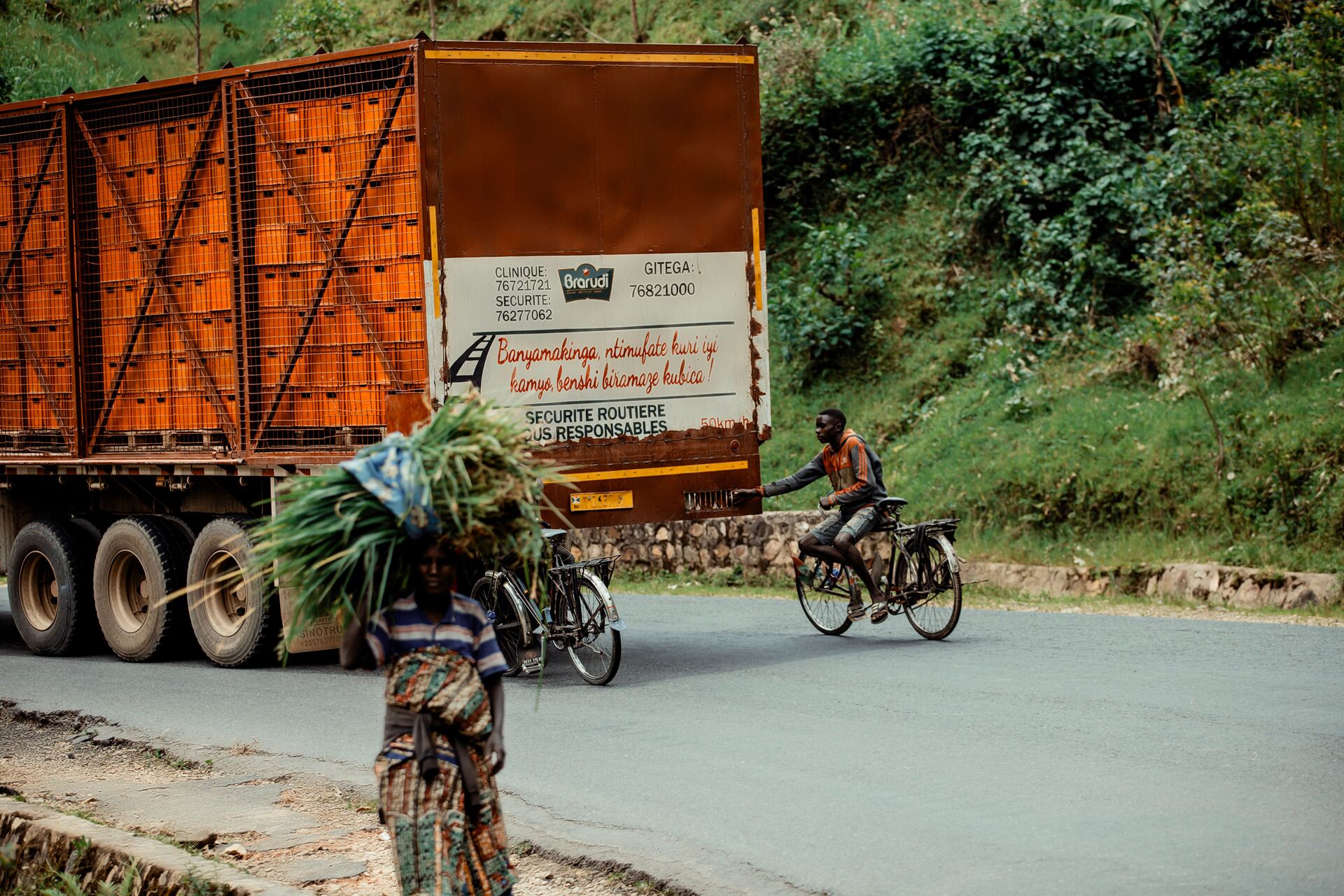
Cyclist holding on to a truck, rural road and a woman walking with a load, Congo DRC
Independence Day: 30 June 1960. For twenty-three years before it was even a colony, this country was the private property of one European man — who never once visited it. Everything that has happened since is downstream of that.
The other one — the Republic of the Congo, Congo-Brazzaville — was French, has about six million people, and has its own page on this site.
This one is the Democratic Republic of the Congo. Congo-Kinshasa. Formerly Zaire. It was Belgian. It has around a hundred million people, and it is the size of Western Europe.
The two capitals face each other across the river.
The territory held several substantial pre-colonial states: the Kingdom of Kongo in the west, the Luba and Lunda empires in the south and centre, and others.
The Kingdom of Kongo was not a village confederation. It had a capital, a court, provinces, taxation, and a foreign policy. Its ruler converted to Christianity in the 1490s. It exchanged ambassadors with Portugal and with the Vatican. Its nobility learned to read and write Portuguese.
And in 1526, King Afonso I of Kongo — Nzinga Mbemba — wrote to the King of Portugal to protest that Portuguese traders were depopulating his kingdom by buying and stealing his subjects, that even members of noble families were being seized and sold, and that he wanted the trade stopped.
His letters survive. They are among the earliest African documents of protest against the Atlantic slave trade, written by a Christian monarch to a fellow Christian monarch, in Portuguese, five hundred years ago.
Portugal ignored him.
Hold that letter in mind, because the pattern in it — an African ruler formally objecting to the extraction of his country's most valuable resource, in writing, to Europeans who do not reply — repeats on this page four more times across five centuries.
In 1885, at the Berlin Conference, the European powers recognised a claim that had no precedent and has had none since.
The territory was not awarded to Belgium. It was awarded to Leopold II personally.
The Congo Free State was the private possession of an individual — a European monarch acting as a sovereign in his own right over a territory eighty times the size of his own country.
He never went there. Not once, in twenty-three years.
He called it a humanitarian and civilising enterprise, financed the venture on credit, and needed it to pay.
First it paid in ivory. Then the bicycle and the motor car created a global demand for rubber, and the Congo had wild rubber vines.
Cyclist holding on to a truck, rural road and a woman walking with a load, Congo DRC
Villages were assigned quotas. Agents of the state and of the concession companies enforced them.
The method was hostage-taking. Soldiers of the Force Publique would seize the women and children of a village and hold them until the men brought in the rubber. Failure to meet quota was punished with the chicotte, a hippopotamus-hide whip, and with killing.
And because ammunition was expensive and had to be accounted for, soldiers were required to produce a severed right hand for every cartridge fired, to prove it had not been wasted on hunting.
Which produced, predictably, a trade in hands — cut from the living when the shot had missed, cut from the dead, smoked to preserve them, brought in in baskets.
The photographs exist. They were taken by missionaries, and they became the first mass-circulated atrocity photographs in history.
What happened next is one of the few genuinely hopeful things on this page.
A Liverpool shipping clerk named E. D. Morel noticed something in the manifests. Ships were going to the Congo full of guns and chains and coming back full of rubber and ivory. Almost no trade goods were going in. There was no commerce — only extraction and weapons.
He worked out what that meant, left his job, and started a campaign.
In 1903 the British government sent its consul, Roger Casement, to investigate. His report of 1904 was detailed, specific and impossible to dismiss.
Morel and Casement founded the Congo Reform Association, and it became the first mass international human rights movement of the modern era — public meetings, lantern-slide shows of the photographs, pamphlets, parliamentary pressure across Europe and America. Mark Twain and Arthur Conan Doyle wrote for it. Joseph Conrad, who had captained a steamer on the river, had already written Heart of Darkness.
It worked. In 1908 the Belgian parliament, under overwhelming international pressure, took the Congo away from its own king and annexed it as a colony.
Leopold burned the archives of the Free State before handing over. The furnaces ran for days.
He died in 1909, one of the richest men in Europe.
And Roger Casement, who had exposed him, was hanged by Britain in 1916 for his part in the Irish republican movement. The man who documented the Congo atrocities was executed for treason by the state that had sent him to document them.
This is genuinely disputed and this page will not pretend otherwise.
The most widely cited figure is around ten million, roughly half the population, over the Free State period — popularised by Adam Hochschild's King Leopold's Ghost and derived from a comparison of population estimates.
Other historians argue the baseline population figures are too unreliable to support it, and propose lower totals or a wider range, and emphasise that much of the mortality came from disease and famine caused by the collapse of food production, sleeping sickness spread by forced movement, and a falling birth rate — rather than from direct killing.
What is not disputed: the population fell catastrophically, the system was based on hostage-taking and mutilation, it was run for the private profit of one man, and it was stopped only because of an international campaign.
There has never been a trial, a commission, or a formal Belgian apology of the kind other European states have offered for other crimes. Belgium's king expressed regret in 2020 for the suffering caused. Regret is not acknowledgement of the thing itself.
From 1908 to 1960 the Belgian Congo was run on a doctrine of paternalism, in partnership between the colonial state, the Catholic Church and the mining companies — above all Union Minière du Haut Katanga.
Belgium provided primary education and rural clinics on a scale better than many neighbouring colonies, and called itself a model.
What it did not provide was any African who could run anything.
There was essentially no African higher education until the mid-1950s. At independence, in a country of thirteen or fourteen million people, the number of Congolese university graduates is usually given as somewhere between sixteen and thirty.
There was not one Congolese officer in the Force Publique. Not one. The entire officer corps was Belgian.
There were no Congolese doctors, engineers, magistrates or senior administrators.
That was not neglect. It was policy — an explicit judgement that political consciousness should be prevented by withholding the education that produces it.
One more thing came out of Katanga.
The mine at Shinkolobwe produced uranium ore of a richness found nowhere else on earth — in some samples over sixty per cent, against fractions of a per cent elsewhere.
The uranium in the bombs dropped on Hiroshima and Nagasaki came from this country.
It was shipped out by Union Minière, and the Congolese who dug it were told nothing about what it was or what it did.
The Congo helped end the Second World War, and fifteen years later it could not staff its own army.
In January 1959 riots in Léopoldville caught Belgium completely unprepared. Within weeks Brussels went from a published plan envisaging independence in perhaps thirty years to setting a date eighteen months away.
On independence day King Baudouin gave a speech praising Leopold II as the founder of the Congolese state and describing Belgian rule as a civilising work that the Congolese should not squander.
Patrice Lumumba, the elected prime minister, was not scheduled to speak. He spoke anyway, and told the King, in front of the world, what Belgian rule had actually consisted of.
That afternoon is covered in full in our article on Lumumba. What matters here is the sequence that followed, and how fast it was.
5 July 1960 — the Force Publique mutinies against its all-Belgian officer corps. Belgian civilians panic. Belgium sends troops without the new government's consent.
11 July 1960 — Katanga secedes under Moïse Tshombe, with Belgian troops, Belgian officers and the active support of Union Minière. Katanga holds the copper, the cobalt, the uranium, and around forty per cent of national revenue.
8 August 1960 — South Kasai secedes under Albert Kalonji. South Kasai is the largest diamond producer in the world.
A country six weeks old had lost both provinces that paid for it, to secessions financed and armed from outside.
Lumumba asked the United Nations for help to end the secessions. The UN sent a force, and then declined to use it against the secessionists on the grounds that this was an internal Congolese matter.
So he asked the Soviet Union — and that request was all Washington and Brussels needed.
He also sent the army into South Kasai, where large numbers of Luba civilians were killed. That episode is real, it is part of his record, and it was used against him immediately.
14 September 1960 — Colonel Joseph-Désiré Mobutu, thirty years old, seizes control and announces he is neutralising all politicians.
17 January 1961 — Lumumba is shot in the Katangan bush and his body is destroyed with acid.
18 September 1961 — Dag Hammarskjöld, Secretary-General of the United Nations, dies when his aircraft comes down at Ndola in Northern Rhodesia, on his way to ceasefire talks with Tshombe.
That crash has never been satisfactorily explained. The United Nations reopened the investigation decades later, and successive appointed experts have reported that the possibility of external attack cannot be excluded and that certain member states have still not released their records. The General Assembly has kept the inquiry formally alive.
A murdered prime minister and a dead Secretary-General, in the same country, in the same year, over the same secession.
January 1963 — the Katanga secession is finally ended by UN military force.
1964–65 — the Simba rebellion, in Lumumba's name, takes Stanleyville and much of the east. It is put down with white mercenaries under Mike Hoare, Belgian paratroopers dropped from American aircraft, and Cuban exile pilots flown by the CIA.
Che Guevara came in 1965 with a Cuban column to help the rebels, spent seven months in the east, concluded the movement was not serious, and left.
24 November 1965 — Mobutu's second coup. This one lasts thirty-two years.
Mobutu's rule has its own article on this site. In summary: the country renamed Zaire, the authenticité campaign, kleptocracy refined into a system of government, the palace complex at Gbadolite with a runway built for Concorde, an unknowable personal fortune, and Western backing throughout because he was anti-communist and sat on strategic minerals.
Twice, in 1977 and 1978, invasions from Angola nearly finished him, and twice French and Belgian paratroopers — with American logistics — saved him.
By 1990 the Cold War was over and so was his usefulness. Western support dried up, the army went unpaid and looted the capital, and the state stopped functioning in almost every respect except the collection of money.
In 1994, genocide in Rwanda killed around 800,000 people in a hundred days.
When the RPF took Kigali, roughly 1.2 million Hutu refugees crossed into eastern Zaire — and among them, in the camps, were the army and militias that had carried out the genocide, still armed, still organised, and now using UN-supplied camps on the border as a base to attack Rwanda.
This is the hinge. Everything in the eastern Congo since 1996 runs from it.
In 1996, Rwanda and Uganda backed a Congolese front, the AFDL, under Laurent-Désiré Kabila, and invaded. They crossed the country and took Kinshasa in May 1997. Mobutu fled and died in Morocco four months later.
During that advance, tens of thousands of Hutu refugees — including large numbers of women and children who had nothing to do with the genocide — were hunted and killed across the Congo.
A United Nations Mapping Report published in 2010, cataloguing more than six hundred serious incidents in the Congo between 1993 and 2003, stated that these killings, if proven before a competent court, could be characterised as crimes of genocide.
No such court has ever been convened. Nobody has been prosecuted.
In 1998 Rwanda and Uganda turned on Kabila, the man they had installed.
What followed drew in nine African countries — Angola, Zimbabwe and Namibia fighting for Kinshasa; Rwanda, Uganda and Burundi against it — plus dozens of armed groups. It is called Africa's World War, and it was the deadliest conflict anywhere on earth since 1945.
The most cited estimate, from the International Rescue Committee, is 5.4 million dead — the overwhelming majority from disease, hunger and collapse of health care rather than combat. The methodology has been criticised and lower figures argued for; nobody disputes that the toll runs into the millions.
And in the middle of it, in 2000, Rwanda and Uganda — allies — fought each other three times in the streets of Kisangani, a Congolese city hundreds of kilometres inside the Congo, over control of the diamond trade. Hundreds of Congolese civilians were killed in fighting between two foreign armies over Congolese stones.
16 January 2001 — Laurent Kabila is shot dead in his office by one of his own bodyguards. His son Joseph Kabila, aged twenty-nine, takes over.
A transitional settlement followed in 2003, and in 2006 the Congo held its first free elections in more than forty years.
Joseph Kabila governed until 2019. When his second term ended in 2016 he simply stayed, postponing the election for two years while protests were suppressed.
The election finally held in December 2018 produced the country's first transfer of power between presidents without a coup or a death — and almost nobody believes it was clean. Leaked electoral data and the Catholic Church's own parallel count both indicated that Martin Fayulu had won, and that a deal had been struck to install Félix Tshisekedi instead.
In May 2025 the Congolese parliament lifted Kabila's immunity, and he now faces accusations of supporting the rebellion in the east — which he denies.
The war in the eastern Congo has never stopped.
M23 — a mostly Congolese Tutsi armed group, which UN experts have repeatedly documented as being supported and commanded by Rwanda, and which denies it — took Goma in 2012, was defeated in 2013, and came back in 2021.
In January 2025 it captured Goma, a city of two million people. In February 2025 it took Bukavu. Two provincial capitals, in six weeks.
Around 5.2 million people are displaced in the east — 1.6 million of them in 2025 alone. Between October 2025 and February 2026 the UN human rights office documented 2,560 violations affecting 6,760 victims, and said the real figure was certainly far higher.
And since May 2026, on top of the war, there has been an Ebola outbreak across Ituri and the Kivus, including in territory the rebels control. By September 2026 the confirmed case count had passed six thousand, with close to three thousand dead. Containment is being attempted across a front line.
On 27 June 2025, the foreign ministers of the Congo and Rwanda signed a framework agreement in Washington: the Congo would dismantle the Rwandan Hutu armed groups on its territory, and Rwanda would withdraw its forces.
On 4 December 2025, Presidents Tshisekedi and Kagame signed a full peace accord at the White House with President Trump.
Fighting continued in the east on the day of the signing. Within a week M23 had pushed toward Uvira.
And the accord's other content is the reason this page ends here rather than with the ceasefire.
The agreement included provisions expanding American access to Congolese minerals. At the signing, the American president said publicly that the United States would be taking out some of the rare earths and that everybody was going to make a lot of money.
In July 2025 the Congolese government signed with the US firm Kobold Metals for large-scale AI-driven exploration for copper, cobalt, nickel and lithium. Further deals followed with American government and development-finance backing. In February 2026, at the first US–Congo Joint Steering Committee meeting in Washington, the Congo added the Rubaya coltan mine — which produces between fifteen and thirty per cent of the world's coltan, and which M23 currently controls — to the list of projects open to American investment.
Congolese officials had proposed the framework themselves, as minerals-for-security, and asked Washington to model the relationship on American defence partnerships in the Gulf.
In August 2026 the Congo and M23 agreed a roadmap for further talks.
Because every mechanism this website documents was either invented here or perfected here.
Private ownership of an African territory by a European. Here.
The first international human rights campaign. Here — and it succeeded.
The uranium for the atomic bomb. Here.
A colonial power deliberately preventing the education of an entire population. Here, more completely than anywhere.
An elected prime minister murdered within seven months with Western knowledge. Here.
A UN Secretary-General killed in the middle of it. Here.
Secessions financed by mining companies. Here.
White mercenaries deciding African outcomes. Here.
A thirty-two-year Western-backed kleptocracy. Here.
Nine countries fighting a war over minerals on someone else's soil. Here.
And a peace agreement signed in a foreign capital that includes a chapter on mining rights. Here, in December 2025.
A hundred million people live on top of the cobalt that powers every electric car and phone battery on earth — around seventy per cent of global supply — much of it dug by hand, some of it by children.
The Congo has never in its recorded modern history been allowed to decide what happens to what is under it.
Afonso I wrote to Lisbon in 1526 asking for the extraction to stop. Lumumba said it in 1960 and was dead in seven months. It is now written into a treaty signed at the White House.
Five hundred years, and the letter has still not been answered.
None of that removes Congolese responsibility, and the record is not kind.
Tshombe seceded and took Belgian money. Kalonji seceded and took the diamonds. Mobutu was Congolese, and so were the men who arrested Lumumba and put him on the aircraft. Laurent Kabila was installed by foreign armies and governed badly enough that they removed him within a year. Joseph Kabila refused to leave office for two years and is now accused by his own parliament of backing the rebels. Tshisekedi's presidency began with a result that his own country's Catholic bishops did not accept.
Congolese armed groups — dozens of them, with no foreign sponsor at all — have killed, raped and displaced enormous numbers of their own countrymen. The Congolese army has done the same.
And Rwanda's fear is not imaginary. The forces that carried out the 1994 genocide did regroup in eastern Congo, and their successors are still there. That is a real security problem, and it has been used for thirty years as the justification for an occupation that also happens to sit on the coltan.
Both halves. Always. The structure was built by others, and Congolese have operated inside it, and some of them have operated it enthusiastically.
There are photographs from the 1900s of men holding the severed hands of their neighbours, taken by missionaries, which started the first human rights movement in history.
There is a burnt archive in Brussels.
There are letters from a Christian king to a Christian king, from 1526, asking that his people stop being taken.
There is a mine at Shinkolobwe, officially closed, from which the uranium for two atomic bombs was taken, and where people still dig.
There is a body that was dissolved in acid in January 1961, and one tooth returned in 2022.
There is an aircraft wreck at Ndola and an inquiry the United Nations refuses to close.
There is a UN report from 2010 describing acts that might be genocide, and no court.
There are 5.2 million people displaced in the east, and an Ebola epidemic being fought across a front line.
And there is a peace treaty, signed in Washington in December 2025, with a chapter on mining rights — on a day when people were being killed in Kivu.
Updated and fact-checked: 11 September 2026.
How this page was checked. Dates and events were verified against the sources listed above. The recognition of the Congo Free State as the personal possession of Leopold II at the Berlin Conference, the rubber concession system and the severed-hand practice, the Casement Report of 1904 and the Congo Reform Association, the Belgian annexation of 1908, the supply of Shinkolobwe uranium to the Manhattan Project, independence on 30 June 1960, the Force Publique mutiny of 5 July, the Katanga secession of 11 July and the South Kasai secession of 8 August 1960, Mobutu's coups of 14 September 1960 and 24 November 1965, the killing of Patrice Lumumba on 17 January 1961, the death of Dag Hammarskjöld at Ndola on 18 September 1961, the ending of the Katanga secession in January 1963, the Simba rebellion and the foreign interventions of 1964–65, the Shaba invasions of 1977 and 1978, the refugee crisis of 1994, the AFDL campaign of 1996–97, the Second Congo War of 1998–2003, the Kisangani fighting between Rwandan and Ugandan forces in 2000, the assassination of Laurent-Désiré Kabila on 16 January 2001, the elections of 2006 and 2018, the M23 captures of Goma and Bukavu in early 2025, the Washington framework of 27 June 2025 and the accords signed on 4 December 2025, the Kobold Metals agreement of July 2025, the addition of the Rubaya mine to the US investment list in February 2026, the Ebola outbreak from May 2026 and the roadmap agreed in August 2026 are as recorded. Casualty figures are among the most disputed in modern history and are given here as such. The commonly cited figure of around ten million deaths under the Congo Free State derives from comparison of unreliable population estimates and is contested by historians who propose lower totals or wider ranges; what is not disputed is a catastrophic population decline and the documented use of hostage-taking and mutilation. The figure of 5.4 million dead in the Second Congo War originates with the International Rescue Committee and its methodology has been criticised; lower estimates have been published and the true total is not established. Rwanda denies supporting M23, and M23 denies being directed by Rwanda; United Nations groups of experts have repeatedly reported evidence of such support, and both positions are recorded here. The 2010 United Nations Mapping Report stated that certain killings of Hutu refugees in 1996–97 could, if proven before a competent court, be characterised as crimes of genocide; no such proceedings have taken place and no finding of guilt exists. Allegations that Joseph Kabila has supported the rebellion are denied by him. The cause of the Ndola air crash of September 1961 remains formally unresolved and the United Nations inquiry is open. This page makes no allegation against any living person beyond matters already on the public record.
Written and researched by Remo Kurka · africanindependence.com
We strive to unify diverse narratives from across Africa, showcasing the continent's shared heritage and unique stories.
Our mission is to honor and preserve the history of African cultures and independence movements for future generations.
We provide a platform for innovative exchange of ideas, resources, and insights, understanding that knowledge should be accessible to all.