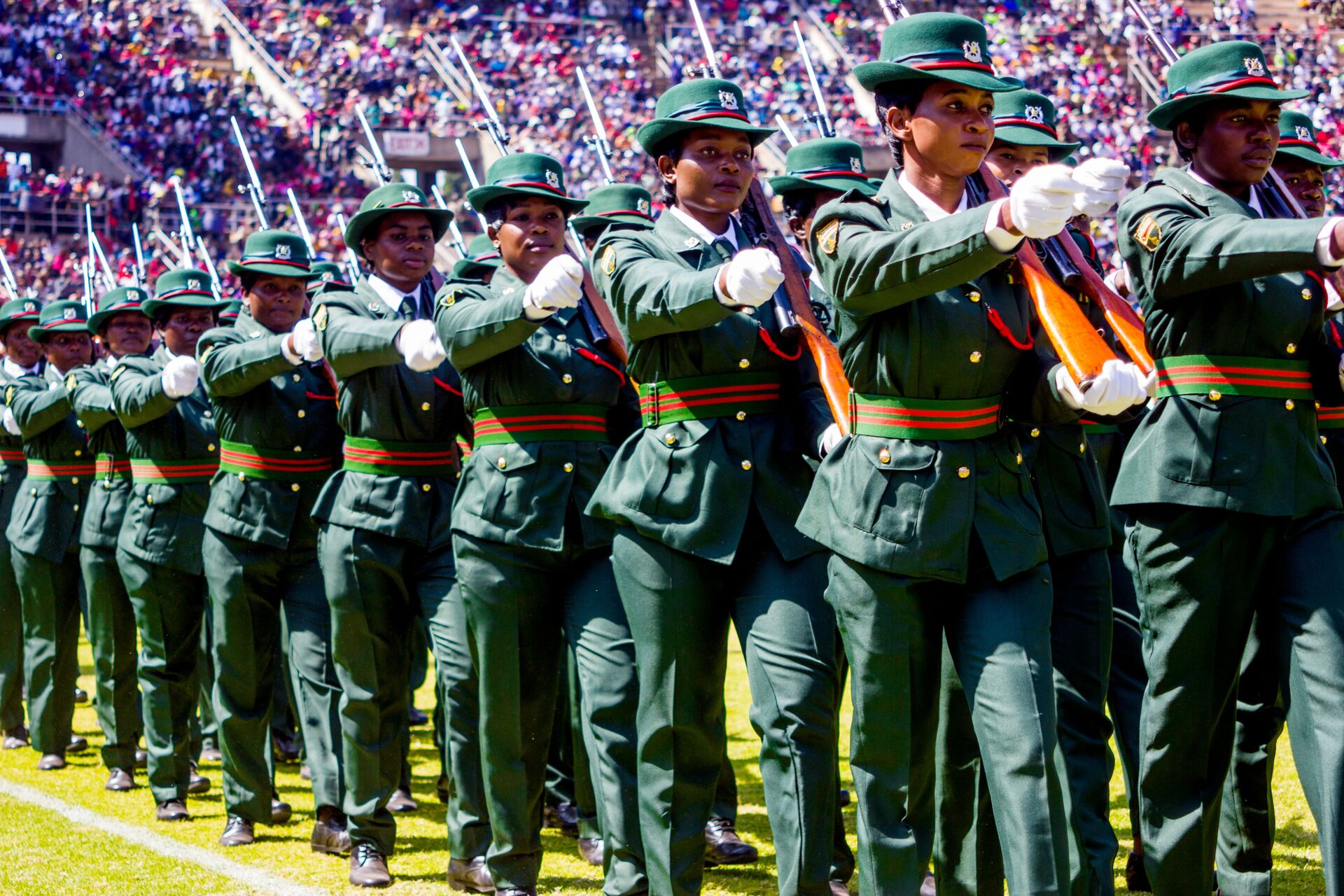
Zimbabwe, women soldiers at a military parade, Harare, sports stadium
Independence Day: 18 April 1980. The capital is Harare, called Salisbury until 1982; Bulawayo is the second city and the heart of Matabeleland. Zimbabwe was the last country on the African mainland to be freed from white minority rule, after a war of seven years and fifteen years of an illegal white republic before that. It takes its name from Great Zimbabwe, a stone city built by Africans centuries before any European saw it, a fact the colonial state spent decades denying. Its president has been in power since a military takeover in 2017, and in July 2026 he signed a law that abolishes the direct election of the president and keeps him in office until 2030.
This is the fifty-fourth and final country page in this series, and Zimbabwe is a fitting place to stop, because its story contains almost every theme the other fifty-three pages record.
Denied history. Stolen land. A liberation war. A hero who became the problem. A massacre the state will not account for. An economy destroyed twice. And, at the end, a constitution amended so that the clock no longer runs.
If you read only one page on this website alongside this one, read Togo. In May 2025 Togo moved the presidency into an office chosen by parliament with no term limit. In July 2026 Zimbabwe did the same thing. The method is spreading.
In the hills of the southeast stand the walls of Great Zimbabwe: granite blocks laid without mortar, an enclosure with walls eleven metres high, a conical tower, and the remains of a city that at its height held perhaps 10,000 to 18,000 people. It was built from around the eleventh century by ancestors of today's Shona, and it traded gold and ivory as far as China; Chinese and Persian ceramics have been found there.
The colonial state could not accept this. Rhodes's contemporaries insisted the city had been built by Phoenicians, Arabs, the Queen of Sheba, anyone but Africans. When archaeologists demonstrated conclusively that it was African, the Rhodesian government of the 1960s and 1970s censored them, and museum staff were instructed not to say publicly what the evidence showed.
The country is named after that city, from the Shona for houses of stone, and the soapstone birds found there are on the flag and the banknotes. One of them only came back from Germany in 2003, having sat in a Berlin museum since the colonial period.
After Great Zimbabwe came the Mutapa state and later the Rozvi, trading gold with the Swahili coast and dealing with, and eventually expelling, the Portuguese.
In the 1830s, fleeing the wars in the south, Mzilikazi led the Ndebele north and founded a kingdom in the west, around Bulawayo. His son Lobengula ruled it when the Europeans came.
In 1888 Lobengula signed the Rudd Concession, believing he was granting a limited mining right to a handful of men. What Rhodes's agents took away was a document used to obtain a royal charter for the British South Africa Company and, with it, a country.
In 1890 the Pioneer Column marched in and raised a flag at what became Salisbury. Settlers were promised gold claims and farms.
In 1893 the company made war on the Ndebele. Machine guns did the work. Bulawayo was burned and Lobengula died in flight in 1894.
In 1896–97 came the First Chimurenga, the first war of liberation, Shona and Ndebele rising together. The spirit mediums Mbuya Nehanda and Sekuru Kaguvi were at its centre. It was crushed, and in 1898 both were hanged. Nehanda is said to have declared that her bones would rise again. Eighty years later, the guerrillas of the second war marched under her name, and there is a statue of her in Harare today.
Zimbabwe, women soldiers at a military parade, Harare, sports stadium
The country was named after Rhodes, and ruled by its white settlers: self-governing from 1923, with Africans excluded from the vote in practice.
The land was divided by law. The Land Apportionment Act of 1930 and the laws that followed reserved roughly half the country, and almost all the best farmland, for a white population that never exceeded about five per cent of the people. Africans were pushed into crowded, dry "native reserves" and made to supply labour.
This is the origin of everything that happened in Zimbabwe after 1980. Not a grievance invented by politicians: a statute.
Zimbabwe joined the Federation with Northern Rhodesia and Nyasaland in 1953, which broke up in 1963 when the other two moved to independence under African rule.
On 11 November 1965 Ian Smith's government declared independence unilaterally rather than accept majority rule, and said African rule would not come in a thousand years. Britain did not use force. The United Nations imposed sanctions, which South Africa and others helped to evade.
The war began in earnest in 1972. ZANU's ZANLA fighters operated from Mozambique, ZAPU's ZIPRA fighters from Zambia.
It was a brutal war on all sides: villagers herded into "protected villages" by the Rhodesian forces, guerrilla units killing suspected collaborators, cross-border raids that killed hundreds of refugees and fighters in camps at Nyadzonia and Chimoio. Perhaps 30,000 people died, the great majority of them African civilians. Rhodesia's neighbours paid too, as the Zambia and Mozambique pages record.
At Lancaster House in London, in December 1979, a settlement was signed. Britain resumed formal control for a few months, elections were held, and on 18 April 1980 Zimbabwe became independent, with Robert Mugabe as prime minister. Bob Marley played at the ceremony.
The agreement included one clause that mattered more than any other: for ten years, land could only be bought from willing sellers, at market prices. Britain and the United States indicated they would help fund the purchases. That promise, and the argument over whether it was kept, would define the next two decades.
Mugabe's first speech called for reconciliation. White farmers kept their farms. Schools and clinics were built at an extraordinary rate, and Zimbabwe's literacy rate became one of the highest in Africa.
Then, within three years, came the crime that Zimbabwe has never resolved.
The rivalry between Mugabe's ZANU, drawing on Shona support, and Joshua Nkomo's ZAPU, based among the Ndebele, turned violent. Arms caches were found on ZAPU properties, and Nkomo was dismissed from the cabinet.
From 1983 the North Korean-trained Fifth Brigade was sent into Matabeleland and the Midlands. It reported directly to the prime minister. What followed, known as Gukurahundi, the rain that washes away the chaff, included mass killings, disappearances, torture and the burning of villages. The most widely cited study, by Zimbabwean church and legal organisations, estimated around 20,000 dead.
It ended with the Unity Accord of December 1987, which absorbed ZAPU into ZANU-PF and made Mugabe executive president.
Nobody has ever been prosecuted. And the man who was Minister of State Security at the time, responsible for the intelligence services, is the man who is president of Zimbabwe today. He has called it a closed chapter and, in other moments, promised community-led hearings, which have moved very slowly.
By the late 1990s, twenty years after independence, white farmers, well under one per cent of the population, still held the majority of the best farmland. Willing-seller purchases had resettled some families, often on poorer land, and both governments blamed the other for the money drying up. Britain's position from 1997 was that it accepted no special responsibility for funding it.
In 1997 Mugabe paid large unbudgeted gratuities to war veterans, and the currency crashed. In 2000 the government lost a constitutional referendum, its first defeat at the polls, against a new opposition, the MDC, backed by the unions and by many farm workers.
Within weeks, war veterans and party militias began occupying white-owned farms. The fast-track land reform that followed was violent, chaotic and politically directed. Farmers were killed, and a much larger number of Black farm workers, hundreds of thousands of them, lost their jobs and homes and are the forgotten victims of the whole episode. Some of the best farms went to officials and generals rather than to landless families. Agricultural output collapsed, and a country that had exported food began importing it.
The historical injustice was real, and the remedy was carried out in a way that ruined the country. Both halves of that sentence are true, and Zimbabwe's politics has spent twenty-five years refusing to say them together.
What followed was sanctions on individuals and institutions by Western governments, an economic implosion, and the hyperinflation of 2008, one of the worst in recorded history, which ended with the Zimbabwe dollar abandoned and the US dollar adopted.
In the 2008 election Morgan Tsvangirai won the first round, and the violence that followed the count killed around 200 people and drove him to withdraw from the run-off. A power-sharing government held from 2009 to 2013, stabilised the economy, and was then dismantled.
For thirty-seven years Robert Mugabe held on. He was 93 when his party split over whether his wife or his vice president would succeed him.
In November 2017 the army took over the streets, insisting it was not a coup. Crowds celebrated. Mugabe resigned. Emmerson Mnangagwa, dismissed as vice president days earlier, returned and was sworn in, promising a new Zimbabwe and telling investors the country was open for business.
The opening did not happen.
This is the last "still happening" section in the series, and it is the sharpest.
The 2013 constitution allows a president two five-year terms. Mnangagwa's second term ends in 2028. In 2024 his party resolved that his term should run to 2030 instead, and reaffirmed that resolution at its conference in Mutare in October 2025, instructing the justice minister to make it law. Mnangagwa himself has repeatedly said he is a constitutionalist and will step down in 2028; his ministers have said he will stay if the people want him to.
Vice President Constantino Chiwenga, the general who led the 2017 takeover and the man who would be next in line, is bitterly opposed, and took a corruption dossier on the businessmen funding the 2030 agenda to the party leadership; the president's camp accused him of incitement. Analysts described the president's preparations, including cars handed to central committee members before the conference, and the removal of Chiwenga's people from key posts.
Then it happened very fast.
The Constitution of Zimbabwe Amendment (No. 3) Bill was gazetted on 16 February 2026. The National Assembly passed it 216 votes to 42 on 18 June, the Senate 75 to 4 on 24 June, and Mnangagwa signed it into law on 7 July 2026.
What the Act does:
The Law Society of Zimbabwe stated that extending the terms of sitting officeholders requires a referendum, under the clause of the constitution designed precisely to stop this, and that passing it without one would breach Zimbabwe's obligations under the African Charter on Democracy, Elections and Governance. The Act overrides that clause with a "notwithstanding" provision. Constitutional lawyers filed court challenges from the day it was gazetted. A leading analyst called it executive consolidation by constitutional disruption.
War veterans' factions and church leaders publicly urged the president to leave in 2028 as scheduled. It made no difference.
Zimbabweans will not vote for a president again unless this is reversed. A country whose people fought a seven-year war for the right to vote has had that vote taken back by a parliamentary majority, without a shot being fired, in under five months.
Mnangagwa was born in 1942. In 2030 he will be 88.
Because Zimbabwe answers the question this website has been asking on every page: what did independence turn out to mean?
In 1980 it meant the end of the last white settler state on the mainland, and the vindication of a century of resistance from Nehanda to the guerrilla camps. For the majority of Zimbabweans it meant schools, clinics, dignity and the vote.
By 2026 it means a president chosen by parliament, an election cancelled, an opposition wrecked, a massacre unaccounted for, and millions of Zimbabweans working in South Africa and Britain because there is nothing at home.
And the thread that runs from Togo in 2025 to Zimbabwe in 2026, and through Somalia, Uganda, Tunisia and half of this list, is not colonialism. It is a technique: the term limit removed by legal text rather than by tanks, applauded by a parliament the ruling party controls, while the outside world says very little.
That is the state of independence in Africa in 2026. Not the borders, not the flags, not the anniversaries. The clocks.
For Britain and Rhodes: the Rudd Concession was obtained by misrepresentation, the country was taken by a chartered company, the land was divided by racist statute, and when Ian Smith declared his illegal republic in 1965 Britain declined to remove him by force. The denial of Great Zimbabwe's African origins was official policy, and objects taken from it sat in European museums for a century.
For Britain again, on land: the willing-seller clause was the price of the 1979 settlement, and the funding to make it work never remotely matched the scale of what had been taken. Britain's refusal in 1997 to accept a special responsibility handed Mugabe the argument he used for the next twenty years.
For Mugabe and ZANU-PF: Gukurahundi was not a colonial crime. It was carried out by an independent Zimbabwean government against its own citizens, three years after liberation, and it has never been answered for. The land reform of 2000 was directed against an opposition as much as for the landless, it destroyed the livelihoods of hundreds of thousands of Black farm workers, and much of the best land went to the powerful.
For the region: SADC and the African Union have watched elections in Zimbabwe for two decades and have rarely said plainly what their own observers reported. On the constitutional change of 2026, the regional response has again been close to silence, exactly as with Togo.
And for the men in power now: the generals who removed Mugabe in 2017 promised the country a new beginning, and have delivered an amendment that ends the direct election of the president. The argument they are having with each other is not about democracy. It is about which of them holds what Mugabe held.
There are the walls of Great Zimbabwe, standing without mortar, built by people whose descendants were told they had not built them.
There is a soapstone bird that came home from Berlin in 2003.
There is a concession signed by Lobengula in 1888 for something other than what he thought he was signing.
There is a gallows from 1898, and a statue of Mbuya Nehanda in Harare.
There is a statute from 1930 dividing a country by race, which explains most of what followed.
There is a declaration from 11 November 1965 and a promise about a thousand years.
There are the graves in Matabeleland from the years 1983 to 1987, and no trial.
There are farms that were taken from people who had taken them, and the hundreds of thousands of workers who lost everything in the process and are in nobody's story.
There is a hundred-trillion-dollar banknote, sold to tourists as a souvenir.
There is a compensation agreement from 2020 worth 3.5 billion dollars, largely unpaid.
And there is a law signed on 7 July 2026 which means that the next president of Zimbabwe will be chosen in a room in Harare, by people whose own terms were extended by the same document.
Updated and fact-checked: 18 September 2026.
How this page was checked. Recent events were verified against the sources listed above; the historical record was checked against standard reference works on Zimbabwe and southern Africa. The dating and African origin of Great Zimbabwe, the Rudd Concession of 1888, the BSAC charter and the Pioneer Column of 1890, the Matabele war of 1893 and the death of Lobengula, the First Chimurenga of 1896–97 and the executions of 1898, the Land Apportionment Act of 1930, self-government in 1923, the Federation of 1953–63, the unilateral declaration of independence on 11 November 1965, the liberation war of 1972–79, the Lancaster House Agreement of December 1979, independence on 18 April 1980, Gukurahundi from 1983 to 1987, the Unity Accord of December 1987, the referendum defeat and farm occupations of 2000, the hyperinflation and violence of 2008, the power-sharing government of 2009–2013, the constitution of 2013, the removal of Robert Mugabe in November 2017, the shootings of 1 August 2018 and January 2019, the compensation agreement of 2020, the ZANU-PF resolutions of 2024 and October 2025, and the gazetting, passage and signing of the Constitution of Zimbabwe Amendment (No. 3) Act between February and 7 July 2026 are as recorded. Casualty figures are estimates and are given as approximate where they are disputed: deaths in the liberation war (around 30,000), deaths in Gukurahundi (around 20,000, from the study by Zimbabwean church and legal organisations), deaths after the 2008 first round (around 200), and deaths in August 2018 and January 2019. The assessment that the term extension required a referendum is that of the Law Society of Zimbabwe and of constitutional lawyers who have filed challenges; the government's position is that the Act was lawfully passed by both chambers. Both are recorded. President Mnangagwa's own statements that he intends to respect the constitution are recorded alongside his party's resolutions. This page makes no allegation against any living person beyond matters already on the public record.
Written and researched by Remo Kurka · africanindependence.com
We strive to unify diverse narratives from across Africa, showcasing the continent's shared heritage and unique stories.
Our mission is to honor and preserve the history of African cultures and independence movements for future generations.
We provide a platform for innovative exchange of ideas, resources, and insights, understanding that knowledge should be accessible to all.