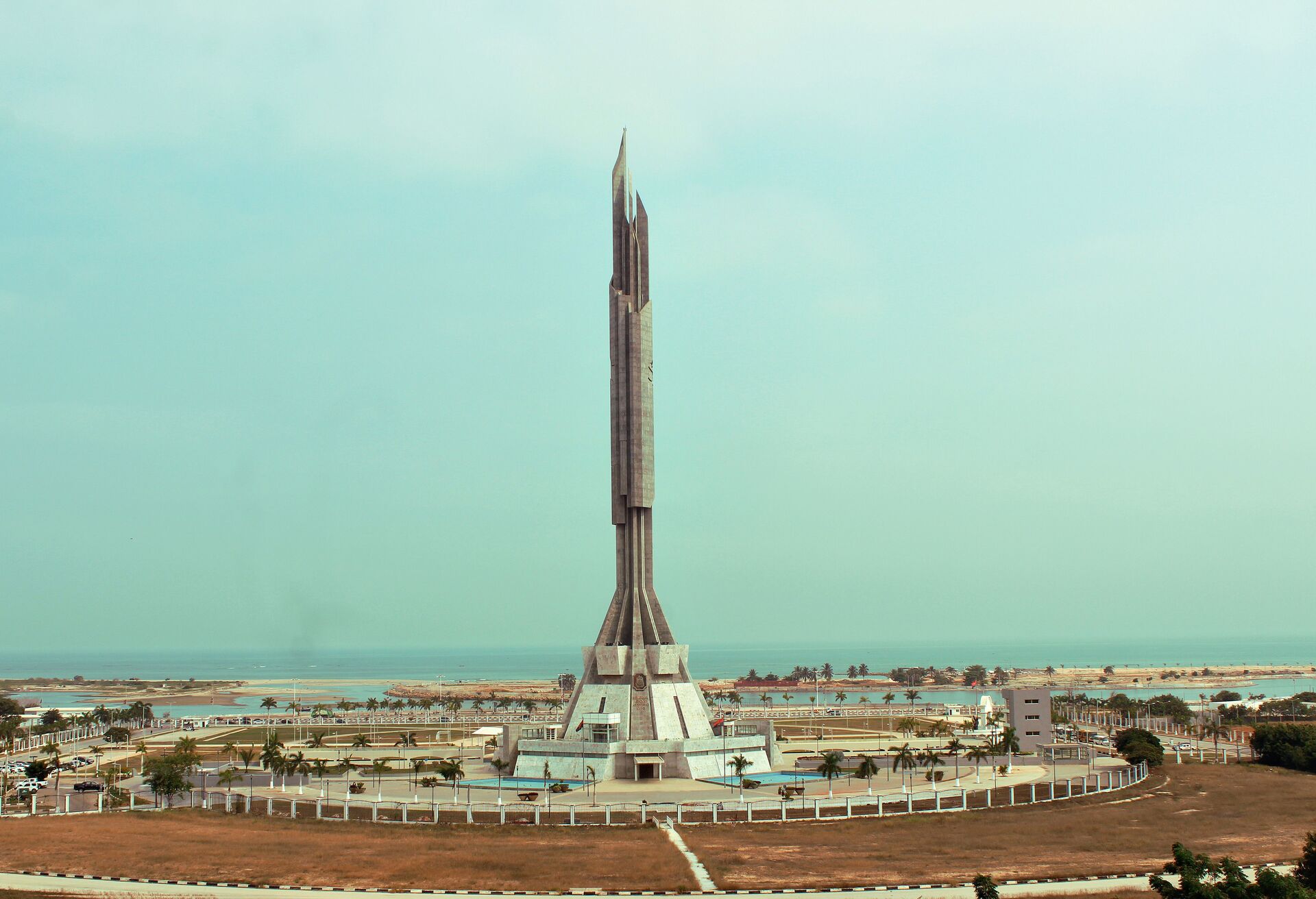
Angola
Independence Day: 11 November 1975. A nation that fought one of the world's longest colonial occupations, and then fought itself for twenty-seven more years.
Portuguese ships reached this coast in the 1480s. Luanda was founded in 1575. Portuguese rule ended in 1975.
Four hundred years — the longest European presence anywhere in sub-Saharan Africa.
But the phrase "five hundred years of colonial rule" flattens something important. For most of that time Portugal did not control Angola. It controlled a coastal strip, some river forts and the slaving routes inland. The interior belonged to African states that traded with it, fought it, and outlasted it.
The clearest example is Queen Njinga of Ndongo and Matamba, who fought Portugal for most of her thirty-nine-year reign in the seventeenth century. She lost her capital, was driven into exile, took another kingdom to have somewhere to stand — and the state she built survived European conquest for roughly two hundred and fifty years after her death. Angola's name itself comes from ngola, the title of Ndongo's rulers, which the Portuguese mistook for a place name.
Effective colonial occupation of the whole territory only came in the late nineteenth and early twentieth centuries, after Europe had divided Africa on paper at Berlin. Some Angolan regions were not brought under Portuguese administration until the 1910s and 1920s.
Angola was not conquered for five centuries. It was resisted for five centuries, and conquered for about sixty years.
Angola
Angola was not conquered for five centuries. It was resisted for five centuries, and conquered for about sixty years.
Under the Estado Novo dictatorship, Angola was officially not a colony at all. It was an "overseas province" of Portugal — one nation across several continents.
Underneath that fiction was forced labour. The contrato system supplied workers to the coffee plantations, the cotton fields and the mines under conditions repeatedly described by outside observers in terms hard to distinguish from bondage.
Angolans could apply to become assimilados — legally Portuguese, with rights — by proving literacy in Portuguese, Christian practice and sufficient income. After four centuries of Portuguese presence, roughly one per cent of the African population had qualified.
Meanwhile Lisbon pushed settlement. By the early 1970s the white population had passed three hundred thousand, holding the best land, the towns and the administration.
Two facts belong side by side. Angola had oil, diamonds, iron, coffee and superb farmland. And at independence it had one of the lowest literacy rates on the continent, a handful of African university graduates from a population of around six million, and almost no African doctors, engineers or administrators.
That was not backwardness. That was the design.
Two dates, six weeks apart, and both belong in an honest account.
On 4 February 1961, militants attacked police headquarters and prisons in Luanda, trying to free political prisoners. The attack failed. Angola commemorates this date as the start of the armed struggle.
On 15 March 1961, a rising began in the northern coffee districts under Holden Roberto's UPA. Portuguese settlers were killed. So were large numbers of Ovimbundu contract labourers who had been brought north to work the plantations — Africans killed by Africans in the first week of the war.
Portugal's response was aerial bombing, napalm and mass killing across the north. Tens of thousands died. Hundreds of thousands fled across the border into the Congo.
Everything that would define the next forty-one years was present within six weeks: colonial brutality, ethnic division inside the resistance, and civilians as the main casualties.
This is where most short accounts of Angola go wrong, and it is the single most important thing to understand.
Angola did not have a liberation movement. It had three, and they were fighting each other long before Portugal left.
MPLA — the Popular Movement for the Liberation of Angola, led by Agostinho Neto. Based in Luanda and the Mbundu regions, strong among urban intellectuals and mixed-race Angolans. Marxist. Backed by the Soviet Union and, decisively, by Cuba.
FNLA — the National Front for the Liberation of Angola, led by Holden Roberto. Based among the Bakongo of the north. Anti-communist. Backed by Mobutu's Zaire, to whose ruler Roberto was related by marriage, and by the United States.
UNITA — the National Union for the Total Independence of Angola, founded in 1966 by Jonas Savimbi after he left the FNLA. Based among the Ovimbundu of the central plateau, Angola's largest population group. Backed at various times by China, and later by apartheid South Africa and the United States.
Each had a genuine constituency. Each had a foreign patron with its own agenda. None could win alone. None would accept losing.
And there was a fourth conflict inside the third: Cabinda, the oil-rich enclave cut off from the rest of Angola by Congolese territory, with a separatist movement that has never gone away.
Angola did not fracture because independence went wrong. It was three movements at war with each other in 1961, and independence removed the one thing they had in common.
Portugal did not lose militarily in Angola. By 1974 its army held the towns and most of the country, and the MPLA in particular was in a poor state — divided, marginalised, with Neto facing serious internal challenges.
What ended the empire was that Portugal broke.
On 25 April 1974, Portuguese officers overthrew their own dictatorship in Lisbon. They had been fighting three simultaneous colonial wars — Angola, Mozambique, Guinea-Bissau — for thirteen years, and had concluded that the wars could not be won and were not worth winning.
This does not diminish the liberation movements. Thirteen years of guerrilla war across three territories is precisely what broke the Portuguese army's willingness to continue. The African wars caused the Lisbon coup.
But the sequence matters. The decisive event happened in Europe, it happened suddenly, and it left Angola roughly eighteen months to build a state that nobody had been trained to build.
On 15 January 1975, Portugal and all three movements signed the Alvor Agreement: a transitional government of all four parties, integrated armed forces, elections, and independence on 11 November 1975.
It functioned for weeks.
By March there was fighting in Luanda. By July the MPLA had driven the FNLA out of the capital and UNITA had withdrawn south. Angola split along the lines of the three movements' home regions, and all sides prepared for November.
Meanwhile the Portuguese settlers left — several hundred thousand people in a matter of months, taking what they could carry and, in many documented cases, destroying what they could not. Vehicles were driven into the sea. Machinery was sabotaged. The country's entire technical and administrative class disappeared inside a year.
By the autumn of 1975, count who was inside Angola.
In July, the United States authorised a covert operation funding and arming the FNLA and UNITA, running through Zaire.
On 14 October, South Africa launched Operation Savannah. Armoured columns crossed from South West Africa — today's Namibia — and drove north at extraordinary speed, aiming to take Luanda before independence day and install UNITA and the FNLA.
On 4 November, Fidel Castro launched Operation Carlota. Cuban specialists and special forces began arriving. Cuba's commitment would eventually run to tens of thousands of troops over more than a decade.
In early November, Zairean regular troops, Portuguese volunteers and European mercenaries assembled with the FNLA north of Luanda.
Four foreign states had soldiers or paid proxies in Angola before it had a flag.
Angola's independence was decided by an artillery engagement on low ground about twelve miles north of Luanda, in the days immediately before 11 November.
A force of a few thousand — FNLA fighters, Zairean commando battalions, mercenaries, armoured vehicles and a small South African artillery detachment — advanced on the capital.
Facing them was a smaller MPLA force with Cuban artillerymen and something the attackers had not anticipated: BM-21 rocket launchers.
The attack was destroyed. Angolans afterwards called the valley the road of death. The FNLA never recovered as a fighting force.
It is worth stating the alignment plainly: in November 1975 the apartheid South African Defence Force and the Central Intelligence Agency were on the same side, attempting to install a government in an African capital. They were stopped by Cubans.
The Portuguese High Commissioner left on 10 November without handing power to anyone, because there was nobody all parties would accept.
At midnight, in Luanda, Agostinho Neto proclaimed the People's Republic of Angola.
The same week, in Huambo, the FNLA and UNITA proclaimed their own Democratic People's Republic of Angola.
Two governments. One country. Day one.
There were celebrations in Luanda that night, and they were real. So was the fact that the country was already at war.
Africa then had to decide which Angola was Angola, and the Organisation of African Unity split roughly down the middle.
At the extraordinary OAU summit in Addis Ababa in January 1976, Nigeria's General Murtala Mohammed read out the substance of a letter from President Gerald Ford urging Nigeria not to recognise the MPLA — and demolished it in public, arguing that a United States which had chosen white minority rule over African self-determination had disqualified itself from telling Africa who its friends were. He asked the assembly to seat Agostinho Neto's government.
The OAU recognised the MPLA. Murtala Mohammed was assassinated thirty-three days later.
In Washington, the revelation that the United States was fighting alongside apartheid South Africa produced a revolt in Congress. Funding was cut, and the Clark Amendment barred further American aid to Angolan factions for a decade. South Africa withdrew its columns in early 1976.
Independence in Angola was not the end of the war. It was the start of a longer one.
The fighting ran from 1975 to 2002 — twenty-seven years. It was sustained first by the Cold War and then, after the superpowers lost interest, by Angola's own minerals: UNITA sold diamonds, the government sold oil. This is where the phrase "blood diamonds" comes from. Angola became one of the most heavily mined countries on earth.
UN-supervised elections were held in 1992. The MPLA led. Savimbi rejected the result and returned to war, and the phase that followed was the bloodiest of the entire conflict — worse than anything the Cold War had produced.
The war ended on 22 February 2002, when Jonas Savimbi was killed by government troops in Moxico province. UNITA signed a ceasefire six weeks later.
Estimates of the dead across those twenty-seven years generally run between five hundred thousand and one million, with around four million displaced.
There is one more thing an honest page has to include. On 27 May 1977, eighteen months after independence, supporters of Nito Alves — a popular former guerrilla commander and government minister who had accused the MPLA leadership of corruption and of excluding the poor black majority — seized a prison and the national radio station in Luanda. Whether it was an attempted coup or a mass demonstration is still disputed. The government's response was a purge that lasted two years, carried out with Cuban assistance, killing an unknown number of MPLA activists, students and intellectuals. Estimates range from several thousand into the tens of thousands. No official count has ever been published, no inquiry has been held, and no one has been prosecuted.
Angolans campaigning for an accounting of 27 May are still harassed today.
Peace came in 2002, and then came the oil boom. Luanda filled with cranes, Chinese construction credit and glass towers, and became for several years the most expensive city in the world for expatriates.
José Eduardo dos Santos, who succeeded Neto in 1979, ruled for thirty-eight years. His family became extraordinarily wealthy while most Angolans stayed poor; inequality widened through the boom rather than narrowing. He stood down in 2017 and died in 2022.
João Lourenço became president in 2017, promising an anti-corruption reckoning. He was re-elected in 2022 and his term runs to 2027.
In November 2025 Angola marked fifty years of independence. The MPLA has governed for every one of them.
There is a version of this story in which brave Angolans united, defeated Portugal, and raised their flag. It is the version most of the internet tells. It is not true, and Angolans know it is not true.
What actually happened is harder and more worth remembering.
A people resisted for four centuries, was conquered for sixty years, was denied education and rights by deliberate policy, and rose in 1961 anyway. Thirteen years of that war helped bring down a European dictatorship. And then, at the moment of freedom, Angola was handed to the Cold War — invaded by apartheid South Africa, armed by four foreign powers, and left to fight itself for a generation with weapons other people supplied.
Angola's independence was real and it was earned. What followed was not the fault of independence. It was the consequence of a colonial system that trained nobody and divided everybody, arriving at its ending too fast, in the worst decade possible.
Fifty years on, that is worth commemorating honestly rather than simply.
Freedom is not granted. But it is not the end of the story either — and pretending otherwise dishonours the people who are still living with what came next.
Published: 11 November 2024 · Fully revised and fact-checked: 7 September 2026.
How this page was checked. Dates, casualty figures and the sequence of foreign interventions were verified against the sources listed above. The dates of 4 February and 15 March 1961, the Carnation Revolution of 25 April 1974, the Alvor Agreement of 15 January 1975, Operation Savannah from 14 October 1975, Operation Carlota from 4 November 1975, the proclamation of independence on 11 November 1975, the events beginning 27 May 1977, Agostinho Neto's death on 10 September 1979 and the killing of Jonas Savimbi on 22 February 2002 are as recorded. Contested figures are given as ranges, not as single numbers: total civil war deaths, the toll of the 1961 reprisals and the toll of the 1977–79 purge are all disputed, and no official Angolan count of the 1977 purge has ever been published. Accounts also differ on the exact date of the engagement at Quifangondo. This page states disagreement where it exists rather than resolving it, and makes no allegation against any living person.
Written and researched by Remo Kurka · africanindependence.com
We strive to unify diverse narratives from across Africa, showcasing the continent's shared heritage and unique stories.
Our mission is to honor and preserve the history of African cultures and independence movements for future generations.
We provide a platform for innovative exchange of ideas, resources, and insights, understanding that knowledge should be accessible to all.