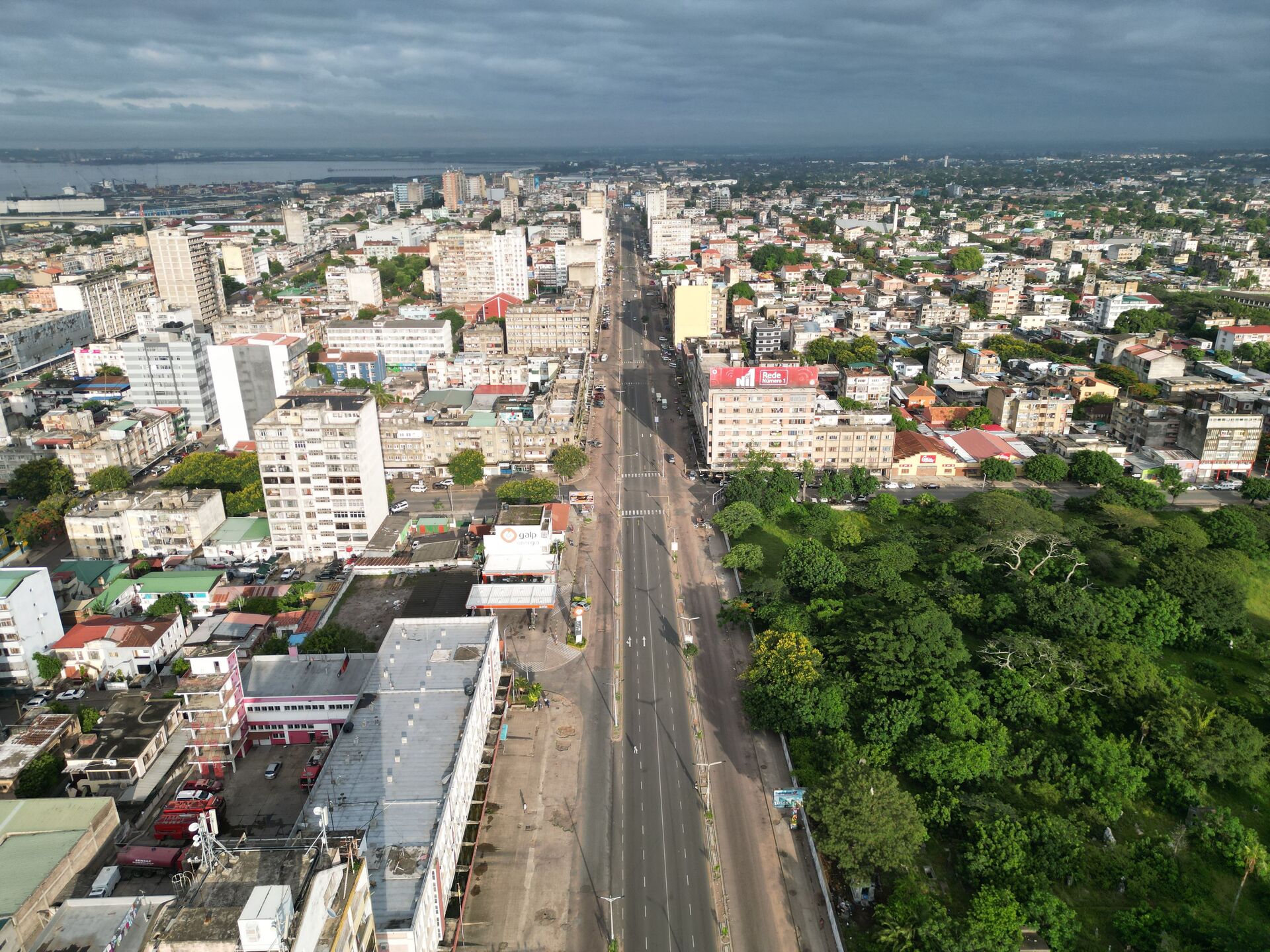
Mozambique, Maputo cityskape
Independence Day: 25 June 1975. Mozambique fought Portugal for eleven years and won. Then it did something that cost it far more than the liberation war had: it opened its territory to the guerrillas fighting white rule in Rhodesia and South Africa. Both of those states responded by manufacturing an insurgency inside Mozambique and arming it for fifteen years. Around a million Mozambicans died. Rhodesia became Zimbabwe and apartheid ended, and Mozambique was left with the bill.
Most civil wars on this continent had domestic causes with foreign encouragement. Mozambique's was the other way round.
RENAMO was created by the Rhodesian intelligence service in the late 1970s as an instrument against a neighbouring government, and when Rhodesia ceased to exist in 1980 the apartheid South African military took the whole apparatus over and expanded it. Mozambican grievances were real and RENAMO recruited on them — but the organisation was built abroad, for a foreign purpose, and its purpose was punishment.
Mozambique paid roughly a million lives so that Zimbabwe and South Africa could be free.
Nobody has ever compensated it. No truth commission has ever examined it. No South African or Rhodesian official has ever been tried for any of it.
And there is a second thing, which is why this page matters now: Mozambique is currently being handed the largest single investment in African history in a province where an insurgency has killed more than six thousand people since 2017. The same question is being asked again — who bears the risk, and who takes the revenue.
Mozambique, Maputo cityskape
The coast here was part of the Indian Ocean world long before Europe arrived.
Sofala was the southern terminus of the Swahili trading system, an outlet for the gold of the Mutapa state in the interior and, before that, of Great Zimbabwe. Arab, Swahili, Persian, Indian and Chinese goods moved through it.
Ilha de Moçambique, the small coral island that gave the country its name, was a Swahili port before the Portuguese took it in 1507 and made it their capital for nearly four centuries. It is a UNESCO World Heritage site, and it is one of the most extraordinary and least visited places in Africa: a stone town of mosques, a Hindu temple, the oldest European building in the southern hemisphere, and a Portuguese fortress, on an island you can walk across in an hour.
Inland, in the nineteenth century, Soshangane built the Gaza Empire across southern Mozambique — a Nguni state formed in the same upheaval that produced the Zulu and, as the Lesotho page describes, the Basotho.
Its last ruler, Ngungunhane, was defeated and captured by the Portuguese in 1895, paraded through Lisbon, and exiled to the Azores, where he died in 1906. His remains were brought back to Mozambique in 1985, and he is a national hero.
Portugal claimed Mozambique for four hundred years and governed almost none of it for most of that time.
For long stretches it was run through prazos — vast estates granted to settlers, which in practice became private fiefdoms with their own armies. And from the 1890s until well into the twentieth century, huge areas were leased outright to chartered companies: the Mozambique Company and the Niassa Company, which ran their own police, issued their own stamps, collected their own taxes and supplied labour to whoever paid. The Niassa Company's concession did not expire until 1929. The Mozambique Company's ran to 1942.
Portugal did not colonise Mozambique so much as sublet it.
The economy Lisbon did build was built on people.
Forced labour — chibalo — was legal until 1961. Men could be conscripted for public works or handed to private employers. Forced cotton cultivation from the 1930s required peasants to plant cotton instead of food, sell it at fixed prices to concession holders, and go hungry when the harvest failed, which it did.
And the most lucrative export was labour itself. Under agreements with South Africa going back to 1897, Mozambique supplied migrant workers to the Witwatersrand gold mines, and the Portuguese state took a share of their wages — part of it paid to Lisbon in gold at a favourable price. Mozambique's ports and railways served Rhodesia, South Africa and Nyasaland, and the transit fees were a pillar of the colonial budget.
Mozambique was profitable to Portugal mainly as a labour depot and a corridor for its neighbours' exports. That is why its economy pointed outward and sideways rather than inward, and it still does.
Under Salazar's Estado Novo, the colonies were redefined in 1951 as "overseas provinces" — constitutionally part of Portugal, which is why Lisbon could later argue it was not decolonising but defending national territory. A tiny number of Mozambicans qualified as assimilados with limited civil rights; at independence the literacy rate was in single digits and the number of African university graduates in the whole country could be counted in dozens.
In the far north, on the Makonde plateau, a crowd gathered at the administrative post at Mueda to press cooperative farmers' grievances with the Portuguese administrator.
Portuguese troops opened fire. The death toll has never been established — Portuguese accounts gave low double figures, FRELIMO said around six hundred, and the true number is unknown.
Whatever it was, Mueda is the moment Mozambican politics stopped being petitions.
FRELIMO was founded in Dar es Salaam in 1962 out of three exile movements. Its first president was Eduardo Mondlane — a Mozambican who had studied in Portugal, South Africa and the United States, taken a doctorate at Northwestern, worked as a research officer at the United Nations, and taught anthropology at Syracuse.
He was, by common consent, the most capable man in the movement: an intellectual who could hold together Makonde peasants, urban assimilados, and Cold War donors on both sides.
The armed struggle began in September 1964, in the north.
On 3 February 1969, Eduardo Mondlane was killed in Dar es Salaam by a parcel bomb. The book that exploded reached him through channels that have never been fully explained. Portuguese involvement is generally accepted; the extent of complicity inside FRELIMO is argued about in Mozambique to this day.
Samora Machel emerged as his successor — a nurse by training, a guerrilla commander by experience, and a far more radical figure.
The war ground on for a decade across the northern provinces, with FRELIMO holding liberated zones and running schools and clinics in them, as the PAIGC did in Guinea-Bissau.
In December 1972, Portuguese troops massacred the inhabitants of Wiriyamu and neighbouring villages in Tete province. Estimates run from around 150 to several hundred, including women and children.
And it was exposed. A British Catholic priest, Adrian Hastings, published the accounts of Spanish missionaries in The Times in July 1973 — days before the Portuguese prime minister arrived in London on a state visit marking six hundred years of the Anglo-Portuguese alliance.
The scandal was enormous, and it fed directly into the collapse of Portuguese political will that produced the Carnation Revolution of 25 April 1974, described in full on this site's Guinea-Bissau page.
The Lusaka Accord was signed in September 1974, and Mozambique became independent on 25 June 1975, with Samora Machel as president.
Roughly 250,000 Portuguese settlers left within about a year — the great majority of the country's skilled workers, technicians, doctors, engineers, managers and mechanics.
Many did not simply go. Vehicles were driven into the sea, machinery was smashed, livestock was killed, plans and records were destroyed. Tractors were poured with concrete.
A country of ten million people was left with a literacy rate under ten per cent and almost nobody who knew how to run anything. That is the actual starting position of independent Mozambique, and every judgement of what FRELIMO did next has to begin there.
FRELIMO declared itself Marxist-Leninist in 1977, a one-party state on the Soviet model.
It did some remarkable things. Literacy campaigns and mass vaccination pushed both indicators sharply in a few years, and the health programme was internationally admired. Machel was a genuinely charismatic figure with real authority.
It also did serious damage. Land, housing, schools and health care were nationalised, along with much of the economy, and the state had nobody to run it. Communal villages concentrated scattered rural populations, often by force, and broke farming systems that worked. Traditional chiefs — the régulos — were abolished as colonial collaborators, which removed the only functioning rural authority and created a large constituency with nothing to lose. Religious practice was suppressed.
And there were re-education camps in the north, to which prostitutes, petty criminals, political suspects and "unproductive elements" were sent, in conditions from which many did not return.
RENAMO would recruit in exactly those places: among displaced villagers, dispossessed chiefs, and people the revolution had classified as obstacles.
Here is the central fact of Mozambique's modern history.
Machel gave sanctuary and bases to ZANU, fighting Ian Smith's Rhodesia, and later to the ANC, fighting apartheid. He also applied UN sanctions against Rhodesia by closing the border in 1976, at enormous cost to his own transit revenues.
Rhodesia's Central Intelligence Organisation created RENAMO — the Mozambican National Resistance — in 1975–77, as an instrument for gathering intelligence and destabilising the FRELIMO state. It was armed, trained, based and broadcast from Rhodesia.
When Rhodesia became Zimbabwe in 1980, South African military intelligence took the whole operation over, moved it, expanded it massively, and ran it as a strategic weapon.
What followed, from 1977 to 1992, was not a conventional civil war. It was a campaign against the functioning of a country. Railways, power lines and bridges were destroyed. Schools and clinics were specific targets: thousands of each were burned, and teachers and health workers were killed because they represented the state. Villages were attacked, civilians mutilated, and children abducted and forced to fight — a practice RENAMO industrialised before anyone had a name for it.
FRELIMO forces committed abuses too, and the villagisation programme and the camps had already alienated much of the countryside. This page will not pretend the government was clean.
Around one million people died, most of them from hunger and disease caused by displacement rather than by direct violence. Around five million were displaced, and the country was left one of the most heavily mined on earth.
In March 1984, Mozambique signed the Nkomati Accord with South Africa: Mozambique would expel the ANC, and South Africa would stop supporting RENAMO.
Mozambique complied. South Africa did not. Documents captured at RENAMO's Gorongosa headquarters in 1985 showed the supply had continued throughout. Machel had given up his allies for nothing.
Samora Machel's aircraft, a Soviet-built Tupolev, crashed into a hillside at Mbuzini, inside South African territory, on the night of 19 October 1986, returning from a summit in Zambia. Machel and thirty-three others were killed.
The South African commission of inquiry blamed crew error. Mozambique rejected that finding and has never accepted it.
The allegation — made then and since — is that a decoy navigation beacon was used to lure the aircraft off course. South Africa's Truth and Reconciliation Commission examined the matter in the 1990s, found the evidence insufficient to reach a conclusion, and recorded that the South African authorities had obstructed the original investigation and that relevant material had gone missing.
Forty years on, it remains formally unresolved, and no South African official has ever been prosecuted. A memorial of upright steel tubes stands at the crash site, which sings when the wind blows through it.
Joaquim Chissano succeeded Machel and did what Machel probably could not have done: abandoned Marxism-Leninism, adopted a multiparty constitution in 1990, and negotiated.
The Rome General Peace Accords were signed on 4 October 1992, brokered largely by the Catholic lay Community of Sant'Egidio — one of the few peace processes anywhere led by a religious community rather than by states.
It held. RENAMO became a political party. Elections were held in 1994. The UN operation demobilised both armies and left.
And FRELIMO has won every national election since 1975. Fifty-one years in power.
Chissano stood down voluntarily in 2005, which was rare and creditable. But the party fused with the state, and what followed was a political economy in which access to FRELIMO was access to everything.
RENAMO returned to arms briefly between 2013 and 2019, and a further peace agreement was signed in 2019.
And then Mozambique produced one of the purest corruption scandals of the century.
Between 2013 and 2014, officials arranged around two billion dollars in secret, state-guaranteed loans — arranged through Credit Suisse and VTB — to three newly created state-linked companies, nominally for a tuna fishing fleet, coastal surveillance and a shipyard.
Parliament was not told. The IMF was not told. The debts were hidden.
When they surfaced in 2016, donors suspended budget support, the currency collapsed, the country defaulted, and Mozambique lost years of growth. Independent estimates put the cost at well over ten billion dollars and hundreds of thousands pushed into poverty.
A fleet of unused fishing boats has sat rusting in Maputo harbour ever since.
The former finance minister, Manuel Chang, was arrested in South Africa in 2018, extradited to the United States, and convicted in Brooklyn in 2024. Credit Suisse paid a substantial penalty to regulators and forgave part of the debt. Bankers were convicted. Testimony in the various proceedings named senior Mozambican figures, including the man who became president; he has denied wrongdoing and has not been charged.
The people who lost the most have recovered the least.
In October 2017, an armed group attacked police posts in Mocímboa da Praia, in the far northern province of Cabo Delgado.
The group — known locally as al-Shabaab, with no connection to the Somali organisation, and later affiliated to Islamic State — grew out of a marginalised, mostly Mwani and Makua population in a province that is simultaneously one of the poorest in Mozambique and the site of one of the largest gas discoveries of the century.
In March 2021 they attacked the town of Palma, next to the gas site, killing dozens including foreign contractors, and TotalEnergies declared force majeure on its $20 billion project.
Mozambique brought in Rwandan troops and a SADC mission. The SADC mission left in 2024; the Rwandans are still there, funded in part by the European Union, which also runs a training mission for Mozambican forces.
Since 1 October 2017, conflict monitors have recorded more than 6,500 deaths in Cabo Delgado, including over 2,700 civilians, and around a million people displaced at the peak. The violence has since spread into Niassa and Nampula.
The general election of October 2024 produced a declared victory for FRELIMO's Daniel Chapo. The runner-up, Venâncio Mondlane, rejected the result.
What followed was the worst civil unrest since the civil war. Months of protests and strikes, security forces firing on crowds, hundreds killed, and an economy shut down at an estimated cost of around half a billion dollars. Mondlane's lawyer and a party official were shot dead in a car in Maputo in October 2024. Chapo was inaugurated in January 2025 amid the unrest, and reached an accommodation with Mondlane in March 2025.
The peace since is real and it is not settled. Analysts expect the same pressures — the election dispute, youth unemployment, and Mondlane's popularity — to build again towards the votes of 2028 and 2029.
And on 29 January 2026, at a ceremony at Afungi in Cabo Delgado, TotalEnergies and President Chapo announced the full restart of Mozambique LNG.
Force majeure had been lifted on 7 November 2025 after months of negotiation, largely over who bears the roughly $4.5 billion of losses accumulated during the four-year pause — a question still subject to an audit of the company's cost claims.
The numbers: a $20 billion project, around 40 per cent complete at restart and 45 per cent by mid-2026, with over 6,000 workers on site. Designed for more than 13 million tonnes of LNG a year. First output expected in 2029. The government's own estimate is as much as $35 billion in revenue over the life of the project.
Mozambique is about to become a significant energy exporter.
And the province where the plant sits is guarded by Rwandan troops paid for by Europe, the insurgency is active elsewhere in the same province, civil society is asking publicly how much of the revenue will reach Mozambicans, and the last time enormous sums moved through the Mozambican state, two billion dollars of it went missing and the fishing boats are still rusting in Maputo harbour.
Because Mozambique is the clearest case anywhere of a country destroyed for other people's independence, and never repaid.
Zimbabwe is free. South Africa is free. The ANC governs in Pretoria. And the state that sheltered them, applied the sanctions, took the raids and the sabotage, and buried a million of its own people is one of the poorest countries in the world.
There has been no reparation, no commission, no apology and no prosecution — not from Britain for Rhodesia, not from South Africa, not from anyone. South Africa's own Truth and Reconciliation Commission dealt with the regional wars only glancingly. The destabilisation of the front-line states is the largest unexamined crime in southern African history.
And because Mozambique is the test of whether the second time is different. The country now has gas, and the question is precisely the one this website asks on every page: who bears the risk, and who receives the revenue. In 2013 the answer was that Mozambicans bore a two-billion-dollar debt they were never told about. In 2029 the first cargo sails.
FRELIMO's own decisions made RENAMO possible. Forced villagisation, the abolition of chieftaincy, the re-education camps and the suppression of religion created the grievances that a foreign intelligence service recruited on. Rhodesia and South Africa built the weapon; Mozambique supplied the powder.
RENAMO's atrocities were its own. Blaming Pretoria entirely denies the agency of the Mozambicans who mutilated civilians and abducted children, and Mozambican victims know exactly who was standing in front of them.
Fifty-one years of one party is fifty-one years of one party, however it began. The 2024 election and its aftermath were not an aberration; they were the system under stress.
The peace of 1992 was a genuine achievement, and it was made by Mozambicans with help from a lay Catholic community rather than by great powers. It has held for thirty-four years in a region that expected it to fail.
And Ilha de Moçambique, Gorongosa, the Quirimbas and the Bazaruto archipelago are among the most extraordinary places on this continent, in a country almost nobody visits. Gorongosa National Park, wrecked in the civil war, has been rebuilt into one of the great conservation recoveries anywhere, with the wildlife counts to prove it.
Two things are true. Mozambique gave more for southern African liberation than any other country and received nothing for it. And it is about to receive more money than it has ever handled, from the same province where its people are still being killed.
There is an island you can walk across in an hour that gave a country its name, with a Swahili stone town, a Hindu temple and the oldest European building south of the equator.
There is a king who was paraded through Lisbon in 1896 and died in the Azores, and came home in 1985.
There is a company that ran a province with its own police and its own postage stamps until 1929.
There is a word, chibalo, for labour that was legal until 1961.
There are cotton fields that people were made to plant instead of food.
There is a share of a miner's wages paid to Lisbon in gold.
There is a crowd at Mueda on 16 June 1960 and a number nobody has ever established.
There is a parcel bomb in Dar es Salaam on 3 February 1969.
There are villages in Tete in December 1972, and a priest who put them in a London newspaper four days before a state visit.
There are tractors filled with concrete in 1975.
There is an insurgency designed in Salisbury and inherited by Pretoria.
There are thousands of burned schools and clinics, and teachers killed for being teachers.
There is an accord signed at Nkomati in 1984 that one side kept.
There is a hillside at Mbuzini where a president's aircraft came down in October 1986, and a memorial that sings in the wind, and no conclusion.
There is a peace agreement signed in Rome in October 1992 by a lay Catholic community, and it has held.
There are fishing boats rusting in Maputo harbour that cost two billion dollars.
There are six and a half thousand dead in Cabo Delgado since October 2017.
And there is a gas plant at Afungi, forty-five per cent built, guarded by Rwandan soldiers paid for by Europe, due to ship its first cargo in 2029.
Updated and fact-checked: 15 September 2026.
How this page was checked. Recent developments were verified against the sources listed above; the earlier history was checked against standard reference works on Mozambique, the Portuguese colonial wars and the southern African destabilisation campaigns. The Swahili coast and Sofala, the Portuguese capture of Ilha de Moçambique, the Gaza Empire and the capture, exile and death of Ngungunhane, the chartered company concessions, the chibalo forced labour system abolished in 1961, forced cotton cultivation, the migrant labour agreements with South Africa, the redesignation of the colonies as overseas provinces in 1951, the Mueda killings of 16 June 1960, the founding of FRELIMO in 1962, the assassination of Eduardo Mondlane on 3 February 1969, the Wiriyamu massacre of December 1972 and its publication in July 1973, the Carnation Revolution, independence on 25 June 1975, the departure of the Portuguese settler population, the creation of RENAMO by Rhodesian intelligence and its transfer to South African control after 1980, the Nkomati Accord of March 1984 and the Gorongosa documents of 1985, the death of Samora Machel at Mbuzini on 19 October 1986, the 1990 constitution and the Rome General Peace Accords of 4 October 1992, the hidden debts of 2013–14 and the conviction of Manuel Chang in 2024, the Cabo Delgado insurgency from October 2017 and the attack on Palma in March 2021, the 2024 election and the unrest that followed, the lifting of force majeure on 7 November 2025 and the restart announced on 29 January 2026 are as recorded. Casualty figures are estimates, are contested, and are given as ranges: the dead at Mueda in 1960 range from low double figures in Portuguese accounts to around six hundred in FRELIMO accounts and have never been established; the dead at Wiriyamu are estimated from around 150 to several hundred; the civil war dead are generally estimated at around one million, the great majority from hunger and disease, with around five million displaced; deaths in Cabo Delgado since 1 October 2017 are recorded by conflict monitors at more than 6,500, including over 2,700 civilians; deaths in the 2024–25 post-election unrest are estimated in the hundreds. The cause of the crash that killed Samora Machel on 19 October 1986 remains disputed: a South African commission attributed it to crew error, Mozambique has never accepted that finding, and South Africa's Truth and Reconciliation Commission found the available evidence insufficient while recording obstruction of the original investigation. No finding of responsibility has ever been made by any court. Testimony in proceedings arising from the hidden debts named senior Mozambican figures who deny wrongdoing and have not been charged; nothing here should be read as a finding against any individual not convicted by a court. This page makes no allegation against any living person beyond matters already on the public record.
Written and researched by Remo Kurka · africanindependence.com
We strive to unify diverse narratives from across Africa, showcasing the continent's shared heritage and unique stories.
Our mission is to honor and preserve the history of African cultures and independence movements for future generations.
We provide a platform for innovative exchange of ideas, resources, and insights, understanding that knowledge should be accessible to all.