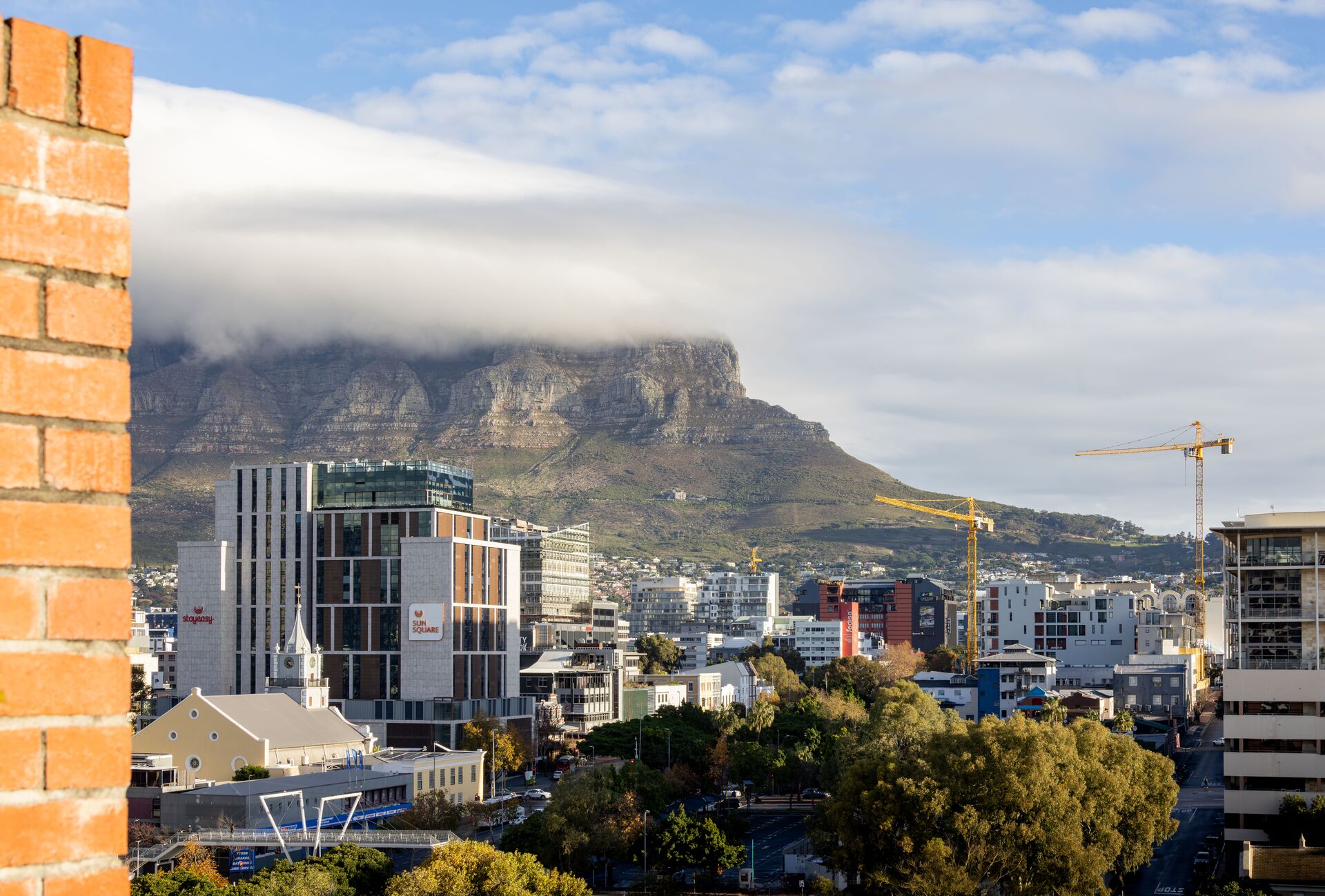
South Africa, Cape Town urban and the Table Mountain under clouds
Freedom Day: 27 April 1994. South Africa is the only country in Africa with three capitals: Pretoria, the seat of government; Cape Town, where parliament sits; and Bloemfontein, home of the Supreme Court of Appeal. It became a self-governing dominion of the British Empire in 1910, fully sovereign in 1931, and a republic outside the Commonwealth in 1961. For most of its people, none of those dates meant anything. They were given the vote for the first time on 27 April 1994.
Every other page in this series asks the same question: when did the colonial power leave?
In South Africa that question has no simple answer. The colonial power left, in stages, between 1910 and 1961. But it handed the country not to its people but to a white minority, which went on to build one of the most elaborate systems of racial rule the modern world has seen.
So South Africa has several independence dates, and each one answers a different question:
And between them sits a fifth kind of "independence," the strangest of all: the homelands that Pretoria declared independent so that millions of Black South Africans would stop being South African.
South Africa, Cape Town urban and the Table Mountain under clouds
South Africa was not an empty land waiting for settlers, whatever apartheid schoolbooks later claimed.
The San had lived here for tens of thousands of years; their rock art covers the Drakensberg and the Cederberg. The Khoekhoe herded cattle and sheep along the western and southern coasts. Bantu-speaking farmers, ancestors of today's Zulu, Xhosa, Sotho, Tswana, Venda and others, had settled the east and the interior by the first millennium.
At Mapungubwe, on the Limpopo, a kingdom trading gold and ivory with the Indian Ocean world flourished around a thousand years ago, centuries before any European ship arrived. The golden rhinoceros found there was hidden from the public for decades, because it did not fit the story the state wanted told.
The Portuguese sailed past in 1488. On 6 April 1652 Jan van Riebeeck landed at Table Bay for the Dutch East India Company, to build a supply station for ships bound for Asia.
It did not stay a supply station. Company servants were released to farm. From 1658 the Company imported enslaved people from Madagascar, Mozambique, India and the Indonesian islands, and for almost two centuries the Cape was a slave society. The Khoekhoe lost their land in a series of wars, and a smallpox epidemic in 1713 devastated them.
Out of the mix of European settlers, enslaved people, and Khoekhoe grew the communities later called "Coloured," and the language that became Afrikaans. It was first written down in Arabic script, by Muslim teachers of enslaved descent.
Britain took the Cape in 1795, returned it, and took it for good in 1806.
Britain abolished slavery at the Cape in 1834. It was one of the grievances, along with British law and land policy, that drove thousands of Dutch-speaking farmers, the Boers, to leave the colony in the Great Trek of the 1830s.
They moved into lands already occupied. On 16 December 1838, at Blood River, Trekkers defeated a Zulu army; the day was later turned into a religious holiday of Afrikaner nationalism. The Boers founded their own republics: the South African Republic (Transvaal) and the Orange Free State.
On the eastern frontier, Xhosa kingdoms fought the colonists in a series of wars lasting a century. In 1856–57 the cattle-killing movement, inspired by the prophecy of the young Nongqawuse, led to the slaughter of cattle and the destruction of crops. Tens of thousands of Xhosa people starved, and the colonial government used the catastrophe to take their land and labour.
In 1867 diamonds were found near Kimberley. In 1886 gold was found on the Witwatersrand, in the largest gold deposit ever discovered. Johannesburg grew from nothing in a decade.
Everything changed. The mines needed hundreds of thousands of cheap workers, and the system built to supply them, with migrant labour, pass laws, and closed compounds, became the foundation of everything that followed.
Britain wanted the gold fields. In January 1879 it invaded the Zulu kingdom and, at Isandlwana, suffered one of the worst defeats in its colonial history before crushing the Zulu later that year.
Then it turned on the Boers. The South African War of 1899–1902 was the largest war Britain fought between Napoleon and 1914. To break the Boer guerrillas, the British burned farms and moved civilians into concentration camps. Around 26,000 Boer women and children died in them. Black Africans were held in separate camps, and at least 14,000 of them died there too, a fact Afrikaner memory long ignored.
Britain won the war, and then gave the Boers much of what they had fought for.
On 31 May 1910 the four colonies became the Union of South Africa, a self-governing dominion. Louis Botha, a Boer general, became prime minister. The compromise between English and Afrikaner whites left out everyone else. Outside the Cape, Black South Africans had no vote, and the Cape's limited non-racial franchise was later abolished.
On 8 January 1912, in Bloemfontein, educated Black leaders founded the South African Native National Congress, renamed the African National Congress in 1923. It is older than almost every other liberation movement on this website.
The next year the Union passed the Natives Land Act of 1913, which reserved roughly 7 per cent of the country for the Black majority (later raised to about 13 per cent). Sol Plaatje wrote that the African had woken up on the morning after the Act to find himself a pariah in the land of his birth.
In 1931 the Statute of Westminster made South Africa legally sovereign, confirmed by South African law in 1934. By any legal definition, South Africa was independent. For the majority of its people, nothing had changed.
In 1948 the National Party won the white election on a single word: apartheid, "separateness."
What followed was not simply segregation, which South Africa already had. It was a legal system designed to control every part of life by race:
Resistance grew. In 1955, at Kliptown, the Congress Alliance adopted the Freedom Charter, which begins with the declaration that South Africa belongs to all who live in it. In August 1956 some 20,000 women marched on Pretoria against the pass laws.
On 21 March 1960, at Sharpeville, police opened fire on a crowd protesting the pass laws and killed 69 people, most of them shot in the back. The government banned the ANC and the Pan Africanist Congress.
In October 1960 white voters narrowly approved a republic in a referendum in which the majority could not vote.
On 31 May 1961, the anniversary of Union, South Africa became a republic and left the Commonwealth, where criticism of apartheid had become intolerable to Pretoria.
This is the date some would call South Africa's full independence from Britain. It was, in the most exact sense, a white republic's independence.
The ANC turned to armed struggle. Umkhonto we Sizwe was launched in December 1961. In 1964, at the end of the Rivonia trial, Nelson Mandela and other leaders were sentenced to life imprisonment. Mandela spent 27 years in prison, most of them on Robben Island.
This is the chapter that belongs on this website more than any other.
Apartheid's planners had a solution to the problem of a Black majority: make it disappear on paper. The Black population was divided into ten ethnic "homelands," or Bantustans, and each was to become "independent." Black South Africans would become citizens of these territories and lose their South African citizenship.
On 26 October 1976 Transkei was declared independent. Bophuthatswana followed in 1977, Venda in 1979 and Ciskei in 1981.
No country in the world recognised them, apart from South Africa itself. They had flags, anthems, presidents and embassies, which only Pretoria and the other homelands accepted. Some of them, like Bophuthatswana, were scattered across several separate pieces of land. Millions of people were stripped of their South African citizenship by these acts. They became "foreigners" in the country where they worked.
It was the most cynical use of the word independence in African history, and it was designed in Pretoria.
On 16 June 1976 schoolchildren in Soweto marched against being taught in Afrikaans. The police shot at them. Hector Pieterson, aged twelve, became the image of the day. The uprising spread across the country, and hundreds were killed.
In September 1977 Steve Biko, the leader of the Black Consciousness Movement, died in police custody after being beaten.
In the 1980s the townships rose. The United Democratic Front organised hundreds of civic groups. The government declared states of emergency, detained tens of thousands without trial, and used death squads. It fought wars in Namibia and Angola and raided neighbouring countries.
South Africa also built six nuclear weapons. It later became the only country ever to build nuclear weapons and then give them up voluntarily, dismantling them in 1989–1991, before the transition.
Abroad, sanctions and boycotts tightened. In sport, culture and banking, South Africa became isolated.
On 2 February 1990 President F. W. de Klerk announced the unbanning of the ANC and other movements. On 11 February 1990 Nelson Mandela walked out of prison.
The four years that followed were not peaceful. Around 14,000 people were killed in political violence between 1990 and 1994, much of it between the ANC and the Inkatha Freedom Party, with elements of the security forces fuelling the conflict. On 10 April 1993 the communist leader Chris Hani was assassinated by a white extremist, and the country came close to civil war. Mandela's televised appeal for calm is widely seen as the moment he became the country's real leader before he was its president.
On 27 April 1994 South Africans of every race voted together for the first time. The queues stretched for kilometres. The ANC won almost 63 per cent. On 10 May 1994 Nelson Mandela was inaugurated as president. The homelands were abolished and their people restored to citizenship.
This is the date South Africa celebrates as Freedom Day. It is the only one of its independence dates that included everyone.
The new state chose not to hold Nuremberg-style trials. The Truth and Reconciliation Commission, chaired by Archbishop Desmond Tutu, heard victims and offered amnesty to perpetrators who told the whole truth about politically motivated crimes.
It gave thousands of families answers they would never otherwise have had. It also left many without justice. Few of those who were refused amnesty were ever prosecuted, and victims' families are still going to court today over cases the state never pursued.
The democracy that followed achieved things that are easy to forget:
And failures that are impossible to ignore:
In May 2024 the ANC lost its majority for the first time, falling to about 40 per cent. Jacob Zuma's new MK party took nearly 15 per cent.
The ANC formed a Government of National Unity with the Democratic Alliance and other parties. Ramaphosa remained president.
This is the part of the page that is still happening.
The next test is close. Ramaphosa has declared Wednesday 4 November 2026, the date of the local government elections, a public holiday. The stakes are high because many municipalities are failing, and parties are campaigning on that failure. The EFF describes local government as being in deep and worsening crisis, DA leader Geordin Hill-Lewis promises to fix what is broken, and the ANC answers that it has not collapsed. Voter disillusionment is a serious concern: a government-appointed panel found that only 31 per cent of voters believe the electoral system truly reflects their will.
Corruption continues to shadow the state. The Madlanga Commission and a parliamentary ad hoc committee are both investigating alleged criminal cartel involvement and interference in the police and criminal justice system.
Relations with the United States have collapsed. President Trump imposed 30 per cent tariffs on most South African exports, berated Ramaphosa in the Oval Office over discredited claims of a "white genocide," and boycotted the G20 summit held in Johannesburg in November 2025, the first on African soil. The United States, as 2026 host, has made clear that South Africa will not be included in the G20 this year, even though South Africa is a full member. In March 2026 South Africa was also removed from the guest list for the G7 in France, having first been invited.
At the same time, Washington has largely frozen refugee admissions while creating an exception for white Afrikaners, and announced it would admit 10,000 more in 2026, bringing the total to 17,500.
The disputes go beyond race. They include South Africa's genocide case against Israel at the International Court of Justice, its BRICS membership, and its land expropriation law. South African officials and Afrikaner leaders alike have rejected the claim that white farmers are being targeted for genocide. Violent crime on farms is real, as it is across the whole country; the evidence does not show that it is aimed at one race.
Because South Africa shows that independence and freedom are not the same thing.
South Africa was legally independent from 1931. It was a republic from 1961. By the standards of most countries on this website, it had been decolonised for decades before its majority could vote. And its government used the language of independence itself, through the homelands, as a weapon against its own people.
It also shows the other side of the coin. When freedom finally came, it came through negotiation, not through the collapse of the state. The white minority gave up power without a civil war, and the Black majority chose not to take revenge. Very few countries have managed a transition like that.
Several truths sit badly with each side of South Africa's arguments.
For the old order: apartheid was not a misunderstanding or a form of "separate development" that went wrong. It was a system designed to keep land, wealth and power in white hands by force. The homelands were a legal fraud. The security state killed, tortured and bombed. Many of the men responsible died in comfort, without ever facing a court.
For the liberation movement: the ANC's exile camps, including Quatro in Angola, saw torture and executions of its own members, as the ANC's own commissions admitted. In the 1980s the "necklacing" of suspected collaborators killed hundreds. After 1994 the party that ended apartheid presided over AIDS denialism, Marikana, state capture and the decay of basic services. Much of the damage of the last thirty years was done by South Africans to South Africans, in government.
For the world: Britain built the system of land dispossession and migrant labour, and handed power to a white minority in 1910 knowing what it was doing. Western governments, including the United States and Britain in the 1980s, treated apartheid South Africa as a Cold War ally and the ANC as a terrorist organisation; Mandela remained on a US terrorism watch list until 2008. Today the United States accuses South Africa's democratic government of racism against whites, while having protected apartheid for most of its existence.
And one truth for everyone: the land question is not settled. A national land audit in 2017 found that white South Africans, about 7 per cent of the population, held the large majority of privately owned farmland. How to change that without destroying food production or property rights is the hardest question in South African politics. It will not be answered by slogans from either side.
There is a golden rhinoceros from Mapungubwe, hidden from the public for decades because it did not fit the story.
There is a cell on Robben Island, a little over two metres long.
There is a Transkei passport, from a country no one recognised.
There is a photograph of a dying twelve-year-old being carried through Soweto.
There are the empty lots where District Six stood, left unbuilt for years after the bulldozers.
There are six nuclear weapons that no longer exist.
There are the ballot papers of 27 April 1994, and the queues that stretched for kilometres.
There are the names of 34 miners shot at Marikana, under a government elected by their parents.
There is a local election on 4 November 2026, a coalition government trying to survive it, and a superpower that has shut South Africa out of the G20.
And there are three capitals, Pretoria, Cape Town and Bloemfontein, a compromise from 1910 that the country still lives with, like so much else from that year.
Updated and fact-checked: 17 September 2026.
How this page was checked. Recent events were verified against the sources listed above; the historical record was checked against standard reference works on South African history. The founding of the Cape station on 6 April 1652, the abolition of slavery at the Cape in 1834, the Battle of Blood River on 16 December 1838, the Battle of Isandlwana on 22 January 1879, the discovery of gold in 1886, the Union of 31 May 1910, the founding of the SANNC on 8 January 1912, the Natives Land Act of 1913, the Statute of Westminster of 1931, the National Party victory of 1948, the Freedom Charter of 26 June 1955, the Sharpeville massacre of 21 March 1960, the Republic of 31 May 1961, the Rivonia sentences of June 1964, the Soweto uprising of 16 June 1976, the declared "independence" of Transkei on 26 October 1976 and of Bophuthatswana, Venda and Ciskei, the death of Steve Biko in September 1977, the unbanning of 2 February 1990, Mandela's release on 11 February 1990, the assassination of Chris Hani on 10 April 1993, the election of 27 April 1994, the inauguration of 10 May 1994, the Marikana killings of 16 August 2012 and the formation of the Government of National Unity in 2024 are as recorded. Casualty figures are estimates and are given as approximate where they are disputed: deaths in the concentration camps of the South African War (around 26,000 Boer civilians and at least 14,000 Black Africans); deaths in political violence from 1990 to 1994 (around 14,000); the estimated cost of AIDS denialism (more than 330,000 lives, from a Harvard School of Public Health study); deaths in the July 2021 unrest (more than 350). Claims of a "white genocide" in South Africa are recorded as claims; they are rejected by the South African government and Afrikaner leaders and are not supported by the evidence. This page makes no allegation against any living person beyond matters already on the public record.
Written and researched by Remo Kurka · africanindependence.com
Updated and fact-checked: 17 September 2026.
How this page was checked. Recent events were verified against the sources listed above; the historical record was checked against standard reference works on South African history. The founding of the Cape station on 6 April 1652, the abolition of slavery at the Cape in 1834, the Battle of Blood River on 16 December 1838, the Battle of Isandlwana on 22 January 1879, the discovery of gold in 1886, the Union of 31 May 1910, the founding of the SANNC on 8 January 1912, the Natives Land Act of 1913, the Statute of Westminster of 1931, the National Party victory of 1948, the Freedom Charter of 26 June 1955, the Sharpeville massacre of 21 March 1960, the Republic of 31 May 1961, the Rivonia sentences of June 1964, the Soweto uprising of 16 June 1976, the declared "independence" of Transkei on 26 October 1976 and of Bophuthatswana, Venda and Ciskei, the death of Steve Biko in September 1977, the unbanning of 2 February 1990, Mandela's release on 11 February 1990, the assassination of Chris Hani on 10 April 1993, the election of 27 April 1994, the inauguration of 10 May 1994, the Marikana killings of 16 August 2012 and the formation of the Government of National Unity in 2024 are as recorded. Casualty figures are estimates and are given as approximate where they are disputed: deaths in the concentration camps of the South African War (around 26,000 Boer civilians and at least 14,000 Black Africans); deaths in political violence from 1990 to 1994 (around 14,000); the estimated cost of AIDS denialism (more than 330,000 lives, from a Harvard School of Public Health study); deaths in the July 2021 unrest (more than 350). Claims of a "white genocide" in South Africa are recorded as claims; they are rejected by the South African government and Afrikaner leaders and are not supported by the evidence. This page makes no allegation against any living person beyond matters already on the public record.
Written and researched by Remo Kurka · africanindependence.com
We strive to unify diverse narratives from across Africa, showcasing the continent's shared heritage and unique stories.
Our mission is to honor and preserve the history of African cultures and independence movements for future generations.
We provide a platform for innovative exchange of ideas, resources, and insights, understanding that knowledge should be accessible to all.