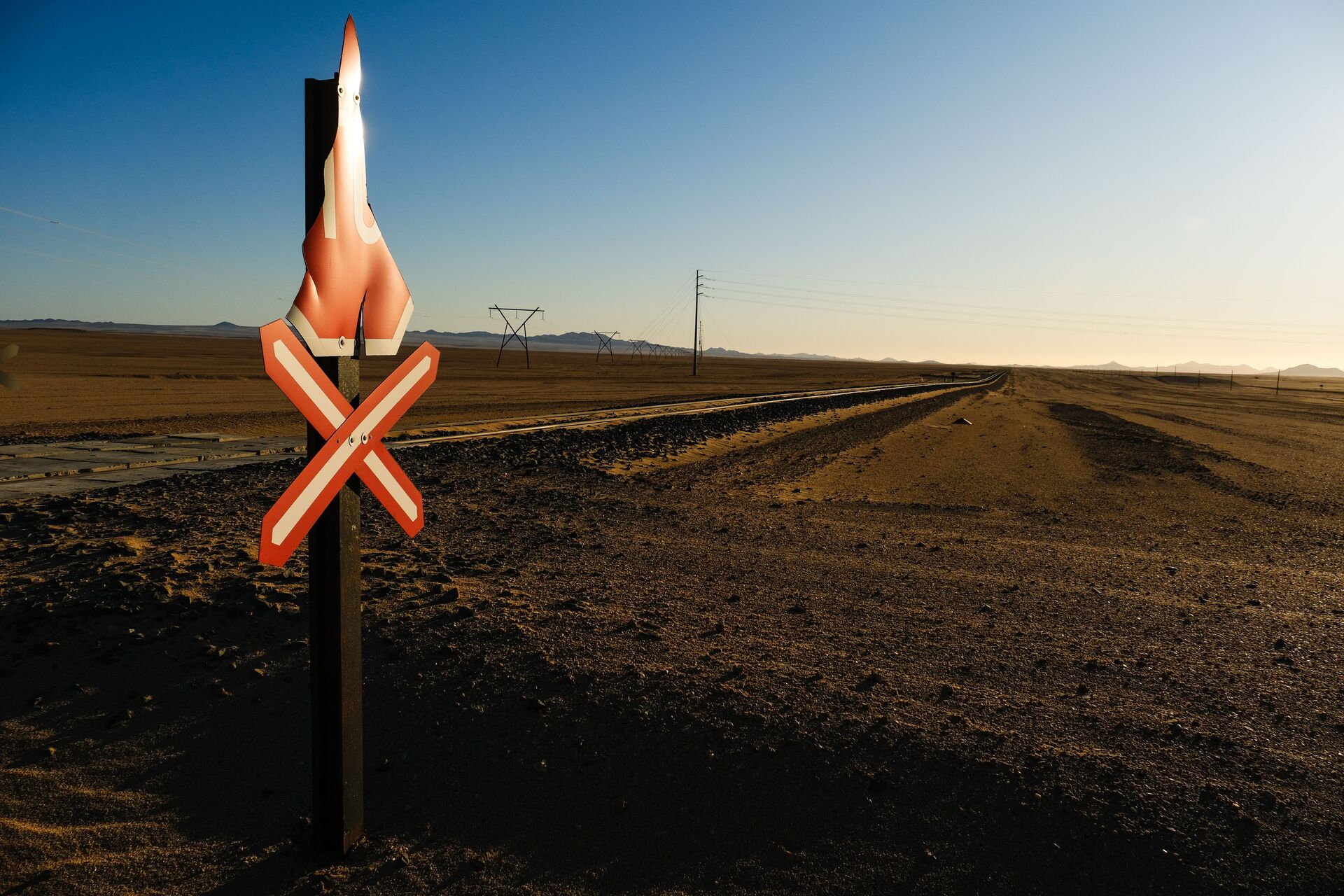
Namibia, desert railroad with a warning sign
Independence Day: 21 March 1990 — the last mainland African country to become free. Between 1904 and 1908 the German Empire killed roughly eighty per cent of the Herero people and half of the Nama, under a written extermination order, in a desert it sealed, and in camps it called concentration camps. Germany did not use the word genocide until 2021. It still refuses the word reparations. And the descendants of the dead were not in the room when the two governments agreed what the crime was worth.
This is the page where German colonialism stops being a footnote.
Germany held colonies for barely thirty years and lost them all in 1918, which is why Germans of every generation since have been able to treat the colonial period as a brief and marginal episode — something that happened before the thing that really happened.
It was not marginal. It was the first genocide of the twentieth century, and it was rehearsed here. The vocabulary, the camps, the racial science, the skull collections in German university institutes, the idea of living space for settlers, and several of the actual people — all of it is documented, all of it is in German archives, and a substantial part of it is still in German museum storerooms.
This network has spent this year documenting what it takes to get anything back from a European collection, and has looked at eight cases that worked. Namibia is the one where a European state has come closest to a full reckoning and still cannot say the word.
Before the Germans, this was not empty and it was not simple.
The Nama and related Oorlam groups, Khoekhoe-speaking, moved north across the Orange River in the early nineteenth century, mounted and armed, and established themselves in the centre and south. Jonker Afrikaner built a power base at what became Windhoek.
The Herero were cattle pastoralists in the central highlands, with wealth measured in herds and a social order built around them. The Herero and the Nama fought each other for decades over cattle and grazing, in wars that the Germans would later exploit and that Namibians still discuss carefully.
The Damara, the San, the Rehoboth Basters and, in the far north, the densely settled Ovambo kingdoms — which the Germans barely penetrated, and whose people would later supply the contract labour that replaced the populations Germany destroyed.
Hendrik Witbooi, the Nama leader, kept diaries. They survive, they are on the UNESCO Memory of the World register, and they are one of the very few African accounts of the colonial encounter written by a leader as it happened.
Namibia, desert railroad with a warning sign
By fraud, and then by declaration.
In 1883 the Bremen merchant Adolf Lüderitz bought coastal land from a Nama captain, paid in goods and guns, with the area measured in "miles". The Nama understood English miles. Lüderitz meant German geographical miles — about 7.4 kilometres each, more than four times as much. The trick is remembered in Namibia as the Meilenschwindel, the mile swindle, and it is the founding transaction of the colony.
In April 1884 Bismarck declared the territory under German protection. That winter, Berlin hosted the conference that divided the rest of the continent.
The city that is now negotiating what the genocide is worth is the city where the partition of Africa was chaired.
What followed was a settler colony. So-called protection treaties with individual chiefs, played off against each other. Land taken for farms. Cattle taken for debts. A rinderpest epidemic in 1897 destroyed perhaps half the Herero herds and with them the basis of Herero independence, and settlers bought up what was left at collapse prices.
Then came the Credit Ordinance of 1903, which gave traders one year to collect all outstanding African debts. The result was a year of mass seizure — of cattle, and of the last land.
Add to that a colonial legal system in which German men were not convicted for the rape of African women, and plans to confine the Herero to reserves, and the position by the end of 1903 was that the Herero had a year left as a people with property.
Herero leaders had been meeting since at least April 1903. The rising began in January 1904, while most German troops were in the south suppressing a Nama Bondelswarts revolt.
And here is a detail that matters, because of what was later built on it.
Samuel Maharero's order specified who was not to be harmed: the English, the Boers, the Nama, the Basters, the Damara, and the missionaries. Only Germans were to be attacked.
German colonial circles concluded from this that Britain was behind the uprising, and the claim entered German colonial literature and has stayed there. It has never been substantiated. The documented causes are the ones above — land, cattle, debt, the credit ordinance, and the absence of the troops — and the planning predates any British involvement anyone has been able to show.
What can be documented about Britain is less dramatic and more damning. British officials in the Cape Colony watched the genocide from next door and were principally concerned that it might unsettle Africans in their own territories. Britain sent troops to Walvis Bay, its enclave inside the German colony, to protect its own interests. And in 1918, when Germany's colonies were being confiscated, Britain published the Blue Book — a detailed documentation of German atrocities in South West Africa, compiled precisely because it was politically useful.
Then, in 1926, having acquired the territory and needing to reconcile the German settlers who remained, the administration withdrew the Blue Book and ordered copies destroyed.
Britain documented the genocide when it was useful and suppressed the documentation when it was not. That is a sentence worth keeping.
On 11 August 1904 at Waterberg, the German commander Lieutenant General Lothar von Trotha engaged the main Herero concentration — tens of thousands of people, fighters and families and herds together.
The battle was inconclusive as a battle. What mattered was the shape of the German deployment: the encirclement was left open in one direction, towards the Omaheke, the sandveld at the edge of the Kalahari.
The Herero were driven into it. German patrols occupied or sealed the waterholes along the desert edge and shot those who came back for water.
On 2 October 1904 von Trotha issued the Vernichtungsbefehl — the extermination order — proclaimed to the Herero people. It declared that the Herero were no longer German subjects, that they must leave the land, that every Herero found within the German borders, with or without a rifle, would be shot, and that women and children would be driven back or fired upon.
It is one of the very few written extermination orders in the history of colonialism, issued by a commanding general, published, and preserved in the German archives.
It was so explicit that it caused unease in Berlin. In December 1904 the Chancellor had it revoked — and replaced with a policy of internment.
That was not mercy. It was the camps.
Survivors who surrendered, and Nama who rose the following year under Hendrik Witbooi — who was killed in 1905, aged around eighty — were placed in Konzentrationslager at Windhoek, Swakopmund, Karibib, Okahandja and, above all, at Shark Island at Lüderitz.
Shark Island was a peninsula of bare rock in the South Atlantic, exposed to wind and freezing spray, with no shelter. Prisoners were worked on harbour construction and on the railway. Mortality was catastrophic — reported by German officials themselves at rates that made it clear nobody was expected to leave. Namibians call it the death island.
Forced labour built the Otavi railway. Prisoners were issued numbered metal tags.
And the dead were used. Skulls and other remains were shipped to Germany for the racial anthropology of the day, to universities and to private collectors. There are accounts — including from the women themselves — of female prisoners being made to clean the flesh from the skulls of their own dead with shards of glass before the skulls were packed for shipping.
Eugen Fischer conducted his study of the Rehoboth Basters here in 1908. The book he produced from it, published in 1913, argued for the biological consequences of racial mixing and against it. Fischer went on to direct the Kaiser Wilhelm Institute for Anthropology, Human Heredity and Eugenics in Berlin, and to teach Josef Mengele. His work was read in Germany in the 1920s by people who would legislate on race in the 1930s.
Historians argue about how direct the line from Windhoek to Auschwitz is, and the argument is serious and unresolved. What is not in dispute is that the personnel, the institutions, the collections and the ideas existed and were continuous.
The camps were closed on 28 May 1908. Namibia now marks that date as Genocide Remembrance Day.
The pre-war Herero population is generally estimated at around 80,000. The German census of 1911 recorded 15,000 to 18,000.
The pre-war Nama population is estimated at around 20,000. Afterwards, around 9,000 to 10,000.
Roughly 65,000 Herero and at least 10,000 Nama were killed — about eighty per cent and fifty per cent of each people.
Survivors were forbidden to own land or cattle, forbidden to gather, and required to wear the metal labour tags. The basis of Herero existence as a people was abolished by decree after the killing stopped.
One thing has to be said here, and it is uncomfortable in Britain rather than in Germany.
The Germans did not invent the concentration camp, and they knew exactly where the model came from.
Spain used reconcentración in Cuba in 1896. And between 1900 and 1902, during the South African War, Britain interned Boer civilians — overwhelmingly women and children — to break the commandos in the field by removing their support. Around 26,000 to 28,000 Boer women and children died in those camps, mostly of disease, and the British nurse and campaigner Emily Hobhouse exposed the conditions and forced an official inquiry.
And there were separate camps for Black Africans, in which at least 14,000 to 20,000 people died. Those camps are still routinely left out of the count, including in South Africa.
That was two years before Shark Island, in the territory immediately next door, and it was known to every officer in southern Africa.
Where does this leave the German case? Exactly where it was. The British camps were a policy of attrition against a white population Britain intended to rule afterwards and did. Von Trotha's order was a policy of extermination against a people he stated should cease to exist, and roughly eighty per cent of them did. The categories are not the same.
But the transnational point stands, and serious historians now insist on it: German colonial violence was not exceptional in kind. It sat inside a European practice that Britain, Spain, France, Belgium, Italy and Portugal all contributed to. Treating Windhoek as a uniquely German aberration lets everybody else off, and this website has spent a year documenting what everybody else did.
The second point is the one that carries: Germany's relations with the Boers were warm — the Kaiser's telegram congratulating Kruger after the Jameson Raid in 1896 caused a genuine crisis with London, and German public opinion was strongly pro-Boer. Germany stayed formally neutral during the war itself. But the rivalry in southern Africa was real, and it shaped what both empires did and what each chose to publish about the other.
In 1915, during the First World War, South African forces took the territory. In 1920 it became a League of Nations Class C Mandate under South African administration — the category reserved for territories deemed least capable of self-government.
South Africa never left voluntarily. It refused to convert the mandate into a UN trusteeship in 1946, extended apartheid legislation to the territory, and in 1964 adopted the Odendaal Plan to divide it into ethnic homelands.
The economy ran on the contract labour system: Ovambo men recruited in the north on fixed contracts, sent south to the mines and farms, housed in compounds, forbidden to bring families, unable to change employer. The general strike against it in 1971–72 was the largest labour action in Namibian history and the beginning of mass nationalist politics.
The UN General Assembly revoked the mandate in 1966, and in 1971 the International Court of Justice held that South Africa's continued presence was illegal and that states should recognise no acts performed by it there. South Africa ignored both for nineteen more years.
SWAPO, founded in 1960 out of the Ovamboland People's Organisation, began armed action on 26 August 1966 at Omugulugwombashe — now Namibia's Heroes' Day.
The war ran for twenty-four years, largely from bases in Angola and Zambia, and after 1975 it became entangled with the Angolan civil war and the Cuban deployment there.
On 4 May 1978, South African paratroopers and aircraft attacked Cassinga in southern Angola. Pretoria called it a SWAPO military headquarters; SWAPO and the UN called it a refugee camp. Around 600 people were killed, a large proportion of them women and children. Namibia marks it as Cassinga Day.
UN Security Council Resolution 435 of 1978 set out the plan for a ceasefire, a UN transition assistance group and free elections. It sat unimplemented for eleven years, because South Africa linked Namibian independence to the withdrawal of Cuban forces from Angola.
The linkage was finally resolved in the New York Accords of December 1988. Elections were held in November 1989. Namibia became independent on 21 March 1990, with Sam Nujoma as president.
Walvis Bay — the deepwater port, the British enclave of the nineteenth century — was retained by South Africa until 1994.
This page will not skip it.
During the exile years, SWAPO detained large numbers of its own members in Angola — at Lubango and elsewhere — as suspected South African spies. They were held in pits, tortured to extract confessions, and many died or disappeared. Estimates run into the hundreds and beyond; the exact number is unknown because there has never been an accounting.
Some survivors were released at independence and formed the Breaking the Wall of Silence movement. Namibia's policy of national reconciliation covered this too: no inquiry, no prosecutions, no list of the dead.
Families of the disappeared are still asking, thirty-six years on, and the party that holds power is the party that held them.
Nujoma's government adopted a policy of national reconciliation that was genuinely important. There were no reprisals, no expulsions, and the German and Afrikaner communities stayed.
It also meant that nothing was returned.
At independence, something in the order of seventy per cent of Namibia's commercial farmland was owned by a white minority of a few per cent of the population, much of it land taken from the Herero and Nama in the decade before 1908 and from others afterwards.
Land reform has proceeded on a willing buyer, willing seller basis, with a resettlement programme that has moved a modest fraction of what was planned. A national land conference in 2018 debated expropriation with compensation; movement since has been limited.
Namibia is among the most unequal countries on earth by income, and the pattern of that inequality is a direct map of who owned what in 1908.
Now the part that is live.
Germany's formal position for most of the twentieth century was silence. A minister expressed regret in Windhoek in 2004, on the centenary, without binding Berlin. Human remains were returned in ceremonies in 2011, 2014, 2018 and 2022 — skulls and skeletons from German university and museum collections, received in Namibia with state honours and, on at least one occasion, handled by the German side in a manner that Namibian delegates found so dismissive that they said so publicly.
Formal negotiations began in 2015.
In May 2021 the two governments announced a Joint Declaration. Germany acknowledged that the events constituted genocide, apologised, and committed €1.1 billion over thirty years for development projects in the affected regions.
And Germany stated explicitly that this was not reparations, because acknowledging a legal obligation to pay would open a category with no clear floor. Berlin's legal argument is that the 1948 Genocide Convention cannot be applied retroactively.
The declaration was rejected. The Namibian parliament did not ratify it. Herero and Nama traditional authorities and descendant organisations rejected it on two grounds: that it is aid rather than reparation, and — more damagingly — that they were not parties to the negotiation. It was agreed between two governments, about a crime committed against two specific peoples, without those peoples at the table.
Attempts to bring claims in United States courts were unsuccessful.
Where it stands in 2026:
A revised joint declaration has been negotiated. President Netumbo Nandi-Ndaitwah, who took office on 21 March 2025 as Namibia's first female president, told parliament in April 2026 that the chiefs' forum and a technical task force have reviewed it, that it will be tabled in the National Assembly before signature, and that she expects conclusion before the end of 2026. She has said the revised text provides that support will not be limited to a single payment but will remain open for long-term healing.
Germany still does not accept the term reparations.
And the descendants still reject it. Descendant organisations have put a figure of N$17 trillion on their claim, and the Genocide Reparations Advocacy Forum has publicly questioned whether the president can represent them at all, stating that most descendants have rejected the joint declaration.
Meanwhile the African Union has declared a Decade of Reparations 2026–2036, and in April 2026 a United Nations resolution recognised transatlantic enslavement as the gravest crime against humanity. Namibia is the test case for all of it.
Because Namibia is where the argument about colonial accountability is furthest advanced anywhere in the world, and it is still stuck on a word.
Germany has done more than Britain, France, Belgium, Italy, Spain or Portugal. It has apologised. It has said genocide. It has returned human remains. It has put a billion euros on the table.
And it will not say reparations, because reparations is a legal category with consequences, and aid is a budget line. Everything else — the apology, the ceremonies, the remains — Berlin can control. The word it cannot.
That is the precise point at which every claim this network follows eventually arrives. Italy paid Libya five billion dollars and called it a treaty about the colonial period. Britain paid 5,228 Kenyans and expressed regret without admitting liability. France returned King Toera's skull under a general law about human remains rather than an admission about a killing.
The pattern is consistent: European states will pay, and will not concede the principle that they owe.
And Namibia adds the second lesson, which this network drew from Kumasi and from Chagos and now has a third example of: the people the remedy is for are not in the room. The Chagossians were not at the 2025 treaty. The freed of 1835 got nothing while their owners were compensated. The Herero and Nama were not parties to the 2021 declaration.
Three continents, three centuries, one procedure.
The Herero and Nama fought each other before the Germans came, and the Germans used it, and the Nama did not rise until the Herero had already been destroyed. Namibians discuss this; outsiders should be careful with it.
The Ovambo, who are today the largest group and who dominate the state and SWAPO, were not subjected to the genocide — the Germans barely reached the north. That is a live fault line in Namibian politics: the reparations issue concerns two peoples who are now minorities, negotiated by a government led by a third.
The British camps came first, and Britain then documented the German genocide when it was useful and destroyed its own documentation when it was not.
SWAPO tortured and disappeared its own people in Angola, and the government that demands accountability from Berlin has never provided any for Lubango.
And Namibia is a functioning democracy with a free press, peaceful transfers of power, an independent judiciary and a president who took office by ballot. It is one of the better-governed states on this continent, and it did that within thirty-six years of a war.
Two things are true. Germany has gone further than any other European power towards reckoning with a colonial crime. And it has spent five years refusing one word, while the last people who heard the survivors' testimony directly are dying.
There is a diary written by a Nama captain as it happened, now on the UNESCO Memory of the World register.
There is a land purchase measured in miles that meant something else.
There is a conference held in Berlin in the winter of 1884 that divided a continent, in the city where the bill is now being discussed.
There is a credit ordinance from 1903 that gave traders a year to take everything.
There is an order from Samuel Maharero in January 1904 that exempted the English, the Boers, the Nama, the Basters, the Damara and the missionaries.
There is a battle at Waterberg on 11 August 1904 in which the encirclement was left open on one side.
There are waterholes on the edge of the Omaheke that were occupied and sealed.
There is a proclamation dated 2 October 1904 stating that every Herero found within the German borders would be shot, with or without a rifle.
There is a rock peninsula at Lüderitz with no shelter on it.
There are numbered metal tags issued to prisoners.
There are women who were made to scrape their own dead clean with glass so the skulls could be crated.
There is a scientist who studied people here in 1908, ran an institute in Berlin, and taught Mengele.
There is a date — 28 May 1908 — when the camps closed, and a country that now stops on it.
There is a British Blue Book from 1918 that documented all of it, and an order in 1926 to destroy the copies.
There are pits at Lubango that SWAPO has never accounted for.
There is seventy per cent of the farmland.
There is a declaration signed in 2021 by two governments about a crime committed against two peoples who were not present.
And there is a figure of N$17 trillion, and a figure of €1.1 billion, and a word that Berlin will not use.
Updated and fact-checked: 15 September 2026.
How this page was checked. Current negotiations were verified against the Namibian reporting and analysis listed above; the colonial history was checked against standard scholarly works on German South West Africa and against the sources cited. The Lüderitz land purchase of 1883 and the discrepancy over the measurement of miles, the German declaration of protection in 1884, the rinderpest epidemic of 1897, the Credit Ordinance of 1903, the Herero leaders' meetings at Okahandja in 1903, the Bondelswarts revolt of October 1903, the outbreak of the Herero uprising in January 1904 and the terms of Samuel Maharero's order, the Battle of Waterberg on 11 August 1904, von Trotha's extermination order of 2 October 1904 and its revocation by Berlin in December 1904, the concentration camps at Shark Island and elsewhere, the shipment of human remains to Germany, Eugen Fischer's 1908 study and his subsequent career, the closure of the camps on 28 May 1908, the South African occupation of 1915, the Class C Mandate of 1920, the publication of the British Blue Book in 1918 and its withdrawal in 1926, the UN revocation of the mandate in 1966 and the ICJ opinion of 1971, the start of SWAPO's armed struggle on 26 August 1966, the Cassinga raid of 4 May 1978, Resolution 435 of 1978 and the New York Accords of 1988, independence on 21 March 1990, the transfer of Walvis Bay in 1994, the returns of human remains from German collections, the Joint Declaration of May 2021 and its rejection, and the state of negotiations in 2026 are as recorded. Casualty figures are estimates and are given as such: the pre-war Herero population is generally estimated at around 80,000 and the 1911 census recorded 15,000 to 18,000; the pre-war Nama population is estimated at around 20,000, with around 9,000 to 10,000 afterwards; the resulting figures of approximately 65,000 Herero and at least 10,000 Nama killed, and proportions of about 80 and 50 per cent, are the estimates in general scholarly use. Deaths in the British camps of the South African War are generally estimated at 26,000 to 28,000 Boer civilians and at least 14,000 to 20,000 Black Africans held in separate camps; the latter figure is widely regarded as an undercount. Deaths at Cassinga in 1978 are generally given as around 600 and the character of the camp is disputed between the parties. The claim, originating in German colonial literature, that the 1904 uprising was instigated by Britain has not been substantiated by historians and is recorded here as an unproven contemporary allegation; the documented causes were land and cattle expropriation, the Credit Ordinance of 1903 and the absence of German troops in the south. Allegations concerning the detention, torture and disappearance of SWAPO members in Angola during the exile period are those of survivors and of the Breaking the Wall of Silence movement; no official inquiry has ever been held and no figures have been established. The scholarly debate over the degree of continuity between German colonial violence in South West Africa and later German history is unresolved, and this page records the documented continuities of personnel, institutions and collections without asserting a conclusion. This page makes no allegation against any living person beyond matters already on the public record.
Written and researched by Remo Kurka · africanindependence.com
We strive to unify diverse narratives from across Africa, showcasing the continent's shared heritage and unique stories.
Our mission is to honor and preserve the history of African cultures and independence movements for future generations.
We provide a platform for innovative exchange of ideas, resources, and insights, understanding that knowledge should be accessible to all.