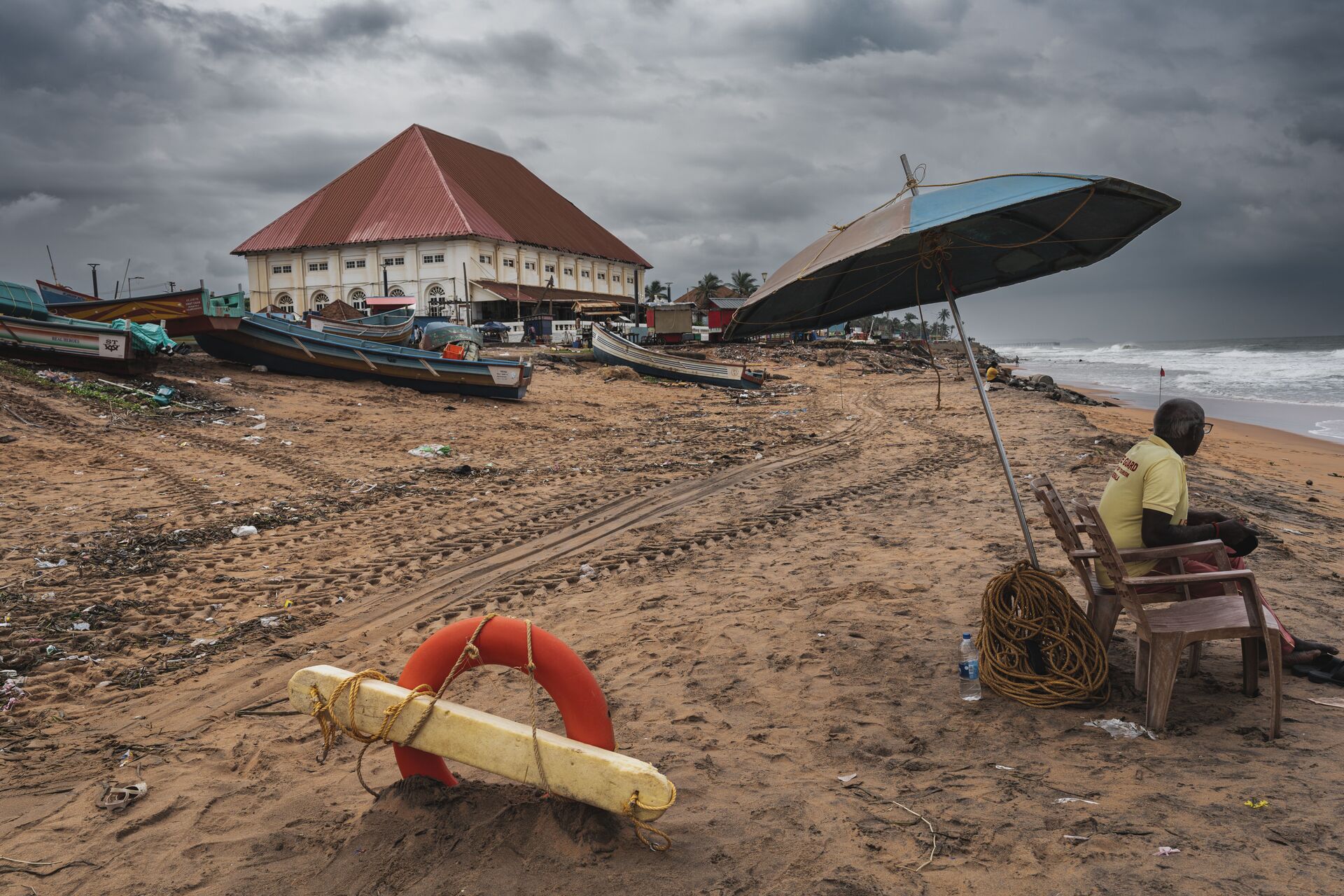
Togo, beach near Lome
Independence Day: 27 April 1960, from France. The capital is Lomé, on the Atlantic, pressed right against the border with Ghana. Togo is one of the smallest countries in Africa, about 57,000 square kilometres, and one of the few where a single family has held power without interruption for nearly six decades: Gnassingbé Eyadéma from 1967 to 2005, and his son Faure Gnassingbé ever since. In 2025 a new constitution gave the son an office with no term limit at all.
Togo is where two of this continent's stories begin.
It is where Africa's era of coups began.
On 13 January 1963, Sylvanus Olympio, the first president of independent Togo, was shot dead outside the American embassy in Lomé. It was the first coup against an elected African government after independence, and dozens followed across the continent.
And it is where a German colonial idea was tested. Berlin called Togoland its Musterkolonie, the model colony. What it modelled is worth knowing.
The land that became Togo was never one kingdom. It was a corridor between the Asante in the west and Dahomey in the east, and the peoples in it largely lived in towns and chiefdoms rather than empires.
In the south are the Ewe, whose tradition tells of a flight from the walled town of Notsé, from a ruler named Agokoli, with the people escaping through a hole in the wall. The Ewe spread west and east, which is precisely why they later ended up in three colonies at once.
On the coast at Aného live the Mina, descendants in part of people who came from the Gold Coast, including from around Elmina, which is where the name comes from.
In the centre and north are the Tem or Kotokoli around Sokodé, the Kabye of the mountains, the Tchamba, the Bassar ironworkers, and many others.
And this coast has a second name in history: the Slave Coast. At Agbodrafo, the house known as Woold Home, where captives were held before being taken out to the ships, is still standing and can still be visited. It is one of the very few surviving slave-holding houses in West Africa outside the great forts.
Togo, beach near Lome
On 5 July 1884 the German explorer Gustav Nachtigal signed a treaty at Togoville, on Lake Togo, with a local ruler known as Mlapa III. Germany declared a protectorate, and the name of that village became the name of a country.
Berlin was proud of Togoland. It was the one German colony that paid for itself. It got railways running inland from Lomé, a modern port for the time, cocoa, coffee, cotton and palm plantations, and mission schools that produced a literate African elite.
That is one half of the picture, and here is the other. The colony paid for itself because the labour was forced and unpaid, because taxes were collected under threat, and because the standard punishment was the whip. Corporal punishment was administered routinely and on a scale that shocked even some German officials. Chiefs who refused to deliver workers were removed, and revolts were put down by force.
Near Atakpamé the Germans built the Kamina wireless station, one of the most powerful transmitters in the world at the time, which connected Berlin with its African and Atlantic communications.
That station is the reason the First World War came here first. In August 1914 British and French forces invaded Togoland. The Germans destroyed the transmitter on 24–25 August and surrendered the next day. Togoland was the first German territory to fall in the First World War, in a campaign of three weeks.
After the war, Britain and France divided Togoland between them, a split confirmed by League of Nations mandates in 1922 and later by UN trusteeship.
The border cut straight through the Ewe country. From then on Ewe families lived in British Togoland, in French Togoland, and in the neighbouring Gold Coast. A movement for Ewe unification grew on both sides and was never granted.
In May 1956 the people of British Togoland voted in a UN-supervised plebiscite. The question was whether to join the Gold Coast, which was about to become Ghana, or to stay under trusteeship pending the future of French Togoland. Union with the Gold Coast won with about 58 per cent, carried by the north; much of the Ewe south voted the other way.
That vote is why the Volta Region is part of Ghana today, and why a Ghanaian in Ho and a Togolese in Kpalimé may belong to the same family and speak the same language in two different countries. The losing side never fully accepted the result, and the question surfaced again in Ghanaian politics decades later.
In French Togoland, elections supervised by the United Nations in 1958 were won by Sylvanus Olympio and his party, the Comité de l'Unité Togolaise, against the candidates France favoured.
On 27 April 1960 Togo became independent, with Olympio as its leader.
Olympio was a businessman, educated in Britain, formerly of the United Africa Company, and he governed with a strong sense of independence from Paris. He kept his distance from France, argued for a Togolese currency, and cut spending.
One of the things he refused to spend money on was the army. Hundreds of Togolese soldiers who had served France in Indochina and Algeria came home wanting to be enlisted in the new national army, which Olympio, with a tiny budget, would not do.
On 13 January 1963 a group of those soldiers killed him outside the United States embassy in Lomé, where he had gone in the night. Among them was a sergeant named Étienne Eyadéma, who later said publicly that he had fired the shot.
It was the first assassination of an elected head of state in independent Africa, and the beginning of the age of the coup.
Nicolas Grunitzky, Olympio's brother-in-law and rival, was installed as president. On 13 January 1967, exactly four years later, Eyadéma took power himself.
He held it for thirty-eight years, until his death in 2005. It was, at that point, the longest rule of any leader in Africa.
His system had all the furniture of the era: a single party, the RPT, from 1969; a personality cult with songs, portraits and youth dance troupes; and an "authenticity" campaign that changed European names to African ones, including his own, from Étienne to Gnassingbé.
In 1974 he survived a plane crash at Sarakawa, near his home village. The crash was turned into a national miracle, complete with a monument and an annual holiday, and shortly afterwards Togo nationalised the phosphate industry, its main export. Whether the two events were connected in the way the state suggested is another matter.
Under Eyadéma, opponents were jailed, tortured or driven abroad. Togo also became a reliable friend of France and of the West, which is why the aid kept coming for a long time.
In 1991, as one-party states fell across Africa, a national conference in Lomé stripped Eyadéma of his powers and set up a transitional government. For a few months, Togo looked like Benin next door, where a national conference had peacefully removed the ruler.
It did not last. The army attacked the transitional institutions, and Eyadéma clawed back control. In 1993 the violence around a disputed election drove an estimated 300,000 Togolese into Ghana and Benin. The European Union suspended most cooperation with Togo for more than a decade.
Benin managed the transition; Togo did not. Two neighbours, the same year, opposite outcomes.
Eyadéma died on 5 February 2005. Within hours, the army installed his son, Faure Gnassingbé, as president, in plain breach of the constitution.
ECOWAS and the African Union called it a coup and imposed sanctions. Faure stepped down, then stood in an election in April 2005 and was declared the winner.
The violence around that election killed several hundred people, by United Nations estimates, and drove tens of thousands into Ghana and Benin. A later truth commission recommended reparations, and some payments were made.
Faure Gnassingbé then governed for twenty years: re-elected in 2010, 2015 and 2020; a constitutional change in 2019 that reset the term limits so he could run twice more; protests in 2017 and 2018, led by Tikpi Atchadam and the opposition coalition C14, that were broken up with tear gas, internet shutdowns and deaths.
Public demonstrations have been banned in Togo since 2022, after a deadly attack at Lomé's main market.
Then came the change that makes Togo a special case even by the standards of this website.
In April 2024 the parliament, controlled by the ruling UNIR party, adopted a new constitution. On paper it was a liberal-sounding reform: Togo would move from a presidential system to a parliamentary one. The presidency would become a largely ceremonial office, filled by parliament rather than by the voters.
The real power was moved into a new post: President of the Council of Ministers, chosen by the parliamentary majority, with no term limit and eligible for re-election by parliament indefinitely.
On 3 May 2025 Faure Gnassingbé was sworn in to that office. The ceremonial presidency went to an 86-year-old politician, Jean-Lucien Savi de Tové.
The opposition called it a constitutional coup. A coalition of civic groups took the name "Hands Off My Constitution."
The spark was a rapper. Aamron, whose real name is Narcisse Essowe Tchalla, posted a video calling for protests on the president's birthday, 6 June. He was arrested in May and taken to a psychiatric hospital, then released in June after a public apology.
From 5 June 2025, young Togolese came out anyway, in a country where protest is illegal. They demanded the end of the constitutional change, lower electricity prices, and the fall of the government. Barricades of concrete blocks and burning tyres went up in the Bè neighbourhood and other opposition areas of Lomé.
The state answered with tear gas, soldiers, and, according to witnesses, plain-clothes men in unmarked vehicles carrying cords, batons and rifles. Rights organisations counted at least seven dead in the late-June protests alone and at least fourteen over the whole wave of demonstrations, among them children aged thirteen and fifteen. The government denies the deaths were connected to the protests. More than three hundred people were arrested.
A French journalist was detained while filming and ordered to delete her footage. The broadcasts of RFI and France 24 were suspended for three months. The United States imposed partial travel restrictions on Togolese nationals in June 2025.
In July 2025 municipal elections were held, the first under the new constitution. The ruling party took about 75 per cent of the vote, on a low turnout.
In September 2025 the authorities arrested Marguerite Gnakade, a former defence minister who had publicly called for Gnassingbé's resignation and who is also his sister-in-law. Aamron was arrested again two days later. Activists from the movement Tournons la Page were detained and charged.
The protest wave faded by December 2025. Electricity prices were reduced. Nothing else changed.
This part is still happening.
The opposition, split since the collapse of the C14 coalition after the 2020 election, has begun to move back together. In August 2026 almost all the leaders of the democratic opposition were due to appear at a single press conference at the CDPA headquarters in Lomé, the first such gathering in years. A ruling by the ECOWAS Court of Justice on 29 January 2026 concerning the constitutional reform is one of the reasons they see an opening.
Two French filmmakers, Sébastien Pérez-Pezzani and Gaël Mocaër, have been detained in Togo, becoming the subject of a diplomatic standoff between Lomé and Paris.
Meanwhile Lomé keeps working. The port is one of the busiest in West Africa and the main sea gateway for the landlocked Sahel; a major regional airline is based here; phosphates are still mined. A country that has no functioning political competition still has a functioning economy, which is exactly why the arrangement survives.
Because Togo is the clearest example of a regime that has learned to speak the language of reform.
The 2024 constitution does not look like a seizure of power. It uses the vocabulary of European parliamentary democracy: less power for the president, more for parliament, an executive accountable to the legislature. It is the kind of reform that, on paper, a donor country could praise.
And its practical effect is that the man who has ruled since 2005, from a family that has ruled since 1967, now holds an office that no voter can remove and no clock can end.
In 1963 a head of state was removed with a rifle. In 2025 the term limit was removed with a legal text. The second method attracts far less attention.
For Germany: Togoland was called the model colony, and the model was forced labour and the whip in a territory run at a profit. That phrase is still occasionally used approvingly in German writing about the colonial period. It should not be.
For Britain and France: the two of them cut the Ewe country in half and kept it that way. The plebiscite of 1956 gave British Togoland a choice between two options neither of which was an Ewe state.
For France above all: Paris backed Eyadéma for decades, and the tradition of French support for whoever holds Lomé outlived him.
For ECOWAS and the African Union: they called the 2005 handover a coup and imposed sanctions, and then accepted the election that followed it. On the constitutional change of 2024 and 2025, the regional response has been little more than silence. Neighbours that have suspended countries after military coups have said almost nothing about a civilian one.
And for Togo itself: it was a Togolese sergeant who shot Sylvanus Olympio, Togolese soldiers who broke the transition of 1991, and Togolese security forces who fired on Togolese teenagers in Lomé in June 2025. The youngest of the dead were thirteen and fifteen years old.
There is a wall at Notsé, and the story of the hole people escaped through.
There is a slave house at Agbodrafo, still standing, with the low room where people were held.
There is a village called Togoville, where a treaty signed in 1884 gave its name to a country.
There is the concrete of the Kamina wireless station, blown up by its own builders in August 1914.
There is a plebiscite result from 1956 that put the Volta Region in Ghana and split a people between two flags.
There is the spot outside the American embassy in Lomé where the first president of Togo was shot in January 1963.
There is a monument at Sarakawa to a plane crash a president survived.
There is a refugee generation in Ghana and Benin from 1993 and from 2005.
There is a rapper who was taken to a psychiatric hospital for a video.
And there is an office called President of the Council of Ministers, which has no term limit, and one man in it.
Updated and fact-checked: 17 September 2026.
How this page was checked. Recent events were verified against the sources listed above; the colonial and post-independence history was checked against standard reference works on Togo and West Africa. The Togoville treaty of 5 July 1884, the fall of German Togoland in August 1914, the mandates of 1922, the British Togoland plebiscite of May 1956, the UN-supervised elections of 1958, independence on 27 April 1960, the assassination of Sylvanus Olympio on 13 January 1963, the Eyadéma coup of 13 January 1967, the Sarakawa crash of 1974, the national conference of 1991, the refugee exodus of 1993, the death of Eyadéma on 5 February 2005 and the installation of Faure Gnassingbé, the constitutional amendment of 2019, the constitution adopted in April 2024, the swearing-in of 3 May 2025, the protests from June 2025, the municipal elections of 17 July 2025 and the arrests of September 2025 are as recorded. Casualty and refugee figures are estimates and are given as approximate: the number of Togolese who fled in 1993 (around 300,000) and deaths around the 2005 election (several hundred, per United Nations estimates) come from contemporaneous reporting and UN assessments; the figures for the 2025 protests (at least seven dead in late June, at least fourteen over the whole wave, more than three hundred arrested) come from Togolese rights organisations and media reports, and the government denies that the deaths were linked to the protests. Both positions are recorded. The report on the detention of two French filmmakers and on the ECOWAS Court ruling of 29 January 2026 follows Togolese media reporting. This page makes no allegation against any living person beyond matters already on the public record.
Written and researched by Remo Kurka · africanindependence.com
We strive to unify diverse narratives from across Africa, showcasing the continent's shared heritage and unique stories.
Our mission is to honor and preserve the history of African cultures and independence movements for future generations.
We provide a platform for innovative exchange of ideas, resources, and insights, understanding that knowledge should be accessible to all.