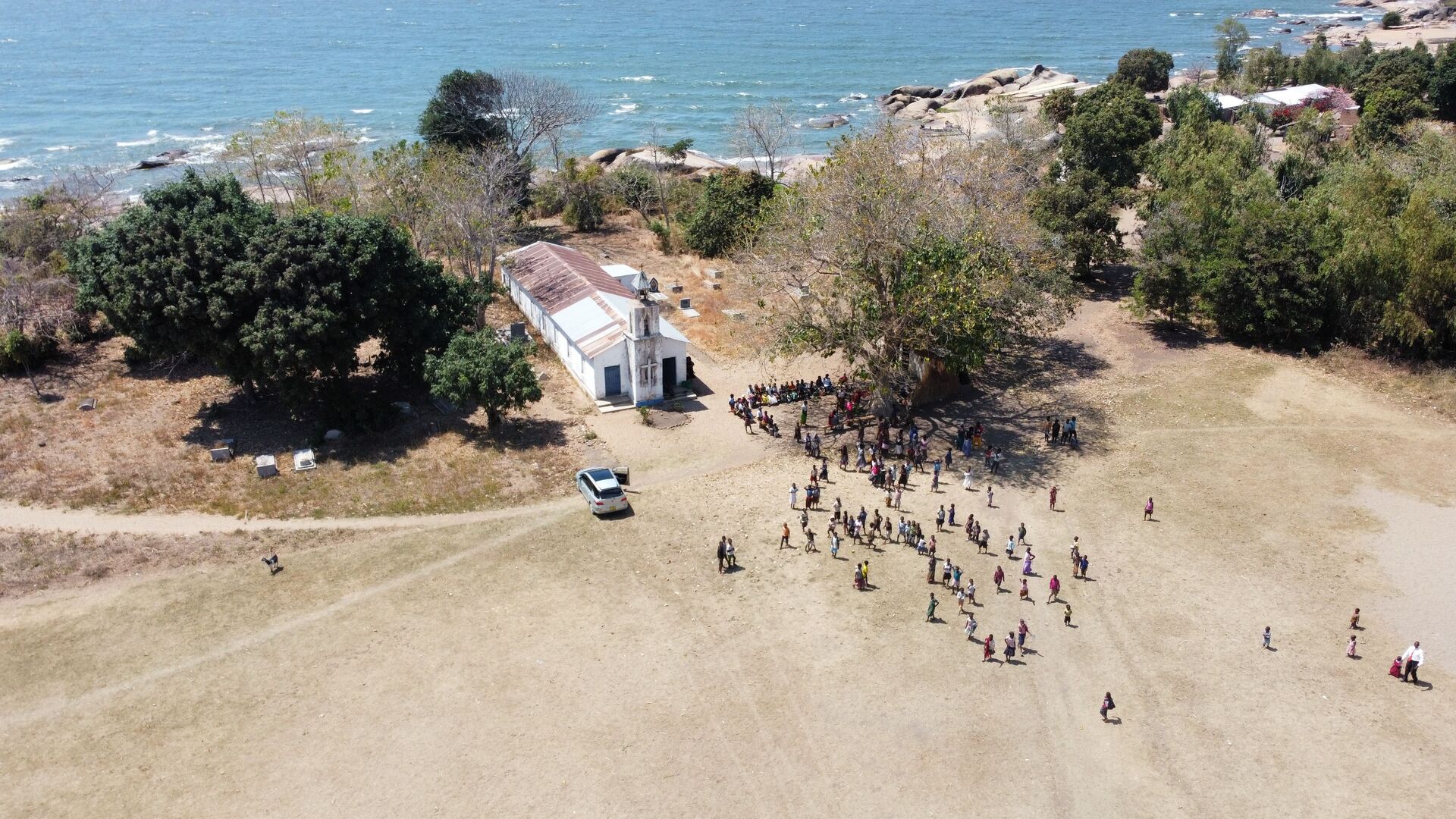
Malawi, a church in a rural area
Independence Day: 6 July 1964. Malawi is a long thin country wrapped around a lake that holds more fish species than any other lake on earth. It has no oil, no diamonds, no coastline, and almost no industry. What it has is tobacco — more of it, as a share of everything the country sells abroad, than any other nation on the planet. And the price is not set in Lilongwe.
Most pages on this site are about power taken and power held. This one is about price.
Malawi has had a dictator who ruled for thirty years, a genuinely brave supreme court, three transfers of power by ballot, and a truly heroic 1915 uprising. All of that is here.
But the thing that determines whether a Malawian family eats is decided at an auction floor, and then in the procurement departments of a handful of companies in London, Richmond, Lausanne and Geneva.
Malawi is the clearest case in this series of a country that is politically independent and economically owned. Not by a colonial administration. By a market structure — one crop, a small number of buyers, no processing at home, and a legal inability to diversify because the alternative crops do not pay.
And there is a detail that makes the trap explicit. Malawi is one of a tiny number of countries in the world that has never ratified the WHO Framework Convention on Tobacco Control — the global public health treaty that almost every state on earth has joined.
It has not refused because it disagrees with the science. It has refused because it cannot afford to agree with it.
Malawi, a church in a rural area
Lake Malawi — Lake Nyasa to Tanzania, Lago Niassa to Mozambique — is about 580 kilometres long, up to 700 metres deep, and holds more species of fish than any other lake in the world: somewhere between 700 and over a thousand, the great majority of them cichlids found nowhere else. The southern end is a UNESCO World Heritage site, listed specifically for what the cichlids demonstrate about evolution.
Around it, by the time Europeans arrived, were the Chewa and the Maravi confederacy whose name the country took, the Yao in the south, the Tumbuka in the north, and the Ngoni, who had come up from the south as part of the same nineteenth-century upheaval that produced the Basotho state described on the Lesotho page of this site.
And this was slave-raiding country. The routes ran east from the lake to Kilwa on the Swahili coast, feeding the Indian Ocean trade to Zanzibar, Arabia and beyond. Whole districts were depopulated.
That is the fact that brought Britain here. When David Livingstone reached the lake in 1859, his answer to what he had seen was a formula that would define the region for a century: Christianity, commerce and civilisation, as the three things that would displace the slave trade.
The missions came first. The Free Church of Scotland at Livingstonia in the north and the Church of Scotland at Blantyre in the south — the latter named after Livingstone's birthplace in Lanarkshire, and now Malawi's commercial capital.
The Scottish missions did something unusual: they educated seriously. Livingstonia in particular produced, per head of population, one of the best-educated African elites anywhere in colonial Africa — teachers, clerks, ministers, and eventually nationalists. Northern Malawians filled skilled positions across Central and Southern Africa for decades.
Then came the British Central Africa Protectorate in 1891, renamed Nyasaland in 1907.
And with it the land grab. Europeans acquired large estates in the fertile Shire Highlands, and the Africans living on them were kept there under a system called thangata.
Thangata originally meant help freely given to a neighbour. Under the estates it meant something else entirely: a family could stay on the land where it already lived only by working for the estate owner, typically for months a year, without wages, as rent. Fail to work and you were evicted from your own home.
Nyasaland also had nothing to export worth having. So Britain used it as a labour reserve — men were recruited to the mines of Southern Rhodesia and South Africa in enormous numbers, exactly as in Lesotho. Remittances became a pillar of the economy and the men were gone for years.
John Chilembwe was a Baptist minister. He had been taken to the United States by a radical missionary, studied at a Black seminary in Virginia, and returned in 1900 to found the Providence Industrial Mission near Chiradzulu — schools, a church he built himself, and a congregation.
He spent fifteen years protesting, in writing and in law, about thangata, about the treatment of workers on the Bruce estates, and about the appropriation of African land.
Then the First World War began, and Africans from Nyasaland were sent to die in a European war in East Africa. Chilembwe wrote a letter to the Nyasaland Times — censored before publication — pointing out that Africans were good enough to be killed for the empire but not good enough to hold its rights.
On the night of 23 January 1915 he rose.
His men attacked the Bruce estates. The estate manager, William Livesey, was killed and decapitated, and his head was reportedly brought to Chilembwe's church, where Chilembwe preached the following morning with it in front of the congregation. Two other Europeans were killed. Women and children on the estates were deliberately not harmed.
The rising was crushed within days. Chilembwe was shot dead on 3 February 1915. His church was dynamited by the colonial authorities. Dozens were executed or imprisoned.
He had no realistic chance of winning and he knew it. The account that survives is that he told his followers the point was to strike a blow that would be remembered, even if they all died — to make Europeans understand that Africans would not simply absorb whatever was done to them.
15 January is John Chilembwe Day, a national holiday. His face is on the kwacha. And in 2022 a sculpture based on the only known photograph of him — in which he stands wearing a hat, which an African was not permitted to do in the presence of a European — was installed on the Fourth Plinth in Trafalgar Square, in the middle of the capital of the empire he attacked.
After the Second World War, Britain decided to join Southern Rhodesia, Northern Rhodesia and Nyasaland into a single Federation of Rhodesia and Nyasaland, created in 1953.
The economics were obvious: Southern Rhodesia had the settlers and the industry, Northern Rhodesia had the Copperbelt, and Nyasaland had people. Africans in Nyasaland opposed it almost unanimously, correctly reading it as annexation to a settler state.
Britain imposed it anyway.
Resistance grew, and in 1959 a state of emergency was declared. Over a thousand people were detained; more than fifty were killed.
Britain sent a commission of inquiry under Mr Justice Patrick Devlin. Its report was one of the most damaging documents ever produced about British colonial rule anywhere, and its central finding was that Nyasaland was — "no doubt only temporarily" — a police state, in which it was unsafe to express opposition to the government.
A British High Court judge wrote that about a British territory in 1959. The government tried to bury it. It could not.
The Federation was dissolved at the end of 1963.
Hastings Kamuzu Banda had left Nyasaland as a boy, walked to South Africa, worked in the mines, got himself to the United States, taken a medical degree at Meharry, then another qualification in Edinburgh, and practised medicine in England and Ghana for decades.
He was invited home in 1958, aged around sixty, to lead the Nyasaland African Congress. He was detained during the 1959 emergency, released, and led the country to independence on 6 July 1964.
And then, six weeks later, he purged the men who had brought him back.
In the Cabinet Crisis of September 1964, most of his ministers — young, educated, and expecting a collegial government — challenged him over the pace of Africanisation, over fees in the health service, and over his opening to Portugal and South Africa. He dismissed them. Several fled into exile. Yatuta Chisiza was killed in 1967 leading an incursion back into the country.
Malawi became a republic in 1966, a one-party state under the Malawi Congress Party, and in 1971 Banda was declared President for Life.
Banda's rule was one of the most controlling on the continent, and the details are remembered in Malawi with a kind of exhausted precision.
The Malawi Young Pioneers, a paramilitary youth wing outside the army's control, enforced party membership: you carried a card, and you could be beaten or detained for not having one.
Detention without trial was routine, and the numbers ran into the thousands. The prisons at Mikuyu and Dzeleka were the destinations.
A censorship board banned books, films and music by the crate. The list of banned works ran into the thousands and included things whose offence was unguessable.
And the dress code. Women were forbidden to wear trousers or skirts above the knee. Men were forbidden to wear their hair long. These were enforced at the airport, on visitors, for decades.
Orton and Vera Chirwa, a lawyer and Malawi's first female barrister, were abducted from Zambian territory in 1981, tried, and sentenced to death, commuted to life. Orton died in prison in 1992. Vera was released in 1993 after twelve years, much of it in solitary — for a period the longest-serving female political prisoner in Africa.
And the Mwanza four. In May 1983, three cabinet ministers and a member of parliament — Dick Matenje, Aaron Gadama, Twaibu Sangala and David Chiwanga — died in what the government announced as a road accident near Mwanza while attempting to flee to Mozambique. A commission of inquiry after Banda's fall found they had been murdered, beaten to death and the vehicle staged afterwards. Banda was tried in 1995 and acquitted for want of direct evidence, at the age of around ninety-seven.
And one thing that set Banda apart from every other African head of state.
He was the only African leader to maintain full diplomatic relations with apartheid South Africa. Ambassadors were exchanged in 1967. Prime Minister Vorster visited Malawi in 1970, and Banda made a state visit to Pretoria in 1971 — the first and only African head of state to do so.
South African money financed the building of the new capital at Lilongwe. South African recruiters took Malawian miners. And Malawi allowed its territory to be used in ways that assisted RENAMO against the government of neighbouring Mozambique, which had supported the ANC.
Banda's argument was that a small landlocked country whose exports ran through Mozambican and South African ports could not afford principles. It is not an absurd argument — read the Lesotho page on this site and see what happened when a country surrounded by South Africa tried the other approach.
It also made Malawi, for thirty years, the exception the apartheid state pointed to whenever it was accused of being isolated in Africa.
Pressure came from an unexpected direction. In 1992 the Catholic bishops of Malawi read a pastoral letter in every church in the country on the same Sunday, describing the poverty, the fear and the absence of justice. It was the first open criticism inside Malawi in a generation, and it broke the silence.
Strikes and demonstrations followed, donors suspended aid, and a referendum in 1993 voted for multiparty politics. In 1994 Bakili Muluzi won the election and Banda left office. He died in 1997.
And Malawi has been, since then, a functioning if battered democracy. Muluzi (1994–2004), Bingu wa Mutharika (2004–2012, who died in office), Joyce Banda (2012–14, southern Africa's first female president, who inherited the Cashgate scandal in which civil servants looted the treasury through the payment system), Peter Mutharika (2014–2020).
And then Malawi did something that belongs in every account of African constitutionalism.
In February 2020, the Constitutional Court of Malawi annulled the presidential election of May 2019 — an election in which results sheets had been altered with correction fluid, which is why Malawians call it the Tipp-Ex election. The court found the irregularities so widespread that the result could not stand, and ordered a re-run.
It was only the second time in African history that a court had annulled the re-election of a sitting president, after Kenya in 2017 — and unlike Kenya, the opposition contested the re-run and won it. Lazarus Chakwera took office in June 2020. The Supreme Court upheld the ruling. The judges were later given an international award for judicial courage.
A poor country with no leverage over anybody enforced its own constitution against its own president.
Chakwera then ran into what every Malawian government runs into: the money.
In September 2025, Peter Mutharika won the presidency back, at the age of 85. Chakwera conceded on 24 September. The reason was not ideology. It was fuel queues, maize prices, a currency that had been devalued by 44 per cent in November 2023, inflation near 30 per cent, and an IMF programme that had been allowed to lapse in May 2025.
By April 2026 the Reserve Bank was selling gold from its reserves to buy fuel, and negotiating an emergency loan from Afreximbank to bridge the gap until the next tobacco auction. Public debt stands at around 91 per cent of GDP and is classified as in distress. Inflation is projected in the low-to-mid twenties. As of mid-2026 there is still no new IMF programme.
Read that sentence again: to bridge the gap until the next tobacco auction. A national treasury timing its solvency to a crop cycle.
Now the part you came for.
Malawi is the most tobacco-dependent economy in the world. Depending on the year and the harvest, tobacco accounts for somewhere around half to two-thirds of all export earnings — in some years more. Nothing else comes close. Tea, sugar, groundnuts and macadamia are real but small. There is no oil, no copper, no significant manufacturing.
Malawi is the world's largest producer of burley tobacco — the cheap, air-cured leaf that is blended into cigarettes worldwide as filler. That is precisely the problem. Burley is a commodity, not a speciality. It competes on price with Brazil, Zimbabwe, Mozambique, Tanzania and India, and the buyers can switch.
The structure of the market is the whole story.
Almost none of it is processed in Malawi. The leaf leaves the country raw or semi-processed. Every unit of value added after that — the blending, the manufacture, the brand, the retail margin, and the enormous tax revenues that governments in consuming countries collect — accrues somewhere else.
And the buying side is concentrated in a way the selling side is not. Hundreds of thousands of Malawian growers and tenants face a small number of international leaf merchants and a handful of manufacturers. Prices at the Lilongwe and Limbe auction floors have repeatedly collapsed below the cost of production, and government after government has tried to impose minimum prices — with the standing risk that buyers simply take fewer bales.
The growers do not have a price. They have an offer.
Underneath the smallholders is a second layer that is worse: the tenancy system. Families are recruited, often from the poorer south, to work tobacco plots in the centre and north. They are advanced food, seed and fertiliser on credit and paid once, after the harvest, against that debt. Research and reporting over two decades has found households ending the season owing more than they earned.
Children work in it. The Guardian's 2018 investigation documented it in detail, and it was that reporting that produced the case now running in London.
In December 2020, the law firm Leigh Day filed a claim in the High Court in London against British American Tobacco and Imperial Brands on behalf of Malawian tenant farming families — a claim that grew to more than 7,000 claimants, over 3,000 of them children. The allegations are negligence and unjust enrichment: that the companies profited from tobacco grown under conditions amounting to forced and child labour and debt bondage.
Both companies deny the allegations.
They applied to have the claim struck out, arguing the farmers could not prove their specific tobacco ended up in the defendants' products. In June 2021 the High Court refused to strike it out. And in doing so the judge noted a piece of correspondence in which BAT accepted that its published claim to have "traceability down to the farm level" did not actually mean it could trace tobacco to individual farmers.
A company that says in its annual report that it can see to the farm gate told a court that it cannot. That single admission is the most useful sentence anyone campaigning on agricultural supply chains has obtained in a decade.
The WHO Framework Convention on Tobacco Control came into force in 2005 and has been ratified by the overwhelming majority of the world's states. It commits parties to reduce demand and, in Article 17, to promote economically viable alternatives for tobacco growers.
Malawi has never ratified it.
The reasoning is not mysterious. A country earning most of its foreign exchange from a crop cannot join a treaty organised around reducing global consumption of that crop unless something replaces the income, and nothing has.
So here is the position Malawi actually occupies:
The consuming countries tax tobacco heavily, run public health campaigns against it, sue the manufacturers, and keep the revenue. The producing country cannot join the treaty, cannot set the price, cannot process the leaf, cannot diversify without capital it does not have, and sells its harvest to companies headquartered in the countries doing the taxing.
Nobody designed that as a policy. It is simply what the arrangement produces, and it has produced it for sixty years.
Because Malawi shows what independence does not reach.
Malawi has everything the formal checklist requires. A constitution that the courts enforce against presidents. Four changes of government by ballot since 1994. A free press by regional standards. A bishops' letter that broke a dictatorship without a shot. An annulled election and a re-run that the opposition won.
And in April 2026 its central bank sold gold to buy diesel, to last until the tobacco auction opened.
The colonial economy was built to supply labour and raw material and to add value elsewhere. Sixty-two years after the flag came down, it still does exactly that — and the mechanism is no longer a governor or a company charter. It is an auction floor, a credit advance, and a procurement decision taken in another country.
That is the thing this website keeps finding, and Malawi states it more plainly than anywhere else: political sovereignty was won, and economic sovereignty was never on the table.
Chilembwe killed civilians. A man was decapitated and his head displayed in a church. The rising was not a clean symbol and Malawians do not pretend it was; they honour him for what he refused to accept, not for how he acted on one night.
The slave trade that brought Livingstone here was real, it was run in part by Yao and Swahili-Arab operators, and the abolitionist impulse that followed was genuine as well as convenient. Both halves are true and Malawians say so.
Banda's calculation about South Africa may have been correct. Lesotho tried the principled route and its government was removed by a border closure within three weeks. Malawi kept its ports open and its people fed, and paid for it in the only currency available: its standing on the continent, and the freedom of its own citizens.
The tobacco is grown by Malawians who want to grow it, because it is the only crop that reliably converts labour into cash. Every attempt to substitute it — legumes, macadamia, industrial hemp — runs into the same wall: there is no buyer at scale and no price guarantee. Telling a Malawian farmer to stop growing tobacco without providing that is an instruction, not a solution.
And the smoking kills Malawians too. Prevalence is rising in low-income countries as it falls in rich ones. Malawi is not only supplying the market; it is becoming part of it.
Two things are true. Malawi is one of the better democracies on this continent, with courts that have done something almost no African court has done. And it cannot pay for fuel between harvests.
There is a lake with more kinds of fish in it than any other lake on earth.
There are routes running east from that lake to Kilwa, and districts along them that never refilled.
There is a word — thangata — that once meant help given freely, and came to mean working for nothing to stay in your own house.
There is a photograph of a minister in a hat, which is why the photograph exists, and a bronze of it in Trafalgar Square.
There is a church at Chiradzulu that the colonial government blew up.
There is a report by a British judge in 1959 using the words police state about a British territory.
There is a cabinet dismissed six weeks after independence.
There is a road near Mwanza in May 1983, and a commission that found the accident was not one.
There is a woman who spent twelve years in prison, much of it alone, and came out and practised law again.
There is a pastoral letter read in every Catholic church in the country on the same Sunday in 1992.
There are results sheets corrected with Tipp-Ex, and a court that threw out a presidential election because of them.
There is a court file in London numbered QB-2020-004542, with seven thousand names on it, three thousand of them children.
There is a sentence in which a tobacco company told a judge that its published claim to trace tobacco to the farm did not mean what it said.
There is a treaty that almost every country on earth has signed and Malawi cannot.
And there is a central bank selling gold in April 2026 to buy diesel, to get to the auction.
Updated and fact-checked: 14 September 2026.
How this page was checked. Recent economic and political developments were verified against the sources listed above; the earlier history was checked against standard reference works on Nyasaland and Malawi. The Scottish missions at Livingstonia and Blantyre, the establishment of the British Central Africa Protectorate in 1891 and its renaming as Nyasaland in 1907, the thangata labour system, John Chilembwe's rising of 23 January 1915 and his death on 3 February, the imposition of the Federation of Rhodesia and Nyasaland in 1953, the 1959 state of emergency and the Devlin Commission's finding, independence on 6 July 1964, the Cabinet Crisis of September 1964, the declaration of Banda as President for Life in 1971, the exchange of ambassadors with South Africa and Banda's state visit to Pretoria in 1971, the abduction and imprisonment of Orton and Vera Chirwa from 1981, the deaths near Mwanza in May 1983 and the later inquiry's finding that they were murders, the Catholic bishops' pastoral letter of 1992, the 1993 referendum and the 1994 election, the Cashgate scandal, the Constitutional Court's annulment of the 2019 presidential election in February 2020 and the re-run won by Lazarus Chakwera in June 2020, the 44 per cent devaluation of November 2023, the lapse of the IMF facility in May 2025, the September 2025 election and Chakwera's concession on 24 September, and the sale of gold reserves in April 2026 are as recorded. Figures are estimates or official series as indicated: tobacco's share of export earnings varies by harvest and is generally given as between roughly half and two-thirds; public debt is put at around 91 per cent of GDP; inflation stood at 28.7 per cent in September 2025; casualties in the 1959 emergency and in the 1915 rising are contemporary estimates. The claim brought in the High Court in London in December 2020 (case number QB-2020-004542) by Malawian tenant tobacco farming families against British American Tobacco and Imperial Brands is a live civil claim in which the allegations have not been determined; both companies deny the allegations, and nothing here should be read as a finding against either. The court's refusal in June 2021 to strike out the claim was a procedural ruling and not a decision on the merits. Hastings Kamuzu Banda was tried in 1995 in connection with the deaths near Mwanza and was acquitted. Findings that those deaths were murders are those of the subsequent commission of inquiry. This page makes no allegation against any living person beyond matters already on the public record.
Written and researched by Remo Kurka · africanindependence.com
We strive to unify diverse narratives from across Africa, showcasing the continent's shared heritage and unique stories.
Our mission is to honor and preserve the history of African cultures and independence movements for future generations.
We provide a platform for innovative exchange of ideas, resources, and insights, understanding that knowledge should be accessible to all.