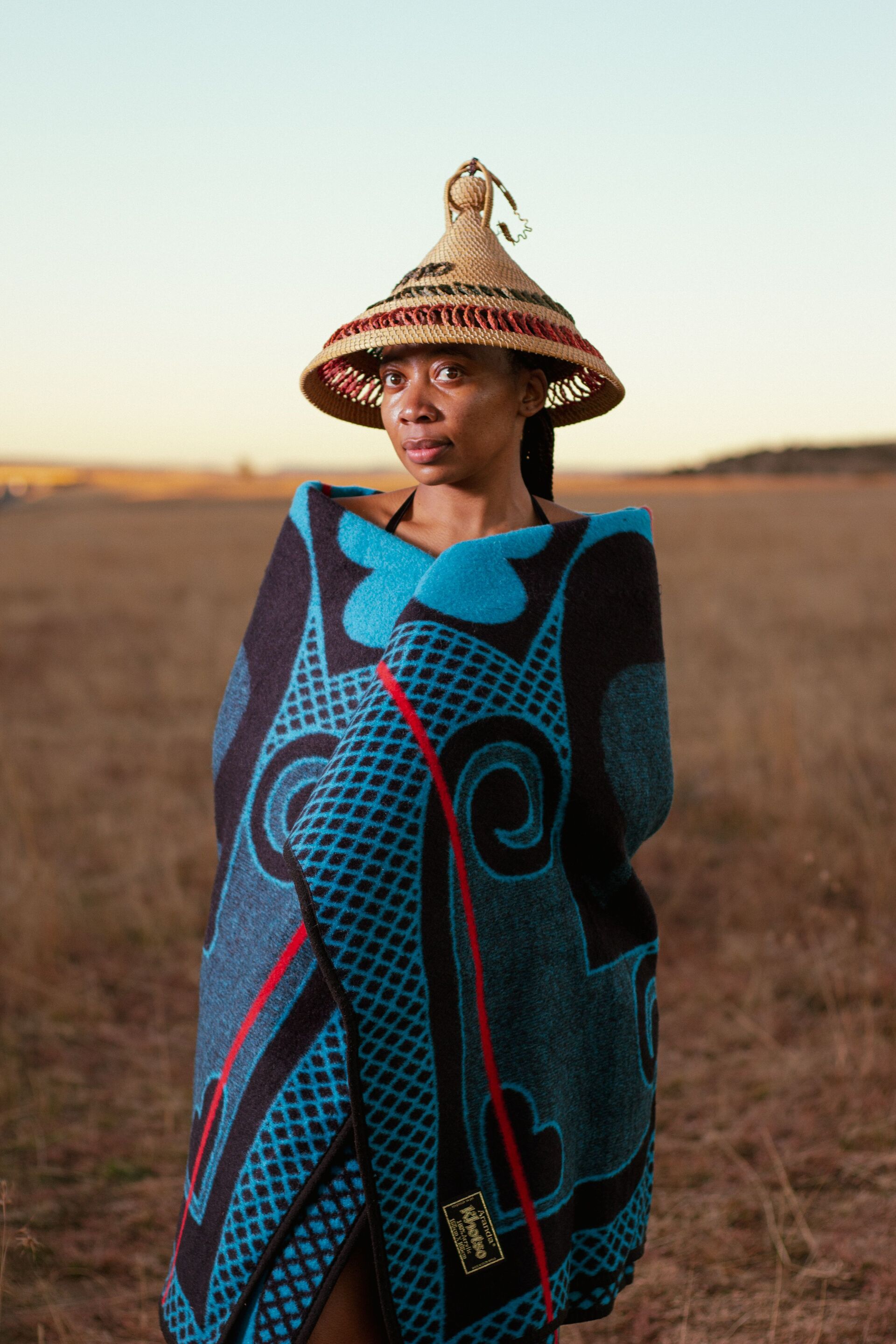
Lesotho, a woman traditional
Independence Day: 4 October 1966. Lesotho is one of three countries on earth completely surrounded by a single other country, and the only one in Africa. It exists because a king in the 1820s built a nation out of refugees on top of a mountain that could not be stormed — and because, forty years later, he gave away the best farmland his people had in exchange for British protection against the Boers who were taking it anyway. Every economic problem Lesotho has had since follows from that trade.
Almost every country on this site was assembled by Europeans and then had to become a nation afterwards.
Lesotho was a nation first. The Basotho existed as a political community, with a founder, a capital and a foreign policy, before any European drew a line near them. There is one language, one people, one royal house, and no ethnic question at all — which in Africa is close to unique.
And yet Lesotho is one of the poorest and most economically dependent countries on the continent.
That is the puzzle this page exists to answer, and the answer is geography plus one decision taken in 1868.
There is also a second reason this page matters more than its size suggests. Read the Eswatini page on this site and you have the other African kingdom — same region, same period, same colonial power. Eswatini kept its land and lost its constitution. Lesotho lost its land and kept its parliament. The comparison is the most instructive pairing in this entire series.
Lesotho, a woman traditional
In the 1820s, southern Africa was convulsed by the Lifaqane — the scattering, the upheaval associated with the rise of the Zulu state, which sent waves of displaced and starving people across the highveld.
Out of that, a minor chief named Moshoeshoe built something new.
He moved his people to Thaba Bosiu, a flat-topped mountain with steep sides and a handful of narrow passes, and from there did something that almost nobody else in the region did: he took in the refugees. Fragments of shattered chiefdoms, Nguni, Sotho and Tswana speakers, survivors of the fighting — he absorbed them, gave them cattle, gave them land, and made them Basotho.
Lesotho is a nation that was deliberately constructed out of the wreckage of other nations. That is its founding fact and it explains why there is no internal ethnic politics today.
Thaba Bosiu was never taken. Not by the Ndebele, not by the Boers, not by the British. Moshoeshoe's other weapon was diplomacy — he negotiated, paid tribute when it was cheaper than fighting, and had a reputation for returning stolen cattle to enemies in order to end a war rather than win it.
Then the Voortrekkers arrived on the western side, in what became the Orange Free State, and the fighting was over the grain-growing land in the valley of the Caledon River.
There were wars in 1858 and again in 1865–68 — the Seqiti war, fought with artillery against Basotho who had firearms but no cannon. The Free State burned the crops. Thaba Bosiu held, but the farms did not.
By 1868 the Basotho had lost most of the arable land west of the Caledon. Basotho call it the Conquered Territory to this day, and it is inside South Africa's Free State province.
This is why modern Lesotho is almost entirely mountain. The country begins at 1,400 metres and goes up to 3,482. It is the only country on earth whose entire territory lies above 1,000 metres. Less than a tenth of it is arable, and the soil erodes.
Lesotho did not choose to be a mountain kingdom. It was left with the mountains.
Facing annihilation, Moshoeshoe asked the British to take his people under protection.
Britain, reluctantly, agreed. Basutoland became a British protectorate in 1868, and the surviving territory was fixed roughly where the border runs today.
It was a trade: sovereignty for survival. And by the brutal arithmetic of the 1860s it worked. Moshoeshoe died the following year having preserved his nation, when almost every comparable African polity in the region was destroyed or absorbed.
The alternative was not independence. The alternative was becoming a labour reserve inside the Orange Free State, with no land, no chieftaincy and no name — which is precisely what happened to the peoples on the other side of the line.
Britain handed Basutoland to the Cape Colony in 1871, and the Cape governed it badly. In 1880 it tried to disarm the Basotho under the Peace Preservation Act.
The Basotho refused, and fought. The Gun War of 1880–81 ended with the Cape unable to win, and the Basotho keeping their weapons.
In 1884 Basutoland was returned to direct rule from London as a High Commission Territory.
That sequence saved the country. Because when the Union of South Africa was created in 1910, the South Africa Act made provision for the eventual transfer of the three High Commission Territories — Basutoland, Bechuanaland and Swaziland — into the Union.
It never happened. The Basotho objected continuously and loudly; Britain kept deferring; and after 1948, when the National Party came to power in Pretoria and built apartheid, transferring three African populations into it became politically impossible in London.
Lesotho, Botswana and Eswatini exist as independent countries today because that transfer was delayed long enough to become unthinkable. It was one of the closest-run things in African history, and it turned on an obscure constitutional provision that was simply never executed.
And here is the economy that Britain built instead of an economy.
Basutoland had no minerals worth mining, no port, no railway of consequence, and a hut tax payable in cash. Sixty kilometres away were the deepest gold mines on earth, permanently short of labour.
So for a century, Lesotho's principal export was men.
Recruiting agencies signed Basotho men on contracts to the South African gold mines. At the peak, well over 100,000 Basotho men — a very large share of the adult male population — were underground in South Africa at any given time. They went for nine or twelve months, lived in single-sex compounds, and came home.
In 1987, the money they sent back was equivalent to 236 per cent of Lesotho's entire GDP. Not twenty-three. Two hundred and thirty-six. More than double the value of everything produced inside the country in a year.
A whole society was organised around it: women ran the farms and the households, the famous Basotho blanket became the miner's coat and then the national dress, and initiation, marriage and burial were all timed around contracts.
It was also a system designed by and for somebody else. The wage was set in Johannesburg. The number of jobs was set in Johannesburg. And when South African mining mechanised and retrenched from the late 1980s onward, Lesotho had no say in it at all.
The remittances did not decline. They collapsed, and they never recovered. Today cross-border worker earnings are around a fifth of GDP.
Independence came on 4 October 1966, as the Kingdom of Lesotho, with King Moshoeshoe II as constitutional monarch and Chief Leabua Jonathan of the Basotho National Party as prime minister.
The first real test came four years later, and Lesotho failed it comprehensively.
In the January 1970 election, Jonathan lost. The opposition Basutoland Congress Party of Ntsu Mokhehle won.
Jonathan annulled the result, declared a state of emergency, suspended the constitution, arrested the opposition and sent the King into exile.
He was among the first African leaders to annul an election he had lost, and Lesotho spent the next sixteen years without a valid one.
Then something unexpected happened. Jonathan, whom South Africa had backed as a moderate, turned against apartheid.
He recognised the ANC, allowed South African refugees to live in Lesotho, opened relations with the Eastern bloc and China, and became loudly critical of Pretoria at the United Nations.
For a country entirely surrounded by South Africa, with every road, every port and every job on the other side of the border, this was an extraordinary thing to do.
Pretoria's answer came on 9 December 1982. South African commandos raided houses in Maseru and killed forty-two people — South African exiles and Basotho civilians, including women and children.
Then came the economic method. In January 1986, South Africa blockaded the borders, and since every import to Lesotho comes through South Africa, the country began to run out of fuel and food within days.
Within about three weeks, the Lesotho army removed Jonathan.
The coup of 20 January 1986, led by Major General Justin Lekhanya, ended civilian rule. Executive power was handed formally to the King. The ANC refugees were expelled. The blockade lifted.
An African government was overthrown by a border closure. It is the single clearest demonstration on this website of what geography does to sovereignty.
1990: Lekhanya deposed Moshoeshoe II and installed his son as Letsie III.
1993: Elections returned. Mokhehle's BCP — the party robbed in 1970 — won every single one of the 65 seats, on about three-quarters of the vote. A first-past-the-post system had produced a parliament with no opposition at all, which turned out to matter enormously.
1994: King Letsie III, backed by part of the army, suspended the constitution and dismissed the government — a palace coup. Regional pressure from South Africa, Botswana and Zimbabwe reversed it. Moshoeshoe II was restored in 1995.
1996: Moshoeshoe II was killed when his vehicle went off a mountain road in the Maloti at night. Letsie III returned to the throne, where he remains.
1998: A disputed election, an opposition occupation of the palace grounds, and a mutiny in the army. The government asked for help, and South African and Botswanan troops entered Lesotho on 22 September 1998 under a SADC mandate — Operation Boleas.
The fighting was worse than anyone expected. Basotho soldiers resisted at the Makhaleng bridge and at Katse Dam. Central Maseru was looted and burned, much of it by Basotho crowds, and the commercial district was destroyed. Estimates of the dead run from around fifty to over a hundred, including South African soldiers.
The intervention was legally contested and remains bitterly resented. It also produced the one durable reform.
Out of the 1998 crisis came a negotiated change to the electoral system. From 2002 Lesotho has used a mixed member proportional system — constituency seats plus compensatory seats that correct the overall result to match the national vote.
It was designed precisely to prevent a repeat of 1993, when three-quarters of the vote produced a hundred per cent of the seats.
It works. Lesotho has since had coalition governments, changes of prime minister without gunfire, and — in 2012, 2015, 2017 and 2022 — genuine transfers of power by ballot. For a country with this history, that is a serious achievement and it is almost never reported.
What the reform did not fix was the army.
August 2014: soldiers surrounded police headquarters and the prime minister's residence; Tom Thabane fled to South Africa. Whether it was a coup is still argued about in Maseru.
June 2015: Lieutenant General Maaparankoe Mahao, the army commander Thabane had appointed, was shot dead by soldiers. A SADC commission of inquiry recommended prosecutions.
September 2017: the army commander Khoantle Motsomotso was shot dead in his office by two officers, who were killed in turn.
June 2017: Lipolelo Thabane, the prime minister's estranged wife, was shot dead near Maseru two days before his inauguration. Thabane was eventually named as a suspect, resigned in 2020, and the case against him and his second wife was later dropped.
2022: Sam Matekane, a businessman with no previous political career, formed a party six months before the election and won it.
Three things, and a fourth that is disappearing.
Water. The Lesotho Highlands Water Project — Katse and Mohale dams, now Phase II with the Polihali dam and tunnel under construction — captures Maloti snowmelt and pipes it north to Gauteng, the industrial heart of South Africa. Johannesburg drinks Lesotho's water. Lesotho receives royalties, and generates its own electricity at Muela.
It is the country's one genuinely strategic asset. A country that is entirely surrounded by a larger neighbour supplies that neighbour with something it cannot do without. It is also, unavoidably, revenue that arrives on a fixed long-term schedule and cannot respond to a crisis.
Diamonds. Letšeng, at over 3,000 metres, is the highest diamond mine in the world and produces the highest average value per carat of any mine anywhere — very few stones, but extraordinary ones, repeatedly among the largest white diamonds ever recovered.
Clothes. Under the American AGOA trade preference, Lesotho built the largest garment industry in sub-Saharan Africa relative to its size: around 35,000 to 40,000 workers, overwhelmingly women, sewing jeans and shirts for American brands. It became the largest private employer in the country, and it was the first thing Lesotho had ever owned that gave women their own wages.
Men. Still going, at about a fifth of GDP, but a fraction of what it was.
And then the thing that should be in every economics textbook about small open economies happened.
On 2 April 2025 the United States imposed a 50 per cent tariff on imports from Lesotho — the highest rate applied to any country. Around three-quarters of Lesotho's garment exports went to the United States.
Orders stopped immediately. Buyers did not wait to see; they simply cancelled. Factories cut shifts. Tzicc, employing 1,300 people, went dark. Lesotho Precious Garments and Maseru E-Textiles prepared to shut.
On 10 July 2025 the government declared a two-year national state of disaster, warning that up to 40,000 jobs were at risk directly and indirectly, with unemployment passing thirty per cent.
The tariff was subsequently cut from 50 per cent to 15, and the replacement duties lapsed on 29 July 2026, restoring duty-free access. AGOA now runs to 2028.
The buyers have not come back. A sourcing decision made in 2025 does not reverse because a duty expires in 2026; the orders went to Asia and stayed there, and no manufacturer will invest against a trade preference guaranteed for two more years.
That is the whole of Lesotho's economic history in one episode. In 1987 the country's income depended on a wage set in Johannesburg. In 2025 it depended on a tariff set in Washington. The decision was taken in a room Lesotho was not in, by people who — as became notorious when the American president suggested nobody had heard of the place — could not reliably locate it.
There is another Lesotho, and this network covers it because it is worth covering.
It is the only country in Africa where it snows reliably every winter, with a ski resort at Afriski. The Sani Pass is one of the great mountain roads in the world. Maletsunyane Falls drops nearly 200 metres in one go. The Basotho pony, bred from horses left in the nineteenth century, is still the only practical transport in large parts of the highlands, and trekking on them is the best way to see a country with very few roads.
There are dinosaur trackways at Moyeni, rock art across the Malotis, and the Maloti-Drakensberg Park, a transboundary UNESCO World Heritage site shared with South Africa.
And Thaba Bosiu is still there — the mountain the nation was built on, with Moshoeshoe's grave on top.
Lesotho gets a tiny fraction of the visitors that pass within an hour of its border on the way to the Drakensberg.
Because Lesotho proves that political independence and economic independence are entirely different things, and that a country can have the first in full while having almost none of the second.
Lesotho has never been ruled from Pretoria. It refused incorporation, it kept its king, it kept its language, and it has held real elections with real changes of government since 2002. On the formal measures of sovereignty it does better than half the countries on this website.
And in 1986 South Africa closed the border and the government fell in three weeks.
That is what it means to be landlocked inside a single neighbour, with no port, no fuel, no railway and no alternative market. Sovereignty is real, and it is not the same thing as choice.
And Lesotho is the direct comparison with Eswatini that makes both pages make sense. Two kingdoms, same region, same colonial power, both spared incorporation into South Africa, both dependent on it. One abolished its constitution in 1973 and has not restored it. The other annulled an election in 1970, took sixteen years to recover, redesigned its electoral system after a war in its own capital, and has changed government by ballot four times since.
Lesotho is poorer. Lesotho is freer. Anyone who argues that African countries must choose stability over democracy should be made to explain that pair.
The 1868 trade was the right decision and it is hard to say so, because it meant surrendering sovereignty to an empire. It also meant the Basotho still exist as a nation with a country, which the peoples west of the Caledon do not.
The Conquered Territory is not coming back. It is farmland inside South Africa, farmed for a century and a half by other people. Basotho remember it; no Lesotho government has a serious plan for it; and saying so out loud is politically dangerous in Maseru.
The migrant labour system was exploitation and it was also the only income there was. Basotho men fought for those jobs and grieved when they went. Nothing about it is simple.
The army is the unsolved problem. Two army commanders shot dead in their own institution within two years. A prime minister's wife murdered. Commissions of inquiry whose recommendations were not carried out, and prosecutions repeatedly dropped. Lesotho's civilians vote; its soldiers do not always accept the result.
And the water project has costs Basotho pay. Communities were resettled for Katse and Mohale and are being resettled for Polihali. Compensation has been contested for thirty years. The water goes to Johannesburg; a large number of Basotho villages still do not have a reliable supply.
Two things are true. Lesotho is one of the few countries in Africa that has never had an ethnic conflict, never had a civil war over identity, and has changed its government peacefully four times in twenty years. And it can be brought to a halt by a decision taken in another country's capital, and has been, twice, in forty years.
There is a flat-topped mountain that was never taken, with a king's grave on it.
There is a nation deliberately assembled out of people other wars had scattered.
There is farmland west of a river that Basotho still call the Conquered Territory, and it is in another country.
There is a request for protection made in 1868 that cost a kingdom its independence and saved its existence.
There is a clause in the South Africa Act of 1910 providing for transfer, which was never executed, and three countries that exist because of that.
There is a figure of 236 per cent of GDP, for money earned underground in someone else's country.
There is a blanket that a miner wore and a nation adopted.
There are forty-two people killed in Maseru houses on a December night in 1982.
There is a border closed in January 1986, and a government gone within three weeks.
There is a burnt-out commercial district in Maseru from September 1998, and an electoral system designed afterwards that has worked ever since.
There is a general shot dead in his office, and another shot dead in a vehicle, and a prime minister's wife shot dead on a road.
There is water running north through a tunnel to the taps of Johannesburg.
And there is an empty factory at Ha Thetsane with the sewing machines still lined up in rows.
Updated and fact-checked: 14 September 2026.
How this page was checked. Recent economic events were verified against the sources listed above; the earlier history was checked against standard reference works on Lesotho and southern Africa. The formation of the Basotho nation under Moshoeshoe I at Thaba Bosiu in the 1820s, the wars with the Orange Free State and the loss of the land west of the Caledon by 1868, the establishment of the British protectorate in 1868, annexation to the Cape Colony in 1871, the Gun War of 1880–81, the return to direct British rule in 1884, the provision in the South Africa Act of 1910 for transfer of the High Commission Territories and its non-execution, independence on 4 October 1966, the annulment of the January 1970 election by Leabua Jonathan, the South African raid on Maseru on 9 December 1982, the border blockade of January 1986 and the coup of 20 January 1986, the deposition of Moshoeshoe II in 1990 and his restoration in 1995, his death in January 1996, the 1993 election in which the BCP won all 65 seats, the palace coup of 1994, the disputed election and SADC intervention of September 1998, the introduction of mixed member proportional representation in 2002, the events of August 2014, the killing of Lieutenant General Maaparankoe Mahao in June 2015, the murder of Lipolelo Thabane in June 2017, the killing of army commander Khoantle Motsomotso in September 2017, the resignation of Tom Thabane in 2020, the 2022 election won by Sam Matekane, the United States tariff of 2 April 2025, the national state of disaster declared on 10 July 2025, and the lapsing of the replacement duties on 29 July 2026 are as recorded. Figures are estimates or official series as indicated: the 1987 remittance figure of approximately 236 per cent of GDP and the current figure of around a fifth of GDP are as reported in the sources above; garment employment is given variously as approximately 35,000 to 40,000; deaths in the September 1998 intervention are estimated from around fifty to over one hundred and were never definitively counted. Tom Thabane and 'Maesaiah Thabane were charged in connection with the murder of Lipolelo Thabane; the charges were subsequently withdrawn and neither has been convicted of any offence, and nothing here should be read as asserting otherwise. Findings concerning the killing of Lieutenant General Mahao are those of the SADC commission of inquiry. This page makes no allegation against any living person beyond matters already on the public record.
Written and researched by Remo Kurka · africanindependence.com
We strive to unify diverse narratives from across Africa, showcasing the continent's shared heritage and unique stories.
Our mission is to honor and preserve the history of African cultures and independence movements for future generations.
We provide a platform for innovative exchange of ideas, resources, and insights, understanding that knowledge should be accessible to all.