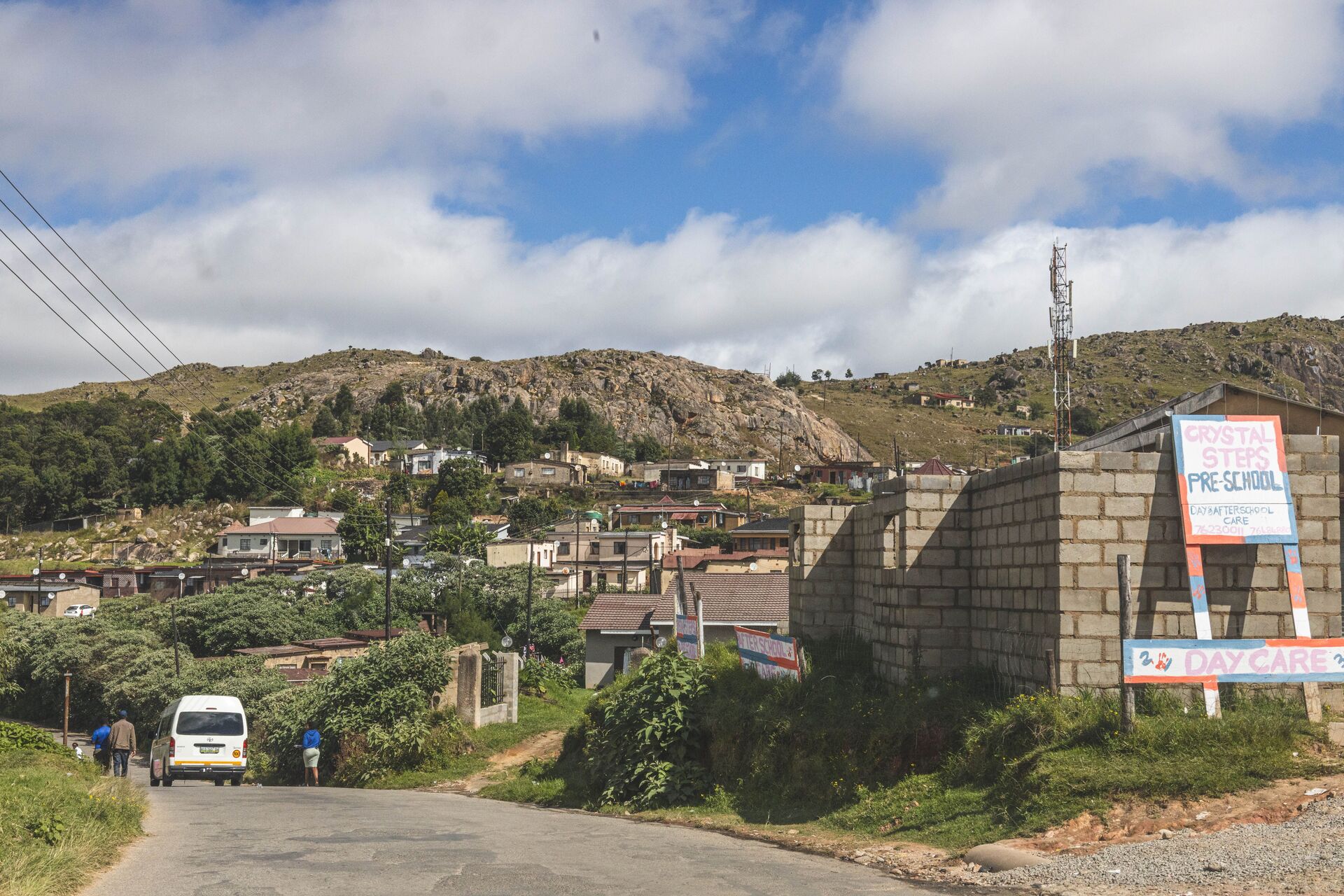
Eswatini village in the mountainous region
Independence Day: 6 September 1968. Britain handed over a Westminster constitution with a prime minister, a parliament and political parties. Four years and seven months later the king repealed it in a single decree, dissolved parliament, banned every party and trade union, and announced that he had assumed all legislative, executive and judicial powers himself. That decree has never been reversed. Africa's last absolute monarchy is still governed by it.
On every other page in this series, the question is what a departing European power left behind — a border, a client, a debt, a mine, an army.
Here the European power left behind a functioning parliamentary constitution, and the country's own head of state destroyed it.
That is not a small distinction, and it is the reason Eswatini is the hardest page to write after Eritrea. You cannot blame Britain for the tinkhundla system. Britain wrote the other one.
What you can blame Britain for is everything that happened before 1968 — and it is considerably worse than most people realise, because the British took the land and then charged the Swazi to buy it back.
Both halves of that are true at once, and any honest account of Eswatini has to carry them together.
Eswatini village in the mountainous region
This matters, and it is why the monarchy's argument is not as hollow as it looks from outside.
Eswatini was a state before Europeans arrived. The Dlamini dynasty had established itself in the territory by the eighteenth century. Under Sobhuza I and then Mswati II — the king the nation is named for — it consolidated a centralised kingdom with a standing regimental system, in the same generation that the Zulu kingdom was forming to its south.
The Swazi are also unusually homogeneous: essentially one people, one language, one royal house. There is no colonial patchwork of rival nations bolted together by a line on a map, which is the founding problem of half the countries on this website.
So when the monarchy says it represents a genuine, continuous, pre-colonial Swazi political order rather than an imported one, that claim has real content.
The question this page asks is what that order has been used for.
In the 1880s, prospectors and speculators arrived looking for gold and grazing.
King Mbandzeni granted concessions — hundreds of them. Land, minerals, grazing, timber, and then increasingly absurd ones: the right to collect customs, to run a lottery, to print and issue documents. The concessions overlapped. Many were obtained by men who knew exactly what they were doing, translated by interpreters with an interest in the outcome, in exchange for cash payments and rifles.
By the time the British established formal control, most of the kingdom had been signed away on paper.
Britain then conducted a partition. The Land Partition Proclamation of 1907 confirmed the concessions and divided the country — allotting roughly a third to the Swazi nation and confirming the remainder to concession holders, with a period for Swazi living on concession land to move.
A third of their own country, and five years to get off the rest.
That is the inheritance. And it explains something that outsiders consistently misread about Swazi politics: the monarchy's control of land is not simply a device for power. Land recovery was the national project for the entire twentieth century, and the crown ran it.
Sobhuza II was installed as Ngwenyama in 1921 and reigned until 1982 — one of the longest documented reigns of any monarch anywhere.
In 1922 he took the land question to London, and litigated it to the Privy Council. He lost. The court held, in effect, that the concessions stood.
So he changed method. Through the Lifa Fund, established in the 1940s, the Swazi nation taxed its own cattle owners and used the proceeds to buy land back from the settlers who had been given it. Piece by piece, over decades. Eswatini recovered a very large share of its territory by purchase rather than expropriation — a quiet, patient, expensive strategy that has almost no parallel on the continent.
And the land that was recovered was vested not in individuals but in the crown, held in trust for the nation.
Remember that phrase. It recurs.
By the 1960s Britain wanted out, and wanted a constitutional monarchy on the way out.
The 1967 elections were held under the pre-independence constitution. The king's own movement, the Imbokodvo National Movement, won every seat. The opposition — principally the Ngwane National Liberatory Congress, which drew on trade unionists and pan-Africanists — won none.
Swaziland became independent on 6 September 1968, with Sobhuza II as constitutional monarch under a Westminster-style constitution: a prime minister, a cabinet, an elected House of Assembly, a senate, a bill of rights, and legal political parties.
It joined the United Nations, the Organisation of African Unity and the Commonwealth.
The economy was built on sugar, forestry, citrus and asbestos, and its geography made it something more useful still: a landlocked kingdom entirely surrounded by apartheid South Africa and Mozambique, and therefore a conduit — for trade, for capital, and for people moving in directions that the South African state preferred not to look at directly.
Also in 1968, Taiwan opened an embassy in Mbabane. It is still there. We will come back to it.
In the 1972 election, the NNLC won three seats.
Three, out of a parliament the king's movement otherwise held entirely. The legal challenge that followed — over whether one of the winning opposition members was even a citizen — went against the government in court.
On 12 April 1973, Sobhuza II issued a decree repealing the constitution.
It dissolved parliament. It banned all political parties and political activity. It suspended the bill of rights. It restricted trade union activity. And it declared that the king had assumed supreme power in the kingdom — legislative, executive and judicial — and would exercise it in consultation with a council.
The stated justification was that the Westminster system was an imported growth, incompatible with the Swazi way of life, and that party politics imported division into a nation that did not have it.
The immediate cause was three opposition seats.
Five years and seven months of parliamentary democracy, ended by the man it had made head of state. Nobody in London objected in any way that mattered; the Commonwealth did nothing; the OAU, committed to non-interference, did nothing.
A new constitution was promulgated in 1978 without ever being put to the population. It formalised tinkhundla.
It is the part everybody gets wrong, so it is worth setting out plainly.
Tinkhundla is not a fiction of elections. Elections happen, and they are real in a narrow sense: people vote, candidates lose, results are announced.
What is missing is everything else.
Candidates stand as individuals. Political parties are not permitted to contest. Nominations begin at chiefdom level, under chiefs appointed by and answerable to the king — so a candidate the palace does not want can be stopped before any ballot is printed.
Of the House of Assembly's seats, the great majority are filled this way and the king appoints the remainder directly. In the senate, the king appoints twenty of the thirty members.
The king appoints the prime minister and the cabinet. He appoints and can dismiss judges. He commands the army and the police. He can dissolve parliament. He is constitutionally immune from suit.
So an elected member of parliament in Eswatini can be sincere, popular, and completely without power — a position two of them would later discover in the most literal way available.
There is a detail here that Eswatini's official history does not include and this site will.
Both Sobhuza II and, later, Mswati III received payments from a secret South African fund established to promote apartheid policy abroad and to finance operations against anti-apartheid activists.
At the same time Eswatini was hosting ANC operatives and refugees, and in 1982 it concluded a security pact with Pretoria under which it acted against them.
A country surrounded on three sides by apartheid South Africa had extremely limited room to manoeuvre, and that is a real defence. It is not a complete one. The royal house was paid, and it was paid by a government whose defeat the rest of the continent was actively working for.
Sobhuza II died in August 1982, aged eighty-two, having reigned for sixty-one years.
What followed was four years of palace conflict. Queen Regent Dzeliwe was deposed in 1983 in favour of Queen Regent Ntfombi, the mother of the young crown prince, after a struggle inside the traditional councils that ended several senior careers.
On 25 April 1986, at eighteen, Prince Makhosetive was crowned King Mswati III. He was one of the youngest heads of state in the world.
He is now, together with his mother as Ndlovukazi, the last absolute monarch in Africa, and forty years into the reign.
Pressure built through the 1990s. Students, unions, churches and lawyers pushed for reform, and donors — the Commonwealth and the European Union among them — largely financed a constitutional process.
A new constitution took effect in 2005. It declares Eswatini a democratic kingdom. It contains a bill of rights.
It also entrenches the king's powers, and it does not restore political parties. The courts have held since that parties may exist but may not contest elections — which is a distinction without a difference at a polling station.
So the 1973 order survived its own replacement. That is the single most important fact about the 2005 constitution.
On 19 April 2018, at a stadium event marking the fiftieth anniversary of independence and his own fiftieth birthday, Mswati III announced that the country would be known as the Kingdom of Eswatini — the land of the Swazi, in siSwati.
The reasoning was sound and long overdue: Swaziland was a colonial-era anglicisation, and it was persistently confused abroad with Switzerland.
The manner was the point. A country's name changed by royal announcement at a birthday party, with no referendum, no parliamentary vote, and no prior consultation.
The reform was genuine. The method was the system.
In May 2021, a law student named Thabani Nkomonye died in circumstances the police could not satisfactorily explain. Protests began over that.
Then members of parliament began accepting petitions from constituents calling for an elected prime minister — a demand that, under tinkhundla, is close to revolutionary, because it takes the appointment out of the palace.
In late June 2021 it broke open. Protests spread nationwide. Shops and businesses connected to the royal family were burned. The government shut down the internet. Soldiers were deployed alongside police.
Human Rights Watch recorded at least 46 people killed; civil society organisations and journalists in the country put the figure above eighty, with hundreds wounded. The true number has never been established, because there has never been an independent investigation.
Leaked material later indicated that the order to the security forces had come from the top.
Nobody has been prosecuted for any of those deaths.
In July 2021 two members of parliament, Mduduzi Bacede Mabuza and Mthandeni Dube, were arrested and charged under the Suppression of Terrorism Act for supporting the petitions. A third, Mduduzi Simelane, fled the country.
On 20 October 2021, police fired live ammunition and tear gas into a bus carrying people to Mbabane to protest against the MPs' detention.
Protests were then banned nationwide.
Thulani Maseko was a human rights lawyer. He had already served a prison term for contempt of court over articles criticising the judiciary. He chaired the Multi-Stakeholder Forum, the coalition of political parties, unions and civil society groups pressing for a negotiated transition to multiparty democracy.
He was also the defence lawyer for Mabuza and Dube.
On the night of 21 January 2023 he was shot dead through the window of his home, in front of his family.
It happened hours after the king had publicly warned people calling for democracy that mercenaries would deal with them and that they should not then complain about being killed.
No one has been charged. The African Commission on Human and Peoples' Rights, the UN human rights chief and governments across the world called for an independent investigation. There has not been one. Maseko's widow, Tanele, has been harassed and briefly detained since.
Mabuza and Dube were convicted — on charges including terrorism, sedition and murder — and in 2024 sentenced to 25 and 18 years respectively.
The trial was condemned by national and international human rights organisations. They had by then already spent close to three years in custody, reportedly assaulted, denied medical treatment and at times denied access to their lawyers.
Two elected members of parliament are serving decades in prison for asking that the prime minister be elected. In the same period, no member of the security forces has been tried for any of the 2021 killings.
Roughly 1.2 million people, in a country the size of Wales.
Well over half the population lives below the national poverty line, and a large share of rural households depend on subsistence farming. Unemployment, particularly among the young, is severe. The economy leans heavily on sugar, on customs revenue shared out through the Southern African Customs Union, and on South Africa, which surrounds it, employs its migrants and absorbs most of its trade.
And Eswatini has the highest adult HIV prevalence in the world — figures range from roughly 23 to 27 per cent depending on the survey and the age band used.
The response to it has been, genuinely, one of the great public health achievements in Africa. New infections and AIDS deaths have fallen dramatically since 2010, and treatment coverage reached levels most wealthy countries would envy.
That achievement was overwhelmingly financed from outside, principally by the American PEPFAR programme — and PEPFAR support was sharply cut back from 2025, with testing and treatment interruptions reported since. A country with the world's heaviest HIV burden has had the floor removed from under the one thing it unambiguously got right.
Meanwhile Tibiyo Taka Ngwane, founded in 1968, holds substantial stakes across sugar, property, hotels and mining. It is held by the king in trust for the Swazi nation. It does not report to parliament and is not taxed as an ordinary company.
The same phrase that recovered the land now holds the economy.
Taiwan opened its embassy in Mbabane in 1968, and Eswatini has never switched.
It is the only African state in the United Nations that recognises Taipei rather than Beijing — one of about a dozen such states left in the world. Every other African country has gone the other way.
Beijing has applied steady pressure: tariff preferences for African partners that pointedly exclude Eswatini, exclusion from the China–Africa summits, and — reportedly — pressure on other African governments to deny airspace to Taiwanese presidential flights.
A planned visit by President Lai Ching-te in April 2026 was cancelled at short notice; the visit went ahead in early May 2026, and the difficulty of simply getting the aircraft there became the story.
And underneath the loyalty, Chinese state-owned firms have been winning major infrastructure contracts in the kingdom anyway.
It is a strange alliance and worth stating in one sentence: a democracy fighting for its existence is diplomatically dependent on an absolute monarchy that jails people for asking for elections, and the monarchy in turn is paid for the friendship in development assistance.
The most recent chapter, and the one that put Eswatini into world news.
From July 2025, under a largely secret agreement with the United States, Eswatini began accepting "third-country nationals" deported from America — people who are not Swazi, have no connection to the country, and in most cases do not speak the language.
The terms that have emerged: Eswatini agreed to receive up to 160 people and was paid US$5.1 million.
The first group of five were nationals of Vietnam, Jamaica, Cuba, Yemen and Laos. More followed in October 2025, and again in March and August 2026 — at least nineteen people by early 2026, from Somalia, Sudan, Tanzania, Cambodia, the Philippines and elsewhere.
They were held in a maximum-security prison. Lawyers reported being unable to reach them at all — no calls, no email, no access through local counsel.
Eswatini's own human rights lawyers challenged the deal in court, arguing that an international agreement of this kind had never been put to parliament and its terms had never been disclosed. In February 2026 the High Court threw the case out — not on the merits, but on the ground that the applicants had no direct interest and therefore no standing to bring it. That ruling is under appeal.
This is the part that should be uncomfortable for readers in Europe and America, because it is not a Swazi invention. Eswatini is one of roughly a dozen African states that have taken such deals, alongside Ghana, Rwanda, Uganda, South Sudan, Cameroon, Equatorial Guinea and the Central African Republic.
A wealthy democracy needed somewhere to put people it could not lawfully return home. It chose, among others, a kingdom with no functioning parliamentary oversight, no political opposition, and courts that answer to the man who appoints them — and that, from the buyer's point of view, was not a defect in the arrangement.
Because Eswatini is the clearest demonstration on the continent that independence and freedom are two different things, and that the first does not produce the second.
Ghana argued its way out. Algeria fought for eight years. Eritrea fought for thirty. Eswatini was handed a parliamentary constitution on a plate in 1968, and it lasted less time than the average mortgage.
And the argument used to destroy it — that multiparty democracy is a foreign import incompatible with African tradition — was not invented in Mbabane. It was made, in almost identical words, by Nkrumah, by Mobutu, by Kenyatta, by Banda, by Houphouët-Boigny. Across the continent, the one-party state and the no-party state were both justified as the recovery of an authentic pre-colonial politics.
Eswatini is the version of that argument that is still running, in its original form, fifty-three years later. Everywhere else it eventually broke. Here it did not.
That is what makes this country worth a page rather than a paragraph.
There are things to be said for Eswatini, and leaving them out would make this page dishonest.
The monarchy is not a colonial invention. The Dlamini state predates the concession hunters by well over a century, and the Swazi kingdom survived the nineteenth century largely intact when almost nothing around it did.
The land was stolen by Britain, and the crown got most of it back. It did so by decades of patient purchase using money raised from the Swazi themselves. No European government gave it back. No court ordered it.
There has been no civil war, no coup, no ethnic massacre, no genocide, no collapse of the state. Read the other pages on this site and understand what that sentence is worth. The kingdom is one of the most stable polities in Africa, and a great many people inside it value that stability very highly and are not pretending.
The HIV response worked, on a scale and at a speed that shames far richer countries.
And the critique of imported party politics is not nonsense. Across southern Africa, party systems have produced ethnic mobilisation, patronage machines and captured states. Swazi political culture — the chiefdom, the inkhundla, the Sibaya assembly where anyone may in principle address the king — is a real tradition and not a stage set.
None of that survives contact with 21 January 2023.
A system is entitled to be judged by what it does when it is challenged. Challenged in 2021, this one shot at least forty-six of its own citizens and has investigated none of it. Challenged in court, it appointed the judges. Challenged by two of its own elected members of parliament, it sent them to prison for a combined forty-three years. Challenged by a lawyer, he was shot through his living-room window with his family beside him.
Two things are true. Eswatini is a genuine African state with a genuine African political tradition and a real grievance against the empire that dismembered it. And that tradition has been used, for fifty-three years, as the reason why the people who live there may not choose their own government.
There is a proclamation from 1907 that gave two-thirds of a kingdom to men who had bought it with rifles and a lottery concession.
There is a fund that taxed Swazi cattle to buy the country back, one farm at a time.
There is a constitution delivered by Britain on 6 September 1968 and repealed by a Swazi king on 12 April 1973, which has never been restored.
There is a secret payment from apartheid Pretoria to a royal house that was simultaneously sheltering the people Pretoria was hunting.
There is a name change announced at a fiftieth birthday party, which was right, and which nobody was asked about.
There are at least forty-six graves from mid-2021 and no investigation.
There are two elected members of parliament serving twenty-five and eighteen years for asking that a prime minister be elected.
There is a window in a house south of Mbabane.
There is a Taiwanese embassy that has stood since the year of independence, in the last African capital that will have one.
And there is a maximum-security prison holding men from Vietnam, Yemen and Somalia who were put on an American aeroplane, and a receipt for 5.1 million dollars.
Updated and fact-checked: 13 September 2026.
How this page was checked. Dates and events were verified against the sources listed above. The granting of concessions by King Mbandzeni in the 1880s, the British administration from 1903, the Land Partition Proclamation of 1907, the installation of Sobhuza II in 1921 and his unsuccessful appeal to the Privy Council, the pre-independence elections of 1967, independence on 6 September 1968 under a Westminster constitution, the opposition NNLC winning three seats in 1972, the royal decree of 12 April 1973 repealing the constitution and vesting all legislative, executive and judicial power in the king, the 1978 constitution and the formalisation of the tinkhundla system, the death of Sobhuza II in 1982 and the regency dispute, the coronation of Mswati III on 25 April 1986, the constitution in force since 2005, the renaming of the country on 19 April 2018, the pro-democracy protests of 2021, the arrest of MPs Mduduzi Bacede Mabuza and Mthandeni Dube in July 2021 and their sentencing in 2024, the killing of Thulani Maseko on 21 January 2023, the third-country deportation agreement with the United States from July 2025 and the High Court ruling of February 2026, and Eswatini's diplomatic recognition of Taiwan since 1968 are as recorded. Casualty figures are estimates and are given as ranges: Human Rights Watch recorded at least 46 people killed in the 2021 crackdown, while civil society organisations and journalists in Eswatini have put the figure above 80; no independent investigation has established a final number. Adult HIV prevalence figures vary between roughly 23 and 27 per cent depending on the survey and age band, and Eswatini's is the highest recorded in the world. Findings concerning the 2021 crackdown, the trial of the two members of parliament and the killing of Thulani Maseko are those of Human Rights Watch, CIVICUS, the African Commission on Human and Peoples' Rights and the United Nations human rights office; the government of Eswatini rejects them. Both positions are recorded. Reported payments to the Swazi royal house from South African government funds during the apartheid period are as documented in the published research cited above. No person has been charged in connection with the killing of Thulani Maseko or with any death arising from the 2021 protests. This page makes no allegation against any living person beyond matters already on the public record.
Written and researched by Remo Kurka · africanindependence.com
We strive to unify diverse narratives from across Africa, showcasing the continent's shared heritage and unique stories.
Our mission is to honor and preserve the history of African cultures and independence movements for future generations.
We provide a platform for innovative exchange of ideas, resources, and insights, understanding that knowledge should be accessible to all.