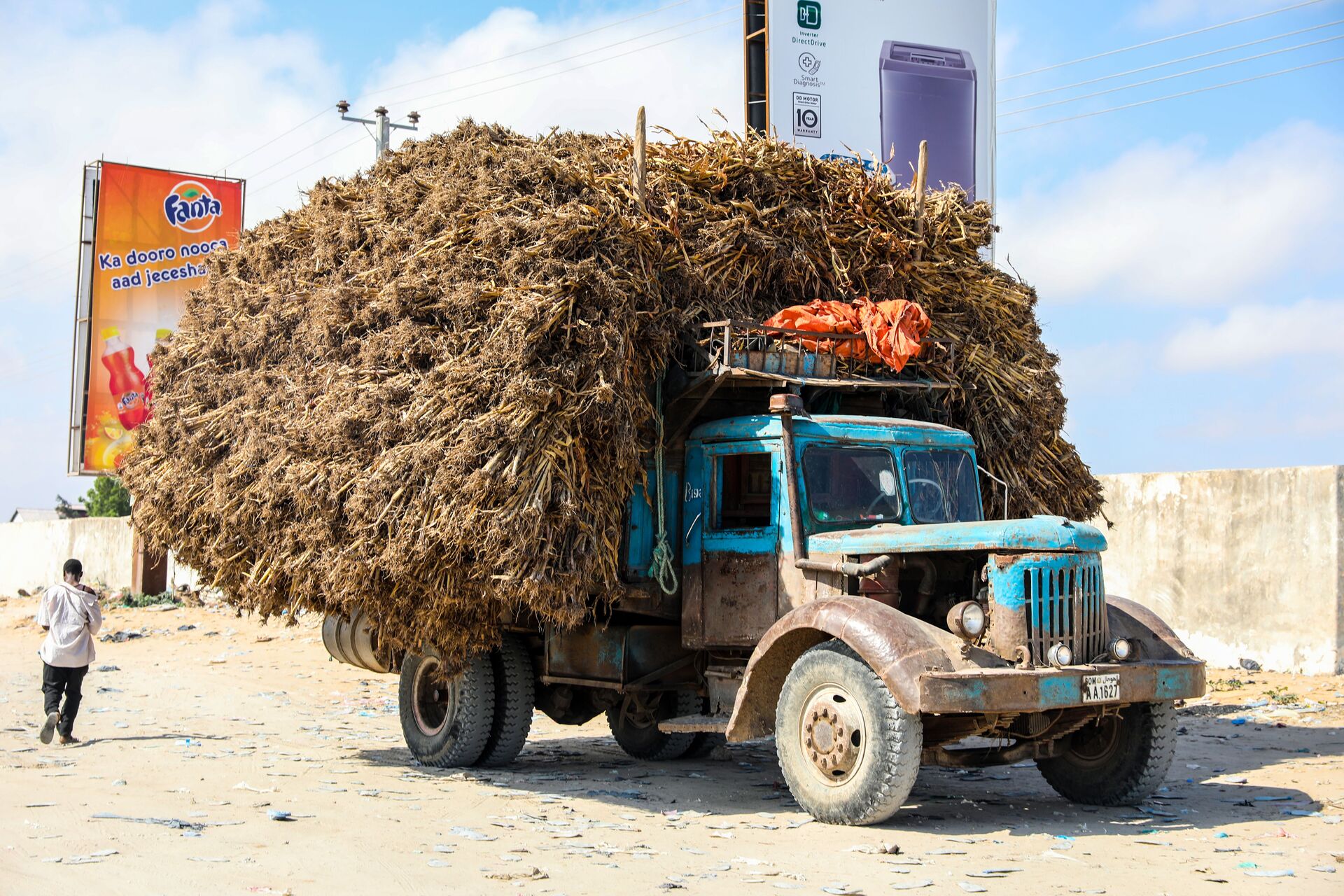
Somalia, Mogadishu.
Independence Day: 1 July 1960. The former British Somaliland became independent on 26 June 1960 and, five days later, joined the former Italian trust territory to form the Somali Republic, with its capital at Mogadishu.
The new flag carried a white five-pointed star, one point for each territory where Somalis lived. Two of the five were inside the new state. The other three never joined it. In 1991 the north walked back out, and it has governed itself ever since.
Almost every other page in this series begins with the same problem. A European power drew a line around peoples who had never shared a state and told them they were now a nation.
Somalia is the reverse. It is one of the very few African countries where the nation came first.
The Somali people share one language, one religion, a common genealogical tradition and, largely, one pastoral way of life, spread across the whole Horn of Africa.
What Europe did here was not to bind different peoples together. It cut one people into five pieces: British, Italian, French, Ethiopian and, through the British in Kenya, a fifth.
So the obvious prediction was that Somalia, of all the countries on this website, would be the one to hold together.
It became the country whose central state collapsed most completely. That is the question this page tries to answer.
Somalia, Mogadishu.
In the 1880s, after the opening of the Suez Canal, the coast of the Horn suddenly mattered.
Britain took the northern coast opposite Aden, the port that supplied its Indian Ocean shipping, and signed protection treaties with Somali clans from 1884. British Somaliland was run cheaply, mainly as a source of meat for the Aden garrison.
France took the Gulf of Tadjoura around Djibouti, the future French Somaliland.
Italy, the latecomer, took the long southern coast. It signed protectorates with the northeastern sultanates of Majeerteen and Hobyo from 1889. It leased the Benadir ports, Mogadishu among them, from the Sultan of Zanzibar, ran them first through chartered companies, and made them a formal colony in the first decade of the twentieth century.
Ethiopia, under Emperor Menelik II, expanded eastward into the Ogaden and the grazing lands of the Haud at the same time. The European powers confirmed those gains in treaties signed without the people who lived there.
Kenya's Northern Frontier District, largely Somali and pastoral, sat inside the British East Africa administration.
These were the five points of the star before anyone had drawn it.
One man refused the arrangement for twenty years.
Sayyid Mohammed Abdullah Hassan, a religious teacher from the north, began a resistance in 1899. He fought the British, the Italians and the Ethiopians at the same time. British newspapers called him the "Mad Mullah." He was a poet of lasting reputation in Somali, and he built fortresses at Taleh and elsewhere.
Four British expeditions failed to defeat him.
In 1920 Britain sent aircraft. The bombing of the Dervish forts was among the first uses of air power as the main weapon of a colonial campaign in Africa, and it was cheap, which was the point. Taleh fell. Hassan escaped to the Ogaden and died there at the end of 1920.
He was no simple nationalist hero. His movement fought clans who did not follow him, and it killed many Somalis. But he is the reason the idea of a Somali cause existed before any Somali state did.
Italian rule in the south brought banana and sugar plantations along the Shabelle and Juba rivers, worked largely by forced labour taken from farming communities, many of them of Bantu descent and at the bottom of Somali society.
Under the Fascist governor Cesare Maria De Vecchi in the 1920s, Italy disarmed and conquered the northeastern sultanates it had previously treated as protectorates.
In December 1934 a clash at the wells of Walwal, in the Ogaden, gave Mussolini his pretext for invading Ethiopia. Somali troops fought in Italy's army in that war.
In 1940 Italy briefly occupied British Somaliland. In 1941 Britain took back its own territory, captured Italian Somaliland, and for most of the decade ran almost the entire Somali world from one administration, with the Ogaden included.
It was the only time in the twentieth century that the pieces were nearly joined, and it was under a British military government.
On 15 May 1943 thirteen young men in Mogadishu founded the Somali Youth Club. In 1947 it became the Somali Youth League.
Its programme was plain: unite all Somalis, reject clan division, and build a modern Somali state. Its members made a point of refusing to name their clans in public.
When a Four Power Commission visited Mogadishu in January 1948 to decide the colony's future, the League organised demonstrations against any Italian return. On 11 January riots broke out. More than fifty Italians and a number of Somalis were killed.
The powers returned the territory to Italy anyway.
And in 1948, and again in 1954, Britain handed the Ogaden and then the Haud grazing lands back to Ethiopian administration, under the old treaties. Northern Somali herders who had crossed those pastures for generations now crossed an international border to reach them.
In 1950 the United Nations placed the former Italian Somaliland under Italian administration as a trust territory for exactly ten years.
That makes Somalia unusual: its independence date was fixed a decade in advance. Everyone knew the handover would come in 1960, and the Italian administration was supposed to use the time to build a civil service, an economy and a political class.
It built some of that. It did not build an economy that could pay for a state. Somalia began independence dependent on foreign aid, and that has never changed.
Britain, for its part, had done very little in the north. When London decided in the late 1950s that British Somaliland could go, it went quickly, with almost no preparation.
On 26 June 1960 British Somaliland became independent as the State of Somaliland. For five days it was a sovereign country.
On 1 July 1960 it united with the former Italian territory to form the Somali Republic. Aden Abdullah Osman Daar became president, and Mogadishu became the capital.
The union was carried through in a hurry and with enthusiasm, and it was carried through badly.
The two legislatures did not pass the same Act of Union text. The north had English law, English administration and English as its official language; the south had Italian ones. Almost every senior post went to the south, and so did the capital. Hargeisa went from national capital to provincial town in five days.
In the June 1961 referendum on the new constitution, the north's main party called for a boycott, and by most accounts a majority of northern voters who took part rejected it. It was adopted anyway, on the southern vote.
In December 1961 a group of northern junior officers attempted a coup in Hargeisa to end the union. It failed within hours.
The grievance was already there in the first eighteen months. It would take thirty years to become a separate state.
The star on the flag was a promise, and the new state spent its first decade trying to keep it.
Kenya's Northern Frontier District: a British commission in 1962 reported that most of its people wanted to join Somalia. Britain gave the district to Kenya anyway at Kenyan independence in 1963. Somalia broke off diplomatic relations with Britain. The guerrilla conflict that followed in northern Kenya, known as the Shifta War, lasted until 1967, and Kenyan security measures there were harsh.
The Ogaden: Somalia and Ethiopia fought a border war in 1964.
French Somaliland: in referendums in 1958 and 1967, the territory voted to stay with France, in contested conditions and with the Afar population largely on the other side of the question. When it became independent in 1977, it became Djibouti, a separate state that never joined anyone.
The Organisation of African Unity decided in 1964 that colonial borders would stand. For every other African government that was a stabilising rule. For Somalia it was a verdict that three points of the star were gone for good.
For all that, the civilian republic of the 1960s was, by the standards of its time, one of the more open political systems on the continent.
Elections were competitive, if chaotic. Dozens of parties stood, most of them clan vehicles. The press argued. And in 1967, when parliament elected Abdirashid Ali Shermarke as president, Aden Adde accepted the result and left office, one of the first African heads of state to hand over power after losing a vote.
Shermarke appointed a northerner, Mohamed Haji Ibrahim Egal, who had led Somaliland in its five days, as prime minister. Egal began to make peace with Kenya and Ethiopia.
On 15 October 1969 Shermarke was shot dead by one of his own bodyguards in Las Anod.
On 21 October 1969 the army took power. Its commander, General Mohamed Siad Barre, became head of state.
Barre declared that Somalia would follow "scientific socialism," banned the parties, and allied the country with the Soviet Union, which built a naval facility at Berbera.
Some of what the regime did was real, and it would be dishonest to leave it out.
On 21 October 1972 the government adopted a Latin script for the Somali language, which had until then had no official written form. It then sent students and teachers into the countryside in a mass literacy campaign in the mid-1970s. For the first time, government, schooling and newspapers ran in the language people actually spoke.
The regime banned clan identification in public life, at least on paper.
In January 1975 it executed ten religious scholars who had preached against a new family law that gave women equal rights of inheritance.
And behind the socialist language, the regime was a personal dictatorship, run increasingly through Barre's own clan and its allies, with a secret police, the National Security Service, and a network of informers.
In 1974 Ethiopia's emperor was overthrown and the country fell into revolution. Barre saw the moment to take the Ogaden.
In July 1977 the Somali army invaded, alongside the Western Somali Liberation Front, and within weeks held most of the region.
Then the Soviet Union changed sides. Moscow chose revolutionary Ethiopia, the bigger prize. Soviet weapons and advisers and Cuban combat troops poured into Ethiopia. By March 1978 the Somali army had been driven out.
Somalia expelled the Soviets and turned to the United States, which took over at Berbera.
Hundreds of thousands of Ogaden refugees crossed into Somalia. Officers blamed the regime for the defeat. In 1978 a coup attempt failed; its survivors founded the first armed opposition in the northeast.
The dream of the five-pointed star had been tried by force, and it had broken the state that tried it.
In the north, the grievance of 1960 had become something worse.
The Somali National Movement, founded in 1981 and drawn mainly from the Isaaq clans of the north, began a guerrilla war. The regime answered with collective punishment: arrests, executions, the destruction of water reservoirs and the confiscation of livestock.
In May 1988 the SNM attacked Hargeisa and Burao. The government's response was to destroy the cities. Hargeisa was bombed and shelled until most of it lay in ruins. Aircraft took off from Hargeisa's own airport to bomb the city. Hundreds of thousands fled across the border into Ethiopia.
Estimates of the number of Isaaq civilians killed between 1987 and 1989 range from roughly 50,000 to 100,000, with some higher. It is widely described as a genocide, and in Somaliland it is remembered as one. No one has been tried for it.
Mass graves are still being found around Hargeisa.
By 1990 armed movements were fighting the regime on several fronts, each largely based in a clan.
In January 1991 Siad Barre fled Mogadishu. He died in exile in Lagos in 1995.
No one replaced him. The faction leaders who had fought him turned on each other at once, above all Mohamed Farah Aidid and Ali Mahdi Mohamed, who split Mogadishu between them. The national army dissolved into clan militias. The state, its ministries, its records and its currency simply stopped.
On 18 May 1991, at a conference in Burao, the north declared that its union with the south was over and that the Republic of Somaliland was restored within the borders of 26 June 1960.
The fighting destroyed the farms of the south, and the militias used food as a weapon.
In the famine of 1991–92, around a quarter of a million people died, by most estimates. The farming communities of the river valleys, the people Italy had once forced onto its plantations, were hit hardest.
The United Nations sent a small mission. In December 1992 the United States led a large military force, UNITAF, to open the supply routes, which it largely did. A larger UN mission followed and moved from protecting food to hunting Aidid.
On 3 and 4 October 1993, in the battle later known through the film Black Hawk Down, eighteen American soldiers were killed in Mogadishu, along with soldiers from Malaysia and Pakistan. Somali deaths are estimated at several hundred to more than a thousand, many of them civilians.
The US withdrew. The UN left in March 1995. Somalia was left to itself.
It is worth recording one more thing about those years, because it involves Europe. Ships dumped industrial and toxic waste off the unpatrolled Somali coast, and foreign trawlers fished it out. In March 1994 the Italian journalist Ilaria Alpi, who was investigating arms and waste trafficking between Italy and Somalia, was shot dead in Mogadishu with her cameraman Miran Hrovatin. The case was never resolved. The piracy that later made Somalia world news started, in its own telling, as fishermen fighting off foreign boats. It soon became an industry.
For the next two decades Somalia had governments that were formed at conferences abroad and rarely controlled much of the country.
Puntland in the northeast declared itself an autonomous state in 1998, without seeking independence. A transitional government formed in Djibouti in 2000. Another was formed in Kenya in 2004.
In 2006 the Islamic Courts Union, a coalition of Sharia courts backed by Mogadishu's business community, took the capital. For some months the city was more peaceful than at any time since 1991.
In December 2006 Ethiopia invaded, with American backing, and drove the Courts out.
The occupation created what it was meant to prevent. The courts' militant youth wing, al-Shabaab, grew into a nationalist insurgency against Ethiopian troops, and later declared allegiance to al-Qaida.
The African Union mission, AMISOM, arrived in 2007, mainly Ugandan and Burundian troops, later joined by Kenya, Ethiopia and Djibouti. It has been described as the world's deadliest peace operation.
In the famine of 2010–12, an estimated 258,000 people died, half of them children under five. Al-Shabaab blocked aid in the areas it held. The international response came late.
In 2012 a Federal Government of Somalia was established, the first to be recognised as a permanent government since 1991, with Hassan Sheikh Mohamud as president. He was followed by Mohamed Abdullahi Mohamed, "Farmaajo," in 2017, and returned to office in 2022.
Presidents are not chosen by the voters. They are chosen by parliament, and parliament is selected through clan elders under a power-sharing formula, which allocates seats to the major clan families and leaves a smaller share for everyone else. It was meant to be temporary. It is still in use.
The federal member states, above all Puntland and Jubaland, have increasingly acted as independent power centres.
On 14 October 2017 a truck bomb at the Zoobe junction in Mogadishu killed 587 people, the deadliest single bombing in Africa's history.
And yet there has been progress, some of it real. In December 2023 Somalia reached the completion point of the international debt relief programme, which cut its external debt from more than five billion dollars to under six hundred million. The UN arms embargo on the government was lifted the same month. In 2024 Somalia joined the East African Community, and in 2025 it took a non-permanent seat on the UN Security Council.
Meanwhile, in the north, something happened that almost no one outside the region noticed for thirty years.
Somaliland rebuilt itself largely without foreign aid, through clan conferences, a hybrid parliament including an upper house of elders, and a constitution approved by referendum in 2001. It has held contested elections, and in November 2024 the incumbent president lost and handed power to the winner, Abdirahman Mohamed Abdullahi, known as Irro.
It has its own currency, army, passport and flag. Its capital is Hargeisa, rebuilt on the ruins of 1988.
For thirty-four years, no government in the world recognised it. The African Union held that recognising it would open every other border on the continent.
In January 2024 Ethiopia signed a memorandum with Somaliland offering access to the sea in exchange for possible recognition. Mogadishu treated it as an act of aggression, and Turkey mediated a settlement between Ethiopia and Somalia at the end of 2024.
Somaliland's own claim is not uncontested. In the east of the territory it claims, around Las Anod, communities who do not want to belong to Somaliland fought its forces in 2023 and pushed them out.
Then, on 26 December 2025, Israel became the first UN member state to recognise Somaliland as an independent country. The recognition involves establishing formal diplomatic relations, including appointing ambassadors and Somaliland joining the Abraham Accords. It triggered protests across Somalia, and the UN Security Council warned it could undermine Somalia's territorial integrity and destabilise the wider Horn. Critical Threatsallafrica
Somaliland had waited three decades for a first recognition, and it came from a government whose own motives had little to do with the Horn of Africa.
This is the part of the page that is still happening.
The federal government wanted to move from the clan-based selection system to direct one-person, one-vote elections. That is a reasonable aim. The opposition, and the federal states of Puntland and Jubaland, argued that the plan would favour the president, since voting could only be organised in the relatively secure areas where he is strongest.
In March 2026, parliament approved and President Hassan Sheikh Mohamud signed constitutional amendments extending both parliamentary and presidential terms from four to five years, postponing elections until 2027. The opposition called it a constitutional coup. USAPP
His original four-year term expired on 15 May 2026. American and British diplomats spent three days trying to broker a compromise in Mogadishu, and the talks collapsed; the president then declared that his mandate ran until 15 May 2027. The opposition began calling him a "former president", and Somalia has no constitutional court to settle the dispute. The Daily Somalia on X: "Somali President Hassan Sheikh Mohamud’s four-year term officially expires on May 15, 2026, exactly four years after he took office on May 15, 2022, under Somalia’s provisional constitution." / X +2
On 3 June 2026 fighting broke out in Mogadishu. It began in the Howlwadaag district ahead of planned protests against the term extension, with shooting near the homes of opposition leaders Hassan Khaire, a former prime minister, and Sharif Sheikh Ahmed, a former president. Thousands of civilians fled. It was the worst fighting in the capital in years. Wikipedia
It is a near copy of 2021, when Farmaajo also tried to extend his term, fighting broke out in the capital, and a deal was eventually reached.
Since then the crisis has spread outward. In August 2026, after heavy clashes on 5 August, Puntland forces took over the remaining federal security camps in the region, removing Mogadishu's last direct military footprint there, while fighting in South West State showed a widening rift between the capital and the regions. The EastAfrican
At the same time, the security floor is being removed. On 1 July 2026, the sixty-sixth anniversary of independence, the United States told the African Union it would stop funding the UN Support Office in Somalia after 31 December 2026. That office supplies the African Union force, now called AUSSOM, with fuel, food, transport and medical care. Analysts warn that without replacement money the mission faces collapse heading into 2027, and that al-Shabaab could use the transition to threaten Mogadishu and Kismayo. The Rio TimesACLED
Al-Shabaab has already retaken territory the army won in 2022–23. Six million people are acutely food insecure, with a risk of famine, more than three million Somalis are internally displaced, and the 2026 UN appeal was less than a quarter funded by mid-year. Congress.gov
And, as the Eswatini page on this site records, Somalis are among the people the United States has deported to third countries they have never lived in.
Because Somalia breaks the easiest explanation of Africa's troubles.
The common argument, and much of it is true, is that colonial borders forced unrelated peoples into artificial states, and that this is why so many of those states failed.
Somalia had the nation already. One language, one religion, one culture. And it produced the most complete state collapse in modern African history.
That does not let the colonial powers off. Britain, Italy, France and Ethiopia cut the Somali people into five, and the effort to put them back together gave Somalia two wars with Ethiopia, a guerrilla war in Kenya, a Soviet and then an American patron, and a military regime that justified itself by the cause. Britain handed the Northern Frontier District to Kenya after its own commission found the people wanted to go to Somalia. Italy left a trust territory with no economy able to pay for a state.
But the state itself was destroyed by Somalis: by a dictator who ruled through clan and bombed his own northern cities, and then by the faction leaders who pulled the country apart when he fell.
A shared language did not make a shared state. Clan, in the end, proved a stronger loyalty than nation, and every Somali government since 1960, civilian, military, transitional and federal, has had to work with that or be broken by it.
There is a great deal to say in Somalia's favour, and much of it is rarely said.
The civilian republic of the 1960s was more democratic than most of its neighbours. A sitting president lost a vote and left. That did not happen in Kenya, Ethiopia or Tanzania in the same decade.
The Somali script and the literacy campaign were real achievements. A language with no official written form became the language of the state within a few years.
Somalis kept a country functioning without a state for two decades. Money transfer companies, mobile phone networks, private schools and hospitals, and one of the cheapest mobile money systems in Africa were built without any government at all, largely with money sent home by the diaspora.
Somaliland rebuilt a peaceful, functioning, largely self-financed state from the rubble of 1988, and changed its president through elections. Few governments on the continent with full recognition can say as much.
The debt relief of 2023 was earned through years of reform that the finance ministry carried out under very difficult conditions.
And foreign powers made almost everything worse. The Soviet Union armed Barre and then armed his enemy. The United States armed him next. Ethiopia's 2006 invasion, with American support, built al-Shabaab into the force it is. Foreign ships dumped waste and emptied the fishing grounds. Gulf states, Turkey, Egypt, Ethiopia and now Israel have all treated Somali territory as a place to pursue their own rivalries.
None of that excuses what Somali leaders did to Somalis.
Siad Barre bombed Hargeisa. Faction leaders turned famine into a weapon in 1992. Al-Shabaab, a Somali movement, blocked food aid during a famine that killed a quarter of a million people and later killed 587 people with one truck. And in 2026, with al-Shabaab advancing and foreign money leaving, the president and the opposition fought each other with artillery in the capital over the length of a term.
Two things are true. Somalia was divided by empires and damaged by every foreign patron it ever had. And the most destructive decisions in its history were made in Mogadishu.
There is a white star on a blue flag, with five points, and a state that holds two of them, and only one of those firmly.
There is a Dervish fortress at Taleh that was bombed from the air in 1920.
There is a commission report from 1962 saying the Northern Frontier District wanted to join Somalia, and a map on which it did not.
There is a country that existed for five days in June 1960.
There is a Latin alphabet chosen for a language in 1972, and a generation of rural Somalis who learned to read it.
There is Hargeisa, rebuilt over the mass graves of 1988.
There is a helicopter crash site in Mogadishu that Americans know from a film, and several hundred Somali dead whose names hardly anyone outside Somalia knows.
There is a murdered Italian journalist and a coastline where the barrels came ashore.
There is a junction called Zoobe.
There is a recognition letter from Israel, dated 26 December 2025, and thirty-four years of waiting before it.
And there is a president who says his term ends in May 2027, an opposition that says it ended in May 2026, and no court to decide which is right, in a capital where the African Union's supply lines will lose their main funder on the last day of this year.
Updated and fact-checked: 17 September 2026.
How this page was checked. Recent events were verified against the sources listed above; the colonial and post-independence history was checked against standard reference works on Somalia and the Horn of Africa. The British protection treaties from 1884, the Italian protectorates from 1889, the Dervish resistance of 1899 to 1920 and the British air campaign of 1920, the Walwal incident of December 1934, the founding of the Somali Youth Club on 15 May 1943, the Mogadishu riots of 11 January 1948, the return of the Ogaden and the Haud to Ethiopian administration in 1948 and 1954, the UN trusteeship from 1950, the independence of Somaliland on 26 June 1960 and the union of 1 July 1960, the 1961 referendum and the failed coup of December 1961, the transfer of the Northern Frontier District to Kenya in 1963, the assassination of President Shermarke on 15 October 1969 and the coup of 21 October 1969, the adoption of the Latin script in 1972, the Ogaden War of 1977–78, the destruction of Hargeisa and Burao in 1988, the fall of Siad Barre in January 1991, the Somaliland declaration of 18 May 1991, the Battle of Mogadishu of 3–4 October 1993, the Zoobe bombing of 14 October 2017, the debt relief completion point of December 2023, Israel's recognition of Somaliland on 26 December 2025, the term extension of March 2026, the Mogadishu clashes of June 2026 and the US funding decision of 1 July 2026 are as recorded. Casualty figures are estimates and are given as ranges where they are disputed: estimates of Isaaq civilians killed in 1987–89 range from roughly 50,000 to 100,000 and higher; deaths in the 1991–92 famine are estimated at around a quarter of a million; the figure of about 258,000 deaths in the 2010–12 famine comes from the study commissioned by the UN food security unit and FEWS NET; Somali deaths in the Battle of Mogadishu are estimated at several hundred to more than a thousand. The dispute over whether President Hassan Sheikh Mohamud's mandate expired on 15 May 2026 or runs to 15 May 2027 is unresolved; the government's position and the opposition's are both recorded. The killing of Ilaria Alpi and Miran Hrovatin has never been solved, and this page makes no claim about who was responsible. This page makes no allegation against any living person beyond matters already on the public record.
Written and researched by Remo Kurka · africanindependence.com
We strive to unify diverse narratives from across Africa, showcasing the continent's shared heritage and unique stories.
Our mission is to honor and preserve the history of African cultures and independence movements for future generations.
We provide a platform for innovative exchange of ideas, resources, and insights, understanding that knowledge should be accessible to all.