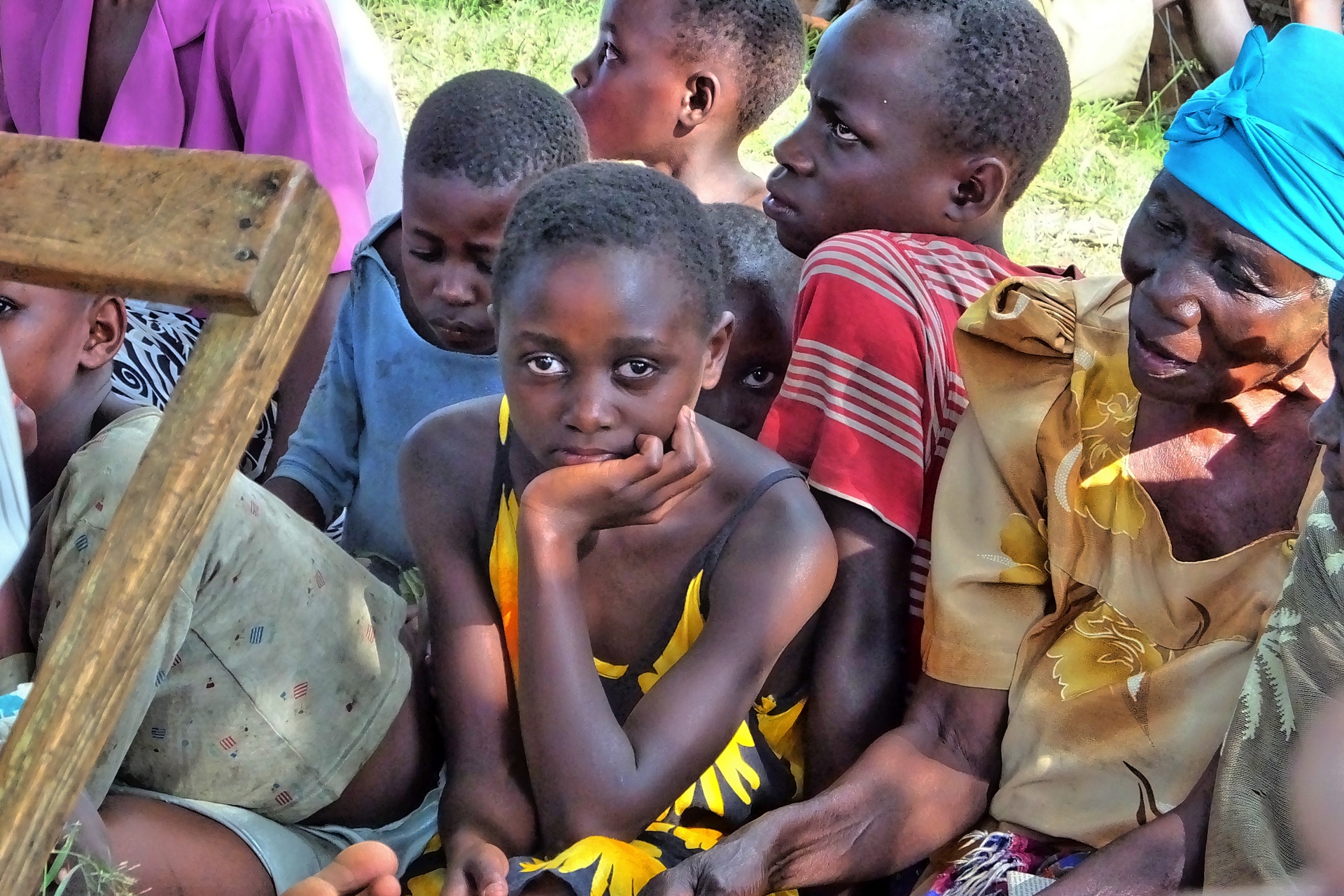
Photo Credit: Remo Kurka. At a village in Kenya, people of Kenya
Independence Day: 12 December 1963. Kenya was not a colony that Britain governed from a distance. It was a colony that Britain settled. Europeans took the best-watered highlands in East Africa, wrote themselves leases running for 999 years, and reduced the people who had been farming and grazing there to labourers on their own ground. Everything that has happened in Kenya since — the war of the 1950s, the assassinations of the 1960s, the burning of the Rift Valley in the 1990s, the killings of 2008 — comes back to who holds the land.
Most of Africa was administered. Kenya was occupied.
The distinction is not rhetorical. In a colony of administration, a few hundred European officials collect taxes, run courts, and leave when the arithmetic changes. In a settler colony, tens of thousands of Europeans own the land, farm it, employ the local population on it, and have nowhere else to go — so they resist decolonisation with everything they have, and the state resists on their behalf.
There were four of these in Africa: Algeria, Rhodesia, South Africa and Kenya. Read the Algeria page on this site and you will recognise the pattern immediately.
And there is a second thing this page has to do, because of where it is published.
This network sells Kenya as a destination. The Mara, Amboseli, Tsavo, Samburu — they are on our own pages, and they are extraordinary, and people should go. They also sit on land that was taken twice: once from Africans for European farms, and once from Africans for European-designed game reserves. A travel network that does not say so is selling a postcard.
So this page says so, and then says why going is still the right thing to do.
Photo Credit: Remo Kurka. At a village in Kenya, people of Kenya
Long before any of this, the Kenyan coast was one of the most cosmopolitan places in the world.
Swahili city-states — Mombasa, Malindi, Pate, and above all Lamu, continuously inhabited since the twelfth century and now a UNESCO World Heritage site — traded across the Indian Ocean with Arabia, Persia, India and China. The Swahili language and civilisation are African, coastal, Muslim and commercial, and they were centuries old when the Portuguese arrived.
The Portuguese built Fort Jesus at Mombasa in 1593. Omani Arabs took it after a siege lasting nearly three years. The Sultanate of Zanzibar then held a coastal strip — a legal fact that mattered right up to 1963, because the ten-mile coastal strip was technically the Sultan's, not Britain's, and had to be separately handed over at independence.
The coast's grievance about land and belonging is older than the highlands' grievance, and less well known. It is still live politics in Mombasa and Kilifi today.
Everything modern in Kenya starts with a railway line built for somewhere else.
Britain wanted Uganda — the source of the Nile, in the strategic thinking of the time. Getting there required crossing a thousand kilometres of what is now Kenya. So between 1896 and 1901 Britain built the Uganda Railway from Mombasa to Lake Victoria.
It imported around 32,000 indentured labourers from British India to build it. Roughly 2,500 died. Several thousand stayed, and their descendants are the foundation of Kenya's Asian community — later formally recognised as Kenya's forty-fourth tribe.
At Tsavo in 1898, two maneless lions killed railway workers over several months and stopped construction. The story is known worldwide; the men they ate are usually not named.
The railway had to be paid for. A railway through empty country earns nothing, so London needed the land beside it to produce exports.
And a supply depot at the halfway point, in a swampy place the Maasai called the place of cool waters — Nairobi — became the capital.
The highlands were fertile, high enough to be free of malaria, and — critically — appeared under-occupied to the men surveying them, because the Maasai and Kikuyu populations had just been devastated by rinderpest, smallpox and famine in the 1890s.
So Britain declared the land Crown land and opened it to European settlement.
The Crown Lands Ordinances of 1902 and 1915 allowed European settlers to take up leases of up to 999 years. By the 1930s the White Highlands — some seven million acres of the best land in the country — were legally reserved for European ownership. Africans could not buy there. Africans could work there.
The Maasai were moved twice, by "agreements" of 1904 and 1911, off the Laikipia plateau and into a southern reserve — a transfer they took to court and lost, and which is still cited in Maasai land claims today.
The Kikuyu lost land on the Rift Valley edge and around Nairobi, and became squatters: families permitted to live on European farms in exchange for labour, with steadily worsening terms.
To force people into wage work, the administration imposed a hut tax, payable in cash. To control movement, it imposed the kipande — a pass carried in a metal container around the neck, recording employment and enabling any employer to blacklist a worker permanently.
A man carried his own labour record around his throat. Burning the kipande later became one of the central symbolic acts of the resistance.
Above it all sat a settler society that produced the Happy Valley set — the drinking, adultery and morphine of a small aristocratic fraction that became the most famous thing about colonial Kenya, and was the least important.
The first mass political movement came early.
Harry Thuku organised against the kipande, the hut tax and forced labour. He was arrested in March 1922. A crowd gathered outside the Nairobi police station demanding his release, with women at the front — Mary Muthoni Nyanjiru among them, who is remembered for challenging the men to act if they would not.
The police and armed settlers opened fire. The official figure was around twenty dead; other accounts put it at over fifty.
Thirty years before Mau Mau, the answer to a peaceful demonstration in Nairobi was a volley.
By 1950 the squatter system was collapsing, the reserves were overcrowded, and a generation of Kikuyu men had come home from the Second World War having fought for Britain in Burma.
The Land and Freedom Army — called Mau Mau by the British, a name of uncertain origin that the fighters themselves did not use — began oathing, organising, and then fighting from the forests of Mount Kenya and the Aberdares.
Britain declared a State of Emergency on 20 October 1952. It lasted until 1960.
Jomo Kenyatta was arrested and convicted at Kapenguria in 1953 of managing Mau Mau, on evidence that has not aged well, and imprisoned for nine years. He had in fact denounced the movement publicly. It made no difference: Britain needed a leader to blame, and it created the leader it feared.
What followed was one of the most severe counter-insurgency campaigns of the entire colonial era.
The Pipeline. A network of detention camps through which suspects were moved and "rehabilitated". Detainee numbers are disputed — the official figure is in the region of 80,000, while later research argues for a figure several times higher.
Villagisation. Over a million Kikuyu were moved from scattered homesteads into some 800 guarded villages, surrounded by ditches and spiked barricades, to cut the forest fighters off from food and recruits.
Hola, March 1959. At a detention camp in the east, eleven detainees who refused to work were beaten to death by guards. The authorities initially claimed they had died from drinking contaminated water. The cover-up failed in the House of Commons, and Hola is one of the specific events that ended British political tolerance for the Emergency.
Dedan Kimathi, the best-known forest commander, was captured in 1956 and hanged in February 1957. Where he is buried was concealed for decades.
And here is the statistic that should be on every page about this war.
The official count of Mau Mau and their supporters killed is around 11,500. The number of European settlers killed in the entire eight-year Emergency was 32.
Thirty-two. Fewer than died in road accidents in Nairobi in the same period. More Africans were killed by the colonial side than any plausible reckoning of the violence on the other, and more loyalist Kikuyu were killed by Mau Mau than Europeans were — because, as in Algeria, this was also a civil war inside the community.
For half a century the archive was the problem. And then, in 2011, during litigation brought by elderly Kenyan claimants, the British government admitted to holding a secret collection at Hanslope Park: thousands of files removed from Kenya and other colonies at independence, hidden for decades, and never handed to the Kenyan state.
They were called the migrated archives, and they documented what had been done, and what officials had known while it was being done.
In June 2013 Britain agreed to pay £19.9 million to 5,228 Kenyan claimants who had been tortured or abused during the Emergency, and the Foreign Secretary expressed regret in Parliament. A memorial was unveiled in Nairobi in 2015, paid for from the settlement.
It is the only case in which Britain has paid compensation to victims of colonial abuse. It happened because a handful of very old people, with British lawyers, would not stop — and because the documents turned up. The lesson for every restitution campaign on this network is that the archive is the case.
Kenya became independent on 12 December 1963, with Jomo Kenyatta as prime minister and, from December 1964, president of a republic.
And the land question was settled in the way that has shaped everything since.
There was no expropriation. The mechanism was willing buyer, willing seller: European farmers who wished to leave would be bought out at market prices, under settlement schemes financed largely by British loans to the Kenyan government.
Read that slowly. Britain lent Kenya the money to buy back land that had been taken from Kenyans, paid the money to the settlers who had taken it, and put the debt on Kenyan taxpayers.
Some of it went to smallholders through the Million-Acre Settlement Scheme. A great deal of it went to people with access to credit and to the new government — politicians, civil servants, well-connected families — who assembled large holdings in the former White Highlands.
The forest fighters, who had no money and in many cases no documents, largely got nothing. Kenyatta told them, in substance, to forget the past and get to work.
The Mau Mau organisation itself remained formally banned in independent Kenya until 2003. Forty years after independence.
What followed was the standard sequence of this website, executed with unusual precision.
Pio Gama Pinto, a socialist MP of Goan descent who had supplied Mau Mau and gone to detention for it, was assassinated in Nairobi in 1965 — the country's first political assassination after independence.
Oginga Odinga, the vice-president, broke away in 1966 to form the Kenya People's Union. He was detained. His son Raila would spend the next half-century on the same road.
Tom Mboya — brilliant, young, a trade unionist, the man who organised the airlifts that sent hundreds of Kenyans to study in America, including the father of a future US president — was shot dead in a Nairobi street on 5 July 1969. He was 38. The killing broke the country along ethnic lines and its full story has never been established.
Months later, a confrontation at the opening of a hospital in Kisumu ended with the presidential escort firing into a crowd; the KPU was banned and Kenya became a de facto one-party state.
J.M. Kariuki, an ex-detainee turned MP who said publicly that Kenya had become a country of ten millionaires and ten million beggars, was abducted and murdered in 1975. A parliamentary committee's report pointed uncomfortably close to the top.
Kenyatta died in 1978. Daniel arap Moi governed for twenty-four years.
A coup attempt by air force personnel on 1 August 1982 was crushed, and the response defined the rest of the era: Section 2A was inserted into the constitution making Kenya a de jure one-party state, and the basement of Nyayo House in central Nairobi became a torture facility where detainees — academics, writers, students, lawyers — were held in flooded cells.
Robert Ouko, the foreign minister, was found murdered in 1990. The investigation was obstructed at every level and never concluded.
On 7 July 1990 — Saba Saba, the seventh of the seventh — a pro-democracy rally was banned and the crackdown that followed killed a substantial number of people. The date became, and remains, Kenya's protest anniversary; it was used again in 2025.
Section 2A was repealed in 1991 under domestic and donor pressure. Moi then won the 1992 and 1997 elections against a divided opposition — and those elections were accompanied by organised "ethnic clashes" in the Rift Valley, in which people whose families had bought land in the former White Highlands were driven off it by armed gangs.
The land question, re-fought with matchets, thirty years after independence.
Meanwhile the Goldenberg scheme drained something in the region of ten per cent of GDP out of the treasury through fictitious gold and diamond export subsidies.
In 2002 Moi was term-limited out, the opposition finally united, and Mwai Kibaki won in a landslide. The celebration in Kenya was extraordinary, and the economy recovered fast.
Then came the election of December 2007.
Kibaki was declared re-elected over Raila Odinga in a count that international observers said they could not verify. The announcement was made in a locked room and Kibaki was sworn in within the hour.
What followed killed more than 1,100 people and displaced around 600,000. It was not spontaneous. Militias were organised, and the targeting followed the same fault lines as 1992 and 1997: who had come from where, and who owned what, in the Rift Valley.
Kofi Annan mediated a power-sharing agreement in February 2008. The commission that investigated recommended a special tribunal; parliament refused to create one, and the file went to the International Criminal Court.
Six Kenyans were named. Among them were Uhuru Kenyatta — son of the first president — and William Ruto, who had been on opposite sides of the violence.
In 2013 they ran for president and deputy president together, and won. The cases collapsed: Kenyatta's was withdrawn in 2014 and Ruto's terminated in 2016, with judges noting a disturbing pattern of witness interference, intimidation and deaths.
Nobody has been convicted of anything for 2008.
And yet, out of that catastrophe, Kenya produced the best thing it has ever produced.
The 2010 constitution, approved by referendum, is one of the strongest in Africa: an enforceable bill of rights, a genuinely independent judiciary, a land commission, limits on presidential power, and devolution — forty-seven counties with their own governors, assemblies and a guaranteed share of national revenue.
Devolution has its own corruption problems, and county governments have invented new ways to waste money. It has also moved real resources and real decisions out of Nairobi for the first time since 1895, and it is quietly the most consequential reform in East Africa.
Its finest hour came on 1 September 2017, when the Supreme Court of Kenya annulled a presidential election on the grounds that the count had not been conducted as the constitution required — the first time any court in Africa had nullified the re-election of a sitting president. The court was attacked, one judge's bodyguard was shot, the opposition boycotted the re-run, and Kenyatta won it. But the ruling stands as a fact about what Kenyan institutions can do.
Kenyatta and Odinga then shook hands in 2018 in a rapprochement that ended the crisis and, in the process, removed the opposition from the political system.
William Ruto won in 2022 campaigning as the candidate of the hustler nation against the dynasties. Odinga challenged the result in court, lost, and accepted it.
In June 2024, the government brought a Finance Bill raising taxes on bread, cooking oil, sanitary products, mobile money and vehicles, in a country already crushed by debt service.
What happened next had no precedent.
The protests were organised on social media, were leaderless, and were explicitly tribeless — the first mass movement in Kenyan history to refuse ethnic mobilisation, run by people in their twenties who had grown up entirely under the 2010 constitution and took its bill of rights literally.
On 25 June 2024, protesters breached and partially burned the Parliament building in Nairobi. Police shot people on the streets outside. Dozens were killed; the eventual counts by rights organisations run higher than the official figure.
Ruto withdrew the bill and dismissed almost his entire cabinet.
And then came the other response: a wave of abductions and enforced disappearances of critics, bloggers and organisers through 2024 and 2025, which human rights organisations attribute to security agencies and which the government denies.
In June 2025 a blogger and teacher, Albert Ojwang, died in police custody in Nairobi, two days after being arrested over social media posts about a senior police official. Police initially said he had injured himself against a cell wall. The autopsy said otherwise. The country erupted again.
During the protests that followed, a street vendor, Boniface Kariuki, was shot in the head at close range by a police officer on camera. He died later. Two officers were arrested.
Saba Saba, 7 July 2025 — the same date as 1990 — brought the largest demonstrations yet and more deaths.
Raila Odinga died on 15 October 2025, in India, aged 80.
He had run for president five times and never been declared the winner. He had been detained for years under Moi, been prime minister under a power-sharing deal, had an election annulled in his favour and then boycotted the re-run, and had ended his career in alliance with the man he had spent four years opposing — a deal struck with Ruto in March 2025 that brought his party into a broad-based government and split his own movement.
No Kenyan of the independence era shaped the country more without ever running it.
His death has left the 2027 election without the figure who had organised every opposition since 1992. His party has fractured. Polling through 2026 shows Ruto leading but short of the fifty per cent plus one needed to avoid a run-off, against an opposition — Gachagua, Musyoka, Matiang'i, Karua — that has not been able to unite.
Kenya is heading into its first post-Raila election with a young population that has already shown it will go into the street, a police service with a documented record of shooting people in it, and a state that owes more than it can comfortably service.
Now the part that concerns this network directly.
Kenya's wildlife estate is magnificent and it is globally important: the Mara, Amboseli under Kilimanjaro, Tsavo, Samburu, Lake Nakuru, Meru. Tourism is one of the largest foreign exchange earners in the country and employs hundreds of thousands of people.
Kenya has also made genuinely brave decisions about it. It banned sport hunting in 1977 when its neighbours did not. In 1989 President Moi burned twelve tonnes of ivory in Nairobi National Park — a gesture that did more for the global ivory ban than any conference. Kenyatta burned over a hundred tonnes in 2016.
And the protected areas were created by moving people off land.
The Maasai lost the Laikipia plateau to settlers in 1911 and then lost grazing in the south to the reserves that became the Mara and Amboseli. Communities around Tsavo and Meru were excluded from land and water they had used for generations. The colonial conservation model — a fenced wilderness without people in it — was invented in places where people had always been, and independent Kenya inherited and kept it.
The response that actually works is the community conservancy: land held by the communities themselves, managed for wildlife, taking a direct share of tourism revenue, with local rangers. Northern Kenya and the conservancies bordering the Mara have proved that wildlife numbers can rise where the people living with the animals are the ones being paid.
It also has not solved human-wildlife conflict, which kills Kenyans every year, or the loss of migration corridors to fencing and settlement, or the problem that the money is deeply unevenly shared.
Our own Kenyan coverage sits at kenyawebnews.com, with the parks at nationalparks.kenyawebnews.com. Go to Kenya. Choose operators who pay the conservancies. And know whose grazing you are standing on.
Because Kenya is where you can watch the land question run, unbroken, from 1902 to this year.
It goes: settlers take the highlands → Africans become squatters and labourers → the Emergency → thirty-two settlers die and tens of thousands of Africans die → independence is granted → Britain lends Kenya the money to buy the land back at full price → the connected buy it → the excluded get nothing → 1992, 1997 and 2008 produce organised violence along exactly the lines that ownership created → and in 2024 a generation with no land, no jobs and no ethnic loyalty goes into the street about a tax on bread.
Every stage follows from the one before it. That is what a settler colony leaves behind, and it is why Kenya, Zimbabwe and South Africa keep having the same argument in different decades.
And Kenya is also where the counter-evidence lives. A British court forced a British government to open an archive it had hidden for fifty years and to pay. A Kenyan Supreme Court annulled a presidential election. A constitution written after a massacre moved real power to forty-seven counties. A generation refused to be organised by tribe.
None of that was given. All of it was taken, in court and in the street, by Kenyans.
Mau Mau was also a civil war. More Kikuyu loyalists died than Europeans. The oathing was coercive, the killings at Lari in 1953 included women and children, and Kenyan families still sit on opposite sides of it. Kenya's long refusal to discuss Mau Mau honestly — the ban stood until 2003 — was partly about that, and not only about Kenyatta's convenience.
The first two presidents were father and son, and the current one was an ICC defendant alongside the second. Kenya's political class is remarkably small and remarkably durable, and it has survived every reform aimed at it.
Corruption is not a colonial legacy. Goldenberg, Anglo Leasing, the Eurobond questions and the county-level theft since devolution were done by Kenyans to Kenyans, and Kenyans say so more bluntly than any foreigner would dare.
And Kenya works. It has the most sophisticated media in the region, the best-known courts, a technology sector that invented the mobile money system the rest of the world copied, universities that draw students from across the continent, and the UN's only global headquarters in the developing world. It absorbs refugees in enormous numbers. It has never had a successful coup.
Two things are true. Kenya has the strongest civil society, the best constitution and the boldest courts in East Africa. And in June 2025 a young man was arrested over a social media post and came out of a police cell dead.
There is a fort at Mombasa built by Portugal in 1593, on a coast that was trading with China before Europe arrived.
There is a railway built with Indian labour for a destination in another country, and a capital that exists because it was halfway.
There are leases written for nine hundred and ninety-nine years.
There is a metal container worn around the neck, holding a man's employment record.
There is a crowd outside a police station in Nairobi in March 1922, and a woman at the front of it, and a volley.
There are eight hundred guarded villages, and a camp at Hola where eleven men were beaten to death for refusing to work.
There is a figure of thirty-two dead settlers, against tens of thousands of dead Africans, in the same war.
There is a room at Hanslope Park that Britain said did not exist until 2011.
There is a loan agreement under which Kenyans borrowed the money to buy Kenya.
There is a street in Nairobi where Tom Mboya was shot in July 1969, and a statue of him looking at it.
There is a basement under Nyayo House with cells that filled with water.
There is a Supreme Court judgment from 1 September 2017 annulling the re-election of a president.
There is a parliament building with fire damage from 25 June 2024.
And there is a police cell in Nairobi where a blogger was held for two days in June 2025 and did not come out.
Updated and fact-checked: 14 September 2026.
How this page was checked. Recent events were verified against the sources listed above; the colonial and post-independence history was checked against standard reference works on Kenya, the Emergency and the British colonial archive. The Swahili coast and the building of Fort Jesus in 1593, the declaration of the East Africa Protectorate in 1895, the construction of the Uganda Railway between 1896 and 1901 with indentured Indian labour, the Crown Lands Ordinances of 1902 and 1915 and the 999-year leases, the Maasai moves of 1904 and 1911, the kipande system, the shooting of demonstrators in Nairobi in March 1922, the State of Emergency declared on 20 October 1952, the Kapenguria trial, villagisation, the deaths of eleven detainees at Hola in March 1959, the execution of Dedan Kimathi in 1957, independence on 12 December 1963, the settlement schemes financed by British loans, the assassinations of Pio Gama Pinto in 1965, Tom Mboya on 5 July 1969 and J.M. Kariuki in 1975, the coup attempt of 1 August 1982 and the one-party amendment, the murder of Robert Ouko in 1990, the Saba Saba crackdown of 7 July 1990, the repeal of Section 2A in 1991, the Goldenberg scheme, the 2002 election, the post-election violence of 2007–08, the 2010 constitution, the Hanslope Park disclosures and the 2013 settlement of £19.9 million to 5,228 claimants, the ICC proceedings against Uhuru Kenyatta and William Ruto and their termination in 2014 and 2016, the Supreme Court's annulment of the presidential election on 1 September 2017, the Finance Bill protests of June 2024, the death of Albert Ojwang in June 2025, and the death of Raila Odinga on 15 October 2025 are as recorded. Casualty figures are estimates, are disputed, and are given as ranges or as official counts clearly labelled: the official count for the Emergency is approximately 11,500 Mau Mau and supporters killed against 32 European settlers, while later scholarship argues for substantially higher African death and detention figures; the dead in Nairobi in March 1922 are given as around twenty officially and higher in other accounts; the post-election violence of 2007–08 is generally given as more than 1,100 killed and around 600,000 displaced; deaths in the 2024 and 2025 protests are counted differently by the authorities and by human rights organisations. Reports of abductions and enforced disappearances of government critics in 2024 and 2025 are those of human rights organisations and are denied by the government; both positions are recorded. The International Criminal Court proceedings against Uhuru Kenyatta and William Ruto were withdrawn and terminated respectively; neither was convicted of any offence, and nothing here should be read as asserting otherwise. Investigations into the killings of Pio Gama Pinto, Tom Mboya, J.M. Kariuki and Robert Ouko have never established responsibility in any court. This page makes no allegation against any living person beyond matters already on the public record.
Written and researched by Remo Kurka · africanindependence.com
We strive to unify diverse narratives from across Africa, showcasing the continent's shared heritage and unique stories.
Our mission is to honor and preserve the history of African cultures and independence movements for future generations.
We provide a platform for innovative exchange of ideas, resources, and insights, understanding that knowledge should be accessible to all.