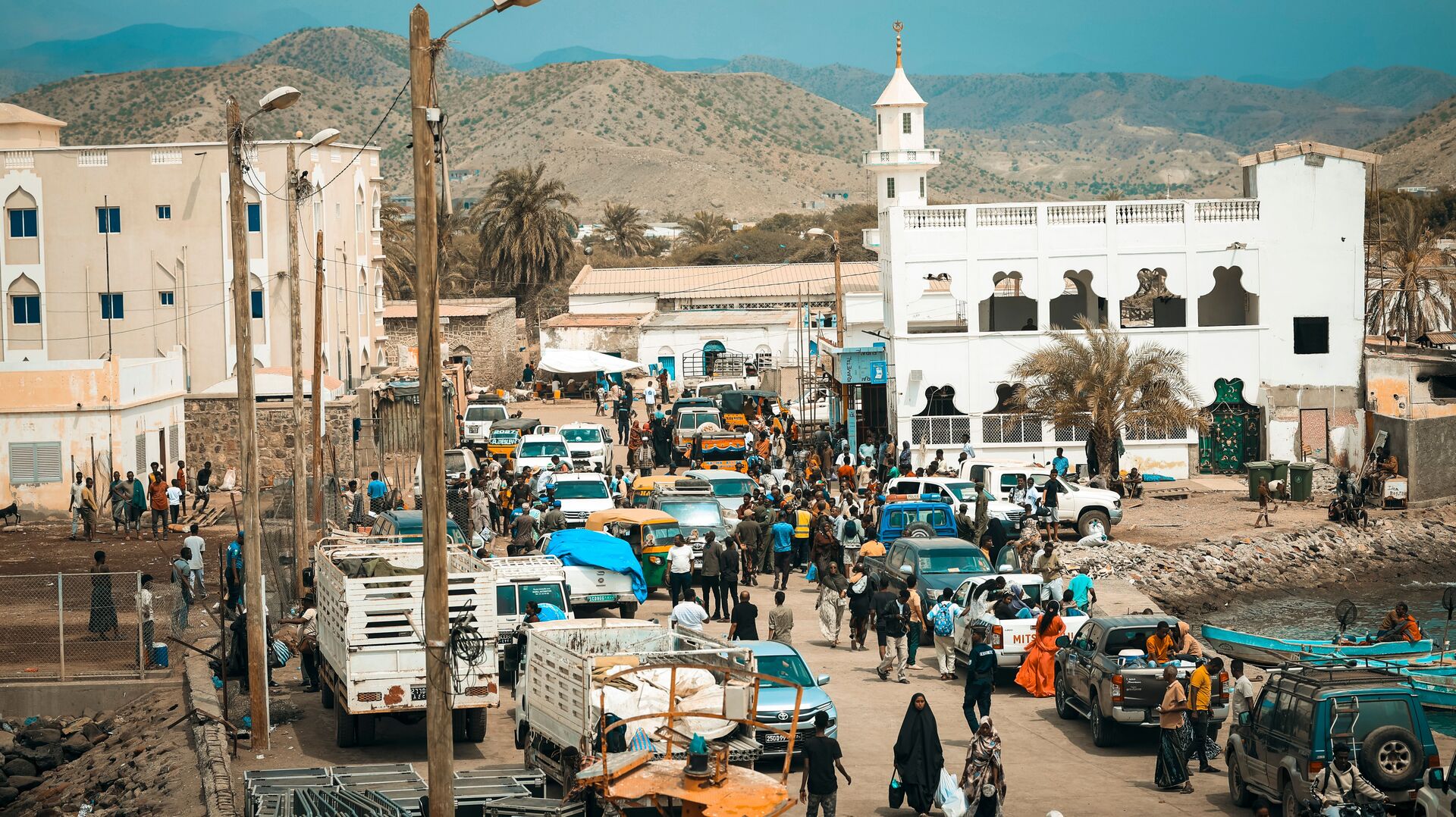
Djibouti, Tadjoura street vibrant scene and local culture. Header photo: Tajjoura coastline seen from a ship
Independence Day: 27 June 1977. The last country on the African mainland to become independent — seventeen years after the wave of 1960. France had held two earlier referendums and rigged them both, and then renamed the territory after its two ethnic groups so that nobody could forget which one they belonged to.
Djibouti is about the size of Wales. It has under a million people.
It has no oil, no gas, no minerals worth extracting, almost no arable land, and very little fresh water. It imports most of its food. By any conventional measure it is one of the poorest countries in the world, and around forty per cent of its population lives in poverty.
And it sits on the Bab el-Mandeb — the Gate of Tears — the strait between the Horn of Africa and Arabia through which everything travelling between Europe and Asia by sea must pass on its way to or from the Suez Canal.
A significant share of global trade goes through a channel that is about thirty kilometres wide at its narrowest, and Djibouti holds the African side of it.
That is the whole story of this country, before and after independence. Its geography is its only resource, and it has been sold, leased and fought over for a hundred and sixty years.
Djiboutians themselves say it plainly: our geography is our oil.
France bought the port of Obock in 1862 and did nothing with it for over twenty years. Then Britain took Egypt in 1882 and the Suez Canal became the artery of empire, and suddenly the African side of the strait mattered enormously.
France built a port on the southern shore and called it Djibouti, and in 1896 the territory became French Somaliland.
Then it built the thing that made the colony viable.
The railway from Djibouti to Addis Ababa, completed in 1917, gave landlocked Ethiopia its outlet to the sea and gave France a hold on the Ethiopian economy. It is the reason this territory exists as a separate country, and it is still, in its modern rebuilt form, the reason it survives.
Djibouti has never been valuable for what is in it. Only for what passes through it.
The population is principally Issa Somali, who are roughly six in ten, and Afar, who are most of the rest, with smaller Arab and other communities. Both are Muslim. Both have lived across this landscape, and across the borders into Ethiopia, Eritrea and Somalia, for centuries.
France governed by playing them against each other, and did so more explicitly here than almost anywhere else in Africa.
The question put to voters was not simply independence. It was whether to remain with France or join Somalia — because the Somali Youth League and the territory's Somali nationalists wanted union with the Somali state that was about to be born.
That framing did France's work for it. Afar voters, fearing domination in a Somali state by the more numerous Issa, voted to stay with France. So did the resident Europeans.
And France did not leave it to chance. There were widespread reports of vote rigging, and thousands of Somalis were expelled from the territory before they could reach the polls.
The result was continued French rule.
Mahmoud Harbi Farah, the Vice-President of the Government Council and the leading pan-Somali nationalist, campaigned for the no. He lost, his party disintegrated, and he fled the territory.
On 29 September 1960 he died in an aircraft crash in Italy. He was thirty-eight or thirty-nine. The circumstances have never been satisfactorily explained.
Djibouti, Tadjoura street vibrant scene and local culture. Header photo: Tajjoura coastline seen from a ship
If you have read the other pages on this site, you will recognise the shape. Barthélemy Boganda, March 1959, aircraft, explosive traces, no published report. Mahmoud Harbi, September 1960, aircraft, no explanation. Within eighteen months of each other, in two French territories.
And there is a detail here that is worth holding: the man who campaigned against independence in 1958, Hassan Gouled Aptidon, became the first president of independent Djibouti in 1977.
In August 1966 Charles de Gaulle visited Djibouti City and was met by demonstrations demanding independence.
France's response was to call another referendum.
It was conducted the same way as the first, and worse. Somalis were struck from the electoral rolls and expelled in large numbers. There was unrest in Djibouti City, and there were deaths.
The result, again, was continued French rule.
And then France did something that this website has not seen anywhere else.
It renamed the territory the French Territory of the Afars and the Issas.
Read that name. A country named after its two ethnic groups, by a colonial power, in 1967 — after two referendums that had been decided by setting those groups against each other.
It was not a description. It was an instruction. It wrote the division into the name of the place, so that every official document, every stamp and every passport would remind both communities that the territory was not one people but two.
France then governed through an Afar head of government, Ali Aref Bourhan, from 1967 to 1976.
By the mid-1970s the position was untenable. Ethiopia had fallen to the Derg and Somalia was pressing its claim; France had no appetite for a war on the Horn, and the international pressure was absolute.
A third referendum was held on 8 May 1977. This time 98.8 per cent voted for independence.
On 27 June 1977, the Republic of Djibouti came into being, with Hassan Gouled Aptidon as its first president.
It was the last country on the African mainland to become independent — seventeen years after Nigeria, Congo, Cameroon, Chad, Côte d'Ivoire and the rest.
And the very first thing the new state did was sign an agreement keeping a strong French garrison in the country.
A reduction was discussed. A full French withdrawal has never taken place, from 1977 to this day.
The first prime minister of independent Djibouti was Ahmed Dini Ahmed, an Afar.
He took office on 12 July 1977 and resigned on 5 February 1978.
Under seven months. He went over the exclusion of Afars from the new state's institutions.
He would later lead the armed rebellion.
In 1981 Gouled Aptidon made Djibouti a one-party state under the RPP.
Between 1991 and 1994, Djibouti fought a civil war.
The Front for the Restoration of Unity and Democracy — FRUD — was an Afar movement, and its charge against the Issa-led government was systematic exclusion: from government jobs, from the civil service, from the army and police.
The war ended in 1994 with a peace agreement that brought a small number of Afars into token positions.
The grievance did not end. There were Afar protests and clashes through the 2000s and again around the 2011 elections.
A country whose two communities had been set against each other by two rigged referendums and then had the division written into its name spent its first two decades of independence fighting about it. That is not a coincidence; it is a consequence.
Hassan Gouled Aptidon governed from 1977 to 8 May 1999 — twenty-two years.
He was succeeded by Ismaïl Omar Guelleh.
Guelleh is his nephew. He had also been his chief of staff and head of his security apparatus for more than two decades. He knew the state from the inside of its intelligence service before he ran it.
He has been president since 1999. In 2010 the constitution was amended to remove presidential term limits. He was re-elected in 2005, 2011, 2016 and 2021, and stood again in 2026, at seventy-eight, for a sixth term.
Two men from one family have held the presidency of Djibouti for all forty-nine years of its existence.
And now the thing that makes Djibouti unlike anywhere else on earth.
France never left. Base Aérienne 188 and the garrison have been there continuously since before independence. A mutual defence pact was renewed in 2024, and President Macron has described Djibouti as sitting at the heart of France's Indo-Pacific strategy.
The United States arrived after September 2001 and took over the old French Foreign Legion post at Camp Lemonnier, formalised by agreement in 2003. It is the only permanent American military base on the African continent, home to more than four thousand personnel and to the Combined Joint Task Force–Horn of Africa. It has been the launch point for American operations in Somalia, Yemen and beyond, and has had a billion-dollar upgrade.
Japan opened a base in 2011 — its first overseas military facility since the Second World War.
Italy followed. So did others.
And in 2017, China opened its first overseas military base in history, at Doraleh — a short drive from Camp Lemonnier.
By 2026 there are eight foreign powers with military facilities in a territory the size of a small European region.
The Chinese and American bases operate a few miles apart. There have been repeated low-level incidents — complaints about surveillance in both directions, disputes about aircraft, divers approaching warships. Analysts have described the atmosphere as resembling naval brinkmanship before the First World War, compressed into a single stretch of coast.
Guelleh's own summary, given in interviews, has been consistently unsentimental: the French have been here a long time, the Americans came for counter-terrorism, the Japanese for piracy, and the Chinese want to protect their interests, and they are all welcome.
The arithmetic is stark.
Foreign military rents are estimated at around ten per cent of GDP. Navies pay over three hundred million dollars a year for access. And Ethiopia — landlocked since Eritrea's independence in 1993, and entirely dependent on Djibouti for over ninety per cent of its foreign trade — is reported to pay around two billion dollars a year in port and transit fees.
Djibouti has almost no industry and almost no agriculture. The state lives on rent.
And forty per cent of the population lives in poverty.
The money arrives, and it does not travel. Port concessions, base leases and transit fees are contracts signed at the top of a state that has been controlled by one family since 1977.
There is one more thing about this stretch of water, and it does not appear in the strategic analyses.
The Bab el-Mandeb is thirty kilometres wide, and on the other side is Yemen.
Every year, tens of thousands of Ethiopians and Somalis cross it from the Djiboutian and Somali coasts in small boats, heading for work in Saudi Arabia. They walk through the Afar desert in temperatures that kill, are held and extorted by smugglers, and are put to sea in overloaded craft.
They are crossing into a war zone. Those who survive Yemen face detention, forced labour and shooting at the Saudi border.
It is one of the busiest irregular migration routes in the world and one of the deadliest, and it runs directly beneath the flight paths of eight foreign air forces stationed to keep the sea lanes open.
Djibouti's position has become more exposed, not less.
The war in Yemen and Houthi attacks on Red Sea shipping have made the strait a live theatre. Traffic through Suez fell sharply, taking transit revenue with it. Escalating conflict involving Iran has put the whole Horn into a wider confrontation, and Djibouti's own finance minister has warned publicly that smaller states risk being pushed into deeper economic uncertainty by it. The American embassy has repeatedly warned its citizens away from the area around Camp Lemonnier.
A country whose entire income depends on ships passing safely, and on foreign militaries paying rent, is now sitting inside the conflict those militaries came to manage.
And the succession question is open. Guelleh is seventy-eight. There is no obvious mechanism for what comes after him, and the ethnic balance he has managed by personal arrangement has never been institutionalised.
Because Djibouti is the clearest case anywhere of a country whose independence changed the flag and nothing underneath it.
France held three referendums. It expelled voters before two of them. It framed the question so that the two communities had to vote against each other. It then gave the territory a name composed of those two communities, so that the division was official.
When independence finally came, seventeen years late, the French garrison stayed — and has never left.
And in the fifty years since, the country has added the United States, China, Japan, Italy and others, and now earns about a tenth of its national income from renting out its own ground to foreign armies.
That is not a failure of decolonisation. It is a business model, and it is the only one available to a state built deliberately on a strategic position and nothing else.
Djibouti's leaders are not victims of the arrangement. They designed it, and they have made it work.
Gouled Aptidon campaigned against independence in 1958 and became the first president of the independent state. He built a one-party system, excluded the Afar minority from the institutions, and presided over the conditions that produced a civil war.
Guelleh removed term limits, has governed for twenty-seven years, and has been explicit that he will host whoever pays. He has also — and this deserves saying — kept a country with a violent ethnic fault line, at the centre of the most contested waterway on earth, next door to Somalia, Yemen, Eritrea and Ethiopia, out of war for thirty years.
That is not nothing. Look at every one of those neighbours.
The honest verdict is that Djibouti has traded sovereignty for survival, consciously and successfully, and that the bargain has kept it intact and kept most of its people poor.
And the foreign powers know exactly what they are underwriting. As one analyst put it, the bases that were meant to guarantee stability have also guaranteed the man who leases them.
There is a railway to Addis Ababa, rebuilt with Chinese money, carrying the trade of a country of a hundred and thirty million people that has no coast of its own.
There is a strait thirty kilometres wide called the Gate of Tears.
There is an aircraft that came down in Italy in September 1960, carrying a man who wanted this territory to join Somalia.
There is a name — the French Territory of the Afars and the Issas — which existed for ten years and told a country that it was two things rather than one.
There is an American base, a Chinese base and a French base within a short drive of one another, and a Japanese one, and an Italian one, and others.
There are small boats leaving the coast at night for Yemen.
And there is a president of seventy-eight, nephew of the first president, who has held the office since 1999 in a country that has never known a head of state from outside one family.
Updated and fact-checked: 11 September 2026.
How this page was checked. Dates and events were verified against the sources listed above. The French purchase of Obock in 1862, the establishment of French Somaliland in 1896, the completion of the railway to Addis Ababa in 1917, the referendums of 1958, 1967 and 8 May 1977, the renaming of the territory as the French Territory of the Afars and the Issas in 1967, the death of Mahmoud Harbi Farah in an aircraft crash in Italy on 29 September 1960, independence on 27 June 1977 under Hassan Gouled Aptidon, the immediate agreement retaining a French garrison, Ahmed Dini Ahmed's brief premiership from 12 July 1977 to 5 February 1978, the establishment of one-party rule in 1981, the civil war of 1991–94 and the FRUD peace agreement of 1994, the accession of Ismaïl Omar Guelleh on 8 May 1999, the removal of presidential term limits in 2010, the formalisation of the United States presence at Camp Lemonnier in 2003, the opening of the Japanese base in 2011 and the Chinese support base at Doraleh on 11 July 2017, and the renewal of the French mutual defence pact in 2024 are as recorded. Reports of vote rigging and of the expulsion of Somali voters before the 1958 and 1967 referendums are drawn from the historical literature and are stated as reported rather than as findings of any inquiry; no official investigation into either referendum has been published. The circumstances of Mahmoud Harbi's death have never been established. Economic figures are estimates: military rents are commonly put at around ten per cent of GDP, naval access payments at over US$300 million annually, and Ethiopian port and transit fees at around US$2 billion a year; none of these is an audited official figure. The number of foreign powers with military facilities in Djibouti is given as eight, as reported in 2026 analysis, and differs between sources depending on what is counted as a base. Statements attributed to President Guelleh are drawn from published interviews. This page makes no allegation against any living person.
Written and researched by Remo Kurka · africanindependence.com
We strive to unify diverse narratives from across Africa, showcasing the continent's shared heritage and unique stories.
Our mission is to honor and preserve the history of African cultures and independence movements for future generations.
We provide a platform for innovative exchange of ideas, resources, and insights, understanding that knowledge should be accessible to all.