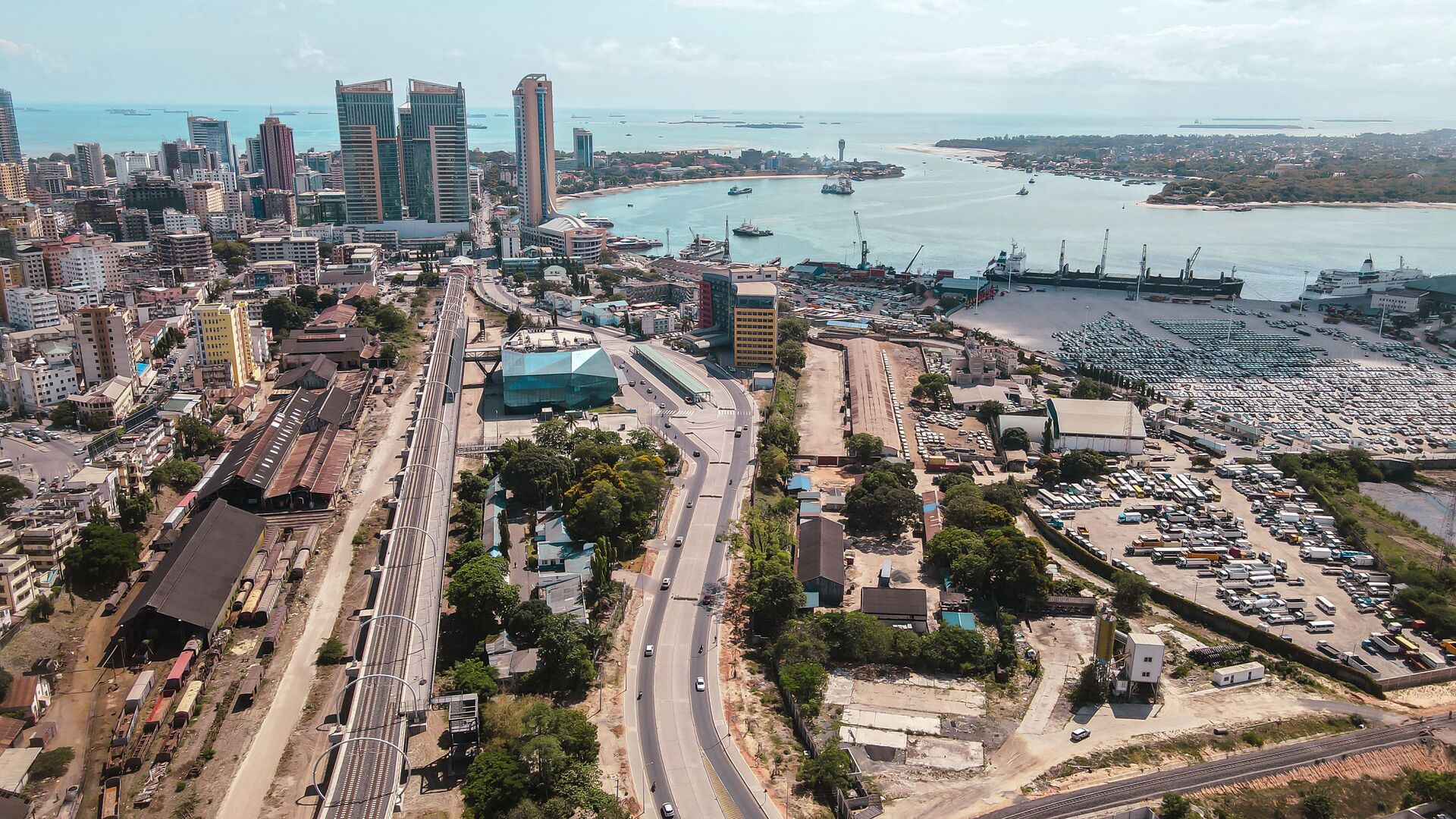
Dar es Salaam, harbor and city skyline
Independence Day: 9 December 1961, when Tanganyika became independent from Britain. Zanzibar followed on 10 December 1963. After a revolution on the islands, the two joined on 26 April 1964 to form what became Tanzania, still marked as Union Day. The official capital is Dodoma, in the centre of the country, where parliament and the government now sit; Dar es Salaam on the coast remains the largest city and the commercial capital. Zanzibar has its own president, parliament and capital, Zanzibar City.
Tanzania spent sixty years as the country nobody worried about. No civil war. No coup. A president who gave up power voluntarily in 1985, when almost nobody in Africa did. A national language, Swahili, that belongs to no single tribe. A country of more than 120 ethnic groups that never split along those lines.
It was also the country that paid, in its own money and its own soldiers, for other people's freedom: Mozambique, Zimbabwe, Namibia, South Africa.
And in October 2025 that reputation ended, in a week of gunfire, an internet blackout and a presidential election result of 97.66 per cent.
This page is about both Tanzanias, because both are real.
The northern part of Tanzania holds some of the oldest evidence of human life anywhere.
At Olduvai Gorge, Mary and Louis Leakey uncovered stone tools and hominin fossils spanning nearly two million years.
At Laetoli, Mary Leakey found footprints made in volcanic ash some 3.6 million years ago by upright-walking hominins, one of the most extraordinary finds in the history of archaeology.
Whatever else is said about this country, human history starts closer to here than to almost anywhere else.
Dar es Salaam, harbor and city skyline
From roughly the ninth century, the coast and islands became part of the Swahili world: Muslim, urban, and trading across the Indian Ocean with Arabia, Persia, India and China.
Kilwa Kisiwani, now a UNESCO World Heritage Site, was the greatest of these city-states. It controlled the gold trade from Sofala, minted its own coins, and built the Great Mosque of coral stone. When the traveller Ibn Battuta visited in the fourteenth century, he called it one of the finest cities he had seen.
The Portuguese wrecked much of that trade in the sixteenth century. Then came Oman. In 1840 Sultan Seyyid Said moved his capital from Muscat to Zanzibar, and the islands became the centre of an economy built on two things: cloves and slaves.
This is where the East African slave trade ran through. Caravans crossed to Lake Tanganyika and into the Congo, bringing ivory and captives to Bagamoyo and across to Zanzibar's slave market. The trade was not European-run: it was Omani and Swahili, financed also by Indian merchants, with African rulers and traders such as Tippu Tip deeply involved. Under British pressure, the Sultan signed a treaty against the seaborne trade in 1873, though it continued inland for years.
In 1884 Carl Peters, a private German adventurer, travelled inland from the coast and got a number of chiefs to sign treaties they could not read. Berlin made those treaties into a protectorate, and German East Africa was born.
Two events should be better known in Germany than they are.
First, the Heligoland–Zanzibar Treaty of 1890. Germany gave up its claim to Zanzibar, which became a British protectorate, and received in exchange the North Sea island of Heligoland, plus a strip of land toward Lake Victoria. An African archipelago and a German island were traded in the same document.
Second, the Maji Maji war of 1905–1907. A rebellion against forced cotton cultivation and German taxation spread across the south. Fighters were told that a sacred water, maji, would protect them from bullets. The German answer was to burn crops and villages across a vast area and starve the population into surrender. Estimates of the dead range from around 75,000 to several hundred thousand, most of them from the famine the Germans engineered. Parts of southern Tanzania have never fully recovered their population.
German rule also built railways, mission schools and towns, and spread Swahili as an administrative language, which is how the language of the coast became the language of the whole country. Neither fact cancels the other.
In the First World War, German East Africa became a battlefield. General Paul von Lettow-Vorbeck kept a small force fighting across the region for four years, and is still remembered in parts of Germany as a hero. The campaign was carried on the backs of African porters, conscripted by all sides in enormous numbers. Tens of thousands of them died of disease, exhaustion and hunger, along with civilians whose food supplies were requisitioned.
In 1919 Germany lost the territory. It became the British mandate of Tanganyika, under the League of Nations, later a UN trust territory. Rwanda and Burundi went to Belgium.
Britain ruled Tanganyika as a poor dependency, and its most famous scheme there, the post-war groundnut scheme, was an expensive failure that cleared land for peanuts that would not grow.
In 1954 the Tanganyika African National Union (TANU) was founded, led by a former teacher, Julius Kambarage Nyerere, called Mwalimu, the teacher. He argued his case at the United Nations rather than in the bush, and he built a movement that crossed every ethnic line in the territory.
On 9 December 1961 Tanganyika became independent, with Nyerere as prime minister, and a republic a year later.
Zanzibar became independent on 10 December 1963, as a sultanate under a minority Arab-led government.
On 12 January 1964 the Zanzibar Revolution overthrew the sultan. It was extremely violent. Thousands of Arabs and South Asians were killed, and many more fled. Estimates of the dead range from several thousand to as many as twenty thousand, and the true figure will probably never be known. Some of the killing was filmed.
On 26 April 1964, Tanganyika and Zanzibar united. In October the new country took the name Tanzania. Zanzibar kept its own government, and the terms of that union have been argued about ever since.
On 5 February 1967 Nyerere announced the Arusha Declaration: Tanzania would build ujamaa, African socialism, based on the extended family and the village. Banks, plantations and large companies were nationalised. Leaders were barred from owning businesses or taking multiple salaries.
What it achieved was real:
What it cost was also real:
Nyerere put Tanzania at the centre of Africa's liberation struggles. Dar es Salaam hosted the OAU Liberation Committee and the exiled movements of Mozambique, Angola, Zimbabwe, Namibia and South Africa. FRELIMO trained here. The ANC had camps here.
Tanzania was bombed and raided for it, and the TAZARA railway, built with Chinese help in the 1970s, existed largely to give landlocked Zambia a route to the sea that did not pass through white-ruled territory.
In 1978–79 Tanzania went to war with Idi Amin's Uganda after Uganda invaded its territory. Tanzanian troops drove Amin out of Kampala in April 1979. It was one of the very few times an African state removed a tyrant next door. It also cost Tanzania an enormous sum it did not have, and the economy never recovered during Nyerere's time.
In 1985 Nyerere stepped down voluntarily. He remains one of the few African leaders of his generation to leave power by choice, and he died in 1999 without a fortune.
His successors dismantled the socialist economy. Multi-party politics returned in 1992, but CCM has never lost a national election, and has now governed continuously since 1961.
On Zanzibar, elections have repeatedly been disputed and violent, above all in 2001, when dozens of protesters were killed on Pemba.
In 1998 the US embassy in Dar es Salaam was bombed by al-Qaida on the same morning as the embassy in Nairobi; eleven people were killed there.
John Magufuli, president from 2015, cut wasteful spending and pushed infrastructure, which made him popular, while banning newspapers, jailing critics and cancelling rallies. During the pandemic he denied the danger of COVID-19 and promoted prayer and herbal remedies. He died in March 2021 after weeks out of public view, officially of heart failure; the circumstances were never fully explained.
Samia Suluhu Hassan, from Zanzibar, became Tanzania's first woman president. She reversed the COVID policy, lifted bans on newspapers and rallies, and talked of reconciliation. For a while, she was widely praised abroad.
Then the country moved back the other way. Opposition figures were arrested, some abducted and one killed. Chadema chairman Tundu Lissu, who had survived being shot sixteen times in an attack in 2017, was arrested in April 2025 and charged with treason.
This is where the calm ended.
Tanzania voted on 29 October 2025. Chadema had been disqualified from the election, and its leader was in prison on a charge that carries the death penalty. Sixteen minor parties stood against the president.
Samia Suluhu Hassan was declared the winner with 97.66 per cent.
Protests broke out immediately, and the state answered with soldiers and an internet blackout. Reporting was almost impossible while it happened.
Nobody agrees on how many died. Chadema said around 700 within three days and later spoke of far higher numbers; the BBC reported more than 500; African rights groups gave figures in the thousands; the United Nations initially confirmed only a very small number. Hundreds were arrested, and dozens were charged with treason.
The African Union said the election violated democratic values.
On 14 November the president told the new parliament she was deeply saddened, announced a commission of inquiry into the killings, and called for the release of some detained protesters. On 2 December she defended the security forces, saying the protests had been violence with malicious intent, planned to bring down the government, and alleging without evidence that young people had been paid to take to the streets.
This part is still happening.
Tundu Lissu is still in custody, and still on trial for treason, more than a year and a half after his arrest. He is defending himself.
The charge rests on a single speech at a Chadema meeting in Dar es Salaam on 3 April 2025, in which the prosecution says he intended to incite the public to block the election. In February 2026 the UN Working Group on Arbitrary Detention found his detention unlawful, calling the charges a grossly disproportionate restriction on freedom of expression. A report by the American Bar Association reached similar conclusions, noting that treason is non-bailable in Tanzania, that the charge criminalises political speech, and that the maximum penalty is death.
The High Court also ruled that the law allowing prosecution witnesses to testify anonymously from enclosed booths was unconstitutional, holding that justice must be seen to be done.
In August 2026 Lissu asked the court to acquit him, arguing that words alone are not treason and that the government does not run elections in any case. On 21 August 2026 a panel of three judges ruled that he had a case to answer, and the trial went to the defence stage. He closed his defence later that month, and the prosecution is now testing his testimony.
Whatever the verdict, the case has already done its work: the leader of the opposition was in a cell for the entire election.
Because Tanzania is the country that shows how much a state can get right and still end up here.
It built a nation out of 120 peoples without a civil war. It gave itself a language that belongs to everyone. It taught its people to read. It fought for other countries' independence at its own expense. Its founding president gave up power and died poor.
And it has been governed by the same party since 1961. One party, without interruption, for sixty-five years. Every one of those achievements happened under a system that never allowed itself to be voted out.
In October 2025 that system was asked a real question for the first time in years, and it answered with soldiers.
For Germany: German East Africa is barely taught in German schools. Carl Peters, whose brutality was condemned even by colonial officials of his own time, later had a street and a cult of admirers. Maji Maji was a deliberate famine. Lettow-Vorbeck was celebrated in Germany for decades while the porters who died carrying his supplies were not counted at all. Human remains taken from this region are still held in German collections, and their return is still being negotiated.
For Britain: the mandate did little, and the groundnut scheme showed what it thought African land was for.
For the slave trade: the East African trade ran through Zanzibar for generations, driven by Omani, Swahili, Indian and African traders. The Atlantic is not the whole story of slavery in Africa, and this coast is the proof.
For the revolution of 1964: the overthrow of the sultan removed a minority government that had ruled over the majority, and it was also a massacre of Arab and Indian civilians, which Tanzania has never seriously examined.
For Nyerere's admirers: villagisation moved millions of people by force and wrecked the country's agriculture. Detention without trial was used on real opponents. He built a nation and a one-party state at the same time, and the second outlived him.
And for today's government: the killings of October 2025 were carried out by Tanzanian police and soldiers against Tanzanian civilians, and the man who might have won votes from the governing party spent the election in prison. No foreign power arranged that.
There are footprints in volcanic ash at Laetoli, 3.6 million years old.
There are the coral ruins of Kilwa, where a sultan once minted his own coins.
There is a slave market site in Stone Town, with a church built over it.
There is a treaty from 1890 in which an African archipelago and a North Sea island changed hands together.
There is the southern countryside emptied by the Maji Maji famine.
There are graves of porters from the First World War that nobody counted.
There is the Arusha Declaration, and the villages people were moved into.
There is the TAZARA railway, built so that a neighbour would not have to depend on white-ruled Africa.
There is a president who resigned in 1985 and died in 1999 with no fortune.
And there is a courtroom in Dar es Salaam, where an opposition leader who was shot sixteen times in 2017 is defending himself against a charge that can end in a hanging.
Updated and fact-checked: 17 September 2026.
How this page was checked. Recent events were verified against the sources listed above; the historical record was checked against standard reference works on East Africa. The Laetoli footprints, the Kilwa city-state, the move of the Omani capital to Zanzibar in 1840, Carl Peters's treaties of 1884–85, the Heligoland–Zanzibar Treaty of 1890, the Maji Maji war of 1905–07, the British mandate from 1919, the founding of TANU in 1954, Tanganyikan independence on 9 December 1961, Zanzibari independence on 10 December 1963, the Zanzibar Revolution of 12 January 1964, the union of 26 April 1964, the Arusha Declaration of 5 February 1967, the war with Uganda of 1978–79, Nyerere's resignation in 1985, the return of multi-party politics in 1992, the death of John Magufuli in March 2021, the arrest of Tundu Lissu in April 2025, the election of 29 October 2025 and the High Court ruling of 21 August 2026 are as recorded. Casualty figures are estimates and are given as ranges where they are disputed: deaths in the Maji Maji war and the famine that followed (estimates range from roughly 75,000 to several hundred thousand); deaths in the Zanzibar Revolution (estimates range from several thousand to around twenty thousand); and deaths in the protests of October and November 2025, where the figures given by the opposition, by rights groups, by media organisations and by the United Nations differ enormously and are all recorded here as claims rather than established facts. The circumstances of President Magufuli's death are recorded as officially stated. The treason charge against Tundu Lissu is recorded as a charge; he denies it, no verdict had been reached at the time of writing, and the findings of the UN Working Group on Arbitrary Detention and the American Bar Association are attributed to those bodies. This page makes no allegation against any living person beyond matters already on the public record.
Written and researched by Remo Kurka · africanindependence.com
We strive to unify diverse narratives from across Africa, showcasing the continent's shared heritage and unique stories.
Our mission is to honor and preserve the history of African cultures and independence movements for future generations.
We provide a platform for innovative exchange of ideas, resources, and insights, understanding that knowledge should be accessible to all.