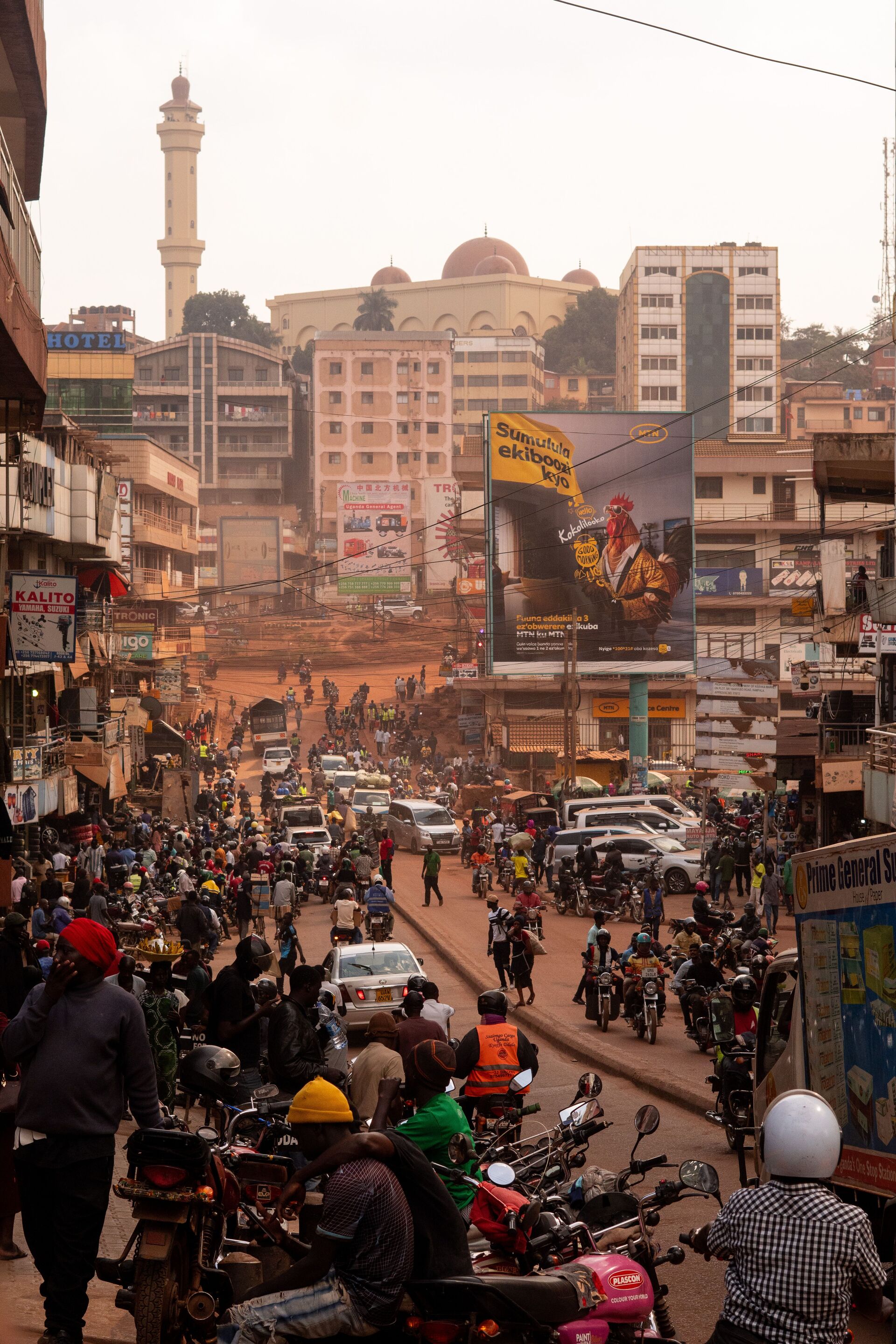
Uganda, Kampala busy street
Independence Day: 9 October 1962, from Britain. The capital is Kampala, built across a set of hills beside Lake Victoria; the colonial administration had sat at Entebbe, where the airport still is. Uganda has had one president since 26 January 1986. Yoweri Kaguta Museveni is 81 years old, was declared the winner of a seventh term in January 2026 with 71.65 per cent of the vote, and will be 86 at the end of it. The army is commanded by his son.
Uganda has already lived through two of the worst governments Africa has produced, and the man who ended them is now the story.
Idi Amin is on this website already. Milton Obote destroyed the country twice, before Amin and after him. When Museveni's fighters walked into Kampala in 1986, there was a real argument that Uganda had been saved.
Forty years later, the argument is over. And the question that matters now is not whether Museveni will leave, but what he is leaving to whom.
Uganda is unusual among African colonies because Britain did not find a collection of villages here. It found kingdoms with courts, armies, taxes and centuries of history.
Buganda, on the northern shore of Lake Victoria, was the strongest: a centralised state under a king, the Kabaka, with a capital, a bureaucracy of chiefs and a navy of war canoes. Bunyoro-Kitara to the west had been the older great power. There were also Toro, Ankole and Busoga, and in the north peoples who were organised very differently, the Acholi, Langi, Lugbara, Karamojong and others.
That division, centralised kingdoms in the south, non-monarchical societies in the north, is the oldest fault line in Ugandan politics, and the British widened it: administrators and cash crops in the south, army recruits from the north.
Uganda, Kampala busy street
European explorers arrived looking for the source of the Nile; John Speke reached it in 1862. Then came the missionaries, Anglicans in 1877 and Catholics in 1879, into a court where Muslim traders were already established.
Buganda's politics split into religious factions, and in the late 1880s and early 1890s the country fought a series of religious civil wars.
Between 1885 and 1887 Kabaka Mwanga had a number of Christian pages at his court executed, most famously by burning at Namugongo. The Uganda Martyrs were canonised in 1964, and Namugongo now draws one of the largest annual pilgrimages in Africa each 3 June.
The Imperial British East Africa Company moved in from 1888, with Frederick Lugard commanding its small force, and when the company ran out of money, Britain declared a protectorate in 1894.
Resistance in Bunyoro under Kabalega was long and bitter. In 1899 Kabalega and Mwanga were captured and exiled to the Seychelles, where Kabalega remained until 1923. Britain rewarded Buganda with land taken from Bunyoro, the "lost counties," which poisoned relations between the two for the next sixty years.
The Buganda Agreement of 1900 is the document that made Uganda what it is. Buganda kept its Kabaka and its parliament, and its chiefs were handed private freehold estates, the mailo land, carved out of what had been held in trust for the people.
So Uganda became a protectorate with a privileged kingdom inside it, administered indirectly through Ganda chiefs, who were also sent to run other parts of the country, which was resented everywhere they went.
Uganda was never a settler colony like Kenya. Its economy was built on cotton and later coffee grown by African smallholders, and its trade was largely handled by South Asian merchants, brought in or drawn by the railway from Mombasa. By the 1950s Ugandans of Indian origin ran much of the commerce and industry, and were resented for it.
Makerere College in Kampala, founded in 1922, became the finest university in East Africa.
Politics before independence ran along the old lines. The Democratic Party was largely Catholic. The Uganda People's Congress (UPC) of Milton Obote was Protestant and northern-leaning. Buganda had its own royalist party, Kabaka Yekka, "the King Alone."
Obote made an alliance with the royalists, and on 9 October 1962 Uganda became independent with Obote as prime minister. In 1963 the Kabaka of Buganda, Mutesa II, became the ceremonial president.
It held for less than four years.
In 1966 Obote attacked the Kabaka's palace at Mengo, using the army commander Idi Amin to do it. Hundreds were killed. Mutesa escaped and died in a London flat in 1969. In 1967 Obote abolished all the kingdoms, tore up the independence constitution and made himself executive president.
Independent Uganda's first act of political violence was committed by its own prime minister against its largest kingdom, and every crisis since has some of its roots there.
On 25 January 1971, while Obote was abroad, Idi Amin took power. Crowds in Kampala celebrated, and so did several Western governments.
What followed is covered in full in our separate article on Amin. In short:
Then came the part that is much less well known outside Uganda.
The 1980 election returned Milton Obote to power, in a vote widely regarded as rigged. Yoweri Museveni, whose party had won almost nothing, went into the bush with a few dozen men and started a guerrilla war.
The army's counter-insurgency in the Luwero Triangle, north of Kampala, was a catastrophe for civilians. Estimates of the dead run from around 100,000 to 300,000. For years afterwards, the roadside was lined with displays of skulls.
In 1985 Obote was overthrown again, this time by his own generals. On 26 January 1986 Museveni's National Resistance Army took Kampala.
It is not honest to write about Museveni without the first fifteen years.
He also built a "Movement" system: no parties, only the Movement, on the argument that party politics in Uganda meant tribal and religious politics. It worked as a rationale for a decade and then became a one-party state by another name.
Two things sit against the recovery years, and both are large.
The Lord's Resistance Army. From 1987 Joseph Kony's movement fought the government in the Acholi north. Tens of thousands of children were abducted as fighters and as wives; villages were destroyed; children slept in town centres each night to avoid being taken. The government's answer was to force roughly 1.5 to 2 million people into "protected villages", camps where disease and hunger killed on an enormous scale. The war lasted about twenty years. Kony has never been caught.
The Congo. Uganda's army occupied parts of eastern DR Congo from 1998 to 2003, and Ugandan officers profited from Congolese gold and timber. In 2005 the International Court of Justice found Uganda liable for violations there, and in 2022 it ordered Uganda to pay 325 million dollars in reparations to the DRC.
In 2005 parliament removed the two-term limit from the 1995 constitution, in the same package that restored multi-party politics. Members were reported to have received payments.
In 2017 parliament removed the age limit of 75. The debate ended in a brawl on the floor of the house, with soldiers entering the chamber and opposition MPs dragged out.
With those two votes, the two constitutional limits on Museveni's rule were gone.
The elections continued. Kizza Besigye, his former personal doctor, ran four times and was arrested, beaten and charged repeatedly. In 2021 the challenger was Robert Kyagulanyi, the musician known as Bobi Wine, whose supporters were shot at, whose rallies were broken up, and in whose campaign more than fifty people were killed in Kampala in November 2020. Museveni won with 58 per cent, and the internet was shut down.
This is the most recent chapter, and it is the harshest one yet.
The election was held on 15 January 2026, with a nationwide internet blackout imposed in the days before the vote and heavy security deployments.
On the day, the new biometric voter identification machines failed, first in opposition strongholds in and around Kampala, and later even at the president's own polling station in Rwakitura. Officials fell back on manual registers. The failure of those machines is likely to be the basis of any legal challenge to the result.
The Electoral Commission declared Museveni the winner with 7,946,772 votes, 71.65 per cent. Bobi Wine received 2,741,238 votes, 24.72 per cent. Turnout was 52.5 per cent, down nearly seven points. In 2021 the gap had been 58 to 35; this time it was far wider on a smaller vote.
Bobi Wine rejected the result as fake and said he had evidence of fraud. He called it not an election but a military operation.
Protests broke out on 16 January and were crushed within five days. Around 30 protesters were killed and more than 2,000 arrested.
And then came the manhunt. Bobi Wine's home in Magere was besieged by the military, with drones and counter-terrorism units, and he escaped on the night the result was declared. He describes his house being raided the next day, and a later raid in which his home was overrun, his wife severely beaten and family members tortured; his wife was hospitalised and then got out of the country with their children. He stayed inside Uganda for nearly sixty days, moving between safe houses, fed and hidden by boda-boda riders and supporters.
In March 2026 he announced he had left the country, and he now speaks from exile in the United States, calling for sanctions on the government and saying he will return.
Here is where the point about family rule comes in, and in Uganda it is not a rumour but a public fact.
General Muhoozi Kainerugaba, the president's son, is Chief of Defence Forces, the head of the entire armed forces. He has said publicly that no civilian can become president. He has used social media to threaten to behead Bobi Wine and to castrate his associates, and he has boasted about the treatment of a detained opposition bodyguard.
He also runs a political vehicle, the Patriotic League of Uganda, which has been placing loyalists in parliament, in the ruling party and in government. He was behind the removal of the former speaker, Anita Among, who is under investigation over alleged corruption and illicit enrichment, and behind the elevation of her successor.
And yet the succession is not settled. The cabinet Museveni named in May 2026 mixed Muhoozi's allies with a long list of old loyalists from the 1990s and 2000s, which Ugandan analysts read as the father slowing the son down rather than handing over. The president's son-in-law has returned to frontline politics. Museveni himself says almost nothing about it.
So Uganda now has the familiar shape: a president approaching his fifth decade in power, a family holding the army, a divided elite manoeuvring for what comes after, and no mechanism by which voters can decide any of it.
None of this is the whole country.
Uganda hosts more refugees than any other African state, well over a million from South Sudan, the DRC, Burundi and elsewhere, and its refugee policy, which gives new arrivals land and the right to work, is genuinely one of the most generous in the world.
Its oil, under Lake Albert, is finally moving toward production through the East African Crude Oil Pipeline to the Tanzanian coast, a project fought over by environmental campaigners, some of whom have been arrested for protesting it.
Its economy still grows. Its population is among the youngest on earth. Its musicians, writers and footballers are doing well. Its national parks are extraordinary and its tourism is real.
It has also passed one of the world's harshest anti-homosexuality laws, in 2023, which carries the death penalty for what it calls aggravated homosexuality. Supporters in Uganda describe it as a defence of family and culture against foreign pressure; the World Bank suspended new lending and the United States cut trade preferences and imposed some sanctions in response. Both sides of that argument are part of the public record, and Uganda's relations with Western donors have been shaped by it ever since.
And, as the Eswatini page on this site records, Uganda is one of the countries reported to have agreed to receive people deported from the United States who are not Ugandan.
Because Uganda shows the most common ending of all.
The man who took power in 1986 did so after a decade in which his country had been governed by Amin and by Obote. He had every reason and every right to say he was rescuing Uganda, and for a while he was.
Then he removed the term limit, then the age limit, then the internet, and then put his son in charge of the army.
It is the pattern this website keeps recording, from Togo to Gabon to Equatorial Guinea: the liberator who becomes the institution, and the family that becomes the state.
For Britain: the Buganda Agreement of 1900 created a privileged kingdom inside a protectorate and handed away Bunyoro's land, and the exiles of Kabalega and Mwanga to the Seychelles are part of the same story. Britain also built the north-south division that still runs through Ugandan politics.
For Uganda's own leaders: it was Obote who attacked the Kabaka's palace in 1966, Amin who expelled the Asians and killed on a mass scale, Obote again whose army devastated Luwero, and Museveni's government that forced nearly two million northerners into camps while fighting Kony.
For Western governments: Uganda has been a favoured partner for decades, praised for economic reform and used as a security ally in Somalia and the region, with a great deal of military aid and training, while elections were rigged and opponents were tortured. The praise and the money largely continued.
For the argument about stability: Uganda is calmer than it was in 1979 or 1985, and that is real. But a stability that depends on one 81-year-old man and on which of his relatives holds the guns is not stability. It is a postponed crisis.
There are the royal tombs at Kasubi, where the Kabakas of Buganda are buried, burned in 2010 and rebuilt.
There is the shrine at Namugongo, where the martyrs died in the 1880s, and the pilgrimage every June.
There is an agreement from 1900 that gave chiefs private title to land that was not theirs.
There is a grave in Kampala for a king who died in a London flat in 1969.
There is the Luwero Triangle, where the skulls were displayed by the roadside.
There are the camps of the north, emptied now, and the children who slept in town centres to avoid being taken.
There is a judgment of the International Court of Justice with a figure of 325 million dollars attached.
There is a constitution from 1995 with two limits removed from it.
There are the biometric machines that failed in the opposition's districts on 15 January 2026.
And there is an army commander who is the president's son, and a man in exile in Washington who received a quarter of the vote and says he is going home.
Updated and fact-checked: 17 September 2026.
How this page was checked. Recent events were verified against the sources listed above; the historical record was checked against standard reference works on Tunisia and the Maghreb. The founding and destruction of Carthage, the founding of Kairouan in 670, Hafsid and Ottoman rule, the abolition of slavery in 1846, the constitution of 1861, the bankruptcy of 1869, the French invasion and Treaty of Bardo in 1881, the founding of the Destour in 1920 and the Neo-Destour in 1934, the founding of the UGTT in 1946 and the assassination of Ferhat Hached in 1952, independence on 20 March 1956, the Code of Personal Status of August 1956, the Bizerte crisis of 1961, the events of January 1978 and 1984, the removal of Bourguiba on 7 November 1987, the protest of Mohamed Bouazizi on 17 December 2010, the flight of Ben Ali on 14 January 2011, the assassinations of 2013, the constitution of 26 January 2014, the Nobel Peace Prize of 2015, the attacks at the Bardo Museum and in Sousse in 2015, the measures of 25 July 2021 and after, the re-election of October 2024, the sentences of April 2025 and November 2025, the sentencing of Rached Ghannouchi in June 2026 and the protests of July and August 2026 are as recorded. Casualty figures are estimates and are given as approximate where they are disputed: deaths in the Bizerte crisis (several hundred to about a thousand) and deaths during the uprising of December 2010 to January 2011 (around three hundred). The conspiracy convictions are recorded as convictions of a court whose independence is contested; the defendants deny the charges, and the assessment that the case was politically motivated and lacked due process is that of Human Rights Watch. The arguments for and against the measures of July 2021 are both recorded, as they are made in Tunisia. This page makes no allegation against any living person beyond matters already on the public record.
Written and researched by Remo Kurka · africanindependence.com
We strive to unify diverse narratives from across Africa, showcasing the continent's shared heritage and unique stories.
Our mission is to honor and preserve the history of African cultures and independence movements for future generations.
We provide a platform for innovative exchange of ideas, resources, and insights, understanding that knowledge should be accessible to all.