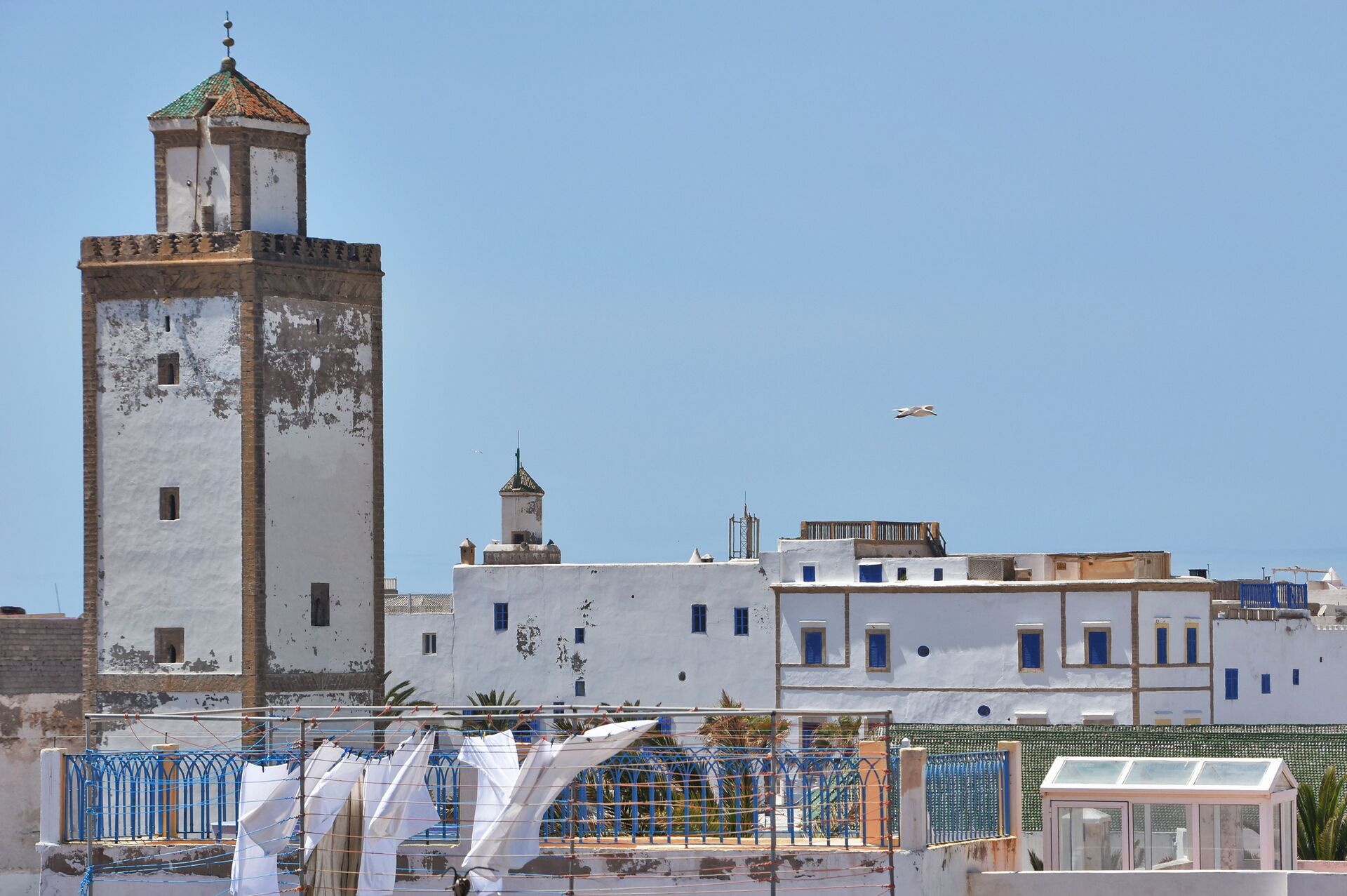
Essaouira, Morocco, historic architecture
Independence Day: 2 March 1956. Morocco has been governed by the same dynasty since 1666, was the only North African state the Ottomans never took, and once killed a Portuguese king in battle so decisively that Portugal lost its own independence for sixty years.
It was also carved into a French protectorate, a Spanish zone and an international city in 1912, and was subjected to one of the first sustained aerial chemical weapons campaigns against a civilian population anywhere in the world. And it administers Western Sahara, which has been on the United Nations list of non-self-governing territories since 1963 and is still there.
Every other page in this series has one relationship to colonialism. Morocco has two.
It is among the oldest continuously existing states on earth, with a political identity that predates almost every country in Europe. It was colonised late, briefly and incompletely — forty-four years, against more than a century for Algeria — and it never lost its monarchy, its legal traditions or its sense of itself.
And Morocco is, today, the administering power of the last territory in Africa on the UN decolonisation list.
That is not a rhetorical trap; it is the actual position, and this page will set out both sides of it properly, because the argument is live, it moved significantly in October 2025, and honest people disagree about it.
What this page will not do is pretend the question is simple in either direction.
Morocco's political continuity is genuinely exceptional.
The Idrisid dynasty was founded in 788, and Fez with it. Then came the Almoravids in the eleventh century — who, as the Mauritania page on this site describes, came out of the western Sahara, took Marrakesh and Morocco, and crossed into Spain.
Then the Almohads, who at their height ruled from Tripoli to Lisbon. Then the Marinids, the Saadians, and from 1666 the Alaouites, who reign today.
Essaouira, Morocco, historic architecture
Morocco was never part of the Ottoman Empire. Algeria, Tunisia and Libya all were. Morocco stopped them at the Moulouya, and that single fact shaped four centuries of North African politics.
And two episodes belong on an African independence website specifically.
The Battle of the Three Kings, 4 August 1578, near Ksar el-Kebir. A Portuguese invasion army was destroyed by the Saadians. King Sebastian of Portugal was killed, his body never reliably recovered, and with no heir the Portuguese crown passed to Philip II of Spain. Portugal did not regain its independence for sixty years.
An African army ended a European kingdom. It is one of the most consequential battles fought anywhere in the sixteenth century, and it is not taught in Europe.
And in 1591, a Saadian expedition crossed the Sahara and destroyed the Songhai Empire — the event described on this site's Mali page, which ended the last of the great Sahelian empires and shattered the political order of the Niger bend for centuries.
Morocco was an imperial power as well as a victim of imperialism. Any account that leaves that out is not history, it is advocacy.
One more, because it is a small fact that Americans find startling: Morocco was the first state in the world to recognise the independence of the United States, in 1777, and the treaty signed in 1786 is the longest unbroken treaty relationship the United States has with anybody.
Decline was financial before it was military. Defeat by France at Isly in 1844 and by Spain at Tetouan in 1860 brought indemnities that Morocco borrowed to pay, and the debt brought European control of the customs.
The Algeciras Conference of 1906 internationalised Moroccan finances. The Treaty of Fez, 30 March 1912, made Morocco a French protectorate. Spain took a zone in the north and another in the far south around Tarfaya and Ifni. Tangier became an international city.
Note the legal form. Morocco was a protectorate, not a colony: the sultan remained, the state remained, the courts remained. It was a fiction of sovereignty, and French residents-general governed in fact — but the fiction mattered at independence, because there was a state to hand back.
Marshal Lyautey, the first resident-general, built the villes nouvelles — new European cities alongside the old medinas rather than through them. It preserved Fez and Marrakesh, which is why they are World Heritage sites today, and it produced two-tier cities in which Moroccans and Europeans lived separate lives. Casablanca grew from a port town into the largest city in the Maghreb.
And now the part of Moroccan history that Europe has buried most completely.
In 1921, in the Rif mountains of the Spanish zone, a Berber leader named Muhammad ibn Abd el-Krim al-Khattabi — a former judge and newspaper editor, educated in Spanish institutions — led a revolt.
At Annual, in July 1921, his forces destroyed a Spanish army. Estimates of the Spanish dead run to around thirteen thousand. It was one of the worst defeats any European army suffered in a colonial war, it brought down a Spanish government, it fed directly into the crisis that produced the Primo de Rivera dictatorship, and it made Abd el-Krim famous from Cairo to Beijing.
He declared the Republic of the Rif — with a constitution, an assembly, a currency, taxation and a foreign policy. It lasted five years.
And to destroy it, Spain used chemical weapons on the civilian population.
From 1923 to 1927, Spanish aircraft dropped mustard gas and other chemical agents on Rif villages, markets and water sources — not on battlefields, on the people. Spain had acquired the agents and the technical assistance from abroad, and France, which entered the war in 1925 after Abd el-Krim pushed into the French zone, brought overwhelming force.
This was among the first sustained aerial chemical bombardments of a civilian population anywhere in the world, and it came a decade before Italy did the same thing in Ethiopia and Libya — both described elsewhere on this site, both by the same generation of European officers.
Abd el-Krim surrendered in 1926 and was exiled to Réunion, later escaping to Cairo, where he died in 1963.
Spain has never formally acknowledged the chemical campaign. Rif associations have pressed for recognition and for investigation of unusually high cancer rates in the region for decades. Spanish parliamentary motions have been raised and have gone nowhere. There has been no apology, no inquiry, no compensation.
Compare that with Italy's 2008 treaty with Libya, described on this site, or with Germany's Benin transfers, or with Britain's 2013 Mau Mau settlement. The Rif is the open file, and it is open because nobody has forced it.
Moroccan nationalism organised through the Istiqlal party from 1944, and around the sultan.
Mohammed V became the symbol rather than the instrument of French rule, and in August 1953 France deposed and deported him — to Corsica, then Madagascar. It was a catastrophic miscalculation. Armed resistance and urban violence followed, the country became ungovernable, and France was simultaneously losing Indochina and starting the war in Algeria.
He came back on 16 November 1955 to enormous crowds, and independence was agreed on 2 March 1956. Spain gave up its northern zone on 7 April 1956, and Tangier was reintegrated in October.
Not everything came back. Ifni was returned only in 1969. Tarfaya in 1958. Ceuta and Melilla remain Spanish to this day, along with several islets — a live Moroccan claim and the reason those two cities are the European Union's only land borders in Africa.
Mohammed V died in 1961. His son Hassan II ruled for thirty-eight years.
Les années de plomb is the Moroccan name for roughly 1961 to 1999, and Moroccans use it without euphemism.
Political opponents were disappeared. The secret detention centre at Tazmamart, in the desert, held survivors of the failed coups in underground cells for eighteen years; roughly half of those sent there died. Its existence was denied until the early 1990s.
Mehdi Ben Barka, the most prominent left-wing opposition leader, was abducted in Paris in October 1965 in an operation involving French police officers and Moroccan agents, and was never seen again. The case remains formally open in France sixty years later. No body, no trial, no answer.
The Rif was punished again. The 1958–59 rising there was suppressed with severity that the region has not forgotten, and Hassan II's hostility to the Rif was personal and public.
Casablanca burned twice — in the 1965 student riots and in the 1981 bread riots, both put down with live fire and hundreds of deaths on credible accounts.
And there were two attempts to kill the king: the attack on his birthday party at Skhirat in 1971, and in 1972 an attempt to shoot down his aircraft, organised by his own interior minister and closest security figure, General Oufkir, who died the same night in circumstances the palace never explained. Oufkir's wife and six children — the youngest three years old — were imprisoned for nearly twenty years, much of it in desert isolation, and escaped in 1987.
Hassan II died in 1999. His son Mohammed VI was 35.
In 2004 he created the Instance Équité et Réconciliation — the Equity and Reconciliation Commission. It was the first truth commission in the Arab world, and it was created by the son of the man responsible, about his own father's reign, while the same dynasty remained in power.
It received around twenty thousand submissions, documented several thousand cases of disappearance and arbitrary detention, held public hearings broadcast on national television in which victims described what had been done to them, and awarded reparations to thousands of families and to affected communities.
And it did not name perpetrators, and it did not lead to a single prosecution. That was the deal, and it was explicit: truth and compensation in exchange for impunity.
This is one of the most instructive cases anywhere on the accountability question this network keeps returning to. Compare it with Liberia, whose commission named fifty people and produced nothing, or The Gambia, whose commission produced a tribunal with no money. Morocco's commission produced money, a public record and closure for many families — and no justice.
Which of those is worth more is a real question, and Moroccan victims themselves are divided on it.
Now the unresolved thing, set out as fairly as this website can manage.
Spain held the territory as Spanish Sahara from 1884. It was placed on the UN list of non-self-governing territories in 1963, and remains on it.
In 1975, as Spain prepared to withdraw, the International Court of Justice was asked whether the territory had been terra nullius before Spanish colonisation, and what its legal ties were to Morocco and to Mauritania. The Court found that it was not terra nullius, that there were legal ties of allegiance between certain Saharan tribes and the Sultan of Morocco, and also ties with the Mauritanian entity — but that none of these amounted to territorial sovereignty, and that they did not affect the application of the principle of self-determination through the free expression of the will of the people.
Both sides quote that opinion. Both quote it accurately, and each leaves out the other half.
On 6 November 1975, Morocco launched the Green March: around 350,000 unarmed civilians walked into the territory carrying flags and Qur'ans. It was a masterstroke of political theatre and it is a founding national memory in Morocco, marked every year.
Spain signed the Madrid Accords on 14 November 1975, transferring administration to Morocco and Mauritania and leaving. The UN has never recognised that transfer as conveying sovereignty, and Spain is still formally listed as the administering power.
The Polisario Front declared the Sahrawi Arab Democratic Republic in February 1976 and fought both occupiers. Mauritania was broken by the war and withdrew in 1979, as the Mauritania page on this site describes; Morocco then took the Mauritanian sector too.
The war ran to 1991. Morocco built the berm — a sand and stone wall running some 2,700 kilometres, with minefields, radar and garrisons — which by the late 1980s enclosed roughly the western four-fifths of the territory, including the coast and the phosphates.
The 1991 ceasefire created MINURSO — the United Nations Mission for the Referendum in Western Sahara. Its central task was to organise a referendum on self-determination.
That referendum has never been held. The parties could not agree on who was entitled to vote, and the impasse ran for thirty years.
Around 90,000 to 170,000 Sahrawi refugees, depending on whose count, have lived in camps near Tindouf in Algeria since 1975 — now a fourth generation. Morocco has invested very heavily in Laayoune and Dakhla, and the territory's economy and population have been transformed, with substantial Moroccan settlement.
Morocco left the Organisation of African Unity in 1984 when the SADR was admitted, and stayed out for thirty-three years, rejoining the African Union in 2017 — the only country ever to leave and return.
In November 2020 fighting resumed briefly at Guerguerat and Polisario declared the ceasefire over.
In December 2020 the United States recognised Moroccan sovereignty over Western Sahara, in exchange for Morocco normalising relations with Israel under the Abraham Accords. Spain shifted to supporting the autonomy plan in 2022. France did so in July 2024. The United Kingdom followed in June 2025. Algeria cut diplomatic relations with Morocco in 2021 and the border remains closed.
And then, on 31 October 2025, the UN Security Council adopted Resolution 2797 by eleven votes in favour, none against, with three abstentions — China, Pakistan and Russia. Algeria did not take part in the vote.
The resolution renewed MINURSO until 31 October 2026 and, for the first time, expressed support for negotiations taking Morocco's 2007 autonomy proposal as a basis. It contains no reference to an independence referendum.
The readings diverge completely, and this page will give both.
The Moroccan reading, set out by the palace and by Moroccan institutions: this is a historic turning point; autonomy under Moroccan sovereignty is now the sole basis for negotiation; the referendum option has been definitively set aside; and Morocco says 118 countries now support its plan. The king used the occasion to invite the people of the Tindouf camps to return and to appeal to Algeria to open a new chapter.
The opposing reading, put at the UN Decolonisation Committee in 2026 by Namibia among others: the resolution did not impose the autonomy plan; it reaffirmed the need for a mutually agreeable solution; Western Sahara remains a decolonisation question and the Committee must remain seized of it. Analysts sympathetic to this view argue the resolution makes negotiation conditional on Sahrawis giving up independence in advance, which is not what self-determination means.
In April 2026 Morocco presented a revised and much more detailed version of its autonomy proposal: elected local institutions, a regional parliament, an administrative government responsible for the economy and development, local police and courts — with defence, foreign affairs, currency and the religious authority of the king reserved to the central state.
Where this stands in September 2026: the diplomatic momentum is with Morocco, the legal question of self-determination has not been formally extinguished, no referendum is scheduled, and no negotiated settlement exists.
There is one more piece, and it is where the dispute becomes commercial.
Morocco's OCP controls roughly seventy per cent of the world's known phosphate rock reserves. Phosphate is fertiliser; fertiliser is food. It is the single most strategically important mineral position held by any African country.
Part of it — the Bou Craa deposit — lies in Western Sahara.
The Court of Justice of the European Union has repeatedly held that Western Sahara is separate and distinct from Morocco, that EU–Morocco trade and fisheries agreements cannot be applied to the territory or its waters without the consent of its people, and in October 2024 it delivered a final judgment annulling the contested agreements as they applied there.
A European court has ruled, repeatedly, that the people of the territory must consent. No European government has changed its policy as a result.
Morocco in 2026 is, by most economic measures, a success.
Tanger Med is the largest container port in Africa and the Mediterranean. Morocco is Africa's largest car exporter, with Renault and Stellantis plants supplying Europe, alongside a substantial aerospace sector. Noor Ouarzazate is one of the world's largest concentrated solar plants, and green hydrogen projects are being built at scale. Tourism has passed seventeen million visitors a year. Morocco hosted the Africa Cup of Nations over the turn of 2025–26, and co-hosts the 2030 World Cup with Spain and Portugal.
And in September and October 2025 the country was gripped by nationwide protests.
The movement called itself GenZ212 — young, online, leaderless — and its demands were healthcare, education and an end to corruption. Its central argument was the contrast between stadium budgets and hospitals: people were dying in under-resourced public hospitals while the state spent on the AFCON and the World Cup.
Police and gendarmerie used lethal force. Three people were killed and dozens injured. Around 2,100 people were arrested, judicial proceedings were opened against at least 1,400 — including 330 children — and roughly a thousand were still detained months later, according to the Moroccan Association for Human Rights.
That is the same pattern seen in Kenya in 2024 and Madagascar in 2025, and the same generation making it.
Alongside it: a severe multi-year drought with reservoirs at historic lows and agriculture under strain; the Al Haouz earthquake of September 2023, which killed around 2,900 people in the High Atlas; and continuing pressure at Ceuta and Melilla, where in June 2022 at least twenty-three people died at the Melilla fence in circumstances that have never been properly investigated on either side.
Because Morocco is the strongest available case that African statehood is not a European creation — and the strongest available case that being an old state does not settle what you may do with your neighbours.
The Alaouites have reigned since 1666. The battle that ended Portugal's independence was won here. The Ottomans never got in. And the same state destroyed Songhai in 1591 and holds a territory today that the United Nations still lists as awaiting decolonisation.
And because the Rif is the unpaid bill. Spain gassed civilians from the air for four years in the 1920s and has never acknowledged it — no apology, no inquiry, no compensation, while the cancer registries in the north of Morocco keep being cited and keep being ignored. Every argument this network makes about German museums, Italian obelisks and British archives applies here with more force, and nobody is making it.
And because of the commission. Morocco built the Arab world's first truth commission, broadcast its victims on television, paid them, and prosecuted nobody. That is the bargain that Liberia never struck and The Gambia cannot afford. Whether it was the right one is a question every country on this website eventually faces.
Morocco's case on Western Sahara is not frivolous. Pre-colonial allegiance ties did exist; the ICJ said so. Spain left without organising anything; Algeria's support for Polisario is inseparable from its rivalry with Rabat; the territory has been transformed by Moroccan investment, and many of the people living there now are Moroccan. Fifty years is a long time, and the autonomy plan is a real offer of self-government.
And the Sahrawi case is not frivolous either. The same ICJ opinion said the ties did not amount to sovereignty and that self-determination applied. The UN has never recognised the 1975 transfer. A referendum was promised in 1991 and has not happened in thirty-five years. European courts keep ruling that consent is required. Four generations have now been born in camps in the Algerian desert.
Both of those paragraphs are accurate, and any page that gives you only one is selling you something.
The Years of Lead have been acknowledged and not prosecuted. Thousands were compensated. Nobody was tried. Mehdi Ben Barka's family has waited sixty years.
The Rif has been punished three times in a century — by Spain with gas in the 1920s, by the monarchy in 1958, and by the courts in 2017, when the leader of the Hirak protest movement received twenty years for a demonstration that began when a fish seller was crushed to death in a rubbish lorry.
And the state that hosts the World Cup arrested 330 children in 2025 for protesting about hospitals.
Two things are true. Morocco is one of the oldest and most capable states in Africa, and it is the administering power of the last territory on the continent's decolonisation list.
There is a dynasty that took the throne in 1666 and still holds it.
There is a battlefield at Ksar el-Kebir where a Portuguese king died in 1578, and a kingdom that lost its independence for sixty years because of it.
There is an expedition that crossed the Sahara in 1591 and ended the last great empire of the Niger bend.
There is a treaty with the United States signed in 1786 that has never lapsed.
There is a Spanish army destroyed at Annual in 1921, and a republic in the Rif mountains with its own constitution and currency.
There is mustard gas dropped on Rif villages, markets and wells from 1923 to 1927, and no Spanish apology, inquiry or compensation a century later.
There is a sultan deported to Madagascar in 1953 and carried back on the shoulders of his people in 1955.
There is a man abducted in Paris in October 1965 whose file is still open in a French court.
There is a prison in the desert whose existence was denied for eighteen years.
There is a commission that put torture victims on national television and named nobody.
There are 350,000 people walking south with flags in November 1975.
There is a wall of sand and stone two thousand seven hundred kilometres long.
There is a referendum promised in 1991 and a mission still called the Mission for the Referendum in Western Sahara.
There are camps at Tindouf where a fourth generation has been born.
There is a Security Council resolution from 31 October 2025 that mentions autonomy and does not mention a referendum, and two readings of it that cannot both be right.
And there are 330 children charged in 2025 for demanding hospitals in a country building stadiums.
Updated and fact-checked: 15 September 2026.
How this page was checked. Recent developments were verified against the sources listed above; the earlier history was checked against standard reference works on Morocco, the Rif War and the Western Sahara dispute. The Idrisid foundation of 788, the Almoravid and Almohad empires, the accession of the Alaouite dynasty in 1666, the Battle of the Three Kings in 1578 and its consequences for the Portuguese crown, the Saadian destruction of Songhai in 1591, the recognition of the United States in 1777 and the 1786 treaty, the defeats at Isly and Tetouan, the Algeciras Conference of 1906, the Treaty of Fez of 1912 and the division into French, Spanish and international zones, the Rif War and the Republic of the Rif, the Spanish and French use of chemical agents against Rif civilians between 1923 and 1927, the deposition and return of Mohammed V, independence on 2 March 1956 and the Spanish withdrawal of 7 April 1956, the return of Tarfaya in 1958 and Ifni in 1969, the abduction of Mehdi Ben Barka in October 1965, the coup attempts of 1971 and 1972, the existence of the Tazmamart detention centre, the Equity and Reconciliation Commission of 2004, the International Court of Justice advisory opinion of October 1975, the Green March of 6 November 1975 and the Madrid Accords, the construction of the berm, the 1991 ceasefire and the deployment of MINURSO, Morocco's departure from the OAU in 1984 and return to the African Union in 2017, the resumption of fighting at Guerguerat in November 2020, the United States recognition of December 2020, the judgments of the Court of Justice of the European Union, the GenZ212 protests of September and October 2025, and the adoption of Security Council Resolution 2797 on 31 October 2025 by eleven votes to none with three abstentions are as recorded. Casualty and population figures are estimates and are contested: Spanish losses at Annual in 1921 are generally given as around thirteen thousand; deaths in the Casablanca riots of 1965 and 1981 are disputed and were never officially counted; the Sahrawi refugee population at Tindouf is given variously between roughly 90,000 and 170,000 and no agreed census exists; deaths at the Melilla fence in June 2022 are given as at least twenty-three. The Western Sahara dispute is unresolved and this page sets out the positions of both parties. The 1975 advisory opinion of the International Court of Justice found legal ties of allegiance between certain Saharan tribes and the Sultan of Morocco, and ties with the Mauritanian entity, but found that neither amounted to territorial sovereignty and that the principle of self-determination applied; both parties cite this opinion. Resolution 2797 (2025) is read by the Moroccan government and its supporters as establishing autonomy under Moroccan sovereignty as the sole basis for a settlement, and by other states and analysts as not imposing the autonomy plan and not extinguishing the right to self-determination; both readings are recorded here and neither is endorsed. Figures on the GenZ212 arrests and detentions are those of the Moroccan Association for Human Rights as reported by Human Rights Watch; the authorities dispute characterisations of the policing. Spain has not formally acknowledged the use of chemical weapons in the Rif, and no official inquiry has been held; the account given here rests on published historical research. This page makes no allegation against any living person beyond matters already on the public record.
Written and researched by Remo Kurka · africanindependence.com
We strive to unify diverse narratives from across Africa, showcasing the continent's shared heritage and unique stories.
Our mission is to honor and preserve the history of African cultures and independence movements for future generations.
We provide a platform for innovative exchange of ideas, resources, and insights, understanding that knowledge should be accessible to all.