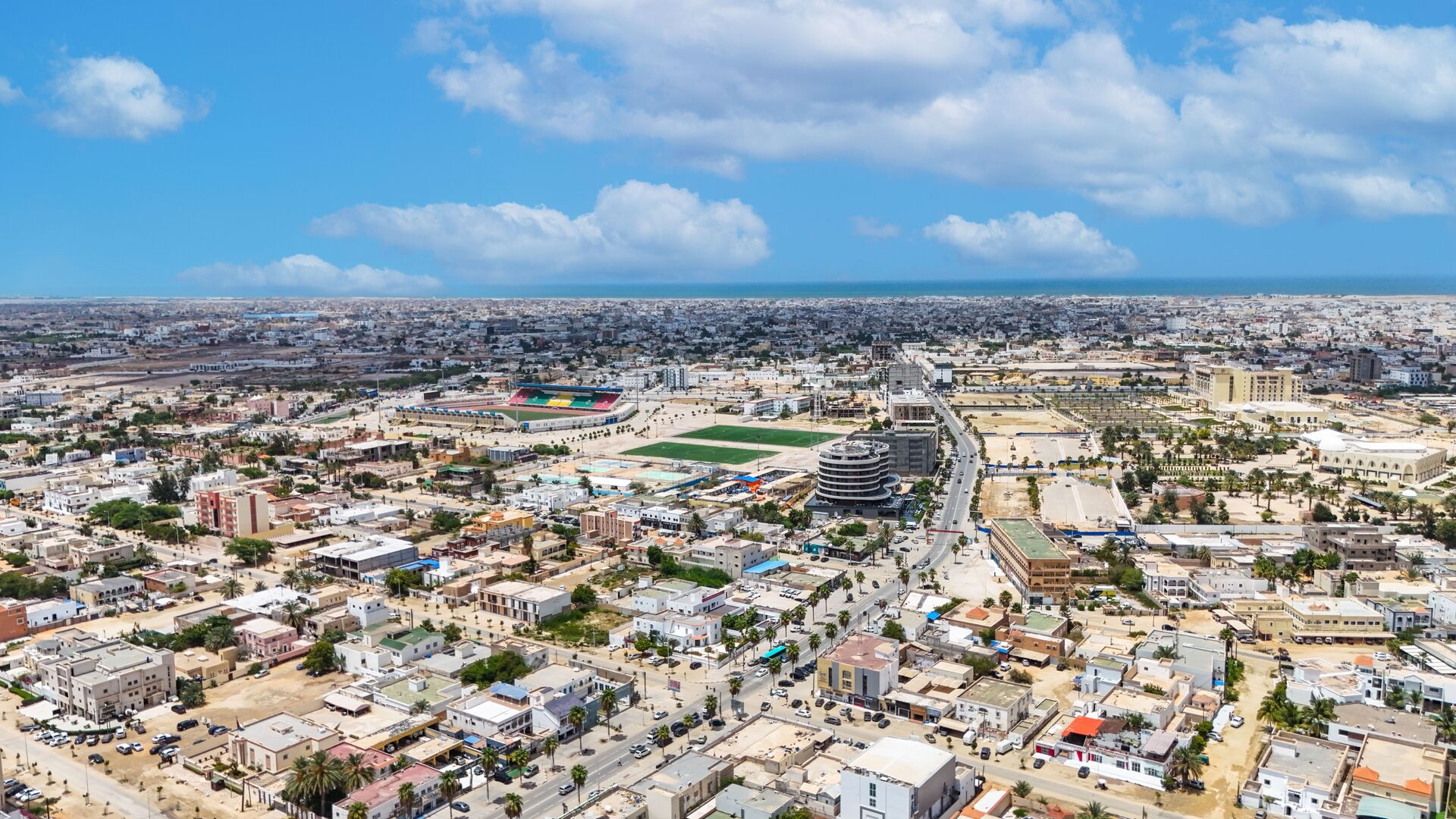
Nouakchott in Mauritania, aerial view
Independence Day: 28 November 1960. Mauritania is nine-tenths desert, sits on the seam between the Arab world and Black Africa, and belongs to both. It produced the dynasty that once ruled Morocco and southern Spain, and it holds desert libraries full of manuscripts that outdate most European universities. It was also the last country on earth to abolish slavery — by decree in 1981 — and it did not make owning a human being a criminal offence until 2007. Almost nobody has ever been convicted under that law.
Every other page in this series is about a hierarchy imposed from outside. This one is about a hierarchy that was already here.
That is a difficult sentence to write on a website devoted to African independence, and it has to be written carefully, because it is exactly the sentence that people who want to excuse colonialism reach for.
So let us be precise. France did not create slavery in Mauritania. France also did not end it. The French abolished it on paper in 1905 and then spent the next fifty years governing through the slave-owning classes, because it was administratively convenient. The abolition that mattered was Mauritanian, and it came in 1981, and it has still not been enforced.
And the second thing this page has to hold is that Mauritania is, right now, the great success story of the Sahel — and the reason is uncomfortable.
Mali, Burkina Faso and Niger are ruled by juntas and losing territory. (There are sponsored attacks on these states) Mauritania has had no significant jihadist attack on its soil in roughly fifteen years, has a functioning parliament, completed the first transfer of power between two elected presidents in its history in 2019, and is about to become a gas exporter.
It has achieved that while being paid by the European Union to stop Africans from leaving, and while an estimated tens of thousands of its own citizens remain in hereditary servitude.
Both halves belong on the same page.
Nouakchott in Mauritania, aerial view
Nine-tenths of Mauritania is Sahara. What lives in it has mattered out of all proportion to the population.
In the eleventh century, a religious movement among the Sanhaja Berbers of this region became the Almoravids. Within decades they had taken Morocco, founded Marrakesh, crossed into Iberia and become the rulers of al-Andalus, and pushed south into the Ghana Empire.
A movement that began in the western Sahara ruled southern Spain. It is not a footnote; it is one of the more consequential political eruptions in medieval history, and it started here.
And then there are the libraries.
Chinguetti, Ouadane, Tichitt and Oualata — four caravan towns, inscribed together by UNESCO in 1996 — were stops on the trans-Saharan routes and centres of Islamic scholarship. Chinguetti is described in Mauritanian tradition as the seventh holy city of Islam, a gathering point for pilgrims crossing to Mecca.
The manuscript libraries are still there, held by families, in stone buildings in a town the dunes are steadily burying: Qur'ans, legal texts, grammar, astronomy, mathematics, correspondence, some of them a thousand years old.
They are in worse condition than Timbuktu's and they have had a fraction of the attention. Sand, heat, termites and emigration are doing slowly what Ansar Dine tried to do quickly in Mali in 2012. There is no evacuation operation here, because there is no emergency dramatic enough to photograph.
Mauritanian society is built on distinctions that no visitor can see and every Mauritanian reads instantly.
The Bidhan, often called white Moors, are Arabic-speaking of Arab-Berber descent, historically the warrior and religious lineages, and they hold most political and economic power.
The Haratine, often called black Moors, are Hassaniya-Arabic-speaking Black Mauritanians descended from enslaved populations. They are, by most estimates, the largest single group in the country.
And the Afro-Mauritanians — Halpulaar (Fulani), Soninke and Wolof — are Black African peoples of the Senegal River valley in the south, with their own languages, who are neither Arab nor Haratine and who have their own, separate grievance against the state.
The Haratine question is about servitude. The Afro-Mauritanian question is about citizenship. They are not the same question, they have never fully made common cause, and the state has benefited from that for sixty years.
France came late and slowly. Xavier Coppolani began the penetration in 1902 and was killed in 1905. Resistance in the north continued until the 1930s.
And France governed through the existing hierarchy. It abolished slavery formally in 1905 and did not enforce it, because enforcing it would have meant confronting the very chiefly and religious families through whom the colony was run.
Mauritania was administered from Saint-Louis, in Senegal. There was no capital inside the territory at all. When independence came, one had to be built: Nouakchott was a village of a few hundred people in 1958, chosen because it was empty and central.
Today it holds perhaps a third of the country's population — swollen by drought, by the collapse of nomadic life, and by people with nowhere else to go.
Independence came peacefully, under Moktar Ould Daddah.
Morocco refused to recognise the new state for years, claiming the territory as historically Moroccan — which is why Mauritania's early diplomacy was consumed by simply establishing that it existed.
Ould Daddah built a one-party state by 1964. He took the genuinely sovereign decisions: leaving the franc zone in 1973 and creating the ouguiya, and nationalising the French-owned MIFERMA iron ore company in 1974, which became SNIM and remains the backbone of the economy.
And then he made the mistake that destroyed him.
When Spain abandoned the Western Sahara in 1975, Morocco and Mauritania divided it between them under the Madrid Accords. Mauritania took the southern third, Tiris al-Gharbiyya.
It was a catastrophe. The Polisario Front turned on the weaker of the two occupiers. Mauritania's small army could not hold desert territory the size of its own southern half. Polisario columns reached and attacked Nouakchott itself, twice. The iron ore railway — the country's single economic artery — was repeatedly cut.
The army swelled, the budget collapsed, and in 1978 officers removed Ould Daddah. In 1979 Mauritania withdrew from the Western Sahara entirely and renounced all claim to it.
A country of under two million people nearly destroyed itself in four years over territory it gave up unconditionally. Everything that followed — the coups, the military presidencies, the army's permanent place at the centre of politics — dates from that war.
Now the thing this country is known for, stated exactly.
Slavery in Mauritania is hereditary, and it is primarily domestic and pastoral. Status passes from mother to child. Enslaved people herd, fetch water, cook, raise children, and are given no wage, no land and frequently no documents. Marriages are permitted or denied by masters. Children can be given away as gifts.
It has been abolished four times.
On paper, Mauritanian anti-slavery law is now among the strongest in the world.
In practice, the number of people convicted of slaveholding since 2007 can be counted on one or two hands. The cases that reach court are usually brought by activists rather than by the state. Prosecutors reclassify slavery cases as labour disputes. Victims have no documents, no literacy, no money and nowhere to go, and are often returned to the household by relatives or by local authorities.
And the government's position, restated regularly, is that slavery no longer exists in Mauritania — only its consequences, which are described as poverty.
Estimates of how many people remain in servitude vary enormously and are all contested, running from tens of thousands to well over a hundred thousand. Nobody has ever been permitted to count properly, and that is itself the answer to the question.
What sustains it is not law and not force. It is religion, illiteracy and land. Enslaved people have been taught, by people they trust, that their condition is divinely ordained and that obedience is the route to paradise. Someone who cannot read cannot check. Someone with no land and no birth certificate has no exit.
Which is why the most important living Mauritanian is a man whose family history is the argument.
Biram Dah Abeid is Haratine, and descended from slaves. His grandmother, he says, was a slave until her death. His father married a slave, and watched his wife and their two children sold in front of him.
He founded the Initiative for the Resurgence of the Abolitionist Movement (IRA-Mauritanie) in 2008. He has been arrested repeatedly, held in prison for long periods, adopted as a prisoner of conscience by Amnesty International, and prosecuted on charges up to and including apostasy after he publicly burned legal commentaries used to justify slavery in 2012 — an act that brought him death threats and that a great many Mauritanians, including opponents of slavery, thought went too far.
He has also twice come second in a presidential election: with over 18 per cent in 2019, and with 22.10 per cent in June 2024, against President Ghazouani's 56.12.
More than one in five Mauritanian voters chose the descendant of slaves who calls the system by its name. That number is rising, and it is the most hopeful fact on this page.
And there is a second wound, which Mauritania calls the passif humanitaire — the humanitarian liability.
A dispute over grazing on the Senegal River in April 1989 escalated into communal violence in both countries. Mauritania then did something that went far beyond the dispute.
Tens of thousands of Afro-Mauritanians — Halpulaar, Soninke and Wolof, most estimates running to around sixty thousand or more — were stripped of their identity documents and expelled across the river into Senegal. Their land was reallocated. Many spent a decade or more in camps. Some have never recovered their nationality.
Then, in 1990 and 1991, the army purged its own Black officers and soldiers. Around five hundred were extrajudicially killed — tortured, buried in unmarked graves, or hanged.
On 28 November 1990, twenty-eight Black Mauritanian soldiers were hanged at the Inal barracks. It was the thirtieth anniversary of independence, and the killings were reported as a way of marking it.
In 1993 the National Assembly passed an amnesty law protecting everyone involved. It has never been repealed. Nobody has ever been tried. Survivors' and widows' organisations have been demanding it for over thirty years, and every government since has answered with a limited compensation scheme and a prayer ceremony.
A state hanged its own soldiers on its independence day and then legislated to make it unprosecutable. That is the sentence to remember when Mauritania is described as the stable one.
Maaouya Ould Taya ruled from 1984 to 2005. He conducted the 1989–91 expulsions and purges, and in 1999 established full diplomatic relations with Israel, making Mauritania one of only three Arab League states to do so at that time. He was removed in a coup in 2005.
Elections in 2007 produced Mauritania's first freely elected president, Sidi Ould Cheikh Abdallahi — who was overthrown in 2008 by General Mohamed Ould Abdel Aziz, who then won the elections of 2009 and 2014.
And then, in 2019, Abdel Aziz stepped down at the end of his second term, and power passed to another elected president — the first transfer of power between two elected presidents in Mauritanian history.
Mohamed Ould Ghazouani was Abdel Aziz's own army chief and chosen successor, so the continuity was substantial. But the precedent was real, and it is the reason Mauritania is not on the same page of this website as its eastern neighbours.
Abdel Aziz was subsequently prosecuted for corruption and convicted in 2023 — a former head of state tried by his own courts, which in this region is rare enough to record.
Ghazouani was re-elected in June 2024 with 56.12 per cent for a second and final term, chaired the African Union that year, and governs with a parliamentary majority.
Mauritania fought al-Qaeda in the Islamic Maghreb between 2005 and 2011, with attacks on garrisons, kidnappings of Europeans and a suicide bombing in Nouakchott.
Since around 2011 there has been essentially nothing. In the Sahel, that is extraordinary.
The explanations given are three, and all are probably partly true.
Military reform. The army was restructured into mobile desert units that could fight in the Sahara rather than sit in barracks, and Mauritania began striking camps across the border in Mali rather than waiting.
Religious dialogue. From 2010 the state ran a programme in which senior Islamic scholars debated imprisoned militants theologically, on the state's own terms, with release for those who renounced violence. Dozens went through it. It was mocked at the time and appears to have worked.
And, it is widely alleged, an accommodation. Analysts and former officials have long suggested a tacit understanding: Mauritanian territory is not attacked, and in return certain activities across the border are not interfered with. No government has ever admitted this, and it cannot be verified. It belongs on the page as an allegation, because it is the third explanation everybody in the region offers.
SNIM hauls iron ore from Zouérat to the port of Nouadhibou on a single line across 700 kilometres of desert — a train that is among the longest and heaviest in the world, well over two kilometres of wagons, running twice a day. Riding on top of the ore, free and unofficially, is one of the legendary journeys on earth.
The fishing grounds off Nouadhibou are among the richest in the world, sustained by the Canary Current upwelling. They have been sold, repeatedly, through agreements with the European Union and with China. Industrial fleets take the catch; Mauritanian artisanal fishermen report emptier water; and fishmeal plants on the coast grind sardinella that people used to eat into feed for farmed fish elsewhere.
There is gold at Tasiast, copper, and uranium projects.
And now gas. The Greater Tortue Ahmeyim field, shared with Senegal and operated by BP, began producing at the end of 2024 and shipped its first LNG cargoes in 2025. The BirAllah field offshore is estimated at close to sixty trillion cubic feet.
Saudi and Emirati money is arriving, the EU is investing through Global Gateway, and Washington has signalled interest.
Mauritania is about to have more money than it has ever had. What happens to the Haratine over the next ten years is the only measure that will matter.
And the reason Europe is so friendly.
From 2023, as other routes closed, Mauritania became the main departure point for the Atlantic crossing to the Canary Islands — a long, brutal passage in open wooden boats in which very large numbers of people have drowned or disappeared. Over eighty per cent of the boats reaching the Canaries were leaving from or passing through Mauritanian waters.
On 7 March 2024, the European Commission president signed a €210 million migration partnership in Nouakchott, followed by a further $100 million package and additional humanitarian funding.
It worked, by the only measure the EU applied. Arrivals in the Canary Islands from Mauritania fell by more than eighty per cent between April and December 2025 compared with the year before.
What it cost is a separate accounting. Researchers and journalists describe migrants living in hiding in Nouadhibou and Nouakchott, pushbacks, mass arrests, and expulsions to remote border areas. West Africans with a legal right to be in Mauritania under regional free movement have been swept up alongside others.
There was also a public backlash inside Mauritania, which is rarely reported in Europe: a country of five million people was being asked to hold back a continent, and many Mauritanians objected. Biram Dah Abeid opposed the deal outright, arguing it serves neither party.
Europe has paid a state with an unresolved slavery problem and an unprosecuted mass expulsion in its recent past to control the movement of Black Africans. It is worth writing that sentence out in full at least once.
Because Mauritania is the hardest test of the argument this website makes.
This site holds that colonialism's structures explain an enormous amount about Africa today, and it has spent fifty pages demonstrating that. Mauritania is where that explanation runs out. The hierarchy here is older than France, survived France, and was reinforced by France for convenience. Blaming Paris for the Haratine's position is both inaccurate and, in its way, another form of condescension — it treats Mauritanians as incapable of having built their own injustice.
And the country is the direct refutation of the claim that the Sahel's problems are simply too large to manage. Same desert, same borders, same armed groups over the frontier, same poverty. Mali has lost its north and its capital is blockaded. Mauritania has parliamentary politics, an opposition leader who takes 22 per cent, a gas field, and no attacks.
What it has not done is fix the thing it is actually famous for.
That is the sentence this page ends on, and it is not a foreign judgment. It is the argument of more than one in five Mauritanian voters.
Mauritanians ended Mauritanian slavery on paper, not Europeans. The 1981 decree, the 2007 law and the 2015 crime-against-humanity statute were all Mauritanian acts, passed under Mauritanian pressure. The failure is one of enforcement, and the pressure for enforcement is also Mauritanian.
Many Bidhan families have no slaves and never did, and to treat a whole community as slaveholders is exactly the collective attribution that makes the problem harder to discuss inside the country.
The Haratine are not a silent mass. They organise, they vote, they run for president, they have their own movements and their own internal disagreements — including over whether to make common cause with Afro-Mauritanians or to press their claim as Arabic-speaking Mauritanians.
The security record is a genuine achievement, not an accident, and Mauritanians are entitled to be proud that their country did not follow Mali. Whether part of the price was an accommodation nobody will confirm is a fair question and an unresolved one.
And the country is running out of water and grazing. Drought broke the nomadic economy in the 1970s and 80s and drove a third of the population into one city built on sand. Climate is not a background condition here; it is the main event of the last fifty years.
Two things are true. Mauritania is the most functional state in the Sahel, and it is the last country on earth where a person can be born into ownership.
There is a movement that began among desert Berbers and ended up ruling Córdoba and Marrakesh.
There is a town called Chinguetti with libraries of thousand-year-old manuscripts, and the dunes are taking it.
There is a colonial abolition from 1905 that was never enforced, because enforcing it would have upset the men France governed through.
There is a capital that was a village in 1958.
There is a war over the Western Sahara that lasted four years, reached the capital twice, and was abandoned unconditionally.
There is a decree from 5 July 1981 that abolished slavery and set no penalty for practising it.
There is a gap of twenty-six years between abolition and criminalisation.
There are three special courts and almost no convictions.
There are twenty-eight men hanged at Inal on 28 November 1990, on the thirtieth anniversary of independence.
There is an amnesty law from 1993 that has never been repealed.
There is a grandmother who was a slave until she died, and a father who watched his wife and two children sold, and their grandson and son who took 22.10 per cent of the vote in June 2024.
There is a train two kilometres long crossing the Sahara twice a day, with people riding free on the ore.
There is a gas field offshore, and the richest fishing water in the world being ground into feed.
And there is €210 million from Brussels, and an eighty per cent fall in the number of Africans reaching the Canary Islands, and a great many people hiding in Nouadhibou.
Updated and fact-checked: 15 September 2026.
How this page was checked. Recent political, economic and migration developments were verified against the sources listed above; the earlier history was checked against standard reference works on Mauritania and the western Sahara. The Almoravid origins in the western Sahara, the caravan towns of Chinguetti, Ouadane, Tichitt and Oualata and their UNESCO inscription in 1996, the French penetration from 1902 and the death of Coppolani in 1905, the French abolition of slavery in 1905, the founding of Nouakchott as capital, independence on 28 November 1960, the one-party state of 1964, the departure from the franc zone in 1973 and the nationalisation of MIFERMA in 1974, the 1975 Madrid Accords and Mauritania's occupation of the southern Western Sahara, the war with Polisario and the attacks on Nouakchott, the 1978 coup and the 1979 withdrawal, the abolition of slavery by decree on 5 July 1981, the criminalisation of slavery in 2007 and its classification as a crime against humanity in 2015 with three special courts, the expulsions of Afro-Mauritanians from April 1989 and the killings of Black soldiers in 1990–91 including the hangings at Inal on 28 November 1990, the amnesty law of 1993, the establishment of relations with Israel in 1999, the coups of 2005 and 2008, the election of Sidi Ould Cheikh Abdallahi in 2007, the transfer of power to Mohamed Ould Ghazouani in 2019, the corruption conviction of Mohamed Ould Abdel Aziz, the EU migration partnership signed on 7 March 2024, the presidential election of June 2024, and the start of production at the Greater Tortue Ahmeyim gas field are as recorded. Figures are estimates, are contested, and are given as ranges: the number of people living in conditions of slavery in Mauritania has been estimated from tens of thousands to well over one hundred thousand by different organisations, no independent census has been permitted, and the Mauritanian government's position is that slavery no longer exists; the number expelled to Senegal from 1989 is generally estimated at around sixty thousand or more; the number of Black Mauritanian soldiers and officials extrajudicially killed in 1990–91 is generally given as around five hundred. Both the estimates and the government's denial are recorded here. Details of the sentence imposed on Mohamed Ould Abdel Aziz have been subject to appeal proceedings and should be verified against current reporting. The suggestion that Mauritania's freedom from attack since 2011 rests in part on a tacit accommodation with armed groups is an allegation made by analysts and former officials; it has never been confirmed by any government and is recorded here as unverified. Reports of pushbacks, mass arrests and expulsions of migrants are those of journalists and researchers cited above and are disputed by the authorities; both positions are recorded. This page makes no allegation against any living person beyond matters already on the public record.
Written and researched by Remo Kurka · africanindependence.com
We strive to unify diverse narratives from across Africa, showcasing the continent's shared heritage and unique stories.
Our mission is to honor and preserve the history of African cultures and independence movements for future generations.
We provide a platform for innovative exchange of ideas, resources, and insights, understanding that knowledge should be accessible to all.