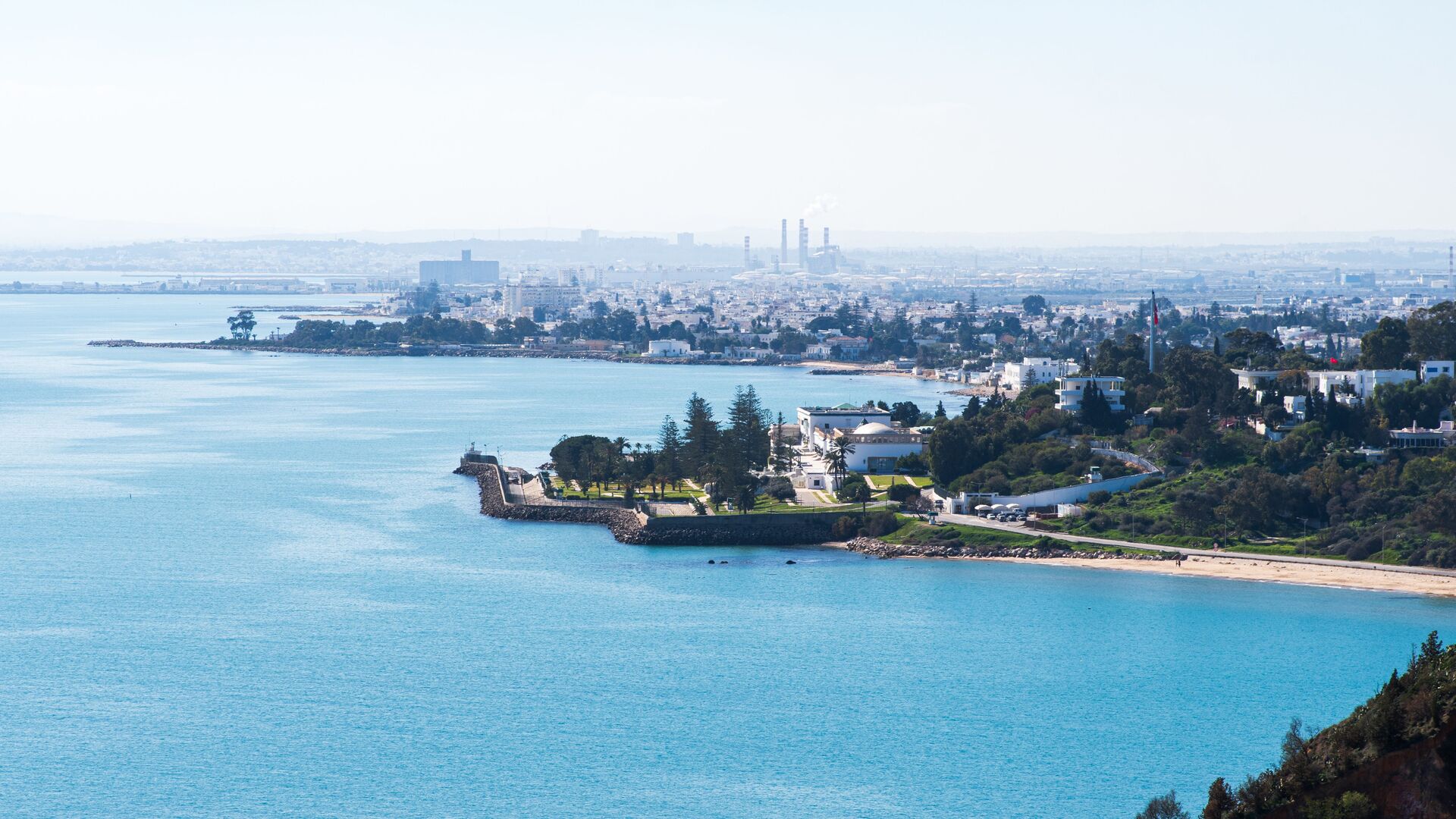
Tunisia, Carthage shoreline
Independence Day: 20 March 1956, from France. The capital is Tunis, beside the ruins of Carthage. Tunisia is the smallest country in North Africa and one of the oldest states on the continent, with borders that have barely moved in centuries. It abolished slavery in 1846, wrote the Arab world's first constitution in 1861, gave women rights in 1956 that most of the region still does not have, and in December 2010 began the uprising that changed the Arab world. It was the only country of the Arab Spring to produce a working democracy. Since 25 July 2021, that democracy has been taken apart by the man the Tunisians elected.
Almost every page on this website ends with a version of the same sentence: independence came, and then the state was captured by soldiers or by one family.
Tunisia is the country that broke that pattern twice, in opposite directions.
In 2011 it removed a dictator of twenty-three years with mass protest and no civil war, and then spent a decade building a real constitution, real elections and a free press. Nothing like it had happened in the Arab world.
And then, in 2021, a president elected by a landslide suspended the parliament, and Tunisians, exhausted and broke, largely cheered.
That is why this page matters. Tunisia is the proof that democracy can be built after a dictatorship, and the proof that it can be taken apart again without a single tank.
Tunis sits next to the ruins of Carthage, founded by Phoenicians from Tyre and, by tradition, by the queen Elissa, whom the Romans called Dido.
Carthage became the great power of the western Mediterranean and fought Rome in the Punic Wars. Hannibal crossed the Alps with elephants and beat Roman armies in Italy for fifteen years. In 146 BCE Rome destroyed Carthage.
Rome rebuilt it, and Roman Africa became one of the empire's richest provinces, the granary of Rome. The amphitheatre at El Jem, which held tens of thousands of spectators, still stands in a small Tunisian town, and so does the Roman city of Dougga.
Then the Vandals in 439, the Byzantines in 533, and the Arab conquest. In 670 the general Uqba ibn Nafi founded Kairouan, the first great Islamic city in North Africa, whose Great Mosque is the oldest in the western Islamic world and made the city a centre of learning for centuries.
Under the Aghlabids, the Fatimids, and then the Hafsids of Tunis from 1229, this became a distinct country long before Europe drew any lines here. The Ottomans took it in 1574, and from 1705 the Husainid beys ruled Tunis with growing independence from Istanbul.
This is one of the reasons Tunisia holds together so well today. Its borders are not a colonial invention. There has been a state centred on Tunis for a very long time.
Tunisia, Carthage shoreline
Two facts about nineteenth-century Tunisia belong in any honest history of reform in Africa or the Arab world.
In 1846 Ahmad Bey abolished slavery in Tunisia. That is nineteen years before the United States, and before much of the rest of the Ottoman world.
In 1861 Tunisia adopted a constitution, following the Fundamental Pact of 1857. It was the first constitution in the Arab world, limiting the ruler's power and guaranteeing rights to subjects of all religions.
It did not last, and it was partly a defensive response to European pressure. But the reformers, above all the statesman Khayr al-Din, were Tunisians arguing for Tunisian reasons.
Reform cost money, and the government borrowed it in Europe at ruinous rates. In 1869 Tunisia went bankrupt and an international financial commission of French, British and Italian creditors took over its finances.
Debt was the doorway. In 1881 France invaded from Algeria, and the Bey signed the Treaty of Bardo. Tunisia became a French protectorate: the Bey stayed on his throne, and France ran the country.
Settlers, French and Italian, took the best farmland. By the 1930s a small European minority held a large share of the fertile land and almost all the modern economy.
Nationalism grew quickly among the French-educated elite. The Destour party was founded in 1920, and in 1934 a young lawyer from Monastir, Habib Bourguiba, broke away to found the Neo-Destour, which built a mass movement rather than a club of notables.
Two other forces mattered. The trade union federation UGTT, founded in 1946 by Ferhat Hached, made the independence movement a movement of workers as well as lawyers. In December 1952 Hached was murdered by a clandestine group linked to French settler interests, known as La Main Rouge. The killing turned him into a national martyr and hardened the struggle.
On 20 March 1956 Tunisia became independent. A year later the monarchy was abolished and Bourguiba became president.
Bourguiba ruled for thirty-one years, and his record splits neatly in two.
What he built:
What he broke:
On 7 November 1987 his prime minister, Zine El Abidine Ben Ali, declared him medically unfit and took power. Bourguiba spent the rest of his life under house arrest in Monastir, where he died in 2000.
Ben Ali ruled for twenty-three years, and he was a very modern kind of dictator.
Abroad, Tunisia was praised as a stable, moderate, business-friendly country with good beaches and low labour costs. Europe liked it. The IMF liked it. Tourists filled Hammamet and Djerba.
Inside, it was a police state. The Islamist movement Ennahda was crushed in the early 1990s, with thousands imprisoned and tortured and its leader Rached Ghannouchi driven into exile in London. Journalists were beaten. The internet was censored. Elections gave the president votes above 90 per cent. And the president's wife's family, the Trabelsis, took a cut of nearly everything worth owning.
In the interior town of Sidi Bouzid, a young street vendor named Mohamed Bouazizi had his cart confiscated and was humiliated by officials. He went to the governor's office to complain, was refused a hearing, and set himself on fire in front of it. He died in January.
The interior of Tunisia, poor and ignored for decades while the coast lived off tourism, rose first. The protests spread to the coast and then to Tunis. The UGTT, the one national organisation the regime had never fully controlled, threw its weight behind them. The army refused to fire on the crowds.
On 14 January 2011 Ben Ali fled to Saudi Arabia. Around three hundred people had been killed.
Within weeks, Egypt, Libya, Yemen, Bahrain and Syria were in the streets. It all started in Sidi Bouzid, and the word Tunisians shouted at Ben Ali, dégage, get out, went around the Arab world.
Everywhere else, the Arab Spring ended in a restored dictatorship or a war. Tunisia is the exception, and it was not luck.
It was close. Ennahda won the first free election in October 2011 and governed in coalition. In 2013 two left-wing politicians, Chokri Belaid and Mohamed Brahmi, were assassinated, and the country came close to collapse.
What saved it was a negotiation. Four organisations, the UGTT, the employers' federation UTICA, the human rights league and the bar association, forced the government and the opposition into a national dialogue. The Islamist-led government stepped down voluntarily in favour of a technocratic cabinet, which is something Islamist parties were said never to do.
On 26 January 2014 Tunisia adopted a new constitution, guaranteeing freedom of conscience, a real parliament and an independent judiciary. In 2015 the National Dialogue Quartet won the Nobel Peace Prize.
Then came the free elections, the peaceful handovers, the newspapers that could print anything, the civil society that argued loudly with everyone.
And alongside it: terror attacks in 2015 at the Bardo Museum and on the beach at Sousse that killed dozens of tourists and destroyed the tourism season; governments that changed almost yearly; unemployment among young graduates that never fell; a currency that kept sliding; and corruption that survived the revolution intact, because the networks did.
By 2019 many Tunisians had concluded that democracy had given them freedom and nothing to eat. In that year's election they chose a constitutional law professor with no party, no money and no charisma, who promised to sweep the political class away. Kais Saied won with more than 70 per cent.
On the anniversary of the republic, Saied suspended parliament and dismissed the prime minister, citing an article of the constitution he had helped to teach.
Crowds celebrated in the streets. The parliament was widely hated.
Then it kept going. He ruled by decree from September 2021, dissolved parliament in 2022, dissolved the Supreme Judicial Council and sacked dozens of judges, and pushed through a new constitution in a referendum with a turnout of roughly 30 per cent, which concentrated power in the presidency. The parliamentary election that followed drew a turnout of about 11 per cent.
Decree 54 of 2022 criminalised the spreading of "false news," and has been used against journalists, lawyers and critics.
In February 2023 he claimed that irregular migration from sub-Saharan Africa was part of a plot to change Tunisia's demographic make-up. Attacks on Black migrants and on Black Tunisians followed, and hundreds of people were driven to the desert borders with Libya and Algeria. A few months later the European Union signed a migration agreement with his government worth hundreds of millions of euros.
In October 2024 Saied was re-elected with 90.7 per cent, on a turnout of under 30 per cent, with one of his rivals in prison during the campaign.
Then the opposition itself was put on trial.
In April 2025 a Tunis court sentenced 37 defendants to prison terms ranging from four to 66 years, in a mass case alleging a conspiracy against state security. The accused included opposition politicians, lawyers, activists and public figures from across the political spectrum. Human Rights Watch called the case politically motivated and said the trial failed to provide adequate due process. Many defendants were tried without being brought to court.
In late November 2025 about forty more people, mostly critics of the president, received sentences of up to 45 years for conspiracy against state security and membership of a terrorist group, among them the activist Chaima Issa, the lawyer Ayachi Hammami and the veteran politician Ahmed Najib Chebbi.
In June 2026 Rached Ghannouchi, the 85-year-old former speaker of parliament, was sentenced to life plus 30 years on terrorism charges. He had already been in prison for years.
This part is still happening.
The summer of 2026 has been brutal in the most literal sense. A heatwave pushed electricity demand to record levels, the state utility introduced rationing, and the power cuts hit the pumping stations, so water went off along with the lights. Medicine shortages, a collapsing health service, rising prices and a currency that buys less each month have done the rest.
And the street has come back.
On 25 July 2026, five years to the day after the suspension of parliament, thousands marched down Habib Bourguiba Avenue in Tunis demanding Saied's resignation. On 20 August they were out again, rejecting one-man rule and demanding the release of jailed opposition figures, activists and journalists. A new opposition collective, Nafas, launched in May 2026, is trying to unite parties and independents beyond the old opposition camps.
The slogans are the ones from 2011: the people want the fall of the regime, and dégage.
Saied's answer has been to say that the water and power cuts must stop immediately, and to warn that the state will act firmly against anyone who tries to make the situation worse. The speaker of his parliament has urged citizens not to let their anger escalate.
Tunisian analysts note the obvious: these protests do not yet threaten the president, and they do show that his opponents can still fill a street, despite everything.
Because Tunisia asks the question this whole website keeps circling: what is independence actually for?
Tunisia has had real sovereignty since 1956, one of the oldest continuous states in Africa, an educated population, women's rights ahead of most of the world, no civil war, no coup by generals, and the only successful democratic transition of the Arab Spring.
And it is here. With a president ruling by decree, an 85-year-old opposition leader sentenced to life plus thirty years, and people queuing for water in the summer heat.
None of that was done by a colonial power. It was done by the country's own political class, first by failing to make the democracy deliver, and then by one man taking it apart while much of the public applauded.
For France: the protectorate was built on a debt trap, the best land went to settlers, and Ferhat Hached was murdered by people acting for settler interests. France left in 1956 and kept its naval base at Bizerte until Tunisians died marching on it.
For Europe today: the EU praised Ben Ali's stability for twenty-three years, and it has signed a large migration agreement with a government that expelled Black migrants to desert borders and that is imprisoning its own opposition. The pattern of paying North African governments to hold people back has not changed since the 1990s; only the amounts have.
For the revolutionaries of 2011: the decade of democracy did not fix the interior towns where the revolution started. Sidi Bouzid is still poor. A democracy that cannot deliver water, work and medicine will not be defended by the people who need those things.
For Tunisians who cheered in July 2021: the parliament that was suspended was elected, and the judges who were sacked were the ones who could have checked the president.
And for Kais Saied: the man who built a political career on the language of the constitution has dissolved the council that guards it, jailed the people who oppose him, and blamed migrants for a crisis that has nothing to do with them.
One more thing, and it belongs on a pan-African website. Tunisia is in Africa. Some of its politics, and the violence that followed the president's speech of February 2023, has treated Black Africans as foreign to this continent's northern shore. That is a fact worth naming plainly, and Tunisian civil society, which fought that campaign hard, deserves credit for doing so.
There are the stones of Carthage, destroyed by Rome in 146 BCE and rebuilt.
There is an amphitheatre at El Jem, standing in a small town, big enough for a Roman city.
There is the Great Mosque of Kairouan, from the seventh century.
There is a decree of 1846 abolishing slavery, and a constitution of 1861, the first in the Arab world.
There is the Bardo Palace, where the Bey signed away his country in 1881, later a museum, later the scene of a massacre of tourists.
There is a Code of Personal Status from 1956 that is still the most far-reaching law of its kind in the Arab world.
There is a governor's office in Sidi Bouzid where a young man was refused a hearing in December 2010.
There is a constitution from 2014 that no longer applies, and a Nobel Peace Prize from 2015 in a country whose opposition is in prison.
And there is Habib Bourguiba Avenue in Tunis, where the crowds came back in the summer of 2026, using the same words they used in 2011.
Updated and fact-checked: 17 September 2026.
How this page was checked. Recent events were verified against the sources listed above; the historical record was checked against standard reference works on Tunisia and the Maghreb. The founding and destruction of Carthage, the founding of Kairouan in 670, Hafsid and Ottoman rule, the abolition of slavery in 1846, the constitution of 1861, the bankruptcy of 1869, the French invasion and Treaty of Bardo in 1881, the founding of the Destour in 1920 and the Neo-Destour in 1934, the founding of the UGTT in 1946 and the assassination of Ferhat Hached in 1952, independence on 20 March 1956, the Code of Personal Status of August 1956, the Bizerte crisis of 1961, the events of January 1978 and 1984, the removal of Bourguiba on 7 November 1987, the protest of Mohamed Bouazizi on 17 December 2010, the flight of Ben Ali on 14 January 2011, the assassinations of 2013, the constitution of 26 January 2014, the Nobel Peace Prize of 2015, the attacks at the Bardo Museum and in Sousse in 2015, the measures of 25 July 2021 and after, the re-election of October 2024, the sentences of April 2025 and November 2025, the sentencing of Rached Ghannouchi in June 2026 and the protests of July and August 2026 are as recorded. Casualty figures are estimates and are given as approximate where they are disputed: deaths in the Bizerte crisis (several hundred to about a thousand) and deaths during the uprising of December 2010 to January 2011 (around three hundred). The conspiracy convictions are recorded as convictions of a court whose independence is contested; the defendants deny the charges, and the assessment that the case was politically motivated and lacked due process is that of Human Rights Watch. The arguments for and against the measures of July 2021 are both recorded, as they are made in Tunisia. This page makes no allegation against any living person beyond matters already on the public record.
Written and researched by Remo Kurka · africanindependence.com
We strive to unify diverse narratives from across Africa, showcasing the continent's shared heritage and unique stories.
Our mission is to honor and preserve the history of African cultures and independence movements for future generations.
We provide a platform for innovative exchange of ideas, resources, and insights, understanding that knowledge should be accessible to all.