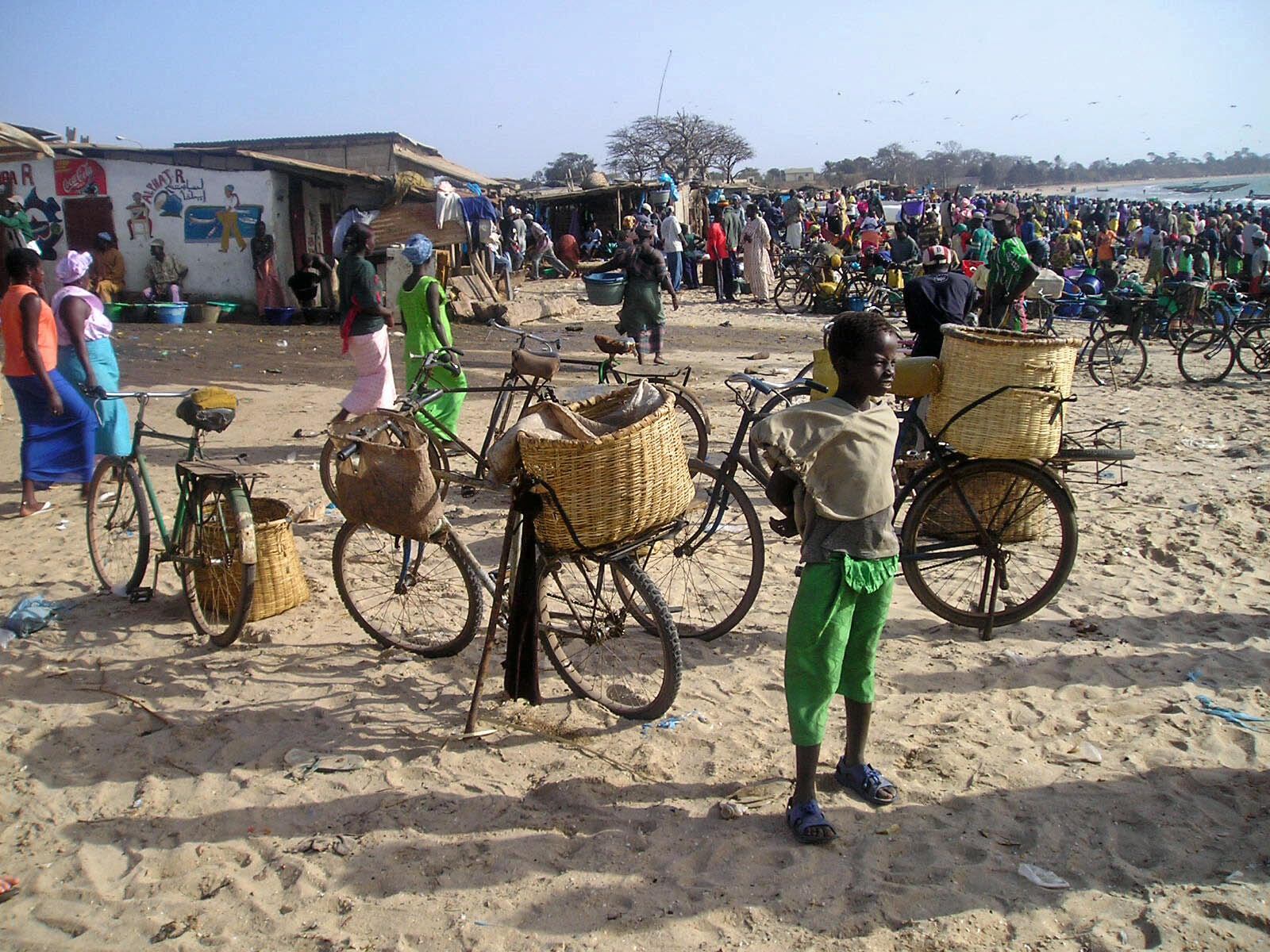
Photo Credit: Remo Kurka, fish market at the beach, Gambia
Independence Day: 18 February 1965. The Gambia is the smallest country on mainland Africa, a ribbon of land drawn along a river to the distance a British gunboat could shell from midstream, entirely surrounded by Senegal except where it meets the sea.
It had almost no resources, and Britain seriously doubted it could be a country at all. It then kept multiparty elections for twenty-nine years, lost them for twenty-two, and in December 2016 did the thing that almost never happens: it voted a dictator out, and he went. Nine years later, he is living comfortably in Equatorial Guinea, and the court built to try him has no money and no hearing date.
Two things, and they pull in opposite directions.
The Gambia is the best news story in this entire series. A sitting African strongman of twenty-two years lost an election he had organised himself, conceded it on television, tried to take it back, and was removed anyway — by West African troops, under a West African mandate, with almost nobody killed. Then the country ran a truth commission so thorough and so publicly watched that it changed what Gambians know about themselves.
And it is the clearest demonstration anywhere of how hard the last step is. The truth commission named the crimes. The government accepted the findings. Regional leaders approved a tribunal. Foreign courts convicted three of the men who did the killing.
And the man they all say ordered it is still free, nine years on.
There is a third thing, and it is why this page sits in the middle of this network rather than at the edge of it. The single worst documented crime of that regime was committed against Ghanaians, and most Ghanaians have never heard of it.
Photo Credit: Remo Kurka, fish market at the beach, Gambia
Look at The Gambia on a map and the shape is absurd: about 400 kilometres long, rarely more than 50 wide, following the River Gambia inland, wrapped on three sides by Senegal.
The shape is not accidental and it is not natural. It is what Britain and France agreed to in the boundary conventions of the 1880s and 1890s, and the working principle behind it is remembered — with what accuracy no one can now establish — as the range of a gunboat's guns fired from the middle of the river.
Whether or not that is literally how the lines were drawn, it describes exactly what the territory is: a river, and as much land on either side as a naval power could control.
Everything else was French.
So The Gambia entered the twentieth century as a strip of riverbank with one export crop — groundnuts — a population that spoke the same languages and belonged to the same families as the people on the other side of the line, and a colonial administration that regarded it as barely viable. Independence was delayed partly because London genuinely did not think it could stand alone, and federation with Senegal was discussed for years.
The river was a highway long before it was a border.
Upstream at Kuntaur stand the Wassu stone circles, part of the Senegambian megalith complex — over a thousand circles across the region, raised between roughly the third century BC and the sixteenth century AD, and a UNESCO World Heritage site. They are among the largest concentrations of stone circles anywhere in the world and almost nobody outside the region knows they exist.
And then there is Kunta Kinteh Island, six hundred metres of eroding rock in mid-river, with the ruins of Fort James on it.
The Portuguese came first, then the Courlanders, then the Dutch, then the British, then the French, each taking the island from the last. It changed hands so often that the fort was rebuilt again and again. It was a trading post for gold, ivory, beeswax and slaves, and it commanded the river, which is why everyone wanted it.
In 1976 Alex Haley published Roots, tracing his family to a village on that stretch of the river and to an ancestor taken from it. The book and the television series that followed put Juffureh on the world map, brought African American visitors to The Gambia in numbers nobody had planned for, and created one of the earliest and most emotionally serious diaspora tourism circuits on the continent.
Historians have picked apart Haley's genealogy for fifty years, and much of the criticism is sound. The effect was real regardless. The island and the related sites were inscribed by UNESCO in 2003, and the island was renamed Kunta Kinteh Island in 2011.
This site covers heritage tourism as well as history, and The Gambia is one of the very few places where the two have the same address. There is more on the country's coast, river and festivals on this network at gambiavibes.com.
The Gambia became independent on 18 February 1965, with Dawda Kairaba Jawara as prime minister. It became a republic in 1970, with Jawara as president.
What happened next is genuinely unusual and gets forgotten because of what came after.
The Gambia held competitive multiparty elections, continuously, for twenty-nine years. Through the era of the one-party state, through the coups that took almost every neighbour, through the Cold War, this tiny country kept an opposition, a functioning parliament, courts that sometimes ruled against the government, and a press. It hosted the drafting of the African Charter on Human and Peoples' Rights — the Banjul Charter, adopted in 1981 — and the African Commission that enforces it sits in Banjul to this day.
For thirty years The Gambia's reputation in Africa was: poor, small, and free.
It was also poor. The economy was groundnuts and, increasingly, European package tourism on the coast — the "smiling coast" marketing that still defines how outsiders picture the country. Both were exposed to weather and to other people's economies. Corruption grew. Young people had nothing.
In July 1981, while Jawara was in London for a royal wedding, an insurrection led by Kukoi Samba Sanyang seized Banjul, armed some of the prison population and declared a revolutionary council.
Jawara invoked a mutual defence treaty and Senegalese troops intervened. The fighting to retake the capital was severe. Estimates of the dead run from several hundred to over a thousand, most of them civilians — by some distance the worst violence in the country's independent history until that point.
Out of it came the Senegambia Confederation (1982–1989): a partial merger of currencies, defence and foreign policy, with a Senegalese-led military arrangement. It fell apart within seven years, because Gambians were not prepared to be absorbed by a country thirty times their size, and Senegal was not prepared to keep guaranteeing a government that would not integrate further.
Jawara survived. The army he rebuilt afterwards contained the men who would remove him.
A group of junior officers took power without firing a shot. Jawara took refuge on an American warship in the harbour and went into exile.
The chairman of the new council was a lieutenant of twenty-nine named Yahya Jammeh.
He promised a short transition. He held an election in 1996 under a constitution written to suit him, and he stayed for twenty-two years.
The TRRC would later document it in seventeen volumes. The shape of it:
A death squad. A unit known as the Junglers, outside the normal chain of command and reporting directly to the president, carried out killings, abductions and torture.
Journalists. Deyda Hydara, co-founder of The Point and correspondent for AFP and Reporters Without Borders, was shot dead in his car in December 2004, days after criticising new press laws. Chief Ebrima Manneh was taken from his newsroom in 2006 and never seen again.
Witch hunts. In 2009, after the death of the president's aunt, so-called witch doctors accompanied by security forces moved through villages, detained hundreds of people, and forced them to drink hallucinogenic concoctions. People died. Human Rights Watch and Amnesty documented it while it was happening.
A cure for HIV. From 2007 the president personally administered a treatment programme, broadcast on state television, in which he claimed to cure HIV and asthma with herbs and Quranic recitation. Patients were required to stop antiretroviral therapy to take part. People died of that too. Anyone in the health system who objected risked their career or their liberty.
Elections, and what happened around them. Opposition activist Solo Sandeng was arrested at a protest in April 2016 and died in custody within days. Others arrested with him were tortured. The opposition leader who demanded his body was jailed.
And the rhetoric. Jammeh said publicly that he would rule for a billion years if God willed it, and told the world that he would kill anyone who destabilised the country — language that his own officials later testified was understood as instruction.
This is the section this website exists to write.
In July 2005, a group of West African migrants — Ghanaians, Nigerians, Senegalese, Ivorians, Togolese and others, more than fifty people in total — arrived on the Gambian coast. They were travelling towards Europe by sea, as thousands were.
Gambian intelligence had been warned of a coup plot by mercenaries. They decided these were the mercenaries.
The migrants were detained. Human Rights Watch and TRIAL International, after interviewing thirty former Gambian officials including eleven officers directly involved, concluded that they were transferred by naval boat to Banjul while the president and his ministers attended a public festival, and then handed to the Junglers, who killed the great majority of them. Bodies were disposed of across the border in Casamance, in Senegal, thrown down dry wells.
Around forty-four Ghanaians are believed to have been among the dead.
One Ghanaian escaped. Martin Kyere cut his bindings, jumped from a moving vehicle and ran into the bush. He is the only known survivor, and for more than a decade he did what no government did: he traced the families of the dead across Ghana, one by one, and refused to let it go.
There was an official investigation. A joint United Nations–ECOWAS mission in 2009 concluded that the Gambian government was neither directly nor indirectly complicit and attributed the killings to rogue elements; Ghana accepted a payment and the matter was, diplomatically, closed. The later evidence — from the men who were there, given to Human Rights Watch, to TRIAL International and then to the TRRC under oath — contradicts that conclusion.
The TRRC found that the killings were carried out by the Junglers on the orders of the president.
Ghanaians were the largest group of victims of the worst single crime of the Jammeh regime, and the case was settled over their families' heads by a diplomatic process that has since been shown to have got it wrong. That is a Ghanaian story as much as a Gambian one, and this network will keep saying so.
Nobody expected anything.
Seven opposition parties agreed on a single candidate: Adama Barrow, a property developer who had once worked as a security guard in London, with no significant political record. Voting in The Gambia is done with marbles dropped into drums — a system designed for low literacy, and the count is audible.
Barrow won.
And then something extraordinary happened: Jammeh went on television and conceded, congratulated the winner, and said the people had spoken.
Eight days later he reversed it, rejected the result and declared a state of emergency.
ECOWAS did not accept that. Regional mediators went to Banjul. Senegalese, Nigerian, Ghanaian and other troops massed at the border under Operation Restore Democracy. Barrow was sworn in at the Gambian embassy in Dakar on 19 January 2017. Nigeria flew aircraft over Banjul.
Jammeh's army did not fight for him. On 21 January 2017 he left for Equatorial Guinea, reportedly taking a good deal of the state's money and a number of luxury vehicles with him.
There was almost no bloodshed. It remains the clearest case anywhere in Africa of a regional organisation enforcing an election result by credible threat of force, and it worked because the threat was credible and because Gambians had already voted.
The Truth, Reconciliation and Reparations Commission sat from 2019 to 2021. Nearly 400 witnesses testified over more than 870 days of hearings.
The hearings were broadcast. Gambians watched, in bars and compounds and on phones, as former Junglers described in ordinary language what they had done and who had told them to do it, with victims' families in the room.
The final report ran to seventeen volumes, identified over a thousand victims, and recommended the prosecution of Yahya Jammeh and sixty-eight others. The government accepted most of it in a white paper in 2022.
As truth commissions go, it is one of the strongest ever run anywhere, and that is not a small thing for a country of under three million people with no money.
While The Gambia's own prosecutions have not started, three courts on two other continents have acted, using universal and extraterritorial jurisdiction.
Germany. A former Jungler, Bai Lowe, was sentenced to life imprisonment for crimes against humanity in November 2023.
Switzerland. Ousman Sonko, interior minister from 2006 to 2016 and before that inspector general of police — the most senior official of any regime ever tried under universal jurisdiction in Europe — was convicted of crimes against humanity and sentenced to twenty years in May 2024. His appeal was heard in the spring of 2026, with the verdict reserved.
The United States. Michael Sang Correa, a Jungler who had entered the US on a diplomatic visa and overstayed it, was found guilty by a Denver jury in April 2025 on five counts of torture and one of conspiracy — the first time a US jury has convicted a non-citizen of torture committed abroad. In August 2025 he was sentenced to 810 months: sixty-seven and a half years.
Gambian victims flew to Denver to watch. Several testified.
On 15 December 2024, ECOWAS formally established the Special Tribunal for The Gambia.
It is genuinely novel: the first tribunal created by a regional organisation to prosecute mass atrocity crimes committed inside one of its own member states. Not a UN court, not an ad hoc creation of the Security Council — a West African court, for a West African country, agreed by West African heads of state.
The statute puts the seat in The Gambia, with the option of sitting abroad. Three judges per panel, one of them Gambian. Trials to be filmed and broadcast — which, after the TRRC, is exactly right. A Special Prosecutor to take the gravest cases to the Tribunal and others to a new division of the Gambian High Court.
And then it stopped.
The tribunal has not been funded. It is expected to cost tens of millions of dollars, and the collapse of American foreign assistance in 2025 removed one of the obvious sources. The post of Special Prosecutor sat empty for nearly two years, until the appointment of the British lawyer Martin Hackett was announced in 2026.
No hearing date has been set. Nobody has been charged.
Jammeh remains in Equatorial Guinea, which has no extradition treaty with The Gambia, and whose president once said publicly that he would protect him. The argument that gives Gambians hope is that Ghanaian, Nigerian and Senegalese citizens were among the dead in 2005 — which makes this a regional case, and makes refusing a regional court considerably more awkward than refusing a Gambian one.
That argument is now nine years old.
Adama Barrow campaigned as a transitional figure who would serve three years and hand over. He served five, ran again in 2021, won, and is seeking a third term in the election due in December 2026.
He is legally entitled to. A new draft constitution with a two-term limit was voted down in the National Assembly in 2020, and a second attempt failed in 2024. So the country that removed a dictator in 2016 still has no presidential term limits, and is going into a third Barrow term with the tribunal unfunded and the prosecutions unstarted.
There is a counter-example worth putting beside that, because it shows the parliament is not a rubber stamp. In 2024 a bill was brought to repeal The Gambia's ban on female genital mutilation — which would have made it the first country anywhere to reverse such a ban. After months of argument, and a campaign led largely by Gambian women including survivors, the National Assembly rejected it.
That is what a functioning legislature looks like. It is also a reminder that the fights inside The Gambia are real and not decorative.
In November 2019, The Gambia filed a case against Myanmar at the International Court of Justice, alleging genocide against the Rohingya.
Read that again. The smallest country on mainland Africa, with a GDP smaller than that of a mid-sized European town, brought a genocide case against a state on the other side of the world on behalf of a people it has no connection to.
It was driven by Abubacarr Tambadou, then justice minister, who had worked as a prosecutor at the International Criminal Tribunal for Rwanda and who visited the refugee camps in Bangladesh and recognised what he was looking at.
The Gambia acted with the backing of the Organisation of Islamic Cooperation, on the principle that the Genocide Convention gives every state party the standing to enforce it.
The Court ordered provisional measures in January 2020. It rejected Myanmar's preliminary objections in 2022. The case on the merits continues.
A country still waiting for justice for its own dead went to The Hague to demand it for somebody else's. Whatever else is unresolved here, that belongs on the record.
Because The Gambia is the control experiment.
Everywhere else on this website, when a regime falls, the successor state is too weak, too implicated, or too uninterested to prosecute. Here almost every condition was right. The dictator was removed constitutionally. The successor government was not his. Civil society was strong. The truth commission was excellent. Regional and international support was real. Foreign courts were already convicting his men.
And the trial still has not started.
That tells you something important, and it is not cynical. It tells you that accountability is not primarily a question of political will or moral clarity — The Gambia had both. It is a question of money, of institutional capacity, and of whether one neighbouring head of state chooses to hand over a guest. Those are the actual obstacles, and they are the same obstacles in every restitution case, every war crimes case, every open file on this entire network.
It also tells you the reverse, and this matters more. Three Junglers are in prison in Germany, Switzerland and the United States because lawyers in Geneva, Berlin and Denver were willing to use laws their own parliaments had passed and mostly forgotten about. Universal jurisdiction is not theoretical. It works. It is slow, it is expensive, and it depends on the accused travelling — but it works.
Some things that have to be said.
The Gambia's democratic record before 1994 was genuine, and the country deserves credit for it that it rarely gets. Twenty-nine years of multiparty elections in that era, in that region, was extraordinary.
Jawara's government was not innocent. The 1981 suppression killed hundreds of civilians, and the corruption and stagnation of the later years are part of why a lieutenant of twenty-nine could take the country in a morning without a shot fired. Jammeh did not arrive out of nowhere.
And Jammeh had real support, which Gambians discuss more honestly than outsiders do. He built hospitals, roads, a university, a television station. He came from a poor rural background in a country run by a Banjul elite, and he never let anyone forget it. When he returned briefly to politics by proxy after 2017, his party did better than his critics expected. A dictatorship that lasts twenty-two years in a country of two million is not held up by a death squad alone.
Senegal's role is ambiguous throughout. It saved the elected government in 1981 and then wanted a merger. It led the intervention in 2017 and it also hosts an unresolved conflict in Casamance, where Gambian bodies were dumped, and where Jammeh's relationship with the separatists was its own long story.
And The Gambia is still poor. Removing a dictator did not create jobs. Young Gambians are among the most numerous nationalities attempting the Mediterranean crossing, per head of population, in Europe — the same journey the men killed in July 2005 were making.
Two things are true. The Gambia did the hardest political thing in Africa and did it almost without blood. And nine years later, the men who ordered the killings are on a beach, and the families in Ghana are still waiting.
There is a border drawn to the distance a gunboat could shell.
There are a thousand stone circles upstream that almost nobody outside West Africa has heard of.
There is a six-hundred-metre island in the river, eroding, with a ruined fort on it and the name of a man from a book.
There are twenty-nine years of free elections that nobody credits, and twenty-two years that everyone remembers.
There is a man who cut his bindings, jumped from a moving vehicle in July 2005, and then spent a decade finding the families of the forty-four Ghanaians who did not.
There is a diplomatic report from 2009 that said nobody was responsible, and a shelf of sworn testimony that says otherwise.
There is a concession speech on state television, taken back eight days later, and an army that would not fight for the man who made it.
There are seventeen volumes, 1,009 victims, and sixty-nine names.
There are three convictions in Germany, Switzerland and the United States, and none in The Gambia.
There is a tribunal with a statute, a seat, a prosecutor and no money.
And there is a genocide case at The Hague, brought by the smallest country in mainland Africa, for a people three continents away.
Updated and fact-checked: 13 September 2026.
How this page was checked. Recent events were verified against the sources listed above; earlier history was checked against standard reference works on The Gambia and Senegambia. Independence on 18 February 1965, the republic of 1970, the adoption of the African Charter at Banjul in 1981, the attempted overthrow of July 1981 and the Senegalese intervention, the Senegambia Confederation of 1982–1989, the coup of 22 July 1994 led by Lieutenant Yahya Jammeh, the killing of Deyda Hydara in December 2004, the disappearance of Chief Ebrima Manneh in 2006, the presidential HIV treatment programme from 2007, the 2009 witch hunts, the death in custody of Solo Sandeng in April 2016, the election of 1 December 2016 and Jammeh's departure on 21 January 2017 following the ECOWAS intervention, the TRRC's hearings and its seventeen-volume report recommending the prosecution of Jammeh and 68 others, the conviction of Bai Lowe in Germany in November 2023, the conviction and 20-year sentence of Ousman Sonko in Switzerland in May 2024, the establishment of the Special Tribunal for The Gambia by ECOWAS on 15 December 2024, the conviction of Michael Sang Correa in Denver in April 2025 and his sentencing in August 2025, and the appointment of a Special Prosecutor in 2026 are as recorded. Casualty figures are estimates and are given as ranges: the deaths arising from the 1981 events are estimated from several hundred to over a thousand; the number of West African migrants killed in July 2005 is given in the investigative record as more than fifty, of whom around forty-four are believed to have been Ghanaian. Findings concerning the Jammeh era are those of the Truth, Reconciliation and Reparations Commission of The Gambia, Human Rights Watch, TRIAL International and Amnesty International, together with the judgments of courts in Germany, Switzerland and the United States. A joint United Nations–ECOWAS investigation in 2009 reached a different conclusion regarding state responsibility for the July 2005 killings; both that conclusion and the later evidence contradicting it are recorded here. Yahya Jammeh has not been charged, tried or convicted by any court, denies wrongdoing, and remains in Equatorial Guinea; allegations against him are those of the TRRC and of the organisations named above, and are recorded as allegations. This page makes no allegation against any living person beyond matters already on the public record.
Written and researched by Remo Kurka · africanindependence.com
We strive to unify diverse narratives from across Africa, showcasing the continent's shared heritage and unique stories.
Our mission is to honor and preserve the history of African cultures and independence movements for future generations.
We provide a platform for innovative exchange of ideas, resources, and insights, understanding that knowledge should be accessible to all.