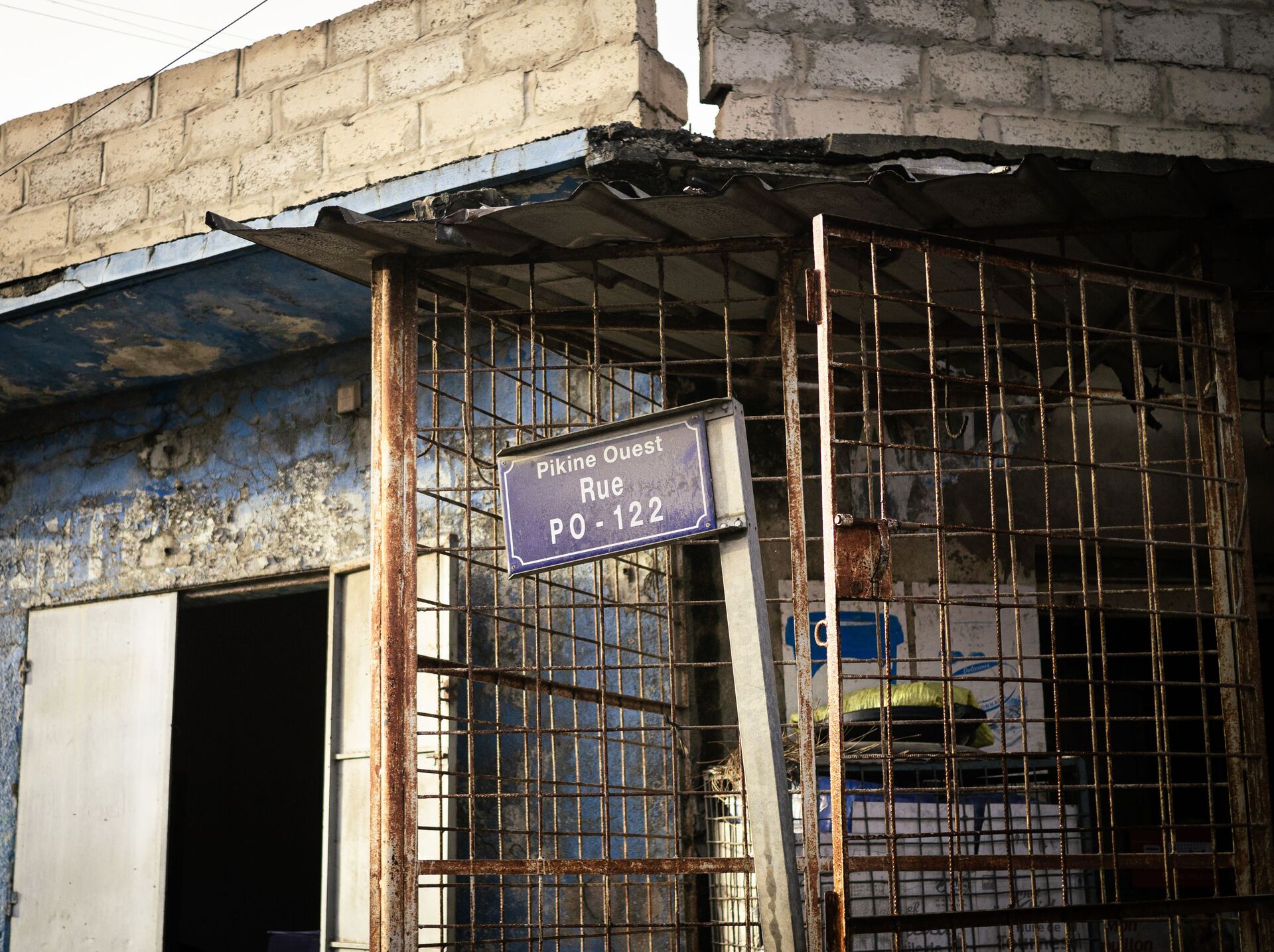
Guinea-Bissau, street photo
Independence Day: 24 September 1973 — declared unilaterally, in the bush, by a movement whose founder had been murdered eight months earlier. Portugal recognised it on 10 September 1974, and only because the war in this small territory had already destroyed the government in Lisbon. Guinea-Bissau is the only country in this series that overthrew its coloniser's regime rather than merely outlasting it.
It is also the country where, in fifty-two years, no elected president has ever completed a full term in office.
Almost every page on this site describes a European power deciding to leave.
Guinea-Bissau describes a European power being broken.
Portugal held the oldest and most stubborn empire in Europe. Salazar's regime had refused decolonisation on principle — the colonies were not colonies, they were overseas provinces, constitutionally part of Portugal itself — and it fought three wars at once, in Angola, in Mozambique and here, for thirteen years, at a cost that eventually consumed close to half the national budget.
The war it lost first, and lost most completely, was in the smallest place. A territory of under a million people, roughly the size of Belgium, with no mineral wealth worth the name.
And the men who lost it came home and overthrew their own government.
That is the story on this page. The other half of it is that the country produced by that victory has been governed, for most of the half-century since, by the army that won it — and by whoever was paying the army that month.
Guinea-Bissau, street photo
A low, wet country of mangrove creeks, tidal rivers and rice paddies, with the Bijagós Archipelago — eighty-eight islands, about twenty of them permanently inhabited — spread across the coast. It is a UNESCO biosphere reserve, with saltwater hippopotamus, nesting green turtles in numbers that matter globally, and manatees.
The Bijagó people have their own social order, in which women hold decisive authority over land, marriage and the initiation of men — one of the most genuinely matrilineal societies in West Africa, and one that resisted Portuguese control into the twentieth century.
Inland, the country is a mosaic: Balanta, Fula, Mandinka, Manjaco, Papel and others, with no group large enough to dominate and a lingua franca — Kriol — that belongs to everyone and to no one.
And the creeks are the reason for everything that has happened since 2005. A shattered coastline with hundreds of channels, uncharted islands, disused airstrips and no functioning coastguard is the ideal place to land an aircraft or a boat from Latin America.
The Portuguese had been on this coast since the fifteenth century, trading — including in people, for centuries, through Cacheu and Bissau.
But Portuguese Guinea was the empire's afterthought. Angola had oil and diamonds; Mozambique had labour, ports and the transit trade with South Africa and Rhodesia. Guinea had rice, groundnuts and rain.
So it was administered thinly, developed almost not at all, and taxed anyway. At independence, the literacy rate was minimal and there were very few African university graduates from the entire territory. Pacification of the interior and the islands continued into the 1930s.
One of the handful of graduates was an agronomist called Amílcar Cabral.
He is, with Nkrumah and Fanon, one of the three most important political thinkers Africa produced in the twentieth century, and he is the least known of them outside specialist circles.
Born in Cape Verde in 1924 to Cape Verdean parents, raised partly in Guinea, he studied agronomy in Lisbon — where he met Agostinho Neto of Angola, Eduardo Mondlane of Mozambique and other students who would lead the wars against Portugal.
He returned to Guinea as a colonial agricultural engineer and was given the job of conducting an agricultural census of the whole territory. He spent years walking it, village by village, recording who farmed what, who owned what, who was in debt to whom and how authority worked in each community.
Nobody in the history of African liberation ever began with better data. When he built a movement, he knew precisely which groups had grievances, which chiefs were compromised, and which villages would feed a column.
He founded the PAIGC — the African Party for the Independence of Guinea and Cape Verde — in 1956, with the two territories deliberately joined in one project.
His thinking is what survives. He argued that liberation was not the transfer of a flag but the recovery of a people's capacity to make its own history; that culture was the terrain of the struggle, not its decoration; and — most uncomfortably — that the petty bourgeoisie which led anti-colonial movements would have to commit suicide as a class to avoid becoming the next ruling elite.
He also insisted, repeatedly and bluntly, that the movement tell no lies and claim no easy victories.
His own party spent the next fifty years disproving him on the first point and ignoring him on the second.
Cabral began as a peaceful organiser. What ended that was a strike.
Dockworkers at the Pidjiguiti quay in Bissau struck over wages. The colonial police opened fire. Estimates of the dead vary and were never established; around fifty is the figure usually given.
The PAIGC concluded that peaceful protest in a fascist colonial state was simply a way of getting people killed, moved its organising to the countryside, and began preparing for war.
It started in January 1963 in the south and it never stopped.
By the early 1970s the PAIGC controlled the majority of the countryside. Portugal held Bissau, the larger towns and the roads between them, with around thirty thousand troops.
What made this war different from the other two was that the PAIGC built a state in the liberated zones while the war was still running: village committees, people's courts, schools, clinics, shops trading at fixed prices, and its own currency of account. Foreign journalists were brought in through Guinea-Conakry to see it, and they reported what they saw.
Guinea-Conakry was the rear base — which is why Portugal launched a seaborne attack on Conakry itself in November 1970, and why the Guinea page on this site is the companion to this one.
Soviet and Cuban support arrived. From 1973, Soviet SA-7 shoulder-fired missiles ended Portuguese air superiority; aircraft began falling and the ability to resupply isolated garrisons collapsed.
The Portuguese commander, General António de Spínola, tried a counter-programme of development and Africanisation. It was intelligent and it was far too late.
Amílcar Cabral was shot dead outside his house in Conakry, by members of his own movement, with Portuguese involvement widely assumed and never fully established in a court.
He was forty-eight. He had eight months to go.
The PAIGC did not wait for Portugal.
At Madina do Boé, in the liberated southeast, the party's People's National Assembly declared the independent Republic of Guinea-Bissau — a unilateral declaration by a movement in the bush, with the war still on.
Within weeks more than eighty states had recognised it. The United Nations General Assembly welcomed it and condemned Portugal's continued occupation.
A country that legally did not exist was recognised by most of the world before its coloniser accepted it existed at all.
Cabral's half-brother, Luís Cabral, became president.
And now the part that ought to be taught in every European school and is not.
In February 1974, General Spínola — home from Guinea — published a book, Portugal and the Future, arguing that the colonial wars could not be won militarily and that a political solution was required. It was the statement of a man who had commanded in the war Portugal was losing worst.
The regime dismissed him. Two months later, on 25 April 1974, the Armed Forces Movement — junior and middle-ranking officers, radicalised by the wars in Africa — overthrew the Portuguese dictatorship in Lisbon.
The Carnation Revolution ended nearly half a century of authoritarian rule in Portugal, and it was made by men whose politics had been formed in Guinea, Angola and Mozambique.
Portugal recognised Guinea-Bissau on 10 September 1974.
So Guinea-Bissau has two independence dates, and both are real: the one it declared, and the one it was granted after its war had already brought down the government that was refusing to grant it.
No other African country can say it ended its coloniser's dictatorship. This one can, and it should never have to say it twice.
Here the page turns, and it turns hard.
1980. The union with Cape Verde was the founding project — the two Cs in PAIGC. It lasted six years. Resentment grew in Bissau that Cape Verdeans and mixed-race cadres held the senior positions while Guineans had done most of the dying, and the flashpoint was a constitutional dispute and the execution of Guinean soldiers who had served with the Portuguese.
On 14 November 1980, João Bernardo "Nino" Vieira — a legendary field commander of the war — overthrew Luís Cabral. Cape Verde left the joint party. The two countries have been separate ever since.
1980–1999: Vieira. Nineteen years, a one-party state until 1994, then a managed multiparty one. Repeated purges, alleged plots, executions. Structural adjustment. Cashew nuts became almost the entire export economy, which they remain — something close to ninety per cent of exports, grown by smallholders, priced by buyers in India and Vietnam, and therefore a national income that swings on a harvest and a foreign price.
1998–99: civil war. Vieira dismissed his army chief of staff, Ansumane Mané, over arms allegedly diverted to separatists in Casamance, across the Senegalese border. Mané rebelled; most of the army went with him. Senegal and Guinea-Conakry sent troops to prop up Vieira. Bissau was shelled for months and largely emptied. Vieira was overthrown in May 1999.
Then: 2000 Kumba Ialá elected; 2003 the army removes him; 2005 Vieira returns and is elected again.
2 March 2009. A bomb killed the army chief of staff, Tagme Na Waie. Within hours, soldiers went to the president's house and killed Nino Vieira — the man who had commanded in the liberation war and ruled the country for over two decades.
2012: the army seized power again, during the interval between the two rounds of a presidential election.
2022 and 2023: further attempts, one of them a gun battle lasting hours at the government palace.
In fifty-two years, no elected president of Guinea-Bissau has completed a full term. Not one.
From about 2005, Latin American trafficking organisations found what they had been looking for: a coastline nobody could patrol, an air force with no working radar, an army that had not been paid, and a state with no functioning judiciary.
Cocaine came in by ship and by light aircraft, was broken into smaller loads, and went north to Europe.
The trade did not corrupt the state from outside; it was operated from inside it. In 2013 the United States indicted the former navy chief of staff, Bubo Na Tchuto, after a sting operation at sea; he pleaded guilty in New York. The army chief of staff, António Indjai, was indicted on charges involving cocaine and weapons, and remained in Guinea-Bissau beyond the reach of the court.
Western reporting settled on the phrase narco-state, and Bissau-Guineans resent it, with some justice: the great majority of a very poor population has never seen a gram or a dollar of it. But the phrase describes something real about why coups here are so frequent and so bloodless. Control of the state is worth an enormous amount to a small number of armed men, and worth almost nothing to anybody else.
Which brings us to the most recent entry, and it is only nine months old.
President Umaro Sissoco Embaló, in office since 2020, had dissolved parliament in 2023, governed by decree for long stretches, and spent 2025 in a dispute about when his own mandate expired. The main opposition party, the PAIGC — Cabral's party — was barred from contesting the presidential election. ECOWAS had withdrawn its observer mission months earlier after being threatened with expulsion.
On 23 November 2025, Guinea-Bissau voted for a president and a parliament. Embaló and the opposition candidate Fernando Dias da Costa both claimed victory. Partial tallies reported by some outlets gave Dias a narrow lead.
On 26 November, one day before the results were due, the army seized power.
It was announced on state television by Brigadier-General Dinis N'Canha, head of the military office of the presidency — in other words, the officer responsible for the president's own security. Embaló confirmed by telephone to a French broadcaster that he had been deposed and arrested. Opposition figures including PAIGC leader Domingos Simões Pereira were detained. Borders were closed, media suspended, a curfew imposed.
On 27 November, General Horta Inta-A Na Man — widely reported as Horta N'Tam — was sworn in as transitional president for one year, at the head of a body calling itself the High Military Command for the Restoration of Order. The African Union condemned the coup and demanded Embaló's release.
And then the results were destroyed. On 2 December the electoral commission reported that armed men in balaclavas had taken computers from forty-five staff and destroyed the tally sheets, except those from Bissau, along with the main server holding the results. The 23 November vote was, in practice, annulled. There is now no way for anyone to establish who won it.
A prime minister was appointed on 28 November: the finance minister who had been campaign director for Embaló's own party. Much of the 28-member cabinet was linked to the ousted president.
That is why a coalition of Bissau-Guinean civil society groups calls it a simulated coup — staged, in their account, to prevent the publication of a result Embaló had lost and to reset the game with him still on the board. Fernando Dias said the same on the day. The junta denies it.
This page cannot resolve that, and says so. What it can record is that the only neutral means of resolving the presidential dispute was physically destroyed while the army held the capital, and that nobody has been held responsible for destroying it.
Pereira was released on 30 January 2026 and placed under house arrest; Dias left the Nigerian embassy the same day. Both refused to join the transitional government. A twelve-month transitional charter adopted on 10 December 2025 bars the transitional president from standing.
On 30 August 2026, nine months after the coup, the military government put a new constitution to a referendum, reported to strengthen the presidency, with elections promised for December 2026. The outcome and what follows from it are the live question in Bissau as this page is written.
Because Guinea-Bissau is the strongest possible answer to the argument that Africans were given their independence.
This country took it. It declared itself a state while the colonial army was still in the capital, it was recognised by most of the world before Lisbon accepted it, and its war destroyed the European regime that was refusing to let it go. Angola and Mozambique became independent in 1975 in substantial part because of what happened here first.
And Guinea-Bissau is the strongest possible answer to the argument that a heroic liberation movement makes a good government. The PAIGC was the most sophisticated liberation movement on the continent — better organised than the FLN, better theorised than any of them, with schools and courts running in the bush while the shooting continued. Within seven years of victory its own field commander had overthrown its own president. Within thirty, the state it built was being used to move cocaine.
Cabral warned about exactly this, in writing, before he was killed. He said the class that leads the liberation must destroy itself or become the new oppressor.
Nobody did, and it did.
The liberation war was genuinely popular and genuinely fought. This was not a negotiated handover dressed as a struggle. Thousands died; villages were bombed; people chose sides and paid for it. Whatever has happened since belongs to a different set of men.
Cabral's assassination removed the one person who might have held it together, and the murder came from inside the movement. That is a Bissau-Guinean wound, not a colonial one, and it was inflicted eight months before independence.
The coups have been remarkably bloodless. For a country with this record, the body count is far lower than in Liberia, Sierra Leone or Côte d'Ivoire. Guinea-Bissau changes governments violently and then does not massacre anyone, which is worth saying out loud.
The cocaine trade requires buyers. It exists because Europeans consume the product, and the profits overwhelmingly stay in Europe and Latin America. Calling Bissau a narco-state while Rotterdam and Antwerp take the tonnage is a European convenience.
And Cape Verde, which left in 1980, is now one of the best-governed democracies in Africa — same party, same founder, same war, different country. That comparison is the most uncomfortable sentence on this page, and it should be, because it means none of what happened here was inevitable.
Two things are true. Guinea-Bissau brought down a European dictatorship with almost nothing, and no African country has a prouder claim. And in fifty-two years it has never once managed to let an elected president serve out a term.
There is a quay at Pidjiguiti where dockworkers asked for more money in August 1959 and about fifty of them were shot.
There is an agricultural census of an entire colony, compiled by the man who would use it to take the colony apart.
There are schools and courts that operated in liberated villages while the bombing continued.
There is a house in Conakry where Amílcar Cabral was shot by his own people on 20 January 1973.
There is a declaration of independence read out at Madina do Boé eight months later, recognised by eighty states and not by Portugal.
There is a book written by a defeated general in February 1974, and a revolution in Lisbon two months after it.
There is a union of two countries that lasted six years and a field commander who ended it in one night.
There is a president killed in his own house in March 2009, hours after his army chief was blown up.
There are creeks and islands and disused airstrips that no coastguard patrols.
And there is a server in Bissau, holding the result of an election held on 23 November 2025, which men in balaclavas destroyed three days later — so that nobody will ever know who won.
Updated and fact-checked: 14 September 2026.
How this page was checked. Recent events were verified against the sources listed above; the earlier history was checked against standard reference works on Portuguese Guinea, the PAIGC and the Portuguese colonial wars. The Pidjiguiti massacre of 3 August 1959, the founding of the PAIGC in 1956, the start of the armed struggle in January 1963, the establishment of civil administration in the liberated zones, the Portuguese attack on Conakry in November 1970, the assassination of Amílcar Cabral in Conakry on 20 January 1973, the unilateral declaration of independence at Madina do Boé on 24 September 1973, the publication of General Spínola's book in February 1974, the Carnation Revolution of 25 April 1974, Portuguese recognition on 10 September 1974, the coup of 14 November 1980 and the end of the union with Cape Verde, the civil war of 1998–99, the coups and interventions of 2003 and 2012, the killing of Tagme Na Waie and of João Bernardo Vieira on 2 March 2009, the 2013 United States proceedings against Bubo Na Tchuto and the indictment of António Indjai, the elections of 23 November 2025, the coup of 26 November 2025, the swearing-in of General Horta Inta-A Na Man on 27 November 2025, the destruction of electoral materials reported on 2 December 2025, the transitional charter of 10 December 2025, the release of Domingos Simões Pereira on 30 January 2026 and the constitutional referendum of 30 August 2026 are as recorded. Figures are estimates and are given as such: the dead at Pidjiguiti are usually estimated at around fifty and were never officially counted. Partial tallies from the 23 November 2025 election were reported by some outlets but were never certified by the electoral commission, and the materials required to certify them were destroyed; no claim as to the winner of that election is made or implied here. The allegation by Bissau-Guinean civil society organisations and by opposition figures that the November 2025 takeover was staged to prevent publication of the result is recorded as an allegation and is denied by the military authorities. Both positions are stated. Responsibility for the assassination of Amílcar Cabral has never been established by any court. Umaro Sissoco Embaló, Domingos Simões Pereira and Fernando Dias da Costa have not been convicted of any offence arising from these events. This page makes no allegation against any living person beyond matters already on the public record.
Written and researched by Remo Kurka · africanindependence.com
We strive to unify diverse narratives from across Africa, showcasing the continent's shared heritage and unique stories.
Our mission is to honor and preserve the history of African cultures and independence movements for future generations.
We provide a platform for innovative exchange of ideas, resources, and insights, understanding that knowledge should be accessible to all.