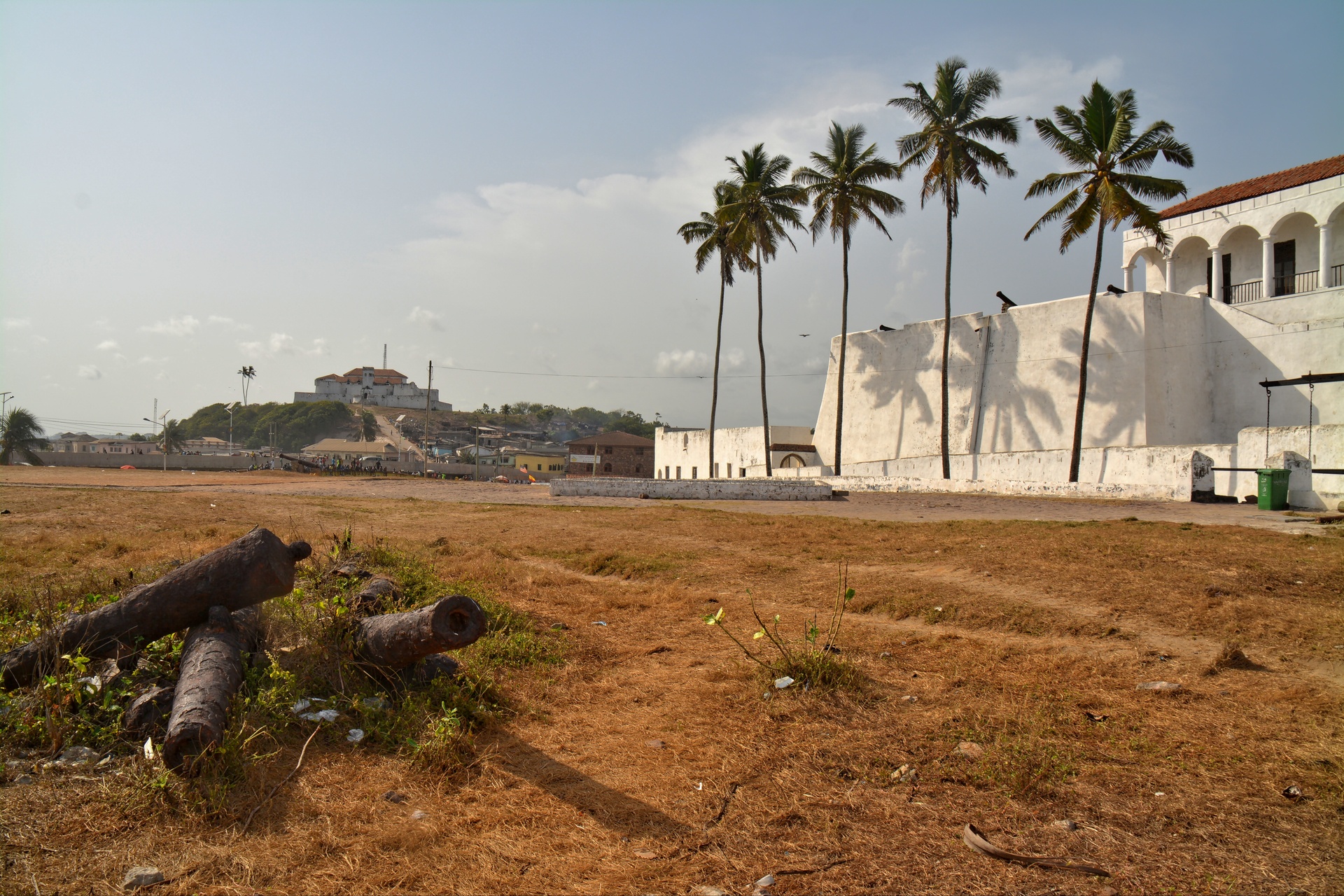
Photo Credit: Remo Kurka, Elmina Castle and the Dutch Fort St Jago top-hill, canons in front of the castle.
Independence Day: 6 March 1957. Ghana was the first colony in sub-Saharan Africa to become independent, and almost everything on this website is downstream of what happened that night in Accra.
Thirty-two African countries followed within a decade. The flag's colours were copied from Addis Ababa and then copied from Accra by half the continent. And nine years later, soldiers removed the man who had stood on that podium, and Ghana went first into that too.
This is the page the rest of this website was built around, so let me say plainly what it is for.
Ghana is the origin of the modern African state, and Ghana is the first cautionary tale about it. Both of those things happened within nine years, to the same country, under the same man.
The temptation on a page like this is to write the anniversary version: the polo ground, the midnight flag, the speech, the black star. That version is true and it is not enough, and it is not what this site does.
The other temptation, now fashionable, is to write the demolition: the detention act, the personality cult, the empty treasury, the coup.
That version is also true and it is also not enough, because it quietly implies that independence was a mistake, which is a conclusion nobody who has read the record of the Gold Coast should reach.
What actually happened is that a colonised people organised, argued, struck, went to prison, voted, and took their country — and then discovered that taking a country and running one are different problems. Every other page on this site is a variation on that discovery. Ghana simply got there first.
The land was never empty and never simple.
By the seventeenth century the forest belt held a dense cluster of Akan states built on gold and on trade routes running north to the Sahel and south to the coast. Denkyira dominated, and then in the 1690s Osei Tutu, with the priest Okomfo Anokye, welded a confederation of Akan states into the Asante Empire — with the Golden Stool, said to have been called down from the sky, as the soul of the nation, a thing that is not a throne and not a symbol but the nation itself in physical form.
Asante defeated Denkyira around 1701 and spent the following century expanding into one of the most formidable states in West Africa: a standing military system, a road network radiating from Kumasi, a treasury, a diplomatic service, and an administrative apparatus that impressed the British envoys sent to negotiate with it.
To the north lay Dagbon, Mamprugu, Gonja and the Mossi-related states — older, centralised, with their own courts and chronicles, and their own long history of conflict with Asante. To the south and east were the Ga, the Ewe and the coastal Fante states, who had their own relations with the Europeans on the shore and their own reasons not to want Asante over them.
None of these peoples asked to be one country. That is not a criticism of Ghana. It is the founding condition of every country on this continent, and Ghana has handled it better than almost anyone — which is itself a story that deserves telling.
Photo Credit: Remo Kurka, Elmina Castle and the Dutch Fort St Jago top-hill, canons in front of the castle.
Between the Volta and the Ankobra, in about five hundred kilometres of coastline, stand roughly thirty European forts and castles — the densest concentration of colonial-era military architecture anywhere in the world.
The Portuguese built São Jorge da Mina at Elmina in 1482, the first and the largest. The Dutch took it in 1637. The Swedes built at Cape Coast in 1653; the Danes, the Brandenburgers and the British all built their own. They changed hands constantly, sometimes several times in a generation, and they were built and rebuilt with local labour under agreements with local rulers.
They were built for gold. They ended up shipping people.
Beneath Cape Coast Castle are the dungeons, and above them, at the time, was a chapel. That arrangement is not a metaphor anyone invented afterwards — it is the building.
The forts and castles were inscribed by UNESCO in 1979. This network documents them in detail at capecoastcastle.com and at ghanamuseums.com, and the coastal heritage and the festivals that surround them at ghana-net.com, so this page will not repeat that work. What belongs here is the political fact: the slave trade was ended on this coast not by conscience arriving but by a change in what Europe wanted, and what Europe wanted next was the interior.
It took nearly eighty years and four wars, and it did not go smoothly.
The Bond of 1844 brought Fante coastal states into a formal arrangement with Britain. In 1824 an Asante army had already destroyed a British force and killed the governor, Sir Charles McCarthy, in the field — one of the very few times a British colonial governor died fighting Africans.
In 1874 Britain sent Sir Garnet Wolseley inland, burned Kumasi and imposed an indemnity — the campaign Ghanaians still call the Sagrenti war, after his name. The Gold Coast Colony was formally proclaimed in the same year.
In 1896 Britain returned, occupied Kumasi without a fight and deported the Asantehene, Prempeh I, to the Seychelles, where he remained for twenty-eight years.
And in 1900 the British governor, Hodgson, sat in Kumasi and demanded to be given the Golden Stool to sit on.
Yaa Asantewaa, Queen Mother of Ejisu, in her sixties, told the assembled chiefs that if the men of Asante would not fight she would call the women, and then led the war that followed. It was the last Anglo-Asante war. Several thousand died. She was captured and deported to the Seychelles, where she died in 1921.
The Golden Stool was never surrendered. It was never found by the British at all. Asante was annexed in 1902 as a separate territory, Prempeh I was permitted to return in 1924, and the Asante confederacy was formally restored in 1935.
What Britain handed over in 1957 was not one thing. It was four:
The Gold Coast Colony on the coast, under direct rule. Ashanti, annexed in 1902. The Northern Territories, taken as a protectorate in 1902 and then deliberately underdeveloped, administered cheaply and used as a labour reservoir for the mines and cocoa farms in the south — a policy whose consequences are still visible in every Ghanaian development statistic today.
And British Togoland — the western third of German Togoland, seized in 1914 and held under League of Nations mandate and then UN trusteeship. In a plebiscite in May 1956 its people voted to join the Gold Coast rather than go with French Togoland. The vote split the Ewe, and the argument about it has never entirely ended. There is a full account of the Ghana–Togo story elsewhere on this network.
Ghana's borders, like everyone else's, were drawn in Europe. The difference is what was done with them afterwards.
Two things made Gold Coast politics different from almost everywhere else in colonial Africa.
The first was cocoa. In 1879 Tetteh Quarshie, a blacksmith who had worked on Fernando Pó, brought cocoa pods home to Mampong Akuapem. By 1911 the Gold Coast was the largest cocoa producer in the world — and crucially, it was grown by African smallholders on African-owned land, not on European plantations.
That single fact changed everything. It created a rural African property-owning class with cash income, which paid school fees, which produced lawyers and journalists and teachers, and which could organise. When the buying firms colluded to hold prices down, the farmers ran cocoa hold-ups — refusing to sell, at enormous personal cost, in 1930–31 and again in 1937–38. These were among the most effective mass economic actions anywhere in colonial Africa.
The second was the coastal intelligentsia, and it was older than most people realise. The Aborigines' Rights Protection Society, founded in 1897, sent a delegation to London and defeated the Lands Bill that would have vested "unoccupied" land in the Crown. They stopped the land alienation that destroyed Kenya, Zimbabwe and South Africa, and they stopped it with lawyers, in 1898. In 1920 J.E. Casely Hayford founded the National Congress of British West Africa in Accra.
So by the 1940s the Gold Coast had money, land, literacy, newspapers, and forty years of successful legal and economic organising.
What it did not have was a mass movement. That arrived from outside.
Ghana's real independence date, if you want the day the argument stopped being polite.
The United Gold Coast Convention had been founded in 1947 by lawyers and businessmen — J.B. Danquah, Ako Adjei, Obetsebi-Lamptey, William Ofori Atta, Edward Akufo-Addo — demanding self-government "in the shortest possible time". They needed an organiser, and Ako Adjei suggested a man in London: Kwame Nkrumah, from Nkroful in the west, educated at Lincoln University and the University of Pennsylvania, then the London School of Economics, a veteran of the 1945 Pan-African Congress in Manchester.
Meanwhile the country was in trouble. Ex-servicemen who had fought for Britain in Burma had come home to nothing. Prices were high, imports were scarce, and a boycott of European firms was running. And the cocoa farms were being devastated by swollen shoot disease, to which the colonial answer was to cut down infected trees — hundreds of thousands of them, often without adequate compensation, on land that people owned.
On 28 February 1948, unarmed ex-servicemen marched towards Christiansborg Castle to present a petition to the governor. At the crossroads a British police superintendent ordered them to stop. They did not. He opened fire.
Sergeant Cornelius Adjetey, Corporal Attipoe and Private Odartey Lamptey were killed.
Accra erupted. Rioting and looting spread to Kumasi and the coast, and by the time it ended roughly two dozen people were dead and hundreds injured.
The British arrested the Big Six — the UGCC leadership, Nkrumah included — and set up the Watson Commission, which reported that the 1946 constitution was outdated at birth. The Coussey Committee then drafted a new one.
That is the moment the British decision changed. Not the moment they decided to leave, but the moment they accepted they would have to negotiate about it.
Nkrumah split from the UGCC — too slow, too lawyerly, too comfortable — and in June 1949 founded the Convention People's Party, with a slogan that fitted on a lorry: Self-Government NOW.
He built it the way nobody in the Gold Coast had built anything: market women, drivers, school-leavers, ex-servicemen, young men with no property, organised by branch, funded by dues, mobilised through newspapers and vans and songs.
In January 1950 he called Positive Action — a general strike and campaign of non-violent non-cooperation, explicitly modelled on Gandhi. It shut the country down. He was arrested and sentenced to three years.
In the February 1951 election, the CPP won overwhelmingly and Nkrumah won his seat from a cell in James Fort Prison.
The governor, Sir Charles Arden-Clarke, did the only sensible thing available and released him the next day. Nkrumah became Leader of Government Business, then Prime Minister in 1952. The CPP won again in 1954 and, against a serious federalist challenge from Asante's National Liberation Movement, again in 1956.
Independence was won by argument, organisation, strike and ballot. No guerrilla war, no maquis, no thirty years in the bush. That is why it mattered so much elsewhere: it demonstrated that the thing could be done.
At midnight, at the Old Polo Ground in Accra, the Union flag came down.
Nkrumah stood in his prison cap and smock and told the crowd that Ghana, their beloved country, was free forever — and then said the sentence that is the actual foundation of this entire website: that the independence of Ghana was meaningless unless it was linked up with the total liberation of the African continent.
The country took the name Ghana, after the medieval empire of the western Sudan — a state that had flourished hundreds of kilometres away and had no direct connection to this territory at all. That was the point. It was a deliberate claim to an African past that colonial education had denied existed.
The flag took red, gold and green from Ethiopia — from Adwa — and added the black star, from Marcus Garvey's Black Star Line. Accra to Addis to Harlem and back, in one piece of cloth.
Within a decade, over thirty African countries were independent. Many of their leaders had passed through Accra. Ghana funded, trained, sheltered and argued for liberation movements across the continent, and hosted the All-African People's Conference in December 1958, which is where a great many of the people on the other pages of this site met each other for the first time.
It should not be possible to argue about this part, though people manage.
The Akosombo Dam and the Volta River Project: conceived before independence, built between 1961 and 1965, creating one of the largest artificial lakes on earth, electrifying the country and powering the Valco aluminium smelter. The terms Ghana had to accept from Kaiser Aluminium and the American and World Bank lenders were poor, and roughly eighty thousand people were resettled with consequences that were never properly repaired. And the lights came on. This network has covered Akosombo in detail separately.
Tema: a new deep-water port and industrial city built from nothing.
Education: fee-free primary education, a massive school-building programme, the expansion of Legon, the founding of what became KNUST and Cape Coast. Ghana's literacy advantage over its neighbours starts here and has never gone away.
Health, roads, factories, Ghana Airways, the Black Star Line revived, the first national television service in the region.
And abroad: the Casablanca group, non-alignment, the push for continental union government that Nkrumah lost at the founding of the OAU in 1963 — and which, sixty years later, everybody quietly concedes he was right about.
And now the part this site does not skip.
The Preventive Detention Act of 1958 allowed detention without trial for five years, renewable. It was used against opposition politicians, trade unionists and eventually against members of his own party. J.B. Danquah — co-founder of the UGCC, the man whose organisation had brought Nkrumah home — died in detention at Nsawam in 1965, on his second period of imprisonment without trial.
Chiefs who opposed the CPP were destooled. The judiciary was interfered with: when a court acquitted men accused of treason in 1963, the Chief Justice was dismissed and the verdict set aside.
In 1964 a referendum with an announced result above ninety-nine per cent made Ghana a one-party state, with the CPP as the sole legal party and the president empowered to dismiss judges.
The personality cult grew — Osagyefo, the statue, the face on the currency, the birthday. Real assassination attempts, including the bombing at Kulungugu in 1962, made him more isolated and more suspicious, and the isolation fed the repression.
And the money ran out. Ghana had entered independence with very large sterling reserves built on cocoa. Then the world cocoa price collapsed, the ambitious state industries consumed capital without returning it, corruption grew, and by 1965 the reserves were gone and the shops were empty.
Both halves of this section are true and the page will not choose between them. The man who built Akosombo also let Danquah die in Nsawam. Ghanaians argue about it constantly, in bars and lecture halls and on the radio, and they are entitled to, because it is their argument.
While Nkrumah was in Beijing, en route to Hanoi to try to mediate the Vietnam war, the army and police removed him.
There were crowds in the streets pulling down his statue. There was also relief that is not the same thing as democratic enthusiasm.
The question of American involvement is unresolved and this page will state it exactly as it stands. Declassified United States documents show the embassy and intelligence station in Accra had contact with the plotters, knew a coup was being prepared, and did not discourage it; some accounts by former officers go further.
The CIA has never acknowledged organising it. What is documented is foreknowledge and encouragement; what is not documented is direction. Ghanaian officers had their own reasons, and treating them as passive instruments of Washington is its own kind of condescension.
Nkrumah went to Guinea, where Sékou Touré made him co-president. He died in Bucharest in 1972. He is buried in Accra, in a mausoleum, under a statue of himself that was broken in 1966 and repaired.
What followed is the part of Ghanaian history that Ghanaians find hardest to explain to outsiders, because there is so much of it.
1969: Kofi Busia and the Second Republic, elected and civilian. In November 1969 his government issued the Aliens Compliance Order, and within weeks something like two hundred thousand West Africans — mostly Nigerians — were expelled from Ghana, losing homes, businesses and schooling. It is important that this appears on a Ghanaian page, and you will see why in a moment.
1972: Colonel Acheampong overthrows Busia. "Operation Feed Yourself" — a genuinely good idea — coexists with kalabule, the era's word for profiteering, shortages and queues. He proposes "Union Government", a no-party system; it is rejected by everyone who can speak freely.
1978: his own officers remove him.
4 June 1979: Flight Lieutenant Jerry John Rawlings, thirty-two, leads a junior-officer uprising after a failed first attempt. The Armed Forces Revolutionary Council carries out a "house-cleaning exercise": three former heads of state — Afrifa, Acheampong and Akuffo — and five other senior officers are executed by firing squad, after proceedings that were not trials in any meaningful sense.
Then, extraordinarily, the AFRC hands over. Elections proceed, Hilla Limann takes office in September 1979.
31 December 1981: Rawlings comes back and removes him. The Provisional National Defence Council rules for eleven years.
30 June 1982: three High Court judges — Justices Cecilia Koranteng-Addow, Frederick Sarkodee and Kwadwo Agyei Agyepong — and a retired army officer, Major Sam Acquah, are abducted and murdered. A special investigation traces the killings into the PNDC's own circle; men are convicted and executed, and a member of the ruling council is implicated and later executed. The families of the judges have never regarded the matter as closed, and the anniversary is marked in Ghana every year.
Everything arrived at once.
Nigeria expelled Ghanaians — around a million people, in the space of weeks, in January 1983. They came home carrying the cheap plaid bags that West Africa has called "Ghana Must Go" ever since. It was, almost exactly, the mirror image of what Ghana had done to Nigerians in 1969, and Ghanaians of that generation say so.
At the same time: the worst drought in living memory, bushfires that took the cocoa farms, food shortages severe enough to be called famine in parts of the country, and an economy in free fall.
And a revolutionary socialist government, facing the collapse of everything, went to the IMF and the World Bank and accepted a structural adjustment programme — devaluation, subsidy removal, public sector retrenchment, privatisation.
The Economic Recovery Programme worked, by the measures its designers used, and Ghana became the Bank's showcase for adjustment in Africa for a decade. It also produced years of hardship for people who had no cushion, and the argument about who paid for that recovery is still live in Ghanaian politics today.
The 1992 constitution returned Ghana to multiparty rule. Rawlings won the presidency in 1992 and 1996 — as a civilian, contested, with the opposition boycotting the first parliament and then coming in.
And then the thing happened that makes Ghana what it is now.
In 2000, Rawlings was term-limited out, his party lost, and John Agyekum Kufuor of the NPP took office. Power passed from one party to another, by ballot, with no tanks. Ghana had been independent for forty-three years, had had five coups, and had never done that before.
Then it did it again. And again.
2008: John Atta Mills beat Nana Akufo-Addo by roughly forty thousand votes out of nine million, decided in a second round and a single re-run constituency. The losing party accepted it. On a continent where much smaller margins have produced much larger graveyards, that election is worth more than any economic statistic Ghana has produced since.
2012: Mills died in office; John Dramani Mahama succeeded him constitutionally, won the election, and Akufo-Addo challenged the result in the Supreme Court — eight months of hearings, televised live, watched obsessively. The Court ruled against him. He accepted it on television.
2016: Akufo-Addo won, and Mahama conceded before the official declaration.
2024: Mahama won again, becoming the first Ghanaian president to lose an election and return to office, and Akufo-Addo's party conceded on the night.
Three alternations of power, plus a fourth, plus a constitutional succession, plus a losing candidate accepting a court ruling against him. That is Ghana's real achievement since 1957, and it is the reason Accra is where West African mediators come from.
Ghana defaulted on most of its external debt in December 2022, restructured its domestic bonds in a programme that cost ordinary bondholders and pension savers a great deal, and entered an IMF programme in 2023 with inflation above fifty per cent.
The recovery since has been real and fast. Inflation fell to around five per cent by the end of 2025 and into the threes in early 2026; the cedi appreciated by roughly forty per cent in 2025, its first annual gain against the dollar in nearly thirty years and among the strongest performances of any currency in the world that year; reserves roughly doubled; the economy grew about six per cent; and the government moved to exit the Fund's credit facility for a non-financing arrangement. Mahama's second, non-consecutive term has been built around that reset and around a 24-hour economy programme legislated in February 2026.
And the thing paying for it is destroying the country.
The current account surplus and the reserves rest heavily on historically high gold prices and gold exports. A large and growing share of that gold comes out of galamsey — illegal and informal mining that has poisoned the Pra, the Ankobra, the Offin and the Birim with mercury and sediment, forced water treatment plants offline, taken cocoa farms out of production, and pushed into forest reserves including Atewa, which supplies water to millions of people.
That is the Ghanaian question in 2026, and this network has been writing about it in detail on ghanaweb-news.com without sugar-coating: the same gold that rescued the currency is destroying the water, the enforcement keeps catching the men with shovels and not the men with excavators and licences, and the official figures have not been telling the truth about the scale of it.
Ghana also, in 2025, joined the list of African states accepting third-country deportees from the United States — an arrangement covered on several other pages of this site, and one that sits oddly with the country's standing as West Africa's democratic reference point.
And there is the Year of Return of 2019 and the Beyond the Return programme that followed: an invitation to the African diaspora to come home, which brought hundreds of thousands of people and a great deal of money, and which was conceived, correctly, as the closing of a circle that began in the dungeons at Cape Coast and Elmina.
Because it is the first page, chronologically and morally, and because everything on the other fifty-three pages is a variation on what happened here.
Ghana proved the thing could be done. Organise, strike, argue, vote, take the state. No war. A continent watched.
Ghana then demonstrated every failure mode within a decade. Detention without trial. The one-party state. The personality cult. The empty treasury. The coup. Read the Guinea page, the Congo page, the Gabon page, the Eritrea page — the specifics differ and the sequence does not.
And then Ghana did something almost nobody else managed: it came back. Four transfers of power between rival parties since 2000. A losing presidential candidate accepting a Supreme Court judgment on live television. A president who lost and returned by ballot rather than by barracks.
That third act is the part this website exists to insist on, because it is the part the world does not report. Africa's first independent country spent thirty-five years demonstrating how it goes wrong and has spent the last twenty-six demonstrating that it can be fixed.
Things this page has to say, since it is written from inside the country's own network.
Ghana expelled two hundred thousand West Africans in 1969, fourteen years before a million Ghanaians were thrown out of Nigeria. Ghanaians remember the second and not the first. It should be the other way round, or at least both.
Three High Court judges were murdered in 1982 and the case runs into the government of the day. No amount of subsequent democratic achievement settles that, and Ghanaians who lived through it know exactly whose names are involved.
Three former heads of state were shot in 1979 after proceedings that were not trials. The man who presided over that went on to be elected president twice and to be treated, by the end, as an elder statesman. That is a genuine unresolved contradiction at the centre of the Fourth Republic and there is no polite way around it.
The north is still behind, by every indicator, because it was deliberately administered as a labour reserve for seventy years and because no government since has closed the gap. That is a colonial policy still producing measurable results in 2026.
And galamsey is not being done to Ghana by foreigners. Chinese operators are real and prominent and the outrage about them is justified. The land is released by Ghanaian chiefs, the licences are issued by Ghanaian institutions, the excavators are cleared by Ghanaian officials, and the politics of every constituency where it happens is Ghanaian.
Rivers that fed people for a thousand years are now unusable, and the decisions that did it were taken locally.
Two things are true. Ghana is the best argument on this continent that African self-government works and is being made to work. And Ghana is currently poisoning its own water to pay off its own debt, and knows it.
There is a castle at Elmina from 1482, and a chapel above the dungeons.
There is a stool that was never surrendered and never found, and a woman in her sixties who went to war for it and died on an island in the Indian Ocean.
There is a blacksmith who came home from Fernando Pó in 1879 with some pods.
There are three men shot at a crossroads on 28 February 1948 while carrying a petition.
There is a man in a prison cap on a polo ground at midnight, saying that Ghana's freedom is meaningless without the whole continent's.
There is a lawyer who brought him home from London and died without trial at Nsawam in 1965.
There is a dam, a lake, a smelter on terms nobody would sign today, and eighty thousand people moved.
There are three judges taken from their homes in June 1982.
There is a plaid bag that an entire region calls Ghana Must Go.
There is a Supreme Court judgment, accepted on television by the man who lost.
There is a river called the Pra that you can see from the air, and its colour is wrong.
And there is a black star, taken from a shipping line founded in Harlem, on a flag whose other colours came from Ethiopia.
Updated and fact-checked: 13 September 2026.
How this page was checked. Economic figures for 2025 and 2026 were verified against the IMF and the reporting listed above; the historical record was checked against standard reference works on Ghana and the Gold Coast. The founding of Elmina in 1482, the formation of the Asante union around 1701, the Anglo-Asante wars of 1824, 1874, 1896 and 1900, the deportation of Prempeh I and of Yaa Asantewaa to the Seychelles, the annexation of Ashanti and the declaration of the Northern Territories protectorate in 1902, the introduction of cocoa by Tetteh Quarshie in 1879, the Aborigines' Rights Protection Society's defeat of the Lands Bill in 1897–98, the cocoa hold-ups of 1930–31 and 1937–38, the British Togoland plebiscite of May 1956, the shooting of ex-servicemen at the Christiansborg crossroads on 28 February 1948, the founding of the CPP in 1949, Positive Action in 1950, the 1951 election and Nkrumah's release from prison, independence on 6 March 1957, the Preventive Detention Act of 1958, the republic of 1960, the Akosombo Dam and the Volta River Project, the one-party referendum of 1964, the death of J.B. Danquah in detention in 1965, the coup of 24 February 1966, the Aliens Compliance Order of 1969, the coups of 1972, 1978, June 1979 and December 1981, the executions of June 1979, the murder of three High Court judges and a retired officer on 30 June 1982, the Nigerian expulsion of Ghanaians in 1983, the Economic Recovery Programme, the 1992 constitution, and the transfers of power in 2000, 2008, 2016 and 2024 are as recorded. Figures are estimates where sources differ and are given as such: the numbers expelled under the Aliens Compliance Order in 1969 and from Nigeria in 1983 are contemporary estimates, as is the number resettled for the Volta lake. On the question of foreign involvement in the 1966 coup: declassified United States records establish that American officials in Accra had prior knowledge of coup preparations and did not discourage them; no official acknowledgement of direction or organisation exists, and the claim that the coup was directed from Washington is contested. Both the documented record and the contested claim are stated here as such. Deaths in political custody and the executions of 1979 and 1982 are matters of public record and of Ghanaian judicial and commission findings. This page makes no allegation against any living person beyond matters already on the public record.
Written and researched by Remo Kurka · africanindependence.com
We strive to unify diverse narratives from across Africa, showcasing the continent's shared heritage and unique stories.
Our mission is to honor and preserve the history of African cultures and independence movements for future generations.
We provide a platform for innovative exchange of ideas, resources, and insights, understanding that knowledge should be accessible to all.