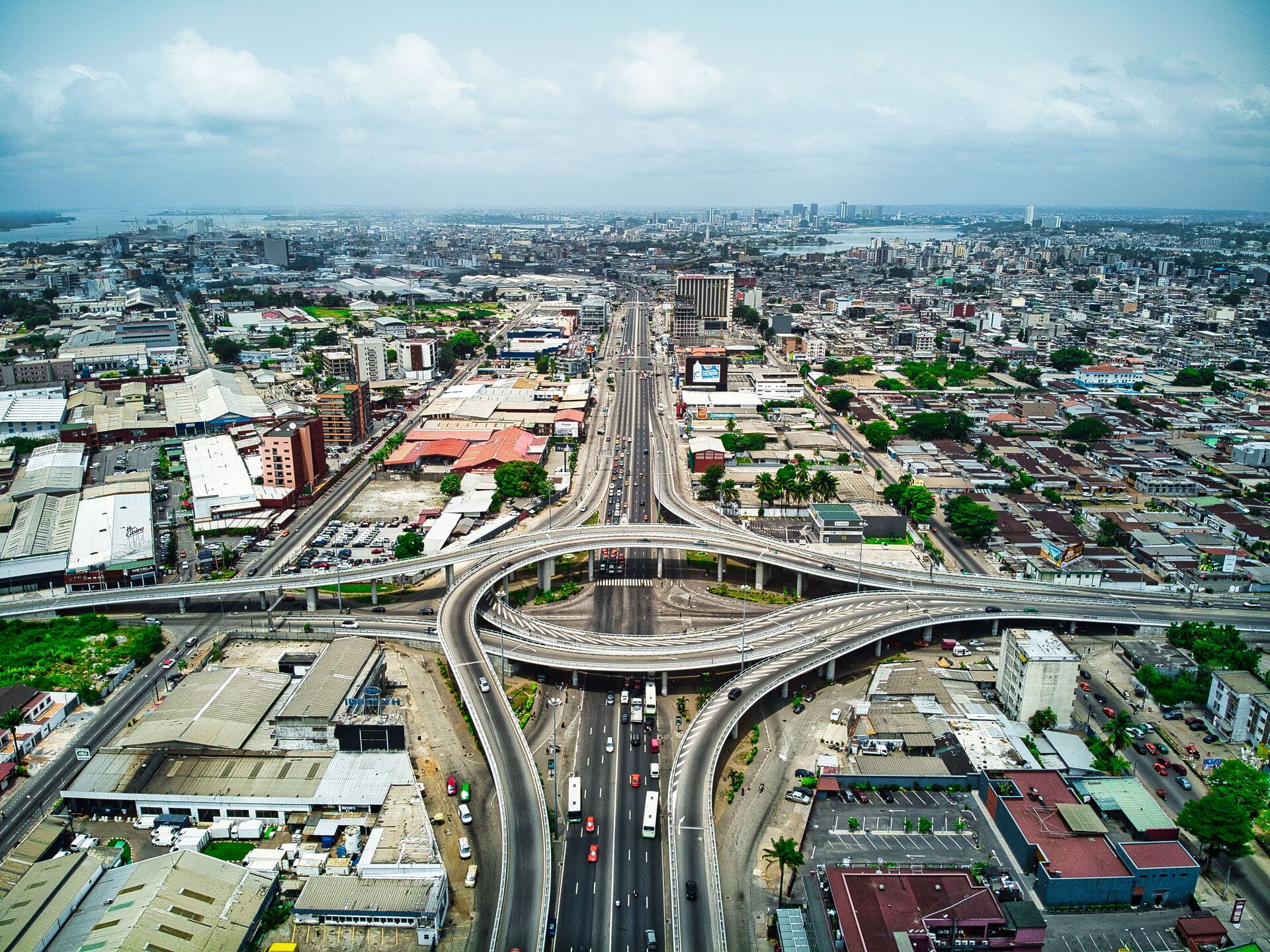
Abidjan, Côte d'Ivoire, Ivory Coast
Independence Day: 7 August 1960. The founding president had already served as a minister in two French governments, had personally written the law that ended forced labour across the whole French empire, and spent years arguing that his country should not become independent at all.
The country is called Côte d'Ivoire, and since 1986 it has formally asked the world to use that name in every language rather than translating it.
The name itself is a European inventory label — the Ivory Coast, from the trade in elephant tusks, next door to the Gold Coast and the Slave Coast, all named by outsiders for what could be taken from them.
Keeping the French form is a deliberate assertion: this is the country's name, not a description to be rendered into whatever language you happen to speak.
He was born Dia Houphouët around 1905 at Yamoussoukro, into a family of Baoulé chiefs with cocoa and coffee plantations. The family's relative wealth is why he went to school at all.
At eleven he converted to Catholicism and took the name Félix.
He then trained as what the French system called an African doctor — a qualification specifically capped below a full French medical degree, because a colonial subject was not permitted one.
He practised as a physician from 1925 to 1940.
In 1940 he inherited the family plantations, went home, and became canton chief.
And that is where the politics started — not in a party, but among planters.
African planters in the colony operated under a system rigged twice over. They were paid less for the same crop than European planters. And European plantations had access to forced labour, recruited by the administration, which African planters did not.
In 1944 Houphouët organised them into the Syndicat Agricole Africain, an African planters' union, to fight both.
It was an economic organisation before it was a political one, and it gave him something very few African politicians of that generation had: a mass membership of people with money and property.In 1945 he was elected to the French National Assembly in Paris.
Abidjan, Côte d'Ivoire, Ivory Coast
And then he did the thing that ought to make him famous.
In 1946, an African deputy in the French parliament introduced and carried the law that abolished forced labour throughout the French colonial empire.
It is known in West Africa as the loi Houphouët-Boigny.
Forced labour was the defining brutality of French colonial rule. It built the Congo–Ocean railway with a death toll in the tens of thousands. It supplied the plantations. It was the mechanism by which the colonies actually functioned.
An African, elected in Africa, ended it from inside the French legislature.
To mark it he added a second name — Boigny, meaning ram, or irresistible force.
Across French West Africa, the day the law took effect was celebrated. In some places it still is.
He also co-founded the RDA, the African Democratic Rally, a party spanning the French territories, initially allied in Paris with the French Communist Party — and he broke that alliance in 1950 and moved to the centre, which is where he stayed.
From 1956 onwards, Houphouët-Boigny served as a minister in French governments — the first African to hold ministerial office in a European government.
He was in the cabinet in Paris while his country was still a colony.
And from that position he argued, consistently and publicly, against independence.
His preference was a Franco-African community — the territories keeping direct links to Paris, with French citizenship, French markets and French investment.
His opposition to the alternative was specific and it was about money. Léopold Senghor and others wanted a federation of the West African territories, so that the region would face France as a bloc. Houphouët-Boigny refused, on the grounds that Côte d'Ivoire was much the richest of them and would end up subsidising the rest.
He said, in effect, that his country would become the milk cow of West Africa.
He won that argument. The federation never happened, French West Africa broke into separate small states, and every one of them dealt with Paris alone — which is precisely the outcome Paris wanted.
If you have read the other pages on this site and wondered why the French territories fragmented into a dozen weak states while the British ones did not, this is a large part of the answer, and it was made by an African.
In the 1958 referendum, Côte d'Ivoire voted yes to the French Community. Only Guinea voted no, and Guinea was punished for it.
Independence came anyway, in the general wave. On 7 August 1960, Côte d'Ivoire became a sovereign state, with Félix Houphouët-Boigny as its first president.
He held the office for thirty-three years, until his death.
For about two decades it worked, and it worked spectacularly.
Côte d'Ivoire became the world's largest producer of cocoa — which it still is, supplying something like two-fifths of the entire global crop — and a major coffee producer. Growth ran at around seven per cent a year for twenty years. Abidjan filled with towers and was called, by people who were not being entirely ironic, the Paris of West Africa.
The strategy was deliberate and it was the opposite of what most of the continent was doing. No Marxism, no nationalisation, no confrontation with the West. Foreign investment welcomed. French technicians retained in large numbers. Agriculture prioritised over industry. Close relations with Paris maintained at every level.
Houphouët-Boigny was also, by the standards of this website, an unusually skilful politician at keeping the peace. Reported coup attempts in 1963 and 1973 came to nothing. He had a genuine talent for absorbing opponents rather than killing them — jobs, contracts, positions.
And he built the labour force by importing it.
The plantations needed workers, and the workers came from Upper Volta — now Burkina Faso — and from Mali. Houphouët-Boigny encouraged this actively. He granted migrants land rights on the principle that the land belongs to whoever cultivates it, and he gave them the vote.
By the 1990s, something like a quarter of the population of Côte d'Ivoire was of foreign origin or descent.
That policy built the miracle. It also built the bomb.
This page does not print miracles without the rest.
Côte d'Ivoire was a one-party state under the PDCI. In 1963 and again in 1973 the government announced conspiracies against the president. Large numbers of people were arrested, held in camps, and tortured; some died. Ivorian historians generally describe the 1963 affair as a fabricated plot used to eliminate rivals.
There was no free press. Trade unions and student organisations were absorbed into the party or suppressed. Laurent Gbagbo, then a history teacher, was imprisoned in the 1970s and later went into exile in France.
And then there was Yamoussoukro.
In 1983 Houphouët-Boigny moved the capital to his birth village. And between 1985 and 1989 he built there the Basilica of Our Lady of Peace — the largest church in the world, larger than St Peter's in Rome, with a dome of imported Italian marble and stained glass covering an area measured in thousands of square metres, in a village in the middle of a country whose economy was by then in freefall.
Estimates of the cost run to around three hundred million dollars. He said he had paid for it personally, from his own funds — a claim that raised as many questions as it answered in a country where the distinction between the president's money and the state's had never been drawn.
Pope John Paul II consecrated it in 1990, having asked, and been promised, that a hospital would be built alongside it.
The cocoa price had collapsed in the early 1980s. The debt crisis had arrived. Structural adjustment followed. The miracle was over, and the largest church in Christendom was going up in a village of a few thousand people.
Multi-party elections were finally held in 1990. Houphouët-Boigny beat Gbagbo and took over eighty per cent.
He died on 7 December 1993, aged eighty-eight, the longest-serving head of state in Africa.
What happened next is the reason this country matters to the argument of this whole website.
Henri Konan Bédié succeeded him, and needed a way to eliminate his most dangerous rival.
That rival was Alassane Ouattara — a former deputy managing director of the IMF, a former governor of the West African central bank, who had served as Houphouët-Boigny's prime minister. He was a northerner and a Muslim, and his family origins were said to lie partly across the border in Burkina Faso.
So Bédié promoted a doctrine called Ivoirité — Ivorian-ness.
The claim was that there is a category of authentic, pure-blooded Ivorians, and that only they are entitled to the full rights of citizenship, above all the right to stand for president.
It was written into the electoral code. Ouattara was declared of doubtful nationality and excluded from the 1995 election, and then from 2000.
Consider what that meant in a country where perhaps a quarter of the population traced its origins to the migrant labour that the founding president had personally invited in, given land to, and enfranchised.
Overnight, several million people were told they were guests.
Land disputes in the cocoa belt turned violent. The north, poorer and largely Muslim, found itself defined out of the nation by a southern, largely Christian political class.
That is the fault line, and everything after it runs along that line.
On 24 December 1999, soldiers mutinied over pay and General Robert Guéï took power — the first coup in the country's history, thirty-nine years after independence, in the state that had been the model of stability.
Guéï promised elections and not to stand, then stood. He used Bédié's own exclusion rules to keep Ouattara off the ballot.
He lost anyway, to Laurent Gbagbo, tried to falsify the result, and was driven out by crowds in the street.
Gbagbo became president in October 2000 on a turnout so low that the result had almost no legitimacy — Ouattara's supporters had been told there was no point voting because their candidate was banned.
Ouattara's supporters then demonstrated for a fresh election, and were attacked. Dozens of bodies were found in a mass grave at Yopougon in Abidjan.
On 19 September 2002 a coup attempt failed and turned into a war. Robert Guéï was killed on the first day. Rebel forces took the north and held it; the government held the south. The country was cut in half for years, with a French force and later a United Nations mission along the line between.
In November 2004, an Ivorian air strike on the rebel-held town of Bouaké killed nine French soldiers. France destroyed the entire Ivorian air force in retaliation within hours. Anti-French riots swept Abidjan, French nationals were evacuated, and the relationship that had defined the country since 1946 broke.
A peace agreement in 2007 was supposed to lead to elections. They were postponed six times.
The presidential run-off was finally held on 28 November 2010.
The electoral commission declared Alassane Ouattara the winner. The Constitutional Council, headed by a Gbagbo ally, annulled results in the north and declared Laurent Gbagbo the winner.
Both men were sworn in. Both formed governments.
The standoff lasted four and a half months and killed around three thousand people.
Atrocities were committed by both sides. In March 2011, in and around Duékoué in the west, hundreds of civilians were killed — by forces fighting for Ouattara.
On 11 April 2011, Gbagbo was captured in the presidential residence in Abidjan, after French and United Nations forces attacked his heavy weapons and pro-Ouattara fighters went in.
He was transferred to the International Criminal Court in The Hague.
Gbagbo spent nearly ten years in detention on four counts of crimes against humanity.
In January 2019 the ICC acquitted him. He was released, and the acquittal was confirmed on appeal in March 2021. He returned home in June 2021, and Ouattara — in a genuine act of political generosity — pardoned him on his domestic convictions and granted him the full status of a former president.
But there is a second fact about those proceedings that human rights organisations have raised repeatedly and that belongs on this page.
Only Gbagbo's side was ever prosecuted at the ICC.
The Duékoué killings and other abuses by forces fighting for the winner have not produced an international prosecution. The court took the losing side and left the winning side alone.
Whatever one concludes about Gbagbo, an international justice process that only tries the people who lost the war is not a justice process. It is a ratification of the result.
That perception has done real damage to the ICC's standing across the continent, and this case is one of the reasons why.
Alassane Ouattara has now governed since 2011.
Economically, the record is genuinely strong. Growth above six per cent. Debt restructured. Roads, schools, ports. Cocoa prices at record highs. A stated goal of upper-middle-income status by 2030. Francophone West Africa's largest economy.
Politically, the pattern is the one this site has now documented in a dozen countries.
He amended the constitution in 2016 and stood for a third term in 2020, taking over ninety per cent after an opposition boycott. Eighty-five people were killed in the violence around that vote.
He said he would hand over to a younger generation. In July 2025 he announced a fourth term at eighty-three.
And here is the part that closes the circle.
Tidjane Thiam — former chief executive of Credit Suisse, one of the most senior Africans in global finance, and the most credible challenger — was disqualified by the Constitutional Council on the grounds of his French citizenship.
Laurent Gbagbo was barred over a domestic conviction.
So the nationality weapon that Bédié invented in the 1990s to exclude Ouattara, which helped destroy the country and killed thousands of people, was in 2025 used to exclude the main challenger to Ouattara.
The election was held on 25 October 2025. Ouattara won 89.77 per cent. Turnout was under fifty per cent. Jean-Louis Billon took just over three per cent. Simone Gbagbo, the former first lady, took 2.42.
An Abidjan voter quoted by Reuters put it plainly: there was nothing at stake.
In February 2025, France handed over its last military base in Côte d'Ivoire, ending decades of permanent French military presence.
The base went. The rest stayed.
Houphouët-Boigny is the hardest figure on this website to judge, and the honest verdict is genuinely mixed.
He ended forced labour across an empire. He built two decades of prosperity that were real and that lifted millions. He kept his country out of the coups and wars that consumed almost every neighbour, for over thirty years. And he did all of this while running a one-party state, fabricating conspiracies, jailing opponents, and building the biggest church on earth in his home village while the economy collapsed.
He also, more than any other single person, prevented the West African federation — and the fragmentation of French West Africa into a dozen dependent states is a large part of why Paris kept its grip for another half-century. He did that for a good Ivorian reason and with foreseeable continental consequences.
And the migration policy that built the plantations — generous, deliberate, and correct — was turned by his successors into the doctrine that tore the country apart. That is not his fault, but it is his legacy that they inherited and weaponised.
Ivoirité is the point. A country whose wealth was built by people from Burkina Faso and Mali decided, when the money got tight, that those people and their children were not really Ivorian. Then it fought a war about it. Then, having supposedly settled it, the same instrument was used in 2025 against a Franco-Ivorian banker.
Nothing about that is uniquely African. It is what political classes everywhere do when the economy stops growing and they need somebody to be the outsider.
There is the largest church in Christendom, in a village of a few thousand people, with a hospital that took decades to arrive.
There is a law from 1946 that ended forced labour across the French empire, written by an African, which almost nobody in France has heard of.
There is a mass grave at Yopougon and another at Duékoué, and one international prosecution, of the man who lost.
There is a cocoa crop that supplies two-fifths of the world's chocolate, produced on land that was rainforest within living memory and by a workforce that includes children, in a country that has lost the overwhelming majority of its forest cover since independence.
There is a former French military base that changed hands in February 2025.
And there is a president of eighty-three, in his fourth term, who was himself excluded from two elections on the grounds that he might not really be Ivorian — and whose principal challenger was excluded in 2025 on the grounds that he might be French.
Updated and fact-checked: 10 September 2026.
How this page was checked. Dates and figures were verified against the sources listed above. Houphouët-Boigny's founding of the Syndicat Agricole Africain in 1944, his election to the French National Assembly in 1945, the passage in 1946 of the law abolishing forced labour in the French colonies, his service as a minister in French governments, his opposition to a West African federation, independence on 7 August 1960, the alleged conspiracies of 1963 and 1973, the move of the capital to Yamoussoukro in 1983 and the construction and 1990 consecration of the Basilica of Our Lady of Peace, the first multi-party elections of 1990, his death on 7 December 1993 after thirty-three years in office, Henri Konan Bédié's promotion of Ivoirité and the exclusion of Alassane Ouattara from the 1995 and 2000 elections, Robert Guéï's coup of 24 December 1999, Laurent Gbagbo's accession in 2000, the failed coup of 19 September 2002 and the partition of the country, the Bouaké air strike of November 2004 and the French destruction of the Ivorian air force, the disputed run-off of 28 November 2010 and the crisis that followed, Gbagbo's capture on 11 April 2011 and transfer to the International Criminal Court, his acquittal in January 2019 and its confirmation on appeal in March 2021, his return and pardon in 2021, Ouattara's third term in 2020, the French handover of its last military base in February 2025, and the election of 25 October 2025 with an official result of 89.77 per cent on a turnout below fifty per cent are as recorded. Casualty figures are estimates and are given as such: the 2010–11 crisis is generally estimated at around 3,000 dead, the 2020 election violence at 85, and the Duékoué killings of March 2011 at several hundred with figures disputed between investigating bodies. The cost of the Yamoussoukro basilica is not officially established; figures around US$300 million are widely reported and Houphouët-Boigny stated that he financed it personally. Laurent Gbagbo was acquitted of all charges by the International Criminal Court and that acquittal was confirmed on appeal; nothing on this page should be read as a finding of guilt against him. The observation that no commander from the pro-Ouattara side has faced international prosecution is a matter of record and is raised by human rights organisations; it is stated here as such and not as an allegation against any named individual. This page makes no allegation against any living person.
Written and researched by Remo Kurka · africanindependence.com
We strive to unify diverse narratives from across Africa, showcasing the continent's shared heritage and unique stories.
Our mission is to honor and preserve the history of African cultures and independence movements for future generations.
We provide a platform for innovative exchange of ideas, resources, and insights, understanding that knowledge should be accessible to all.