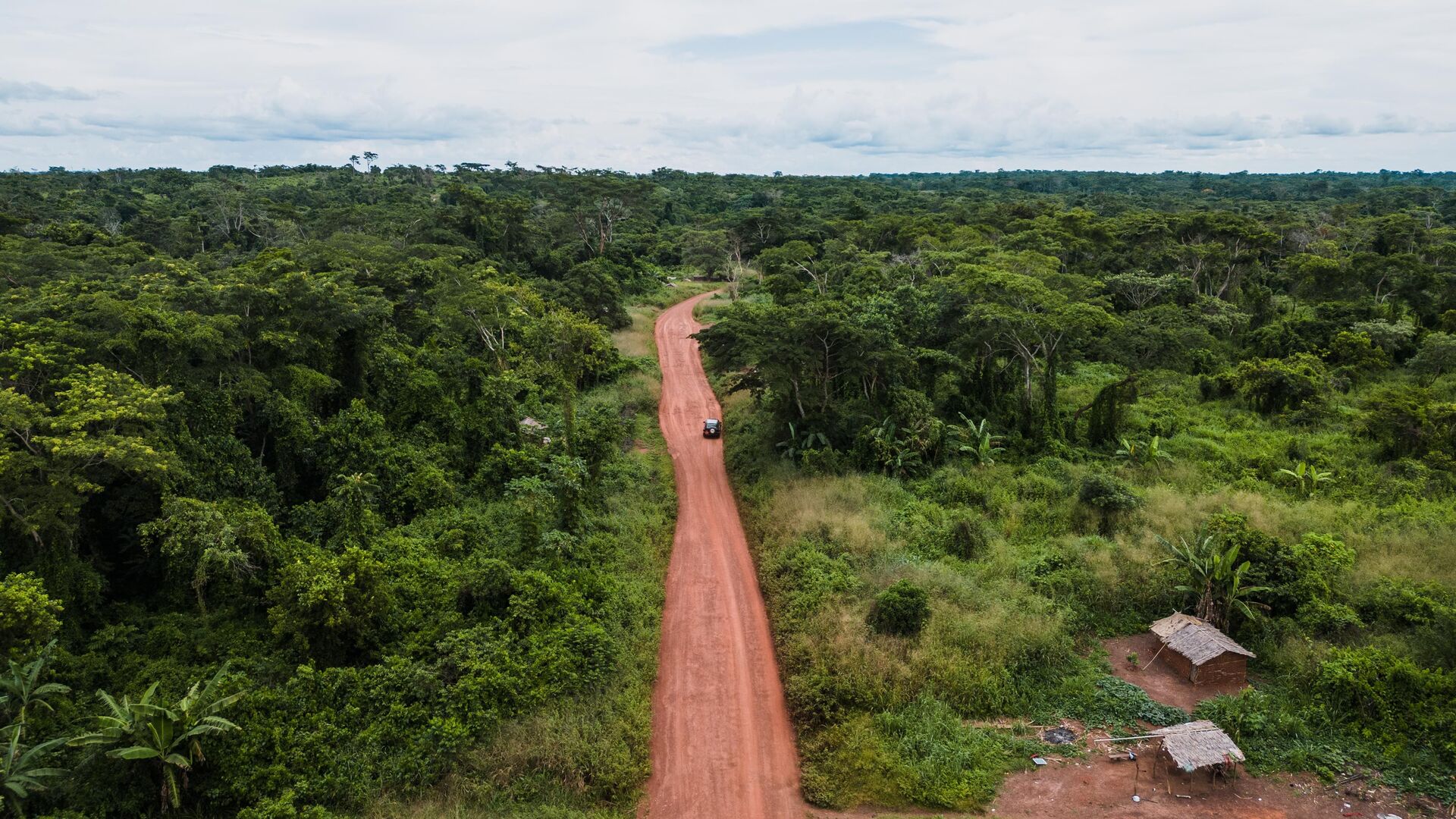
Independence Day: 1 January 1960. France killed the man who led the independence movement, installed the man it wanted, and fought a war here for years before Algeria — a war it has still never officially admitted took place.
Portuguese sailors reached the estuary of the Wouri in the 1470s, found it full of shrimp, and called it Rio dos Camarões — the river of prawns.
Spanish, then German, then French and English adapted it. Cameroon is the only country in the world named after a crustacean.
That is the least of what was done to it from outside.
Germany claimed Kamerun in 1884 and held it for thirty-two years. German rule built plantations, a railway and Douala's port, and it did so with forced labour and punitive expeditions.
In 1914 the Germans hanged Rudolf Duala Manga Bell, the Douala paramount chief, for treason. His offence was petitioning the Reichstag in Berlin against the expropriation of Douala land.
He had been educated in Germany, spoke German, and used German law to object. They hanged him anyway, on 8 August 1914, days after the war in Europe began.
Then the Allies took the colony, and in 1922 the League of Nations divided it. France got about four-fifths. Britain got two strips along the Nigerian border, which it administered as part of Nigeria rather than as a territory in its own right.
One German colony, two European systems, two languages, two legal traditions, two school systems.
Everything difficult about Cameroon today begins with that line.
In 1948 the Union des Populations du Cameroun was founded, led by Ruben Um Nyobè — a former court clerk, a trade unionist, a Bassa from Boumnyebel, and one of the most effective political organisers anywhere in colonial Africa.
The UPC wanted two things: independence, and reunification of the two Cameroons.
And it did something unusual. Because Cameroon was a United Nations trust territory rather than an ordinary colony, the UPC had a legal right of petition to the UN. Um Nyobè used it. He travelled to New York and addressed the Fourth Committee of the General Assembly in 1952, 1953 and 1954, demanding a timetable for independence.
He was, by every account, calm, precise and extremely difficult to answer.
France's problem was not that the UPC was violent. It was that the UPC was popular and legally correct.
A new High Commissioner, Roland Pré, arrived determined to finish the UPC. Unrest followed within weeks, with deaths on both sides, and France used it as the pretext.
On 13 July 1955 the UPC was banned.
Um Nyobè went into the forest of his home region and organised from there. The colonial administration set out to find and kill him.
And in doing so, France built something it would use again.
This is the part that ought to be far better known in Europe, and specifically in France.
Between 1955 and 1960 the French administration in Cameroon developed a full counter-insurgency system: ZoPac — zone de pacification — declared from December 1957, in which the population of whole districts was moved into guarded camps and placed under surveillance. A second martial zone covered the western regions from January 1957 to May 1959, taking in the Bamileke and Bassa areas.
The methods included aerial bombardment of villages, forced resettlement, torture as routine interrogation practice, public executions, forged letters and fake radio broadcasts to divide the insurgency, and the recruitment of local militias and mercenaries.
Algeria came afterwards. Cameroon was the testing ground, and the officers and the doctrine moved on from here — to Algeria, and from there into the counter-insurgency training that France exported for decades.
The scholarly account is Thomas Deltombe, Manuel Domergue and Jacob Tatsitsa's Kamerun! Une guerre cachée aux origines de la Françafrique, now available in English. Their work records the bombing of UPC strongholds in the Bamileke and Mungo regions with some 21,000 killed, and the survivors moved into camps for what was called re-education.
Um Nyobè's hiding place was located after his companions were captured and tortured until some of them talked.
On 13 September 1958 he was shot near his native village by a unit of auxiliaries under the command of a French officer.
He was forty-five.
His autopsy was never published. Witnesses said he was hit by more than fifteen bullets. His body was displayed publicly and then buried in concrete, so that his grave could not become a shrine.
His name was then banned. For decades, Cameroonians could not say it aloud in public.
The French military archives covering the operation of 13 September 1958 remain classified.
With the leader of the independence movement dead, France proceeded to grant independence.
Ahmadou Ahidjo — a Fulani Muslim from the north, a former radio operator, and a man Paris regarded as reliable — was installed as head of government in 1958 and signed the independence agreement, framed around Franco-Cameroonian friendship, in January 1960.
French Cameroun became independent on 1 January 1960. Elections followed in May, in a country where the army was still conducting operations against the UPC in the Bassa and Bamileke regions and where the largest political movement was banned.
Ahidjo's party won 51 seats out of 100 and he was then elected president by the assembly with 89 votes.
De Gaulle called him a model of stability for Africa.
This is the fact that undoes the official chronology entirely.
The killing continued for another decade, under an independent government, with French officers advising it.
In 1959 the Bamileke took over the leadership of the resistance and formed the Armée de Libération Nationale du Kamerun. The war ran on through the 1960s.
Félix-Roland Moumié, who had led the UPC in exile after Um Nyobè's death, was poisoned with thallium in Geneva in October 1960 by an agent of the French external intelligence service posing as a journalist. He died in Switzerland weeks later. He was thirty-five.
Ernest Ouandié, the last of the UPC's founding leadership still fighting, was captured in 1970 and publicly executed by firing squad in the market square at Bafoussam on 15 January 1971, in front of a crowd, eleven years after independence.
Casualty estimates for the whole conflict are among the most disputed on the continent. The independence phase to 1960 is generally put at around 10,000 dead. Estimates for the phase after independence range from 20,000 to 400,000 — a spread so wide it is itself a finding about how little has been established.
What is documented, and is chilling in its own dry way: colonial and post-colonial censuses of the Bamileke region between 1956 and 1971 record sudden, large, unexplained population decreases, in an area that before 1955 had high birth rates, high literacy and high school attendance.
In 2005 a French parliamentary mission used the phrase zones of mass atrocities about Cameroon.
There was no judicial follow-up. There has been no formal recognition by the French state of the war, of the killing of Um Nyobè, of the poisoning of Moumié, or of the numbers. The relevant military archives remain closed. French intelligence maintained an advisory unit working with the Cameroonian authorities into the late 1980s.
Algeria has an official French acknowledgement of torture and of specific killings. Cameroon has a parliamentary phrase and a sealed file.
And Cameroon's own governments have not pressed the point, for reasons that become obvious in a moment.
Meanwhile the British Cameroons had to decide what they were.
In a UN plebiscite in February 1961, the two territories were offered a choice — not independence, but which neighbour to join.
Northern Cameroons voted to join Nigeria. Southern Cameroons voted to join Cameroon. The reunification took effect on 1 October 1961, creating a federal republic of two states, each with its own government, legal system in the English common law tradition, and educational system.
The UPC had wanted reunification. It got this version of it, without being present.
Then in 1972 Ahidjo held a referendum and abolished the federation. Cameroon became a unitary state, the anglophone regions lost their autonomous institutions, and the country's official national day became 20 May — the anniversary of that referendum.
Read that again. Cameroon's national day does not commemorate independence from France or reunification. It commemorates the abolition of the arrangement under which the English-speaking regions had joined.
Ahidjo ruled until 1982, built a one-party state, and then did something almost unheard of: he resigned voluntarily and handed the presidency to his prime minister, Paul Biya.
He regretted it almost immediately. Within two years the two men had fallen out, an attempted coup by the presidential guard was crushed in April 1984, and Ahidjo was sentenced to death in absentia. He died in exile in Senegal in 1989 and has never been reburied at home.
Paul Biya has been president since 6 November 1982.
Forty-three years. He removed presidential term limits by constitutional amendment in 2008. He is the world's oldest serving head of state.
In late 2016, anglophone lawyers and teachers began protesting — against the appointment of francophone magistrates who did not know common law to courts in the English-speaking regions, and francophone teachers to English-language schools.
These were professional grievances, raised peacefully, by two of the most respectable professions in the country.
The response was force. Arrests, internet shutdowns lasting months, live fire on demonstrators.
By 2017 a separatist movement had declared the independence of Ambazonia, and the country was in an armed conflict that is now in its ninth year. Separatist groups have fragmented and radicalised and increasingly attack civilians, including schools. Government forces have carried out reprisals, including the burning of villages.
Thousands are dead. Hundreds of thousands are displaced. Schools in the North West and South West have been closed or attacked for years, meaning a generation of children in those regions has lost most of its education.
Simultaneously, the Far North has been fighting Boko Haram and its offshoots since 2014.
A country with an eighty-year-old set of colonial partitions is fighting two wars along the seams.
Biya, aged 92, stood for an eighth term.
The main opposition figure was barred. His own daughter publicly disowned him. His campaign released an AI-generated video. The Catholic Church urged him to step down.
Issa Tchiroma Bakary — a former minister and long-time Biya ally who had quit the ruling coalition earlier in the year — ran against him, backed by an opposition alliance, and drew support in the three northern regions that hold about forty per cent of registered voters and had always voted for Biya before.
The election was held on 12 October 2025. Tchiroma declared victory on 13 October. The Constitutional Council declared Biya the winner on 27 October with 53.66 per cent against Tchiroma's 35.19 per cent. Different official statements give turnout as 46.3 and as 57.8 per cent.
Tchiroma called it a masquerade and said he had won 54.8 per cent.
Protests followed across the country. Four people were killed in Douala on 26 October when security forces moved from tear gas to live ammunition. More were shot outside Tchiroma's residence in Garoua the following day. The opposition figure Anicet Ekane died in custody. The protests were suppressed by the beginning of December, and Tchiroma left the country.
Biya's eighth term runs to 2032. He would be ninety-nine.
Legislative elections, already postponed three times, are due in 2026.
Because Cameroon is the most complete demonstration on the continent of what the word independence was made to mean.
France killed the leader of the independence movement, banned his party, bombed and interned the population that supported him, installed the candidate it preferred, and then held a ceremony on 1 January 1960 at which independence was granted.
It went on killing people in that country for another eleven years, through a government it advised. It poisoned one UPC leader in Switzerland and watched another shot in a market square.
And it has never formally acknowledged that any of it was a war.
Meanwhile the country has been governed since 1960 by exactly two men — Ahidjo for twenty-two years, Biya for forty-three — and the second of them was re-elected last October at ninety-two amid protests that were put down with live ammunition.
Sixty-six years of independence. Two presidents. One of them still in office.
That is not a failure of African governance in isolation. It is the design working as intended, by people who chose the first president and then, for decades, advised the second.
Cameroon's own governments bear their share, and it is not small.
Ahidjo ran the war against his own countrymen after independence, built a one-party state, and jailed and executed opponents. Biya's government has run the anglophone regions by force for nine years, and the separatists killing schoolchildren are Cameroonian too. Corruption is endemic, and the patronage system Biya presides over is Cameroonian-operated.
And the memory of the UPC has been fought over domestically. A 1991 law formally restored the standing of Um Nyobè and Ouandié as national heroes — while also rehabilitating Ahidjo, the man who hunted them. That is Cameroon's compromise with its own past, and it satisfies nobody.
The activists who campaign for Um Nyobè's memory today, like André Blaise Essama, are as often in trouble with Yaoundé as with Paris.
There is a monument to Ruben Um Nyobè at Éséka, and a grave encased in concrete so that it could not become a place of pilgrimage.
There is a sealed French military file on the operation of 13 September 1958.
There is a national day on 20 May that commemorates the abolition of the federation the English-speaking regions had joined.
There is a border drawn by the League of Nations in 1922 that is now a front line.
There is a president who took office when Leonid Brezhnev was alive and is mandated until 2032.
And there is a country named after prawns by sailors who never intended to stay.
Updated and fact-checked: 8 September 2026.
How this page was checked. Dates and events were verified against the sources listed above, principally the research of Thomas Deltombe, Manuel Domergue and Jacob Tatsitsa. The German annexation of 1884, the execution of Rudolf Duala Manga Bell in August 1914, the League of Nations division of the territory in 1922, the founding of the UPC in 1948 and Ruben Um Nyobè's petitions to the United Nations, the banning of the UPC on 13 July 1955, the ZoPac and western martial zones of 1957–59, the killing of Um Nyobè on 13 September 1958, independence on 1 January 1960 under Ahmadou Ahidjo, the poisoning of Félix-Roland Moumié in Geneva in 1960, the plebiscite of February 1961 and reunification on 1 October 1961, the public execution of Ernest Ouandié on 15 January 1971, the 1972 referendum abolishing the federation, Ahidjo's resignation and Paul Biya's accession on 6 November 1982, the removal of term limits in 2008, and the presidential election of 12 October 2025 with its official result of 53.66 per cent to 35.19 per cent are as recorded. Casualty figures are given as ranges because the evidence does not support a single number: the independence phase to 1960 is generally estimated at around 10,000 dead, while estimates for the period after independence range from 20,000 to 400,000. The reported figure of 21,000 killed in the bombing of the Bamileke and Mungo regions is as given in the cited scholarship. Official turnout figures for the 2025 election differ between published statements and both are noted rather than reconciled. The French military archives covering the operation of 13 September 1958 remain classified, and no French government has formally recognised the conflict as a war or acknowledged responsibility for these deaths; the 2005 French parliamentary reference to zones of mass atrocities produced no judicial follow-up. Allegations concerning the conduct of Cameroonian security forces and of separatist groups in the anglophone regions are reported as they appear in the cited research and are contested. This page makes no allegation against any living person beyond matters already on the public record.
Written and researched by Remo Kurka · africanindependence.com
We strive to unify diverse narratives from across Africa, showcasing the continent's shared heritage and unique stories.
Our mission is to honor and preserve the history of African cultures and independence movements for future generations.
We provide a platform for innovative exchange of ideas, resources, and insights, understanding that knowledge should be accessible to all.