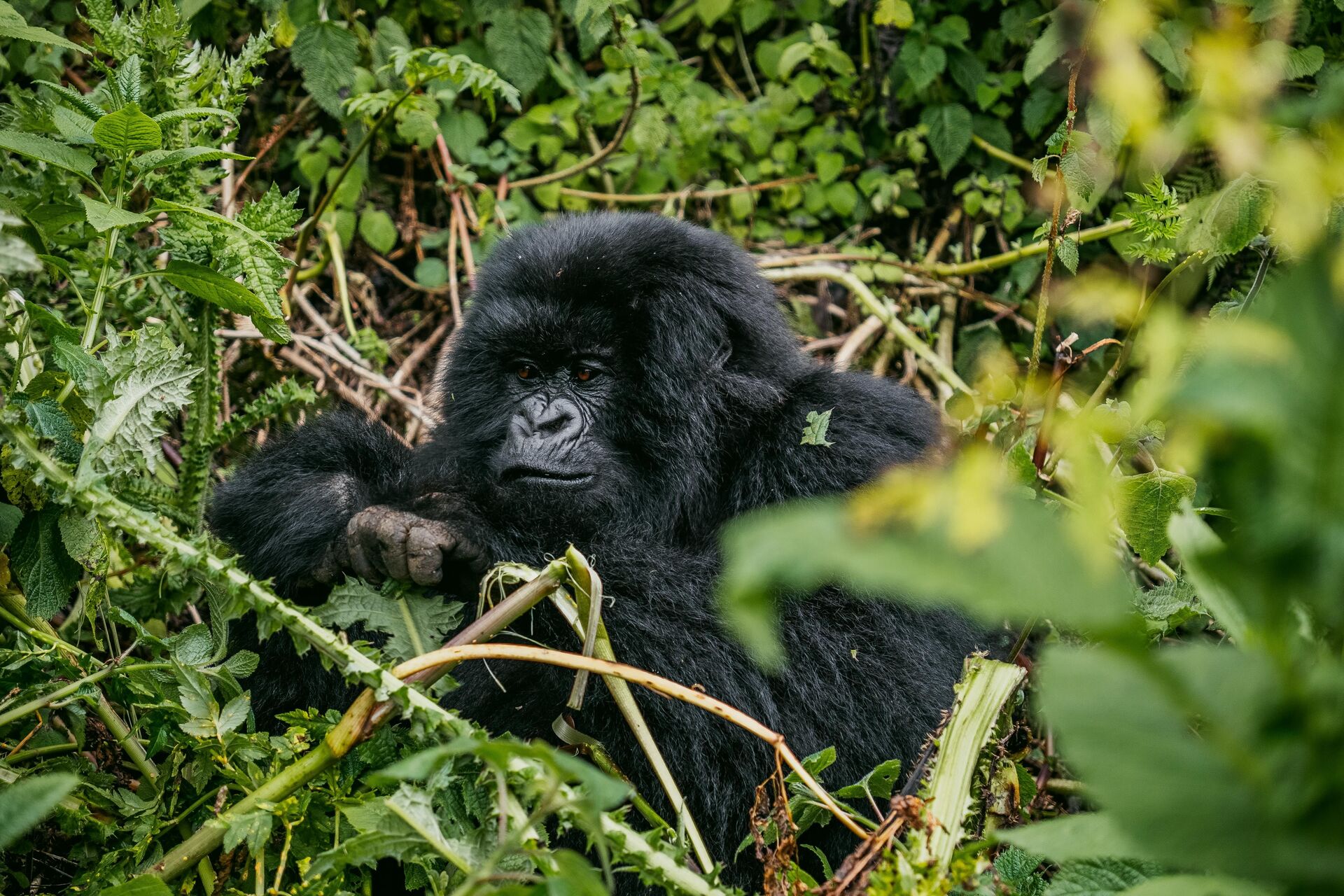
Gorilla of Congo
Independence Day: 15 August 1960. In 1944, Charles de Gaulle convened a conference in Brazzaville that explicitly ruled out independence for France's African colonies. Sixteen years later the Congo took it anyway. One man has since held power for forty-two of its sixty-six years.
There are two, they share a river and a name, and almost every article about either of them causes confusion.
This one — the Republic of the Congo, Congo-Brazzaville — was French. It has about six million people. Its capital, Brazzaville, sits on the north bank.
The other one — the Democratic Republic of the Congo, Congo-Kinshasa, formerly Zaire — was Belgian. It has around a hundred million people, and appears on this website under D.
The two capitals face each other across the water. They are the closest pair of capital cities in the world after Rome and the Vatican. You can see one from the other.
They were colonised by different empires, and they became independent seven weeks apart in 1960.
Here is the fact that ought to lead every account of this country and never does.
In June 1940 France surrendered to Germany. The Vichy regime took the metropole. Charles de Gaulle, in London, had a movement and no territory.
Then in August 1940 French Equatorial Africa declared for the Free French, and de Gaulle had a capital.
From 1940 to 1943, Brazzaville was the capital of Free France.
Not a colonial administrative centre. The seat of the government that claimed to be France. Radio Brazzaville broadcast against Vichy and the Germans across Africa and into Europe. De Gaulle governed from here.
And African soldiers from these territories fought for that France, in North Africa, in Italy, in the liberation of the metropole itself.
Gorilla of Congo
In January and February 1944, with the war turning, de Gaulle convened a conference of French colonial governors in Brazzaville to decide what the empire would look like afterwards.
Not one African was a full participant.
The conference agreed to reforms that were real: the eventual abolition of forced labour, the abolition of the indigénat — the separate legal code applied to colonial subjects — some African representation in a future French assembly, and improvements to education and health.
And it stated, in the recommendation that defined the whole thing, that the purposes of France's work in the colonies excluded any idea of autonomy and any possibility of development outside the French bloc, and that the eventual constitution of self-government in the colonies, even in a distant future, was to be set aside.
Read that once more, and note where it was said.
n the city that had been the capital of France when France did not exist, French officials met and formally ruled out African independence — after Africans had spent four years helping to save the country that ruled them.Sixteen years later the Congo was independent anyway.
Middle Congo was one of the four territories of French Equatorial Africa, and like Oubangui-Chari next door it was leased in large part to concession companies — private firms granted near-total rights over land and people, extracting rubber and ivory through forced quotas, hostage-taking and violence.
André Gide travelled through here and published Voyage au Congo in 1927. The scandal it caused reached Paris and changed some practices.
And then there was the railway.
The Congo–Ocean railway, built between 1921 and 1934 to connect Brazzaville to the Atlantic at Pointe-Noire, was constructed with conscripted labour drawn from across French Equatorial Africa. Men were rounded up in villages and marched to the line.
The commonly cited death toll is around 17,000, and higher figures are argued for. Malaria, dysentery, exhaustion, beatings, accidents.
It was one of the deadliest colonial construction projects anywhere, it was contemporaneous with the Brazzaville that would soon call itself the capital of free France, and it is not taught in French schools.
The Congo became independent under Fulbert Youlou — a Catholic priest.
He had been suspended by his Church for entering politics, and he continued to wear a white cassock in office, which became his trademark.
The parallel with Barthélemy Boganda next door in the Central African Republic is exact: two priests, two neighbouring French territories, two men who came out of the Church because it was one of the only routes to education and a public voice.
Youlou moved quickly toward personal rule. He squeezed out the opposition parties, cracked down on the trade unions and the youth movement — both of which he denounced as communist — and in 1962 proposed to make the Congo a one-party state under his own party.
Brazzaville, as the former capital of French Equatorial Africa, had something most African capitals did not: a large, organised, politically confident urban working class, with real trade unions.
They objected.
Between 13 and 15 August 1963 — the third anniversary of independence — the trade unions, the Congolese Youth Union and the army combined, and three days of mass demonstrations brought the government down.
Youlou resigned. He later escaped to Europe and died in Madrid in 1972.
The Congolese named those days Les Trois Glorieuses, after the three days of the French revolution of 1830.
That is the shape of this country's politics in one phrase: an African popular uprising against a French-backed president, named after a French revolution, in a city that had been the capital of France.
Alphonse Massamba-Débat took over, and the Congo turned sharply left — adopting what it called scientific socialism and building relationships with the Soviet Union, China, Cuba, North Korea and North Vietnam.
It also became a sanctuary. Supporters of Patrice Lumumba who fled the killing across the river found refuge here, and Brazzaville became a rear base for liberation movements operating elsewhere in the region.
In 1966 a coup attempt was put down with the help of several hundred Cuban military personnel who were already in the country training militias.
In August 1968, another coup succeeded.
Marien Ngouabi was born on 31 December 1938 in a poor Kuyu family in the north, trained at Saint-Cyr — the French military academy — and took the presidency at the start of 1969.
On 31 December 1969 he renamed the country the People's Republic of the Congo, and the ruling party became the Congolese Party of Labour.
It was the first avowedly Marxist-Leninist state in Africa.
Ngouabi was a northerner, and his government shifted power away from the southern regions where the population, the unions and the political tradition were concentrated. That north–south division — created and hardened under colonial administration, which recruited and educated unevenly — is the fault line that runs through everything that follows on this page.
Opposition grew in Brazzaville and the southern towns. He survived a coup attempt in 1972.
A sitting head of state, a cardinal and a former head of state, killed within nine days of each other.
The official version held Massamba-Débat responsible. Nobody in the Congo has ever fully accepted it, and the killings have never been independently investigated.
Colonel Joachim Yhombi-Opango took over, and was removed after two years.
On 8 February 1979, the party installed Colonel Denis Sassou Nguesso.
He has governed the Republic of the Congo for forty-two of its sixty-six years of independence, in two stretches.
1979 to 1992, as head of a one-party Marxist-Leninist state.
Then, in 1991, the Congo did what Benin had done the year before: it convened a national conference which declared itself sovereign, stripped the president of his powers, and set up a transition. Benin's model spread, and this was one of the places it worked.
Multi-party elections followed in 1992. Pascal Lissouba won. Sassou Nguesso came third and accepted it.
For a moment, this was a success story.
It lasted five years.
Congolese politics fragmented into three camps, each with its own private militia, each drawn from a different regional base.
Sassou Nguesso had the Cobras. Pascal Lissouba had the Cocoyes, also called Zulus. Bernard Kolélas, mayor of Brazzaville, had the Ninjas.
A first round of fighting ran from 1993 into 1994.
Then on 5 June 1997, with an election approaching, government forces surrounded Sassou Nguesso's compound in Brazzaville to arrest him. His Cobras fought back.
The war that followed destroyed much of Brazzaville. It ended on 15 October 1997, when Sassou Nguesso took the capital — decisively assisted by the Angolan army, which crossed the border on his side.
He has been president ever since.
Estimates of the dead in 1997 run from four thousand to ten thousand. The fighting that resumed in 1998 and 1999, particularly in the Pool region south of Brazzaville, was worse, and displaced several hundred thousand people. No reliable total exists for the whole period.
And then the single episode that has followed him ever since.
In May 1999, with the war winding down, Sassou Nguesso called on Congolese who had fled across the river to Kinshasa to come home. The Congo, the DRC and the UN refugee agency signed a repatriation agreement.
Between 5 and 14 May 1999, refugees crossed back and landed at Brazzaville's river port — known simply as the Beach.
At the Beach they were screened. Women to one side, men to the other. The men were searched.
At least 353 of them were never seen again.
The authorities were hunting Ninja fighters from Kolélas's militia, and the returning men came largely from the districts where the Ninjas had been based.
A parliamentary inquiry was launched in 2002 under pressure from the families. A trial opened in Brazzaville in 2005 with fifteen defendants, most of them serving officers.
All fifteen were acquitted in August 2005.
The court did order the state to compensate the relatives of 86 of the 353 — about fifteen thousand euros for each.
Separately, human rights organisations brought a case in France, at Meaux, alleging crimes against humanity, disappearances and torture, naming the president and senior officials. The Congolese government went to the International Court of Justice to try to stop the French proceedings, arguing sovereign equality and head-of-state immunity.
Marcel Touanga, whose son was among the missing, has led the families' association for a quarter of a century.
Nobody has been convicted.
The Congo is the fourth-largest oil producer in sub-Saharan Africa and a member of OPEC.
It is also heavily indebted, has repeatedly restructured, and has accumulated an estimated 3.2 billion dollars in debt to China, much of it against oil and timber.
Most Congolese are poor. The oil revenue is controlled from the centre, and the regime's method — described plainly in the comparative literature — has been to combine access to that revenue with military coercion: buying off moderate opponents, absorbing former enemies, and dealing with the rest by force.
In 2012 an arms depot explosion in Brazzaville killed at least three hundred people. Colonel Marcel Ntsourou, a former close ally who had turned against the government over corruption, was blamed without evidence; when the authorities came to arrest him in late 2013 there was a firefight in the capital.
In France, a long-running investigation into biens mal acquis — assets allegedly acquired with misappropriated public funds by African ruling families, including the Sassou family — produced a dismissal in the president's own case in 2007. Proceedings concerning other family members have continued.
A 2015 constitutional referendum removed the age limit and extended term limits, clearing the way for Sassou Nguesso to keep standing.
He won in 2016. He won again on 21 March 2021 with an officially reported 88.4 per cent.
In June 2025 the Ministry of the Interior suspended fifteen opposition parties, several of which had been preparing to form a coalition to contest the coming election.
On 5 February 2026 he announced his candidacy. On 15 March 2026 the election was held, with six other candidates, none with significant organisation or funding.
Sassou Nguesso said publicly during the campaign that his only real opponent was the turnout figure.
He was eighty-two.
Because of the symmetry, and because nobody points at it.
An African city sheltered the French state when the French state had been defeated. Africans from these territories fought and died for that France. And in that same city, at the moment of victory, French officials wrote down that independence for the colonies was to be excluded even in the distant future.
The Congo became independent anyway, sixteen years later, on the anniversary of the liberation of southern France.
And then it spent sixty-six years demonstrating that a flag settles very little: a priest turned authoritarian, removed by his own unions in three days; a Marxist-Leninist republic, the first in Africa; a president, a cardinal and a former president killed inside nine days in March 1977; a genuine democratic opening in 1992; a war fought by three private militias with a foreign army deciding it; 353 people who walked off a boat and were never seen again; and one man in power for forty-two years.
Brazzaville was the capital of France. Its own country has been ruled by one man for two-thirds of its independent life.
The 1992 election was real, and Sassou Nguesso lost it and accepted the result. That is worth saying, because it is rare, and because it means what came in 1997 was not inevitable.
The war that followed was not started by one side alone. Lissouba's government sent troops to arrest a former president; Sassou Nguesso had already built a private army for exactly that moment. Kolélas's Ninjas committed atrocities of their own, and their leader was sentenced to death in absentia in 2000 on charges including kidnapping and rape — before being amnestied in 2005 and returning to the country.
Every one of the three militias killed civilians. Every one of the three leaders was Congolese.
Angola decided the outcome, and Angola was pursuing its own war — Luanda wanted a Brazzaville government that would not shelter UNITA supply routes. The Congolese did the fighting; the result was determined next door.
And the deepest structural fact — a north–south divide, sharpened by a colonial administration that educated and recruited unevenly, and inherited whole by every government since — is French in origin and Congolese in operation.
Both halves. Always.
There is a radio transmitter site in Brazzaville that once broadcast the voice of the French resistance across a continent.
There is a railway to the Atlantic, and a death toll from building it that nobody in France was ever asked to account for.
There is a recommendation, written in Brazzaville in 1944, that African self-government be set aside even in a distant future.
There is a river port called the Beach, where at least 353 men were screened and disappeared, and fifteen acquittals.
There are graves in March 1977 — a president, a cardinal, a former president — and no inquiry.
And there is a man of eighty-two who was appointed head of state in February 1979, when Jimmy Carter was in the White House and Leonid Brezhnev in the Kremlin, and who stood for re-election in March 2026.
Updated and fact-checked: 10 September 2026.
How this page was checked. Dates and events were verified against the sources listed above. The role of Brazzaville as the capital of Free France from 1940 to 1943, the Brazzaville Conference of January–February 1944 and its exclusion of self-government, the construction of the Congo–Ocean railway with conscripted labour, independence on 15 August 1960 under Fulbert Youlou, the Trois Glorieuses of 13–15 August 1963, Alphonse Massamba-Débat's presidency and the adoption of scientific socialism, the Cuban assistance in defeating the 1966 coup attempt, the 1968 coup and Marien Ngouabi's presidency, the proclamation of the People's Republic of the Congo on 31 December 1969, the assassination of Ngouabi in March 1977, the murder of Cardinal Émile Biayenda and the execution of Massamba-Débat in the same month, the installation of Denis Sassou Nguesso on 8 February 1979, the 1991 national conference, Pascal Lissouba's election in 1992, the civil war of 5 June to 15 October 1997 and the decisive Angolan intervention, the disappearance of at least 353 returning refugees at the Beach between 5 and 14 May 1999, the acquittal of all fifteen defendants in August 2005 with compensation ordered for the relatives of 86 victims, the 2015 constitutional referendum, the 2021 election result of 88.4 per cent, the suspension of fifteen opposition parties in June 2025 and the presidential election held on 15 March 2026 are as recorded. Where sources differ the disagreement is stated: Ngouabi's assassination is dated to both 16 and 18 March 1977; the death toll of the Congo–Ocean railway is commonly given as around 17,000 but higher figures are argued for; casualty estimates for the 1997 war range from four thousand to ten thousand and no reliable total exists for the whole 1993–1999 period. The official result of the March 2026 presidential election is not stated on this page and should be verified independently. No individual has been convicted in connection with the Beach disappearances; the French proceedings and the dismissal in 2007 of the case concerning the president in the biens mal acquis investigation are recorded as matters of public record. This page makes no allegation against any living person.
Written and researched by Remo Kurka · africanindependence.com
We strive to unify diverse narratives from across Africa, showcasing the continent's shared heritage and unique stories.
Our mission is to honor and preserve the history of African cultures and independence movements for future generations.
We provide a platform for innovative exchange of ideas, resources, and insights, understanding that knowledge should be accessible to all.