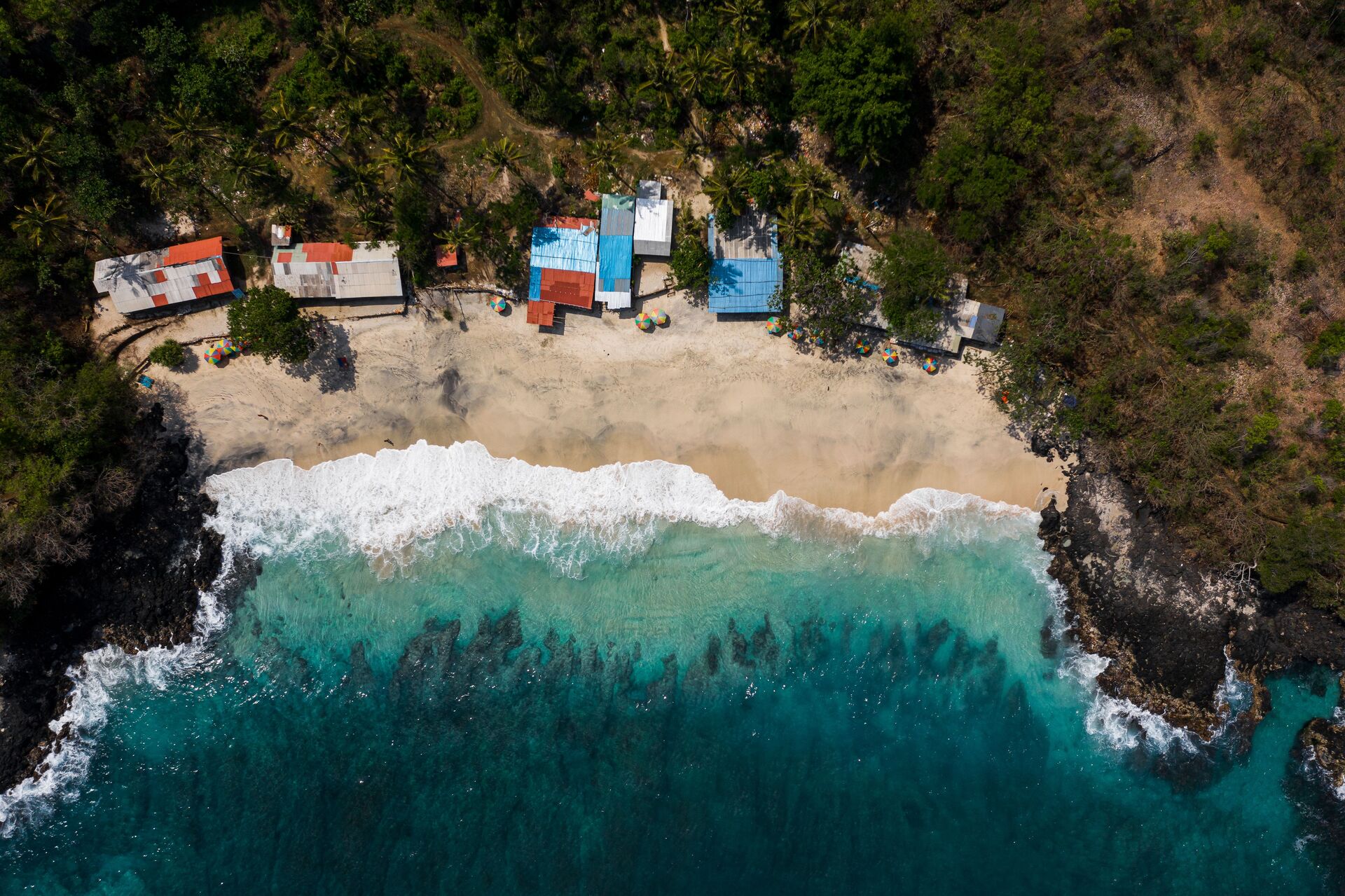
Landscapes of Comoros, beach and houses
Independence Day: 6 July 1975. Four islands voted on independence. The result was overwhelming. France counted them one by one anyway, and kept the fourth — which is why people now drown trying to travel between two islands of the same archipelago.
The Comoros are four main islands in the Mozambique Channel, between Mozambique and Madagascar: Grande Comore, Anjouan, Mohéli and Mayotte.
They share a language — Shikomori, a Bantu language with heavy Arabic borrowing — a religion, a history of Swahili-coast trade, sultanates that fought and married each other for centuries, and a population that has moved between the islands for as long as anyone has lived on them.
Families are spread across all four. They always have been.
Hold that, because it is the entire point of this page.
France did not take the archipelago at once. It took Mayotte first, in 1841, when a sultan who had seized the island and could not hold it ceded it in exchange for a pension and protection.
The other three followed piecemeal, and by 1912 the whole archipelago was a French colony, administered from Madagascar until 1946.
Colonial development was minimal. The islands produced ylang-ylang, vanilla and cloves for export, on plantations that took a large share of the land, and educated almost nobody. What France did build, it built mostly on Mayotte.
That detail matters later.
France held a referendum on independence across the archipelago.
The result, taken as a whole, was overwhelming: around 95 per cent for independence.
But the vote broke down differently on Mayotte, where 63.8 per cent voted against.
Mayotte's reasons were its own and they were real: it had been French longest, it was the poorest and most neglected of the four, it had a Catholic-influenced elite, and it feared domination by Anjouan — the island whose sultans had raided it historically and whose people were the largest group of incomers.
Here is where the argument begins, and it has never ended.
The Comorian position is that the archipelago was a single colonial territory, that the referendum was a single act of self-determination, and that a territory decolonises as a whole — the principle applied everywhere else in Africa, including where regions had voted differently.
The French position was that each island should decide separately.
The French National Assembly took the second view.
So on 6 July 1975, the Comorian parliament stopped waiting and passed a unilateral resolution declaring the whole archipelago independent. Ahmed Abdallah proclaimed it. The deputies from Mayotte abstained.The United Nations admitted the Comoros with all four islands as its territory, and has passed resolutions repeatedly since affirming Comorian sovereignty over Mayotte.
France recognised three.
Landscapes of Comoros, beach and houses
Independence lasted a month before somebody bought a coup.
On 3 August 1975, Ahmed Abdallah was overthrown by a group around Said Mohamed Jaffar and Ali Soilih.
Their supporters were barely armed. So they hired a Frenchman.
Bob Denard — real name Gilbert Bourgeaud, a former French naval commando, veteran of Indochina, Katanga, Yemen, Nigeria and Benin — arrived with a small team and took the country in hours.
He would return three more times.
In January 1976 power passed to Ali Soilih, and what followed was one of the strangest revolutionary experiments in African history.
Soilih was a genuine radical, and a young one. He set out to demolish the entire social order at once: the sultanate traditions, the authority of religious notables, the elaborate and ruinously expensive customary marriage system, and the bureaucracy.
He lowered the voting age to fourteen and built the revolution on adolescents, organised into a youth militia.
He is reported to have burned the state archives in Moroni — the colonial records, the land registers, the civil registry — on the reasoning that a new country should not be governed by the paperwork of the old one.
He was firmly anti-French, and France responded by withdrawing all development and technical aid.
Within two years the state had ceased to function, the economy had collapsed, and he had alienated almost every constituency on the islands including the religious establishment, which in the Comoros is not a marginal thing to do.
Denard came back — this time hired by the man he had removed in 1975.
The coup was financed by Ahmed Abdallah and Mohamed Ahmed from exile in Paris. Denard landed at dawn with a small force. Five people died.
Ali Soilih was captured, and killed thirteen days later, on 29 May 1978. The official account was that he was shot while trying to escape. He was forty.
Abdallah returned from Paris and resumed the presidency.
And then Denard stayed.
From 1978 to 1989 he was commander of the Presidential Guard — a force of some five hundred men that was the only effective armed body in the country, answerable to him.
He converted to Islam, took the name Said Mustapha M'hadju, married locally, and settled in.
He was, in every practical sense, the ruler of the Comoros. Abdallah was the president; Denard controlled the guns.
And he became the country's largest single landowner, taking the best land and developing it into resorts for Western tourists.
Now the part that connects this to the rest of the continent.
South Africa also used the Comoros to break sanctions.
Abdallah, meanwhile, established a one-party state. Opponents were imprisoned, exiled, or disappeared. He was re-elected in 1984 as the only permitted candidate.
Ahmed Abdallah, aged seventy, was shot dead in his own office in Moroni.
He had been trying to dismiss Denard as commander of the Presidential Guard.
The circumstances are disputed to this day. It is generally believed that Denard had him killed. Denard's own account, given at his trial in Paris in 1999, blamed others.
He was acquitted for lack of evidence. The judge found the prosecution case circumstantial.
So: a French mercenary spent eleven years running the army of an independent African country, was accused of murdering its president, was tried in Paris, and walked out.
After Abdallah's death France finally pushed Denard out, and he was deported to South Africa.
He came back in September 1995, with thirty-three men, and overthrew President Said Mohamed Djohar.
By then he was an embarrassment to Paris rather than an instrument of it. France launched Operation Azalée, landed troops, and forced his surrender within days.
That was his fourth coup in the Comoros in twenty years.
He died in France in 2007, having been convicted in other cases but never for anything in the Comoros.
In August 1997, Anjouan and Mohéli declared independence from the Comoros.
Anjouan then did something that ought to be better known.
It asked to be taken back by France.
The secessionists flew the French tricolour and formally requested re-attachment. Their reasoning was straightforward and desperate: Mayotte, the fourth island, had stayed French and was visibly, dramatically better off. Anjouan wanted the same deal.
France refused.
Government troops sent to retake the island were defeated. The crisis ran for years, was mediated by the OAU and then the African Union, and produced the 2001 constitution creating the Union of the Comoros, with wide island autonomy and a presidency rotating between the three islands.
In 2008, when an Anjouan leader refused to leave after a disputed election, African Union and Comorian troops landed and removed him — one of the very few occasions on which the AU has used force successfully.
By one count the Comoros has had more than twenty coups and coup attempts since 1975. It is sometimes called, in the regional press, the coup-coup islands.
Azali Assoumani, the army chief of staff, seized power in a coup on 30 April 1999. He then negotiated the Fomboni accords that produced the rotating presidency, stood down, was elected president in 2002, and left office in 2006 when the rotation moved on.
For a while that looked like a country finding its footing. Presidents came and went. The 2011 handover was judged free and fair.
Azali returned to the presidency in 2016 when the rotation came back to Grande Comore. And then he began dismantling the arrangement.
A 2018 referendum, boycotted by the opposition, ended the rotation and allowed him to run again. He won in 2019 and again in January 2024, in an election marked by fraud allegations and post-election violence in Moroni.
In August 2024 he granted extensive powers to his son, Nour El Fath, widely regarded as his intended successor.
On 13 September 2024 Azali was stabbed at a funeral outside Moroni and slightly injured. The man arrested, a twenty-four-year-old soldier, was found dead in his prison cell the following day.
In January 2025 the ruling party took 28 of 33 parliamentary seats.
Now the consequence of 1974, which is the reason this page exists.
Mayotte voted again in 2009 and became, in 2011, France's 101st département — full French territory, and an outermost region of the European Union.
It is seventy kilometres from Anjouan.
The two islands share a language, a religion, and a great many families.
And in 1995, French Prime Minister Édouard Balladur introduced a visa requirement for Comorians entering Mayotte. Before that, movement within the archipelago had been free.
Overnight, travelling between two islands of the same archipelago became illegal.
People went anyway, in small open fishing boats called kwassa kwassa, at night, across one of the busiest shipping channels in the Indian Ocean.
They have been drowning ever since.
Mayotte is simultaneously the poorest department in France and vastly richer than the country next door. It has severe water shortages, overcrowded schools, and a large undocumented population from the other islands. In December 2024 it was devastated by Cyclone Chido, the worst storm to hit it in ninety years, which destroyed much of the informal housing where most Comorian migrants live.
France has repeatedly tightened immigration enforcement there. The Comoros has repeatedly refused to accept deportees, on the grounds that they cannot be deported from their own country.
Because the Comoros is the one place where you can see the mechanism with no covering.
Everywhere else on this website, foreign control after independence is exercised through advisers, treaties, currencies, mining concessions or an army that happens to have been trained abroad. Here it was a Frenchman with five hundred armed men who lived in the country, controlled the only force in it, took the best land, sold access to apartheid South Africa, and was suspected of shooting the president in his office.
Eleven years. In a sovereign state. In the United Nations.
And because Mayotte shows what a decolonisation looks like when the coloniser gets to choose the unit of counting. Nigeria was not partitioned because the north voted differently. Ghana was not partitioned. But an archipelago of four islands was, and the piece that stayed is now in the European Union, and the people on the other three drown trying to reach it.
Not everything here was done to the Comorians.
Comorians hired Denard. Soilih and Jaffar brought him in to take power in 1975. Abdallah and Mohamed Ahmed paid for him to come back in 1978. He was not imposed; he was contracted, repeatedly, by Comorian politicians who wanted power more than they wanted a country that governed itself.
Ali Soilih's revolution destroyed a great deal that did not need destroying, and his own countrymen turned against it.
Abdallah built a one-party state and kept Denard because Denard kept him in office.
Azali took power by coup, dismantled the power-sharing arrangement that had ended a secession crisis, and is preparing to hand the country to his son.
And Mayotte's voters were not tricked. In 1974 and again in 2009 they said, clearly and repeatedly, that they wanted to stay with France — and the reasons a very poor island might prefer a rich metropole to a neighbour with twenty coups are not difficult to understand.
Two things are true at once. France should not have counted island by island when it counted the whole territory everywhere else. And Mayotte's people have voted the same way for fifty years, and their view is theirs.
That is the hardest sentence on this page, and it is why the dispute has no clean answer.
There is a national flag with four white stars, one for each island — including the one that is in the European Union.
There is a UN General Assembly that has affirmed Comorian sovereignty over Mayotte many times, and a France that does not act on it.
There is a stretch of sea seventy kilometres wide that people cross in open boats at night, and a number of dead nobody can state.
There is a French mercenary's grave in France, and an acquittal.
There was, for eleven years, an apartheid listening station on an African island, paid for with land.
And there is a country of around 850,000 people, with more than twenty coups behind it, currently governed by a man who seized power in 1999, removed the rotation that was meant to prevent men like him, and is now positioning his son.
Updated and fact-checked: 10 September 2026.
How this page was checked. Dates and events were verified against the sources listed above. The French acquisition of Mayotte in 1841 and of the remaining islands by 1912, the referendum of 22 December 1974 with Mayotte voting 63.8 per cent against independence, the unilateral declaration of independence by the Comorian parliament on 6 July 1975 with Mayotte's deputies abstaining, the coup of 3 August 1975, the second Mayotte referendum of February 1976, Ali Soilih's assumption of power in January 1976, the coup of 13 May 1978 led by Bob Denard and financed by Ahmed Abdallah, Soilih's death thirteen days later, Denard's command of the Presidential Guard from 1978 to 1989 and its funding by South Africa and Rhodesia in exchange for a listening station, the assassination of Ahmed Abdallah on 26 November 1989, Denard's fourth coup in September 1995 and French Operation Azalée, the introduction of the Balladur visa in 1995, the secession of Anjouan and Mohéli in August 1997 and Anjouan's request for re-attachment to France, Azali Assoumani's coup of 30 April 1999, the 2001 constitution and rotating presidency, the African Union intervention on Anjouan in 2008, Mayotte's departmentalisation in 2011, the 2018 referendum, the January 2024 election, the stabbing of 13 September 2024 and the January 2025 parliamentary elections are as recorded. Bob Denard was tried in Paris in 1999 in connection with the death of Ahmed Abdallah and was acquitted for lack of evidence; responsibility for that killing remains disputed and nothing on this page should be read as a finding against him or anyone else. The number of deaths in the Mozambique Channel between Anjouan and Mayotte is not established: published estimates range from several thousand to figures in the tens of thousands over three decades, and no reliable count exists. Figures for the number of Comorian coups and coup attempts vary between sources and are commonly given as more than twenty. This page records both the Comorian and the French positions on Mayotte, and the repeated votes of Mayotte's own population, without adjudicating between them. This page makes no allegation against any living person.
Written and researched by Remo Kurka · africanindependence.com
We strive to unify diverse narratives from across Africa, showcasing the continent's shared heritage and unique stories.
Our mission is to honor and preserve the history of African cultures and independence movements for future generations.
We provide a platform for innovative exchange of ideas, resources, and insights, understanding that knowledge should be accessible to all.