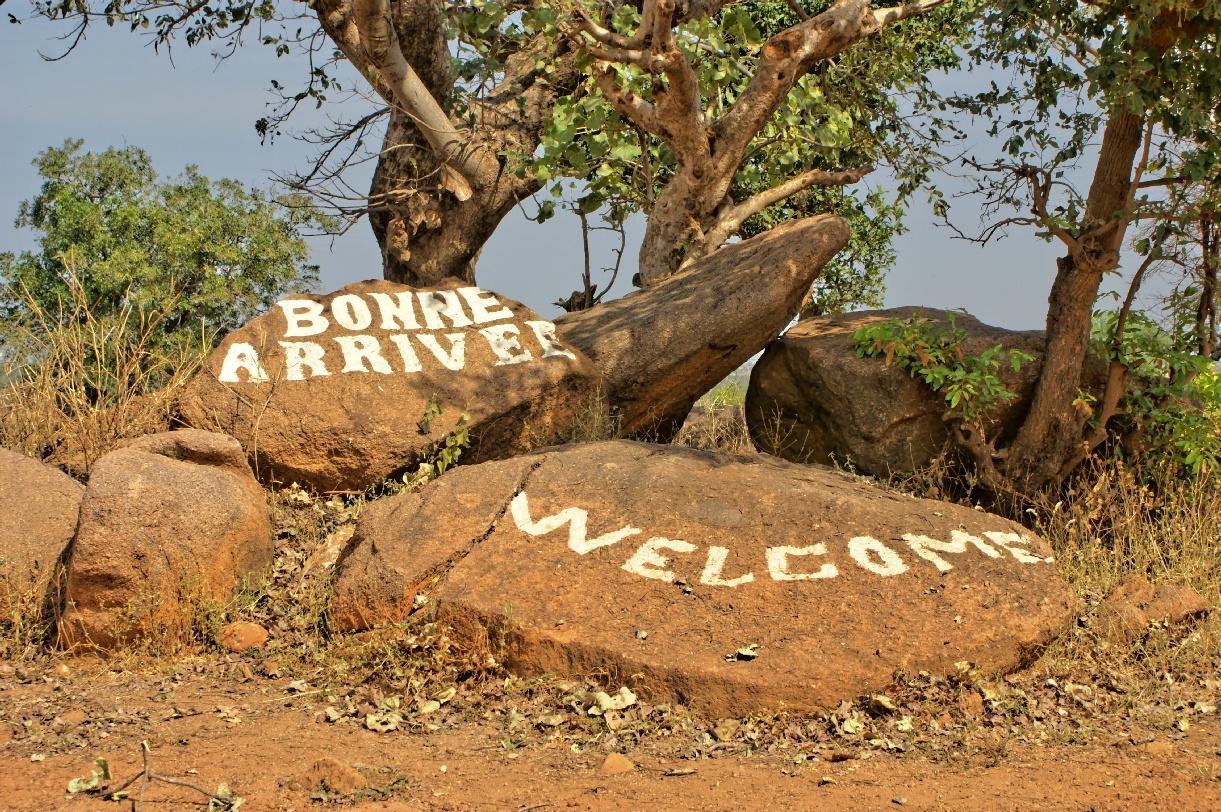
Burkina Faso
Independence Day: 5 August 1960. Eight coups in sixty-six years, a president murdered by his best friend, and a country that renamed itself after integrity while most of its territory slipped out of government control.
France called it Haute-Volta — Upper Volta — after a river. A hydrological label for a territory, chosen by people who did not live there.
On 4 August 1984, one year after taking power, Thomas Sankara renamed it. Burkina Faso is stitched together from two of the country's own languages: burkina from Mooré, meaning upright or men of integrity, and faso from Dioula, meaning fatherland. Citizens became Burkinabè, the ending taken from Fulfulde.
Three languages in one name, deliberately, so that no single group could claim it.
That act tells you what the revolution was about, and it is also why the name now sits uneasily on the country. A nation called the land of upright people has spent most of its independence being governed by whoever last took the presidential palace.
Upper Volta was not a colony France invested in. It was a labour reserve.
Its principal export under French rule was people — men recruited, often under compulsion, to work the plantations of Côte d'Ivoire. The colony was actually dissolved in 1932 and its territory divided among neighbours, largely to make that labour supply easier to administer, before being reconstituted in 1947.
Read that again. France abolished the country for fifteen years for administrative convenience.
Burkina Faso
Read that again. France abolished the country for fifteen years for administrative convenience.
What was handed over in 1960 was landlocked, drought-prone, almost without infrastructure, and among the poorest territories on earth. The pattern of young Burkinabè leaving to work in Côte d'Ivoire did not end with independence; it remains one of the defining facts of the country's economy and, in the 2020s, of its politics.
Upper Volta became independent with Maurice Yaméogo as its first president.
Within five years he had banned opposition parties, entrenched single-party rule, and become known for a lavish personal style in a country with almost nothing. An austerity programme in late 1965 broke the public's patience.
What happened next set the template for everything since.
In January 1966 a general strike and mass demonstrations by workers, teachers, students and civil servants forced Yaméogo out. He resigned on 4 January. And the army stepped into the space the street had created, installing the army chief of staff, Sangoulé Lamizana, as head of state.
The people removed the government. The soldiers took the government.
That has now happened, in one form or another, in 1966, 1980, 1982, 1983, 1987, 2014–15, January 2022 and September 2022.
Lamizana ruled for fourteen years, through alternating military and civilian arrangements, until strikes brought him down in November 1980 and Colonel Saye Zerbo took over. Zerbo lasted two years before junior officers removed him in November 1982 and installed Major Jean-Baptiste Ouédraogo.
Inside that government were young radical officers. One of them was a captain named Thomas Sankara.
Sankara was appointed prime minister in January 1983 and arrested in May. The effort to free him, organised by his friend Blaise Compaoré, produced a coup on 4 August 1983 that made Sankara president. He was thirty-three.
What followed was four years unlike anything else in the history of the continent.
Sankara's government vaccinated some two and a half million children against meningitis, yellow fever and measles in a matter of weeks — a campaign the World Health Organization held up as a model. It ran mass literacy drives. It planted millions of trees against the advancing Sahel. It built railways with volunteer labour when foreign financing was refused. It redistributed land from traditional chiefs to peasant farmers.
And it did something almost no African government of that era did: it went after the position of women as a matter of policy. Sankara banned forced marriage and polygamy, campaigned openly against female genital mutilation, appointed women to senior government posts, and put them in the army. He described the emancipation of women as a requirement of the revolution rather than a favour to it.
He refused a chauffeur-driven Mercedes and had ministers use small Renaults. He cut his own salary. He sold off the government fleet.
And in July 1987, at the OAU summit in Addis Ababa, he told African heads of state that their countries should collectively refuse to pay debts contracted by colonial administrations and corrupt predecessors — and that whoever spoke alone would be killed for it.
He was assassinated three months later.
This site does not print monuments, and Sankara's four years were not only vaccination campaigns.
His government banned trade unions and the free press, both of which had been genuinely strong in Upper Volta. It set up Revolutionary Committees — neighbourhood bodies that carried out real social work and also functioned as instruments of surveillance and score-settling. It ran People's Revolutionary Tribunals that tried opponents outside ordinary courts. Teachers who struck in 1984 were dismissed in their thousands. Traditional chiefs were stripped of authority in ways that alienated much of the countryside.
Sankara himself acknowledged toward the end that the revolution had made enemies it did not need to make.
He was a genuine revolutionary who improved millions of lives at speed, and he governed without elections, without a free press and without courts that could check him. Both statements are true, and a page that prints only the first is doing propaganda.
Sankara was killed at a meeting in Ouagadougou, along with twelve others, in a coup organised by Blaise Compaoré — his closest friend, his comrade from 1982 and 1983, the man who had freed him from arrest four years earlier.
He was thirty-seven. His body was buried hurriedly in an unmarked grave.
Compaoré's government announced that Sankara had died of natural causes.
Henri Zongo and Jean-Baptiste Lingani, the other two leading figures of the revolution, were executed for alleged treason in 1989.
Compaoré ruled from October 1987 until October 2014 — the longest presidency in the country's history.
He dismantled the revolution, opened the economy to the international financial institutions, adopted a multi-party constitution in 1991 and won every election held under it. He became the West that had been nervous of Sankara's most reliable regional partner, and a mediator in other people's conflicts — while his own role in the wars of Liberia and Sierra Leone drew persistent and serious allegations.
In December 1998 the investigative journalist Norbert Zongo, who had been looking into the death of a driver employed by the president's brother, was found burned in his car with three companions. The killing produced the largest protests Burkina Faso had seen and became the country's defining scandal for a generation.
By 2014 Compaoré wanted to change the constitution again to extend his rule.
On 30 October 2014, crowds marched on the National Assembly in Ouagadougou and set it on fire.
Compaoré fled to Côte d'Ivoire, where he still lives and whose citizenship he took in 2016.
The uprising was a genuinely popular, largely civilian achievement — and within hours the army had again claimed the transition, in the pattern of 1966. A civilian-led transitional government was eventually negotiated, and then in September 2015 Compaoré's old Presidential Security Regiment attempted a coup against it. That one was defeated by the streets and by loyal army units, and the RSP was dissolved.
Roch Marc Christian Kaboré was elected president in November 2015. It was the most genuinely democratic moment in the country's history.
It coincided almost exactly with the beginning of the war.
The Islamist insurgency in Burkina Faso is generally dated from 23 August 2015. It arrived from Mali, where the collapse of the north in 2012 — itself a consequence of the NATO intervention in Libya and the weapons that flowed south from it — had created a jihadist theatre that would not stay inside one border.
Groups affiliated to al-Qaeda, principally the coalition known as JNIM, and to the Islamic State in the Sahel, moved into the north and east. Kaboré's government could not stop them. By 2021 large areas of the country were beyond state control, massacres of civilians were routine, and the displacement crisis had become one of the largest in the world and one of the least reported.
In November 2021 an attack on a gendarmerie post at Inata, where soldiers had gone unfed for weeks, broke the army's patience with the government.
On 24 January 2022, Lieutenant-Colonel Paul-Henri Sandaogo Damiba removed Kaboré, citing the failure to contain the insurgency.
On 30 September 2022, Captain Ibrahim Traoré removed Damiba, citing the same failure. He was thirty-four.
Between those two coups, in April 2022, a Burkinabè military court convicted Blaise Compaoré in absentia of complicity in the murder of Thomas Sankara and sentenced him to life imprisonment. Thirty-five years after the killing, and only once the soldiers were back in power.
Compaoré remains in Côte d'Ivoire.
Traoré's government has made Thomas Sankara its central symbol. Streets have been renamed for him. He has been declared a Hero of the Nation. A mausoleum and memorial have been built at the site where he was killed. In April 2025 the government formally declared a Progressive and Popular Revolution, explicitly invoking the language of 1983.
Traoré has called the CFA franc a mechanism that keeps Africa in bondage and announced the intention to leave it. Burkina Faso, together with Mali and Niger, completed its withdrawal from ECOWAS in January 2025 and formed the Alliance of Sahel States. The three governments announced their withdrawal from the International Criminal Court in September 2025. French forces were expelled; ties with Russia, and also China, Iran, Türkiye and North Korea, have deepened. In April 2025 Russia pledged arms and training for a joint AES force.
Among young people across Africa and its diaspora, Traoré is the most popular figure on the continent — a thirty-something captain in fatigues who says publicly what many governments will not.
That popularity is real, it is not manufactured by Moscow, and dismissing it as such is the mistake European commentary keeps making.
And now the part that a site built on refusing picture-postcards has to print.
The war has got worse, not better. Deaths from militant Islamist violence have roughly tripled since Traoré came to power. Eight of the ten deadliest militant attacks on the Burkinabè military have occurred under his command. Government forces are assessed as operating freely in as little as thirty per cent of the national territory; estimates of the area under jihadist control or contest run from forty to eighty per cent. Around 15,500 people have been killed since the September 2022 coup, more than 6,000 of them since the start of 2024.
At Barsalogho in August 2024, JNIM killed some 133 people, many of them civilians who had been digging defensive trenches.
The counter-insurgency has produced atrocities. Tens of thousands of civilians have been recruited into the Volunteers for the Defence of the Homeland, a state-backed militia system. Soldiers and VDP fighters have been credibly reported as carrying out mass killings of civilians, in a war where communities are increasingly targeted on the basis of ethnicity.
Dissent has been closed down. The BBC and Voice of America were suspended in 2024 after reporting on abuses by the security forces. Foreign NGOs have lost their licences. Journalists and critics have been conscripted into the army and sent to the front — a practice with no defence. Political parties have been dissolved outright and their assets transferred to the state. Elections have been postponed indefinitely.
And the country has been divided into categories. Government rhetoric now sorts Burkinabè into patriots and non-patriots. That is not a description of a nation; it is a mechanism for removing people from it.
There have been multiple coup attempts against Traoré. The soldiers' pattern has not been broken; it has been intensified.
The revolution of 1983 and the revolution of 2022 are not the same thing, and the differences matter more than the parallels.
Sankara took a country at peace and spent four years on vaccination, literacy, tree-planting, land reform and the position of women. He was authoritarian, and the authoritarianism was in service of a visible domestic programme that improved measurable things.
Traoré took a country at war and has, so far, delivered a worsening war, dissolved parties, closed media, and an unprecedented level of personal veneration online. The pan-African foreign policy is genuine and it resonates for good reasons. The domestic record does not yet contain a vaccination campaign.
Sankara also had something Traoré does not: he told Africa's leaders that whoever spoke the truth alone would be killed for it, and he was right, and it happened to him.
Time may change the second half of this. It has not changed it yet, and this page will not pretend otherwise while people are being killed at three times the previous rate.
Because Burkina Faso is where the question of what independence was for is being argued out right now, in public, at gunpoint.
The country was a labour reserve, briefly abolished by France for convenience, handed over with nothing, and has been governed by soldiers for most of its existence. It produced, in Thomas Sankara, the most serious attempt anywhere on the continent to make independence mean something concrete — and it killed him, through the hand of his closest friend, thirty-seven years old, and then spent twenty-seven years under the man who did it.
And now it has a young captain who invokes Sankara's name, has finally seen Compaoré convicted, has broken with ECOWAS and the CFA franc and the French garrison — and is losing the war, dissolving the parties and conscripting the journalists.
Both halves of that are the same story, and the story is not finished.
There is a mausoleum in Ouagadougou for a man buried in an unmarked grave in 1987.
There is a conviction, in absentia, against a man living comfortably across the border in Côte d'Ivoire.
There is a National Assembly that was burned down by its own people in 2014 and rebuilt.
There is a name — the land of upright people — chosen in three of the country's own languages by a president who was murdered three years later.
There are around fifteen thousand dead since 2022 in a war most of the world does not report, and a displacement crisis on a scale that would dominate the news if it were happening anywhere else.
And there is a country where, on eight separate occasions, ordinary people have brought down a government and soldiers have collected the result.
Updated and fact-checked: 8 September 2026.
How this page was checked. Dates, casualty ranges and the sequence of events were verified against the sources listed above. Independence on 5 August 1960 under Maurice Yaméogo, his removal in January 1966, the coups of November 1980, November 1982 and 4 August 1983, Thomas Sankara's presidency and the renaming of the country on 4 August 1984, his assassination on 15 October 1987 in a coup led by Blaise Compaoré, the executions of Henri Zongo and Jean-Baptiste Lingani in 1989, the murder of Norbert Zongo in December 1998, the uprising of October 2014, the failed RSP coup of September 2015, the start of the insurgency on 23 August 2015, the coups of 24 January and 30 September 2022, Compaoré's conviction in absentia in April 2022, the completion of the ECOWAS withdrawal and formation of the Alliance of Sahel States, and the declaration of a Progressive and Popular Revolution in April 2025 are as recorded. Casualty and territorial figures are estimates and are given as such: deaths since the September 2022 coup are reported at around 15,500, with more than 6,000 since January 2024; assessments of territory beyond government control range from 40 to 80 per cent, with government forces reported as operating freely in as little as 30 per cent. Figures for the Barsalogho attack of August 2024 are as reported at the time. Dates for the most recent measures — the dissolution of political parties and the postponement of elections — vary between reports and are given here by year rather than by day. Allegations concerning the conduct of the armed forces and the Volunteers for the Defence of the Homeland are reported as they appear in the cited human rights and security research, and are contested by the government. This page records both the substantial popular support for the current government across Africa and the documented deterioration in security and civil liberties, because an account containing only one of those is incomplete. This page makes no allegation against any living person beyond convictions and findings already on the public record.
Written and researched by Remo Kurka · africanindependence.com
We strive to unify diverse narratives from across Africa, showcasing the continent's shared heritage and unique stories.
Our mission is to honor and preserve the history of African cultures and independence movements for future generations.
We provide a platform for innovative exchange of ideas, resources, and insights, understanding that knowledge should be accessible to all.