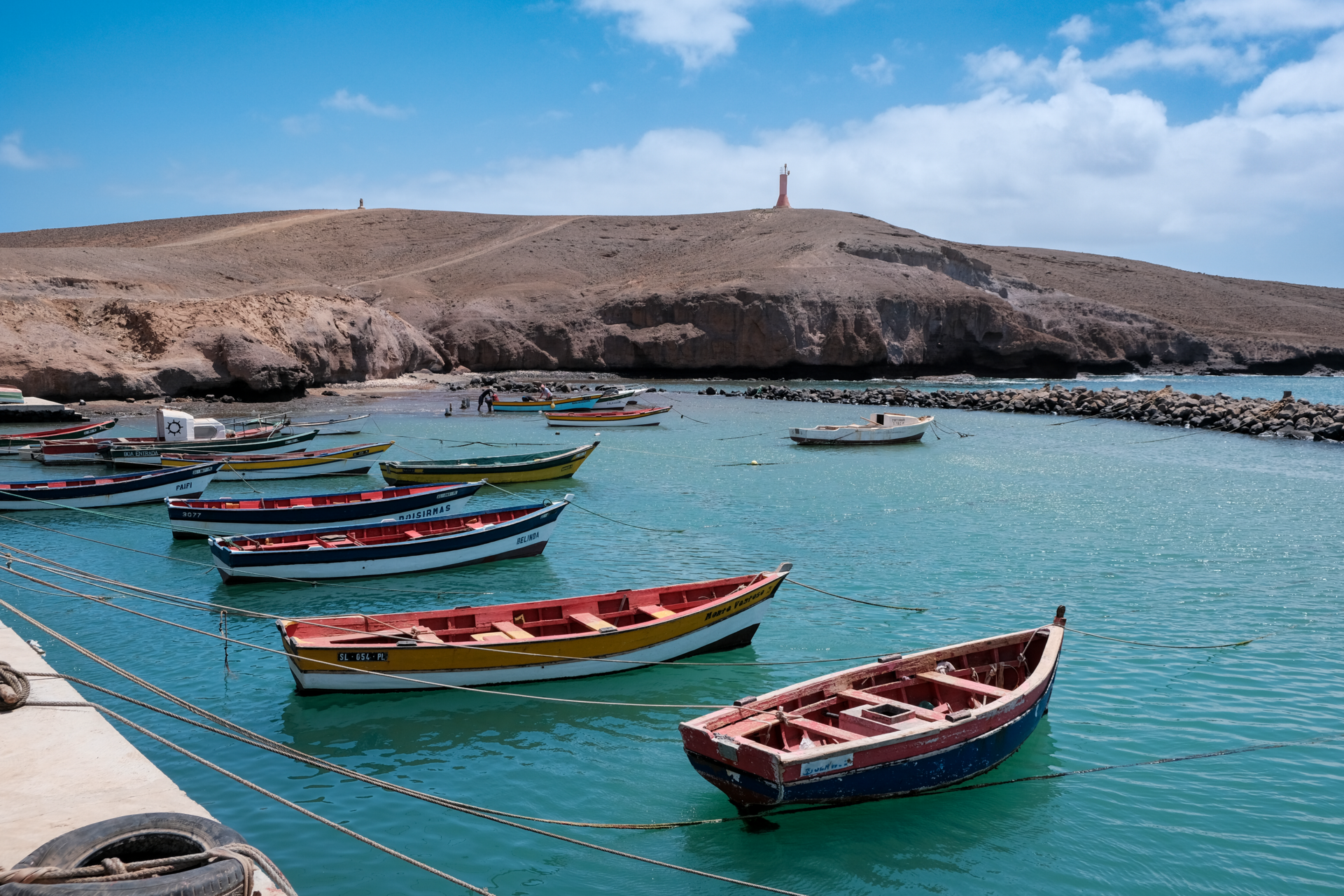
Pedra Lume Sal, Cabo Verde
Independence Day: 5 July 1975. A quarter of the population had starved to death thirty years earlier. The man who led the movement was murdered before either of his countries was free. And not one shot of the liberation war was fired on these islands.
Almost every page on this website begins with a people and what was done to them.
This one cannot. The Cabo Verde islands were uninhabited when Portuguese navigators reached them around 1456 and began settling from 1462. Ten volcanic islands, six hundred kilometres off the Senegalese coast, dry, wind-scoured, with almost no fresh water and very little soil.
Everyone who lives here now descends from people who were brought.
Portuguese settlers received land grants. And the labour came from the mainland, in chains. The islands were populated by the Atlantic slave trade, and the society that emerged — Creole in language, Catholic and West African in religion, mixed in ancestry — is the direct product of that.
Ribeira Grande, on Santiago, was the first European colonial town in the tropics. It is a UNESCO World Heritage Site today, and it earned that status precisely because of what it was: a processing station where captives from the Guinea coast were held, baptised, given Portuguese names and sold onward across the Atlantic.
It is now called Cidade Velha — the old city.
So Cabo Verde does not have a pre-colonial history that colonialism interrupted. It has a country that colonialism manufactured, out of the slave trade, on rocks in the ocean.
That makes what came later more remarkable, not less.
Cabo Verde was Portuguese for 515 years — longer than any other African territory belonged to any European power.
For most of that time it was administered as a way-station: for slave ships, then for supply vessels, then for transatlantic cables and coaling. Guinea-Bissau was actually governed from Cabo Verde between 1650 and 1878, which is why the two territories' histories are welded together.
What Portugal did not do was invest. There was no significant industry, almost no arable expansion, no serious water infrastructure on islands where drought is the defining fact of existence.
And the islands are drought-prone in a specific and lethal way: the rains fail for years at a time.
Pedra Lume Sal, Cabo Verde
This is the central fact of modern Cabo Verdean history and it is essentially unknown in Europe.
Drought struck repeatedly through the nineteenth and twentieth centuries, and repeatedly people starved because nobody sent food.
Between 1941 and 1948, prolonged drought combined with wartime disruption to shipping and the indifference of the Salazar dictatorship produced a famine that killed an estimated 45,000 to 50,000 Cabo Verdeans — roughly a quarter of the population.
A quarter.
There was no war on these islands. There was no siege. There was a colonial government whose subjects were, on paper, its responsibility, and it did not organise relief.
Earlier famines in the 1900s, 1920s and 1930s had killed tens of thousands more.
Portugal had become a right-wing dictatorship in 1926 which regarded the colonies as economic frontiers to be developed in Portugal's interest. Cabo Verde had nothing Portugal wanted, so Cabo Verde received nothing.
Emigration became the only survival strategy, and it began in the eighteenth century.
American whaling ships recruited Cabo Verdean crewmen, which is why there are Cabo Verdean communities in New Bedford and Providence dating back two centuries — some of the oldest African-descended immigrant communities in the United States.
Others were shipped as contract labourers to the cocoa plantations of São Tomé and Príncipe, under conditions that barely differed from slavery and that produced an international scandal in the early 1900s.
The rest went to Senegal, Guinea-Bissau, Portugal, the Netherlands, France and everywhere else.
Today the Cabo Verdean diaspora is larger than the population of Cabo Verde. More Cabo Verdeans live outside the country than in it, and remittances are a pillar of the economy.
That is the shape of the wound. A country whose principal export, for two hundred years, has been its own people leaving because there was nothing to eat.
He was born on 12 September 1924 at Bafatá in Portuguese Guinea, to Cabo Verdean parents. He belonged to both territories, which turned out to matter enormously.
He studied agronomy in Lisbon in the 1940s — one of a tiny number of Africans permitted higher education in the metropole — and it was there, among students from Angola, Mozambique and Guinea, that the intellectual core of the Portuguese-African liberation movements formed.
Then he did something that shaped everything after. As a colonial agronomist he was assigned to conduct an agricultural survey of Portuguese Guinea, and he spent two years walking the territory, village by village, recording soils and crops.
He came out of it with the most detailed knowledge of the country's people and geography that anyone possessed, and with a political analysis nobody else had.
On 19 September 1956, he co-founded the PAIGC — the African Party for the Independence of Guinea and Cabo Verde. One party, one struggle, two territories, one eventual state.
He is, by a distance, the most important political theorist the African liberation movements produced, and he is far better known among scholars than among the public.
His argument was that colonialism's deepest damage was not economic but cultural — that a people whose own culture has been declared worthless cannot organise itself, and that liberation therefore begins with a return to the source, with people reclaiming their own history and languages as the basis of political action rather than as folklore.
He was equally hard on his own side. He argued that the petty bourgeoisie who led liberation movements — men like himself — had to commit what he called class suicide: to renounce their own privileges and identify entirely with the peasantry, or they would simply replace the colonisers.
Read the subsequent history of this continent and ask how many of them did it.
And he insisted on honesty as a matter of operational discipline. His instruction to the PAIGC's cadres was to hide nothing from the masses, claim no easy victories, and "tell no lies."
If this website has a motto, that is it.
The PAIGC began as a peaceful movement demanding negotiation. In 1959 Portuguese forces killed striking dockworkers at Bissau, and the party concluded that Lisbon would concede nothing to argument.
The armed campaign began in January 1963 — in Guinea-Bissau.
It went well. By the late 1960s the PAIGC controlled most of the countryside and ran what it called liberated zones with their own schools, clinics, courts and trading posts. Cabral built a mobile hospital system with Soviet and Swedish supplies. Foreign journalists were brought in to see a state functioning inside a colony.
Portugal committed tens of thousands of troops and could not win.
And in Cabo Verde, nothing happened.
There was no guerrilla campaign on the islands. There was no terrain for one — no forest, no cover, ten separate pieces of land surrounded by ocean and a Portuguese navy. There was clandestine organising, there were arrests, there was the political prison camp at Tarrafal on Santiago, where the Salazar regime held opponents from Portugal and its colonies in conditions that killed a good number of them.
But the war that freed Cabo Verde was fought on the African mainland, by an army in which Cabo Verdeans served and died in large numbers.
That is the fact in this page's title, and it explains almost everything that follows.
Amílcar Cabral was shot dead in Conakry, Guinea, where the PAIGC had its external headquarters.
He was killed by members of his own party. The plot has been consistently linked to the Portuguese secret police, the PIDE, which had been trying for years to infiltrate the PAIGC and to break the Guinea–Cabo Verde alliance specifically.
Responsibility has never been fully established, and Cabo Verdeans and Bissau-Guineans still argue about how much of it was Lisbon and how much was internal resentment.
He was forty-eight.
Guinea-Bissau declared independence eight months later, on 24 September 1973. Cabo Verde became independent twenty-nine months later.
He saw neither.
Portugal's African wars — Guinea, Angola, Mozambique — broke the Portuguese army's willingness to continue, and on 25 April 1974 officers overthrew the dictatorship in Lisbon in the Carnation Revolution.
The new government wanted out. Negotiations moved fast. On 19 December 1974 the PAIGC and Portugal signed an agreement establishing a transitional government in Cabo Verde under Pedro Pires.
A People's National Assembly was elected on 30 June 1975.
On 5 July 1975, Cabo Verde became independent. Aristides Pereira became the first President, Pedro Pires the first head of government — both PAIGC, both veterans of the mainland war.
The first thing the new state did was not what most of this website records.
Cabo Verde was a one-party state from 1975 to 1990 and this page will not pretend otherwise. There was no opposition, the press was controlled, and the PAIGC — later PAICV — held all power.
What it did with that power was unusual.
It spent on education and health, heavily and consistently, in a country with almost no revenue. It built water infrastructure and reafforested eroded hillsides on a scale that changed the landscape of some islands. It managed drought without famine — which, set against 1941–48, is the single most important achievement in the country's history.
It maintained non-alignment rather than tying itself to Moscow, and kept working relationships with the United States, Portugal and the Soviet bloc simultaneously.
And it never executed anybody. Capital punishment was formally abolished in 1983, and Cabo Verde had not used it before that either.
Its human rights record, even under single-party rule, was among the best on the continent, and observers noted at the time that real authority was devolved to local citizens' committees rather than concentrated entirely at the centre.
That is not a defence of one-party rule. It is a record of what this particular one did, and it explains what happened next.
The plan had always been one state.
Then João Bernardo Vieira overthrew Luís Cabral — Amílcar's half-brother, and President of Guinea-Bissau — in a military coup in Bissau.
The grievance driving it was, in part, ethnic and racial. Cabo Verdeans and mestiços had been prominent in the PAIGC leadership out of all proportion to their numbers, because Portuguese colonial policy had given the islanders education and administrative positions that mainland Guineans were denied. By 1980 many Bissau-Guineans regarded their own liberation party as being run by people from the islands.
Cabo Verde was appalled. The unification project was abandoned. The party split, and the Cabo Verdean branch renamed itself the PAICV — African Party for the Independence of Cabo Verde.
The unity Amílcar Cabral had died for lasted five years and two months.
And the divergence afterwards is one of the sharpest contrasts in post-colonial Africa. Guinea-Bissau went on to coups, assassinations, a civil war and a reputation as a transit state for South American cocaine. Cabo Verde went the other way entirely.
Same party. Same founder. Same war. Different islands.
By the late 1980s the PAICV was under pressure from its own citizens and from the diaspora to open up.
It did not have to. It chose to.
The party called an emergency congress in February 1990 to discuss ending single-party rule. Opposition figures formed the Movement for Democracy (MpD) in Praia in April.
In the first multi-party legislative elections in January 1991, the PAICV lost. It handed over.
António Mascarenhas Monteiro was elected president the following month. A new constitution followed in 1992.
Since then, power has alternated peacefully between the MpD and the PAICV, repeatedly, including periods when the president and the prime minister came from opposing parties and simply governed alongside each other.
Cabo Verde has never had a coup. It has never had a political assassination since independence. It has never had a leader refuse to leave.
In 2007 it graduated from the United Nations' least-developed-country category — one of a very small number of African states to do so.
It is consistently rated among the freest countries in Africa, and often among the freest in the world outside Europe and the Anglosphere.
There always is one.
The economy is fragile in a way that no amount of good governance fixes. Cabo Verde imports most of its food. It has almost no fresh water and depends on desalination. It has no minerals, no oil and very little arable land. The economy rests on tourism, remittances and foreign aid — three things that all vanish at once in a global crisis, as 2020 demonstrated.
The islands remain unequal among themselves. Sal and Boa Vista have resort tourism; Santo Antão and Fogo and Brava have emigration.
The diaspora question is unresolved. A country whose citizens abroad outnumber its citizens at home has a structural problem: its most educated young people still leave, and the remittances that keep the country afloat are also the measure of its failure to keep them.
And the founding history is not a clean one. Cabo Verdeans were, under Portuguese rule, positioned above mainland Africans — as clerks, as colonial administrators, as intermediaries in the slave trade itself. Some Cabo Verdean families were slave traders. That is why the 1980 rupture happened, and it is discussed far more openly in Bissau than in Praia.
A page about these islands that recorded only the famine and the democracy, and not the fact that Ribeira Grande was a slave entrepôt run by the ancestors of the people who live there now, would be doing exactly what this website exists to refuse.
For three reasons.
Because of Cabral. He is the most serious thinker the African independence era produced, he is the one who said tell no lies, claim no easy victories, and he was murdered before he saw a single day of freedom in either of the countries he was trying to free. Every other leader on this website who was killed — Lumumba, Rwagasore, Olympio, Sankara — at least held office first. Cabral never did.
Because the islands prove that the outcome was not predetermined. Cabo Verde had less than almost anywhere: no minerals, no land, no water, a colonial history of starvation and a population smaller than a mid-sized European city. It became one of the most stable democracies in Africa. Guinea-Bissau, liberated by the same party in the same struggle, did not. The difference is not resources, because Cabo Verde had none.
And because of what independence actually delivered here. Not a monument, not a mausoleum, not a national day commemorating a constitutional amendment. Between 1941 and 1948, under Portuguese administration, a quarter of these people starved to death. Since 1975, under Cabo Verdean administration, there has been drought after drought and nobody has starved.
That is what independence was for. On these islands, it worked.
There is Cidade Velha, a World Heritage Site, whose heritage is the slave trade that made the country exist.
There is Tarrafal, the colonial prison camp on Santiago, now a museum.
There is a mausoleum in Conakry holding a man who belonged to two countries and lived to see neither of them free.
There is a diaspora larger than the nation, and a music — morna, the sung form of sodade, longing for what is gone — which is UNESCO-listed intangible heritage and is essentially a national archive of departure.
There is a party that lost an election in 1991 and handed over the state.
And there has not been a famine in fifty-one years.
Updated and fact-checked: 8 September 2026.
How this page was checked. Dates and events were verified against the sources listed above. Portuguese settlement of the uninhabited islands from about 1462, the role of Ribeira Grande in the Atlantic slave trade and its UNESCO inscription as Cidade Velha, the administration of Portuguese Guinea from Cabo Verde between 1650 and 1878, the reclassification of the islands as an overseas province in 1951, the founding of the PAIGC on 19 September 1956, the turn to armed struggle after the killing of striking dockworkers at Bissau in 1959, the launch of the armed campaign in January 1963 on the mainland, the assassination of Amílcar Cabral in Conakry on 20 January 1973, Guinea-Bissau's declaration of independence on 24 September 1973, the Carnation Revolution of 25 April 1974, the transitional agreement of 19 December 1974, independence on 5 July 1975 under Aristides Pereira and Pedro Pires, the Guinea-Bissau coup of 14 November 1980 and the subsequent formation of the PAICV, the abolition of capital punishment in 1983, the founding of the MpD in April 1990, the multi-party elections of January 1991 and the peaceful transfer of power that followed, the 1992 constitution and graduation from least-developed-country status in 2007 are as recorded. The famine death toll of 45,000 to 50,000 between 1941 and 1948, and the estimate that this represented around a quarter of the population, are the figures given in the cited sources and should be read as estimates; no comprehensive contemporary count exists. Responsibility for Cabral's assassination has never been conclusively established: he was killed by members of the PAIGC, and the Portuguese secret police are widely held to have engineered or encouraged the plot, but the balance between external instigation and internal factional conflict remains disputed. Current officeholders are not named on this page; readers should check present political arrangements independently. This page makes no allegation against any living person.
Written and researched by Remo Kurka · africanindependence.com
We strive to unify diverse narratives from across Africa, showcasing the continent's shared heritage and unique stories.
Our mission is to honor and preserve the history of African cultures and independence movements for future generations.
We provide a platform for innovative exchange of ideas, resources, and insights, understanding that knowledge should be accessible to all.