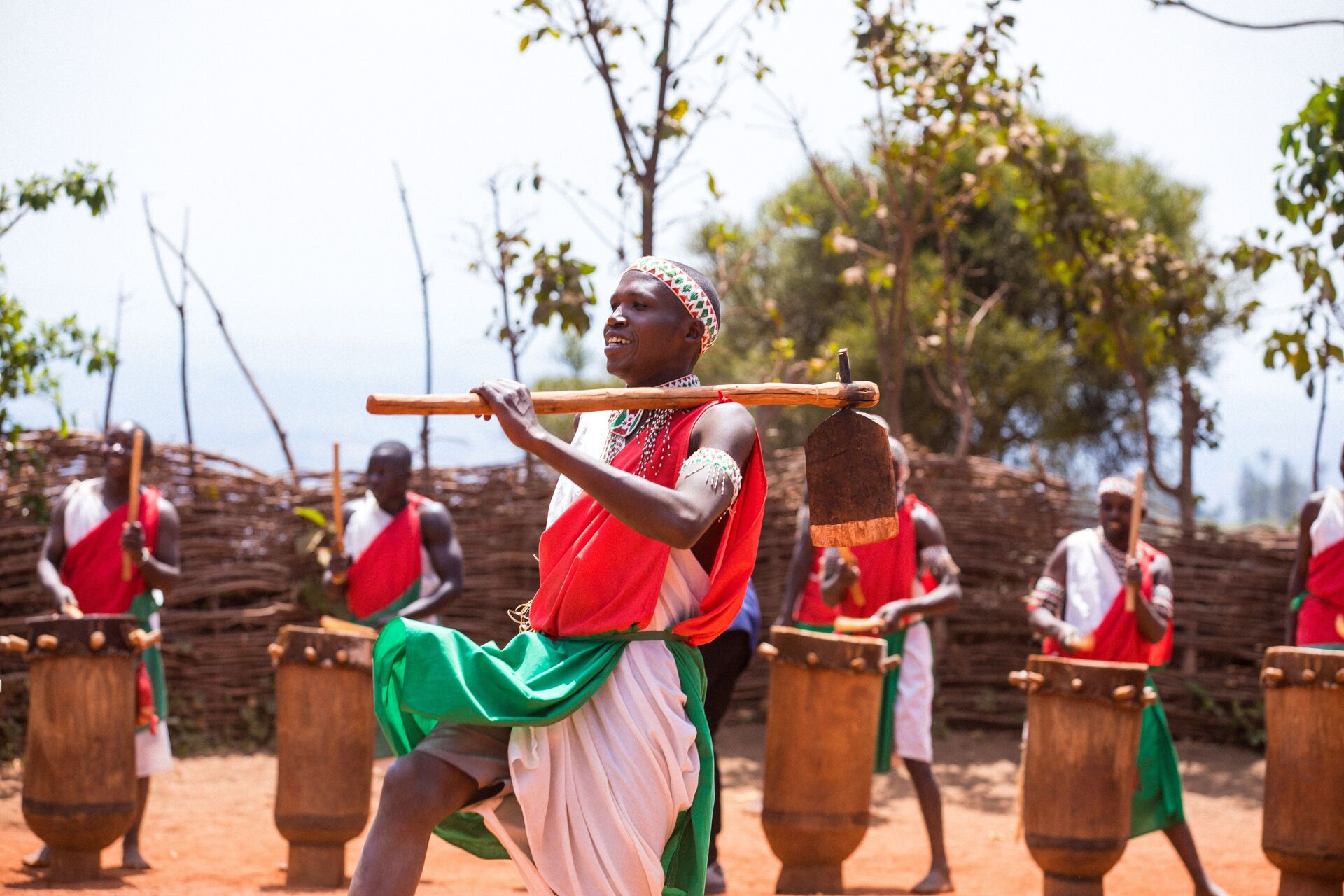
Burundi
Independence Day: 1 July 1962. A kingdom four centuries old, a prime minister murdered two weeks after taking office, and one of the largest mass killings in the history of independent Africa — which most of the world has never heard of.
Burundi is one of the few African states whose borders are broadly its own. The Kingdom of Burundi existed for centuries before any European arrived, ruled by a mwami — a king — from the Ganwa princely class, with a court, a bureaucracy of chiefs, a system of cattle clientship, and a language, Kirundi, spoken by everyone in it.
That last point matters more than almost anything else in this article.
Burundi is not a country of separate peoples who were pushed together by a colonial mapmaker. Hutu, Tutsi and Twa spoke the same language, lived in the same hills, worshipped the same way, intermarried, and were governed by the same king. The categories were real, and they carried real differences of status and occupation — but they were fluid, they were social rather than tribal, and above both of them sat the Ganwa, who were neither.
Nothing about that made 1972 inevitable.
Germany claimed Burundi in the 1890s and administered it as part of German East Africa under indirect rule — leaving the monarchy and the chiefly structures in place and governing through them.
After the First World War the territory passed to Belgium as Ruanda-Urundi, under a League of Nations mandate and later a UN trusteeship.
Belgium did something Germany had not.
It took a fluid social distinction and made it a permanent legal one. Colonial administrators, working from the racial theories of the period, decided that Tutsi were natural aristocrats — taller, finer-featured, of supposedly separate origin — and Hutu were natural cultivators. Administrative posts, mission schooling and access to the colonial state were channelled accordingly. And the categories were written down.
A category you can be born into and never leave is a different thing from a category you can marry out of.
By the time Belgium began preparing Burundi for independence, the country had a small, educated, Tutsi-dominated elite; a large, excluded Hutu majority; and — crucially — a shared national identity and a monarchy that both groups still regarded as their own.
There was still something to build on. One man tried.
Burundi
There was still something to build on. One man tried.
Prince Louis Rwagasore was the eldest son of Mwami Mwambutsa IV — a Ganwa, therefore neither Hutu nor Tutsi in the terms the Belgians had imposed, and one of the very few figures who could speak to the whole country.
He founded UPRONA and campaigned for immediate independence and for national unity across the ethnic divide. Belgium disliked him intensely and manoeuvred against him. International pressure forced the administration to back off, and in the legislative elections of 1961 UPRONA won overwhelmingly.
Rwagasore became Prime Minister on 28 September 1961.
He was shot dead on 13 October 1961. Two weeks in office.
The gunman was a Greek national. He acted, according to the historical record, at the direction of leaders of a rival political party — and probably with the support of the Belgian Resident in Burundi.
Read that again. The colonial power's own senior official on the ground is implicated in the killing of the elected prime minister of the country it was preparing for independence.
Within Burundi, Rwagasore is honoured almost universally to this day, and the anniversary of his death is marked every year with national ceremonies. He is the country's great unanswerable question: the one figure who might have held it together, removed before independence had even arrived.
Burundi became independent as a constitutional monarchy under Mwami Mwambutsa IV. Ruanda-Urundi was split; Rwanda went its own way the same day.
The state Burundi inherited had a king, a parliament, and no Rwagasore.
What followed was a decade of accelerating collapse.
In January 1965, Prime Minister Pierre Ngendandumwe — a Hutu — was assassinated by a Rwandan refugee, days after taking office. Elections later that year returned a Hutu majority in parliament; the king declined to appoint a Hutu prime minister. A Hutu-led uprising followed and was crushed. The officer who put it down was a young Tutsi captain named Michel Micombero.
In 1966 the monarchy fell in two stages. Mwambutsa ceded to his son, who became Ntare V. In November, Micombero deposed him and abolished the kingdom.
Four centuries of monarchy ended on 28 November 1966, and with it the last institution both communities still shared.
By 1968 there was one Hutu left in the cabinet: Martin Ndayahoze, minister of information.
He warned President Micombero directly that a plan existed to eliminate the Hutu population.
He was ignored.
Four years later, Ndayahoze was among the first people executed when the killing began.
On 29 April 1972, a Hutu-led insurrection broke out in southern Burundi. It was violent from the first hours: coordinated attacks on Tutsi civilians and soldiers, killing somewhere between two and three thousand people.
This is not a detail to skip past, and no honest account of what followed can begin after it. The rising was real, it was organised, and it murdered civilians because of who they were.
At almost the same moment, the deposed king Ntare V was returned from exile in Uganda to Burundi. He was accused of supporting the rebellion, and he was killed at Gitega.
Then the state answered.
Ikiza is Kirundi. It is translated as the Catastrophe, the Great Calamity, the Scourge. Burundians also call it Ubwicanyi — the Killings.
What the government and the Tutsi-dominated army did between April and August 1972 was not the suppression of a rebellion. It was the systematic destruction of an entire social class.
The target was educated Hutu. Civil servants. Teachers. Nurses. Priests. University students. Secondary school pupils — children were taken from classrooms by name. Anyone with a qualification, a position, or the potential to hold one. Lists were used. Some Tutsi were killed too, particularly Tutsi-Banyaruguru associated with the monarchy, whom the ruling Tutsi-Hima faction regarded as rivals.
Conservative estimates put the dead at 100,000 to 150,000. Higher estimates reach 300,000.
Burundi's population at the time was around five million.
Every surviving educated Hutu who could get out of the country did. Hundreds of thousands fled to Tanzania, Rwanda and Zaire, and many never returned. Burundi lost, in four months, essentially the whole of one community's professional class — and with it any prospect of a shared state for a generation.
Zaire and Tanzania initially provided assistance to Micombero's government. As the scale of what was actually happening became clear, foreign support fell away.
But nobody stopped it. There was no intervention, no tribunal, no serious international pressure. It ended when the killing had run out of targets.
That is the question this page exists to ask.
The Ikiza happened two decades before Rwanda, in the same region, with a comparable proportional death toll, and it is barely known outside Burundi and specialist scholarship.
Several reasons, none of them good. Burundi was small, landlocked and strategically unimportant to both Cold War blocs. It produced coffee, not oil or uranium. There were few foreign journalists and the government controlled movement. And in 1972 the world's attention was elsewhere entirely.
There is also a harder reason. For decades the Burundian state itself did not permit the subject to be discussed. Speaking about 1972 in public was dangerous under successive governments. The silence was policy.
A killing on that scale, unexamined for fifty years, does not stay in the past. It became the foundational grievance of everything that came after.
In 1988 violence at Ntega and Marangara in the north killed as many as 20,000 people. The trigger, in part, was the rumour that a second 1972 was being prepared.
Then, briefly, something extraordinary happened.
Burundi held genuine multi-party elections in June 1993 and elected Melchior Ndadaye — the country's first Hutu president and its first democratically elected leader. He appointed Tutsi to senior positions, including as prime minister, loosened controls on the press, and tried openly to govern across the divide.
He was assassinated on 21 October 1993 by soldiers of the Tutsi-dominated army, in a failed coup, after three months in office.
Notice the pattern. Rwagasore, 1961: two weeks. Ngendandumwe, 1965: days. Ndadaye, 1993: three months. Every Burundian who has attempted to lead across the ethnic line has been killed for it, and the killers have never faced a court.
What followed Ndadaye's murder was mass violence against Tutsi civilians, and then a civil war that ran from 1993 to 2005 and killed an estimated 300,000 people, with around a million displaced.
A United Nations international commission of inquiry, reporting in 2002 after hearing 667 witnesses, concluded that acts of genocide were committed against the Tutsi minority in Burundi after 21 October 1993.
Both of those findings are part of this history. A page that reports one and omits the other is not telling the truth about Burundi.
The Arusha Peace and Reconciliation Agreement, signed in 2000 under Nelson Mandela's mediation, is the reason Burundi exists as a functioning state today.
Its central mechanism was ethnic quotas written into the constitution: 60 per cent Hutu and 40 per cent Tutsi in government and parliament, and a 50–50 split in the army and police. An army that had been the instrument of the 1972 killings was rebuilt with the rebels inside it.
It was inelegant, it institutionalised the very categories Belgium had imposed, and it worked. The war ended. The last rebel group came in by 2008.
Pierre Nkurunziza, a former rebel commander, became president in 2005. In 2015 he sought a third term that the opposition and much of the international community regarded as a violation of Arusha. A coup attempt failed, protests were suppressed, hundreds died and hundreds of thousands fled. Burundi withdrew from the International Criminal Court in 2017. Nkurunziza died in 2020 and was succeeded by Évariste Ndayishimiye, whose presidency has continued to draw criticism over the treatment of civil society and government critics.
The peace has held. The politics have not opened up.
And here is why this page is being rewritten now.
Arusha required a truth commission. The Commission Vérité et Réconciliation was established in 2014, began work in 2016, and was mandated to examine the period from 1885 to 2008 — from German colonisation to the end of the war. It has taken testimony, investigated, and exhumed mass graves.
In 2021 it formally declared that genocide was committed against Hutu communities in 1972–73, attributing the crimes to the government of Michel Micombero.
In June 2026 its final report was presented to Parliament, reaffirming that finding.
President Ndayishimiye's public response is worth recording precisely, because it is not what one might expect. He said that bad leaders have no ethnicity, and that the massacres were planned and carried out by the authorities of the time — not by the Tutsi as a people.
That is a president of a Hutu-majority government, receiving a report that names a Tutsi-led government as the perpetrator of genocide against Hutu, and telling his own country not to blame an ethnic group for it.
An honest page has to record the criticism as well, because it is serious and it comes from Burundians.
Opposition figures and members of the Tutsi community have argued that the commission's concentration on 1972 risks sidelining what came later — above all the killing of Tutsi civilians that followed Ndadaye's assassination in 1993, which a UN commission characterised as acts of genocide. A truth commission established under a Hutu-led government, delivering a finding about mass killing of Hutu, will be read politically whatever its evidence.
The counter-argument is equally serious: 1972 went unexamined for fifty years precisely because the state would not permit it, and a commission that finally does the work should not be dismissed because of who happens to be in office when it reports.
Both things can be true. The finding about 1972 can be correct and the fear that 1993 will be treated as a lesser matter can be legitimate.
What Burundi has not yet had — and this is the plain summary — is a reckoning that both communities accept as covering both directions of the killing. Nobody has been prosecuted for 1972. Nobody has been prosecuted for Rwagasore, or Ngendandumwe, or Ndadaye. Impunity has been the one continuous feature of Burundian public life since 1961.
Because Burundi is the clearest demonstration anywhere on the continent that colonialism's most lasting weapon was not the gun.
Belgium did not invent Hutu and Tutsi. What it did was take a social distinction that people could move across and freeze it into a permanent legal category, tied to schooling, employment and access to the state, and then hand the resulting arrangement over at independence to a country whose one unifying figure it had helped to have shot.
Everything after 1962 grew from that. The killings ran in both directions and Burundians did them to each other — that responsibility is theirs and this page does not remove it. But the machinery was assembled by others, and left running.
And because the Ikiza deserves to be known. Somewhere between one and three hundred thousand people were killed in four months in 1972, on the basis of who they were and what they had studied, and the world did not notice at the time and has largely not noticed since.
A site called African Independence that skipped that would not be worth reading.
There is a monument to Louis Rwagasore in Bujumbura and a national commemoration every 13 October for a man who governed for fourteen days.
There are mass graves across the southern provinces, some of them now exhumed, many not.
There is a truth commission report, delivered in June 2026, that says the word genocide about 1972 — and a national argument about whether it says enough about 1993.
There is a constitution built on ethnic quotas, which is the opposite of what Rwagasore wanted and the reason the country is at peace.
There is a generation of Burundians in their fifties and sixties named things like Nimubona — "only God will protect him" — because their parents named them in fear that the killing would start again.
And there is not one conviction. Not for 1961, not for 1965, not for 1972, not for 1993.
Sixty-four years of independence, six assassinated heads of state and prime ministers, hundreds of thousands dead, and no court has ever found anybody responsible for any of it.
Published: 1 December 2025 · Fully revised and fact-checked: 8 September 2026.
How this page was checked. Dates, casualty ranges and the sequence of events were verified against the sources listed above and against published scholarship on Burundi, including the work of René Lemarchand. The assassination of Prince Louis Rwagasore on 13 October 1961 after taking office on 28 September, independence on 1 July 1962, the assassination of Pierre Ngendandumwe in January 1965, Michel Micombero's coup of 28 November 1966, the Hutu insurrection of 29 April 1972 and the killings that followed to August 1972, the killing of Ntare V at Gitega, the Ntega and Marangara violence of 1988, the election and assassination of Melchior Ndadaye in 1993, the Arusha Agreement of 2000, the 2015 crisis, Pierre Nkurunziza's death in 2020, the truth commission's 2021 finding and the presentation of its final report to Parliament in June 2026 are as recorded. Casualty figures are given as ranges because they are genuinely disputed: estimates for the Ikiza run from 100,000–150,000 at the conservative end to 300,000 at the higher end; the April 1972 insurrection is generally recorded as killing 2,000–3,000 people; the 1993–2005 civil war is generally estimated at around 300,000 dead. This page states the disagreement rather than resolving it. Killings in both directions are recorded here: the 1972 Hutu insurrection and its Tutsi civilian victims, the state killings of Hutu that followed, and the UN Commission of Inquiry's 2002 finding that acts of genocide were committed against the Tutsi minority after 21 October 1993. Criticism of the truth commission's focus, made by opposition figures and members of the Tutsi community, is recorded because it is part of the public record, not because this page adjudicates it. This page makes no allegation against any living person.
Written and researched by Remo Kurka · africanindependence.com
We strive to unify diverse narratives from across Africa, showcasing the continent's shared heritage and unique stories.
Our mission is to honor and preserve the history of African cultures and independence movements for future generations.
We provide a platform for innovative exchange of ideas, resources, and insights, understanding that knowledge should be accessible to all.