Independence Day: 1 August 1960. Six coups in twelve years, a Marxist republic, and then the meeting that showed the whole continent how a dictator could be voted out — followed, thirty-six years later, by a parliament with no opposition at all.
Before anything else, two corrections. Both matter, and both are made constantly.
The Benin Bronzes are not from Benin. They were looted by a British punitive expedition in 1897 from the Kingdom of Benin, whose capital was Benin City in what is now Edo State, Nigeria. That kingdom has no connection whatsoever to the Republic of Benin. This country was called Dahomey until 1975, and took the name Benin from the Bight of Benin, the stretch of coast it sits on.
Every restitution debate in Europe muddles this, including in German coverage. If you are following the argument about looted African art, the bronzes go to Nigeria. What was looted from this country came from Abomey, and it was taken by France.
And the Agojie were not fighting the slave trade. Since the 2022 film The Woman King there is a version circulating in which Dahomey's women warriors were resisting slavery. They were not. Dahomey was one of the largest suppliers of captives on the Atlantic coast, and the Agojie's wars produced the people who were sold. That is dealt with properly further down, because it is the most important thing on this page.
The Kingdom of Dahomey emerged among the Fon around 1600, with its capital at Abomey. It paid tribute to the Oyo Empire until 1818 and then ran its own affairs, as a highly centralised, militarised state with a standing army, a royal bureaucracy and a court culture recorded in the bas-reliefs of the palace walls.
It expanded by war, and the wars produced prisoners, and the prisoners were sold.
Dahomey became one of the principal suppliers to the Atlantic trade. The port of Ouidah was among the busiest embarkation points on the entire coast; the great majority of enslaved people taken from this shoreline went to Brazil and the Caribbean. In exchange the kingdom received firearms, textiles and liquor — and the firearms funded the next campaign, which produced the next prisoners.
This is not a European slander on an African kingdom. It is the documented economic basis of the state, and Beninese historians say so plainly.
King Ghezo came under sustained British pressure to stop after Britain left the trade in 1807. He formally banned the export of captives. He did not actually end slave trading in Dahomey, and the shift to palm oil that the film presents as a moral conversion was a slow, partial and largely economic adjustment.
They deserve the truth rather than the poster.
They began as the gbeto, a corps of female elephant hunters under King Houegbadja, who brought meat and ivory to the court. They were turned into soldiers by Tasi Hangbe, twin sister of King Akaba, who took the throne when he died suddenly and ruled from about 1708 to 1711 — and who was subsequently written out of the official king lists.
They existed for more than two centuries. Their peak strength is disputed: European accounts claim 6,000, and historians generally put the realistic figure between 1,000 and 3,000.
They were formidable, and the evidence for that comes from the people they fought. When the French Foreign Legion advanced on Abomey in October 1892 — professional soldiers, veterans of colonial campaigns on three continents — they were stopped by an all-female regiment armed with Winchester repeating rifles and heavy blades. General Alfred Dodds, commanding the French expedition, recorded that the women soldiers were more dangerous than the men.
The last documented Agojie was a woman named Nawi, found in the village of Kinta by a Beninese historian in 1978, well over a hundred years old, who said she had fought the French. She died in November 1979.
And they took captives who were sold into the Atlantic trade.
All of that is one story. An elite corps of women soldiers, in a deeply patriarchal society, who fought a European army to a standstill — and who served a state whose economy ran on selling people. Choosing only the first half is what the film did and what the internet has done since, and it is not a favour to them.
King Béhanzin resisted the French advance for nearly two years. When Dodds's forces reached Abomey in November 1892, Béhanzin ordered the royal palaces burned rather than surrender them intact.
French soldiers entered before the destruction was complete and carried away everything they could: thrones, statues, doors, textiles, weapons, ceremonial objects. The loot was shipped to France and displayed in Paris — first at the Trocadéro, eventually at the Musée du Quai Branly.
Dahomey became a French colony in 1894. Béhanzin was deported to Martinique and died in exile in Algeria.
The Royal Palaces of Abomey were inscribed as a UNESCO World Heritage Site in 1985 — the ruins of what was burned and stripped.
Dahomey became independent with Hubert Maga as its first president.
And then it became a byword for instability.
The nationalist movement had fractured into three regional and ethnic blocs, and they never stopped fighting. Sourou-Migan Apithy in the south-east, based on Porto-Novo. Justin Ahomadégbé in the centre and south-west, along the Abomey–Cotonou axis. Hubert Maga in the north, at Natitingou. Every arrangement was two of them against the third.
Between 1963 and 1972 there were six successful coups. Most were bloodless. Foreign commentary called the country the sick child of Africa.
In 1970 the three rivals arrived at a solution of genuine originality: a Presidential Council in which Maga, Ahomadégbé and Apithy would each hold the presidency in rotation for two years. Maga actually handed over to Ahomadégbé in 1972, which is more than most such schemes achieve.
It collapsed anyway.
Major Mathieu Kérékou took power in a bloodless coup, dissolved the Presidential Council, suspended the constitution and banned political parties.
He was thirty-nine and he would run the country, in one form or another, for most of the next thirty-four years.
From 1974 the government adopted Marxism-Leninism, nationalised banks, insurance and much of the economy, and aligned with the Soviet bloc, North Korea and China. In 1975 the country was renamed the People's Republic of Benin and got the flag it still uses.
The record is the familiar one: a one-party state, political prisoners, a security apparatus, an economy managed into the ground. By the late 1980s Benin was effectively bankrupt — civil servants and teachers unpaid for months, students striking, and a banking system that had ceased to function.
In December 1989 Kérékou announced that Marxism-Leninism was no longer the state ideology.
Then he did the thing that put this country in the history books.
Under pressure from unions, students, churches and the sheer impossibility of paying anyone, Kérékou convened a Conférence Nationale des Forces Vives — a national conference bringing together political figures, trade unionists, religious leaders, professional bodies, exiles and civil society.
It met in Cotonou in February 1990. It was broadcast live on national television.
And it declared itself sovereign.
Over nine days the conference stripped Kérékou of nearly all his powers, appointed Nicéphore Soglo as prime minister to run a transition, and set out a new constitution.
Kérékou had the army. He did not use it.
Instead, on live television, he asked the country's forgiveness for the abuses of his rule.
There was no coup, no massacre, no exile, no trial. A military ruler of eighteen years sat in a hall, was told by his own people that he no longer governed, and accepted it — in front of the cameras.
The 1990 constitution was approved by referendum. Multi-party elections followed in 1991, and Soglo defeated Kérékou with 67.5 per cent of the vote.
This was the first time in post-colonial Africa that a sitting authoritarian ruler was removed peacefully at the ballot box and handed over power.
The model spread immediately. National conferences were convened across francophone Africa — in Congo, Mali, Niger, Togo, Zaire — explicitly following Benin's example. Not all of them worked; Mobutu strangled his, and Togo's was undone by the army. But the idea that a country could talk its way out of a dictatorship came from a hall in Cotonou.
And Kérékou was not finished. He ran again, won in 1996, beat Soglo again in 2001, and left office at the end of his term in 2006 under the constitution's age and term limits. Benin called him le caméléon. He had been a Marxist general, a born-again Christian, and a democratically elected president, and he died in 2015 as an elder statesman.
Thomas Boni Yayi governed from 2006 to 2016 and also stepped down at his term limit, despite pressure to change the constitution.
For twenty-five years, Benin did the thing that is hardest: it kept handing over power.
On 9 November 2021, at a ceremony at the Élysée Palace, France formally transferred 26 royal treasures of Abomey back to Benin. It was the most significant restitution France had carried out and it was made possible by a specific law passed for the purpose, because French national collections are otherwise inalienable.
Three things about that return belong on a page like this.
Twenty-six. Estimates of Dahomean material in French collections run into the thousands. Benin's own president said publicly at the ceremony that a great deal remained on display in France.
The museum was financed by a French loan. A €20 million credit from the French Development Agency helped fund the facility at Abomey to receive the objects. France returned what France took, and lent the money to house it.
And Beninese people argued about it. Mati Diop's documentary Dahomey, which won the Golden Bear at Berlin in 2024, is largely built around students at the University of Abomey-Calavi arguing furiously over whether 26 objects constitute justice or an insult, and over what it means for a country to receive back a past it has already lived without.
That argument is the healthiest thing in the whole restitution story, and it happened in Benin rather than in Europe.
Now the part that a page celebrating 1990 has to print.
Patrice Talon, a cotton magnate who had been one of Boni Yayi's principal financial backers before falling out with him spectacularly, was elected president in 2016 on a platform of a single six-year term and constitutional reform.
What followed was a systematic narrowing.
A new party-registration law and electoral code imposed thresholds that opposition parties could not meet. The 2019 legislative elections were contested by no opposition party at all; protests were put down and there were deaths. Talon's principal opponents were prosecuted or went into exile. He was re-elected in 2021 against candidates who posed no serious challenge, in a contest that international monitors described as reflecting democratic backsliding. He did not, in the end, serve one term.
Then the sequence of the last twelve months.
In December 2025 a group of soldiers attempted a coup. It was put down by the security forces, with assistance from Nigerian troops.
In the parliamentary elections of 11 January 2026, a revised electoral code required a party to win 20 per cent nationally and 20 per cent in each of the 24 districts to take any seats at all. The main opposition, The Democrats, won about 16 per cent and received nothing. Talon's two allied parties took all 109 seats.
The Democrats were then unable to register a presidential candidate at all, for want of the required parliamentary endorsements.
On 12 April 2026, Finance Minister Romuald Wadagni, Talon's chosen successor, won the presidency with 94.27 per cent against a single opposition candidate whose campaign had required help from government lawmakers merely to get onto the ballot. International observers characterised the election as neither free nor fair. Turnout was 63.6 per cent.
Wadagni was sworn in on 24 May 2026.
And on 6 August 2026, Patrice Talon — constitutionally barred from a third term — became the first President of the Senate, an office that had just been created.
Benin gave Africa the national conference. It is where the peaceful removal of a dictator was invented, on live television, by a general who accepted the verdict of a hall full of citizens.
Thirty-six years later, its parliament contains no opposition, its president was elected with 94 per cent, and its outgoing president heads a new upper chamber built while he was still in office.
The economy has genuinely improved — growth of around 7.5 per cent in 2024, a modernised port at Cotonou, real infrastructure. That is the argument Talon's supporters make and it is not nothing. The counter-argument, made by voters in the streets rather than in the assembly, is that the growth has not reached them, and they no longer have a legal way to say so.
There is also a war in the north. Jihadist groups pushing down from Burkina Faso and Niger have been attacking in the Alibori and Atacora regions for several years, and the northern border is now a front rather than a boundary.
None of this is Kérékou's Benin, and none of it is 1990's Benin either. It is a third thing, and it is what a great many African states currently look like: competent administration, real economic numbers, and a closed political system.
Because Benin is the clearest case that democratic transition is not a destination.
A country that spent its first twelve years having a coup every two years produced, in 1990, the single most hopeful political event in post-colonial African history — and then, over the following three decades, demonstrated that the mechanism can be dismantled again by lawyers rather than soldiers. No tanks were required. An electoral code did it.
And because Benin holds two of the hardest facts on this continent in the same hands: it is a country whose great pre-colonial kingdom sold people across the Atlantic in enormous numbers, and whose modern government has built a Slave Route memorial at Ouidah and a Door of No Return facing the sea, and asks descendants to come back.
It does not resolve that contradiction by pretending. Beninese scholars, museums and presidents have addressed the kingdom's role in the slave trade in public, repeatedly and without euphemism.
That is more than most of the countries on the other side of that ocean have managed.
There is a Door of No Return at Ouidah, on the beach where the ships loaded.
There are the burned palaces of Abomey, a World Heritage Site consisting largely of what a king destroyed rather than surrender and what a French general took anyway.
There are 26 objects home out of thousands, in a museum built with a French loan.
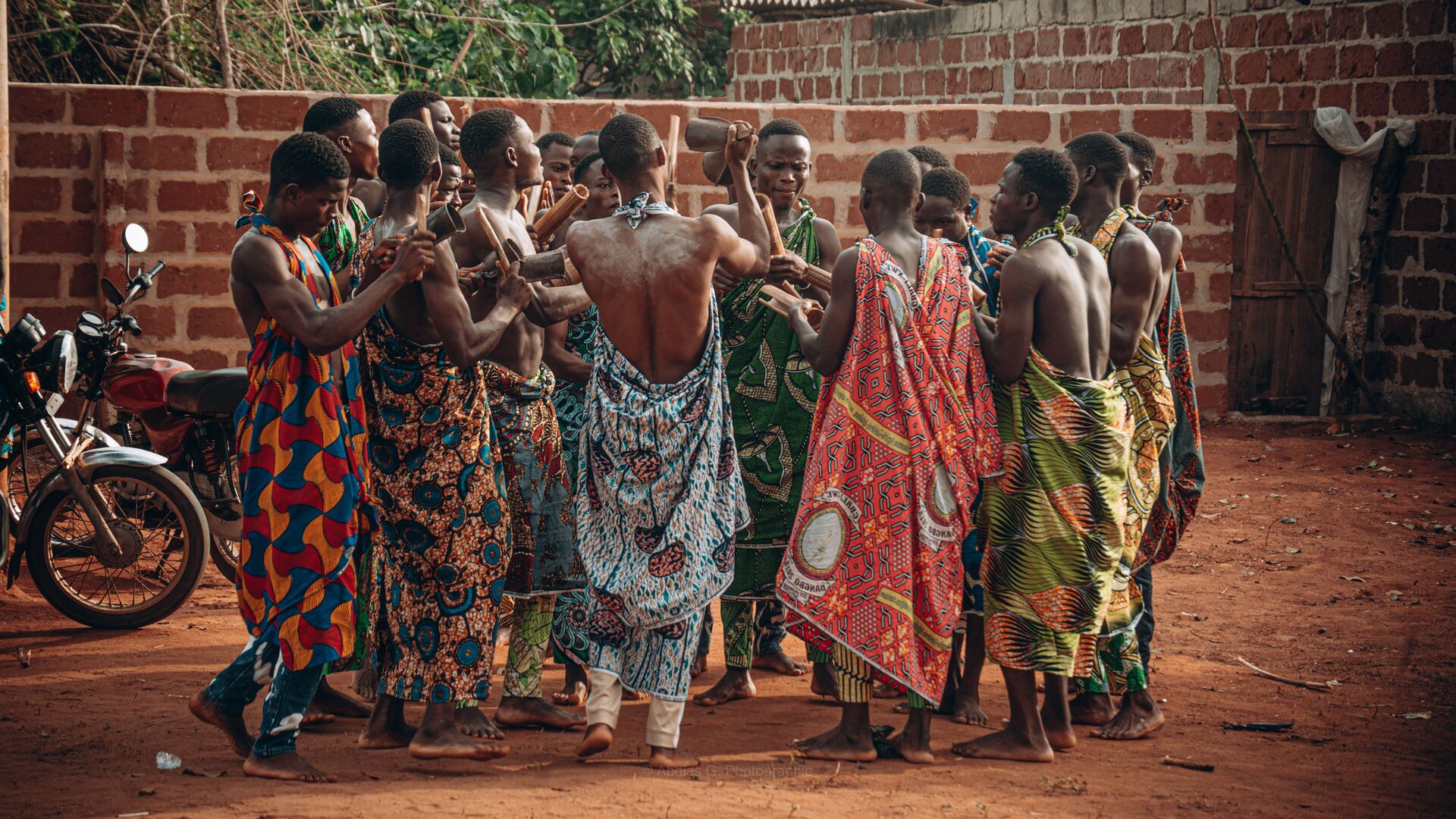
There is Vodun — a state religion here, with a national holiday every 10 January, and the origin of Haitian Vodou, Brazilian Candomblé and Louisiana Voodoo. What was carried out of Ouidah in chains came back across the Atlantic as culture, and Benin now welcomes its practitioners home.
There is a video recording of a general apologising to his country on live television in 1990, which every African government ought to be made to watch.
And there is a National Assembly of 109 members in which not one belongs to an opposition party.
Updated and fact-checked: 8 September 2026.
How this page was checked. Dates and figures were verified against the sources listed above. Independence on 1 August 1960 under Hubert Maga, the six successful coups between 1963 and 1972, the rotating Presidential Council of 1970, Mathieu Kérékou's coup of 26 October 1972, the adoption of Marxism-Leninism and the renaming of the country in 1975, the National Conference of February 1990 and its televised proceedings, Kérékou's electoral defeat by Nicéphore Soglo in 1991 and his returns in 1996 and 2001, the French restitution of 26 Abomey treasures on 9 November 2021, the parliamentary elections of 11 January 2026 in which no opposition party won a seat, the presidential election of 12 April 2026 and Romuald Wadagni's inauguration on 24 May 2026, and Patrice Talon's assumption of the presidency of the newly created Senate on 6 August 2026 are as recorded. Two common errors are corrected on this page rather than repeated: the Benin Bronzes were looted in 1897 from the Kingdom of Benin in present-day Edo State, Nigeria, and have no connection to the Republic of Benin; and the Agojie of Dahomey took captives who entered the Atlantic slave trade, contrary to the version popularised by recent film and social media. Contested figures are given as ranges: estimates of Agojie strength vary between roughly 1,000 and 3,000 in scholarly assessment against European claims of 6,000, and the number of Dahomean objects remaining in French collections is not precisely established. The 2026 presidential election was characterised by international observers as neither free nor fair; that characterisation is reported here as their assessment. This page makes no allegation against any living person.
Written and researched by Remo Kurka · africanindependence.com
We strive to unify diverse narratives from across Africa, showcasing the continent's shared heritage and unique stories.
Our mission is to honor and preserve the history of African cultures and independence movements for future generations.
We provide a platform for innovative exchange of ideas, resources, and insights, understanding that knowledge should be accessible to all.