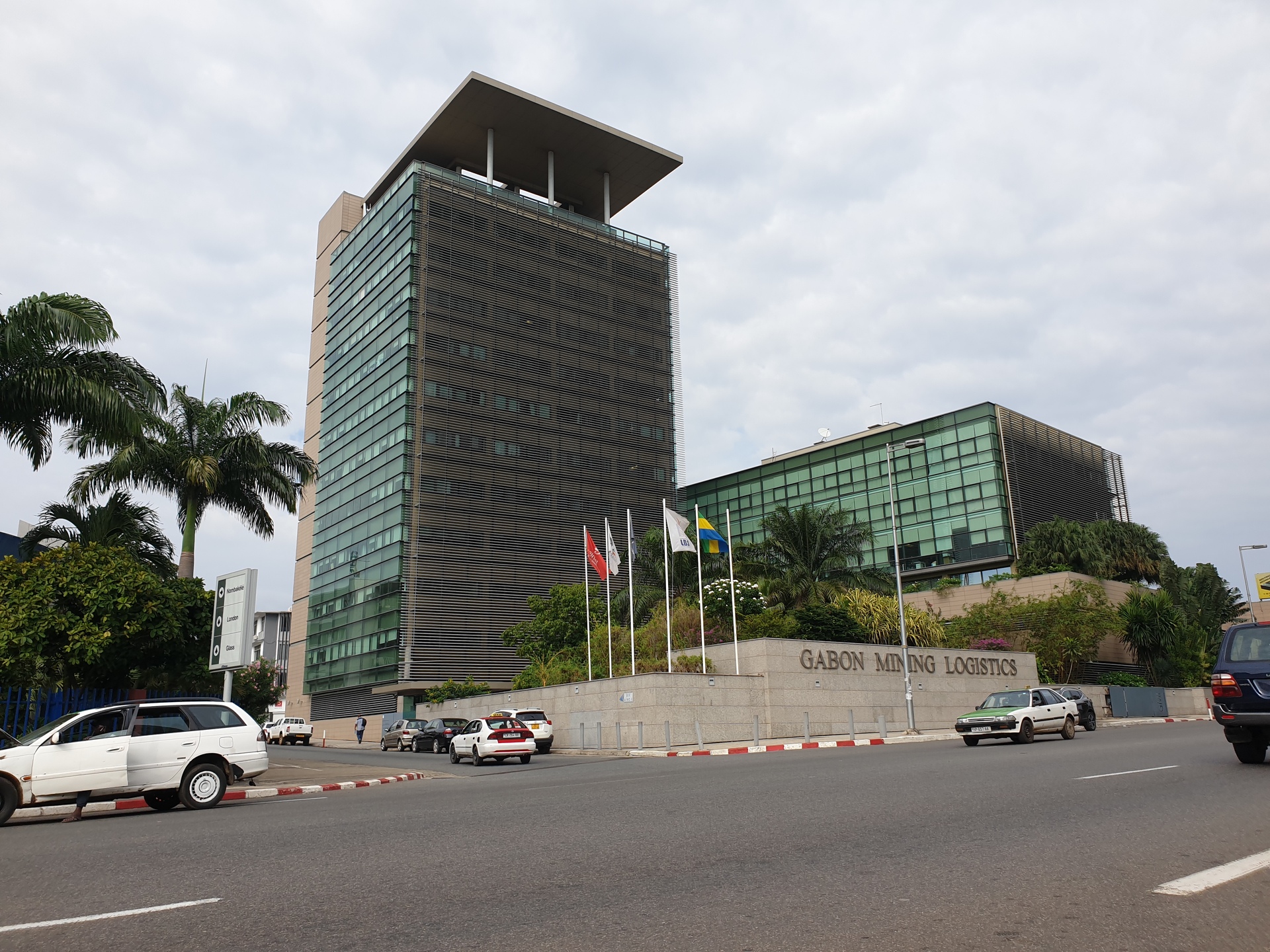
Photo Credit header and this photo: By Shirmy25 - Own work, CC BY-SA 4.0, https://commons.wikimedia.org/w/index.php?curid=163160491 and By Delrick Trevor - Own work, CC BY-SA 4.0, https://commons.wikimedia.org/w/index.php?curid=91075722
Independence Day: 17 August 1960. Gabon became independent from France and then, four years later, its own soldiers removed the president — and France flew in paratroopers and put him back. That single act is the clearest statement of what independence meant in French Africa. What followed was fifty-six years of rule by one family, funded by an oil company that operated as an arm of French foreign policy, and ended in 2023 by a general who was the president's cousin.
Most pages on this site describe how a European power left.
This one describes how a European power stayed.
Gabon is the cleanest documented case of Françafrique anywhere on the continent — cleaner than Chad, cleaner than Côte d'Ivoire, cleaner than Congo-Brazzaville — because in Gabon the arrangement was never seriously concealed, and because a French court eventually put much of it on the record.
It is also the country that makes the strongest case against the simple story this website could easily tell. Gabon is not poor. It has the highest income per head on mainland Africa. It has no ethnic war, no famine, no mass grave, no jihadist insurgency. Roughly nine-tenths of it is still forest, and it protects that forest better than almost anyone.
And a third of its people live in poverty, its capital has power cuts, and youth unemployment runs at around forty per cent — in a country of about two and a half million people sitting on oil, manganese and timber.
That is the Gabonese question, and it has nothing to do with resources and everything to do with where the money went.
Start with the name, because it is not decoration.
In 1849 a French naval vessel intercepted a slave ship, the Elizia, off the coast. The freed captives were landed and settled at the French post on the Komo estuary, and the settlement was called Libreville — free town.
It is the same idea as Freetown in Sierra Leone and Liberia's founding: a place made out of people taken off a slaver.
France then spent the following century turning the country around it into a timber concession.
Photo Credit header and this photo: By Shirmy25 - Own work, CC BY-SA 4.0, https://commons.wikimedia.org/w/index.php?curid=163160491 and By Delrick Trevor - Own work, CC BY-SA 4.0, https://commons.wikimedia.org/w/index.php?curid=91075722
Gabon was folded into French Equatorial Africa in 1910, governed from Brazzaville.
The colonial economy was okoumé — a softwood ideal for plywood, which grows here better than anywhere. Getting it out required labour, and labour was obtained through the indigénat and through forced recruitment, in a region where population was thin and the work was lethal.
This is the same administrative territory in which the Congo–Océan railway was built, a project on which African workers died in numbers that scandalised even contemporaries. Gabon supplied men for it.
Léon M'ba, a Fang from the Estuaire, was in the middle of this history: a customs official, then a nationalist agitator, then exiled to Ubangi-Shari for a decade, then rehabilitated, then mayor of Libreville, then the man France chose.
Independence came in the great wave of that year, negotiated rather than fought for, and in Gabon's case wanted less than almost anywhere else on the continent — M'ba had genuinely proposed that Gabon become an overseas département of France instead. Paris declined.
Gabon became independent on 17 August 1960, with Léon M'ba as president.
The independence package was the standard French one, and its contents matter more than the ceremony: cooperation agreements giving France priority access to strategic raw materials, a defence agreement permitting French military intervention, French officers and advisers embedded in the new state, and the franc CFA — a currency guaranteed by the French treasury, with reserves held in Paris.
Uranium had been found at Mounana. Oil was coming. France had no intention of losing either.
M'ba governed by squeezing out rivals, dissolving the assembly and moving towards a one-party state.
On 18 February 1964 a small group of Gabonese officers removed him — almost bloodlessly. They arrested him, announced a provisional government under the opposition leader Jean-Hilaire Aubame, and invited a return to constitutional politics. There was no massacre, no looting, and by the accounts of the time a good deal of public support in Libreville.
Within about twenty-four hours, French paratroopers were landing.
They came from Dakar and Brazzaville, under the defence agreement, on the authority of Charles de Gaulle and his Africa adviser Jacques Foccart. They put down the coup, restored Léon M'ba to the presidency, and left a permanent French garrison in Libreville.
Aubame was tried and imprisoned. Protests afterwards were suppressed, with deaths.
This is the single most instructive event in the history of French Africa, and it deserves to be stated without softening: a European state militarily reversed the decision of an African country's own army and public, in a country that had been independent for less than four years, and installed the man it preferred.
After 1964 no serious person in Libreville could believe that the question of who governed Gabon would be settled in Gabon.
M'ba, ill with cancer, was treated in Paris. France arranged the succession.
The constitution was amended to create a vice-presidency that would succeed automatically. Into it went Albert-Bernard Bongo, a young official from Haut-Ogooué, aged thirty-one, who had come up through the presidential staff.
M'ba died in November 1967. Bongo became president, and remained president until his death in June 2009 — forty-one and a half years.
He founded a single party in 1968. He converted to Islam in 1973 and took the name El Hadj Omar Bongo Ondimba. He survived every wave that removed everybody else: the fall of the Soviet Union, the national conferences of the early 1990s, the arrival of multiparty elections, three French republics' worth of presidents.
The elections happened. From 1993 they were held regularly. They were also, consistently, disputed, with results that arrived from the interior provinces at the right time and in the right quantity.
By the time he died he had been head of state longer than almost anyone alive.
You cannot explain that survival without the oil company.
Elf Aquitaine was a French state oil company, and in Gabon it was something more: the operational arm of French policy in Central Africa. It produced the oil, it handled the money, and it handled the politics.
When the Elf affair finally broke open in the French courts in the 1990s and 2000s, what emerged was a system of commissions — payments flowing out of African oil revenues into the accounts of African heads of state and of French political parties and individuals, on both left and right. Senior Elf executives, including Loïk Le Floch-Prigent, were convicted in France in 2003.
Gabon was at the centre of it. The country was so closely identified with the company that Gabonese oppositionists and French journalists alike used the same phrase for it: France's petrol station.
And the flow was not one-way. In 2011 the lawyer and intermediary Robert Bourgi publicly described carrying cash from African presidents, Omar Bongo prominent among them, to French politicians — allegations the politicians named denied, and which were never tested in a criminal court.
Whatever the precise sums, the structure is not in dispute: an African state's oil revenue helped finance French political life, and French political life guaranteed that African state's president.
The other half of the money stayed with the family.
The French biens mal acquis — "ill-gotten gains" — investigations, opened after complaints by anti-corruption organisations, examined property held in France by several African ruling families. In the Gabonese case investigators identified dozens of properties in Paris and on the Côte d'Azur, along with luxury vehicles and bank accounts.
Gabon's own courts have since put a figure on the Ali Bongo period specifically. It is set out below, and it is not a small number.
Omar Bongo died in a clinic in Barcelona in June 2009. His son Ali Bongo Ondimba, long-serving defence minister, was declared winner of the election that followed. There were riots in Port-Gentil, the oil city, and the French consulate was burned.
The 2016 election was worse. The national result was close. Then Haut-Ogooué — the Bongo home province — reported a turnout of over ninety-five per cent, with over ninety-five per cent of it for Ali Bongo, and that province alone reversed the outcome. The National Assembly was set on fire, the opposition headquarters was raided, people were killed, and the European Union observation mission reported an anomaly in the results it could not explain.
In October 2018 Ali Bongo suffered a serious stroke in Riyadh. He disappeared for months. The government released almost nothing. A New Year's message broadcast at the very end of the year, in which he appeared visibly impaired, triggered a failed coup attempt by junior officers on 7 January 2019 — put down within hours.
From that point the accusation made by almost everyone in Libreville, and later by the men who took power, was that Gabon was no longer being run by its president at all, but by his wife Sylvia Bongo and his son Noureddin Bongo Valentin.
Ali Bongo stood for a third term in August 2023. Foreign media were expelled, the internet was cut, a curfew was imposed, and the result was announced in the small hours declaring him the winner with sixty-four per cent.
Within minutes, officers of the Republican Guard appeared on television and annulled it.
They dissolved every institution of the state and placed the president under house arrest. There was no significant resistance. There were crowds in the streets of Libreville celebrating.
The man who led it was Brigadier-General Brice Clotaire Oligui Nguema, commander of the Republican Guard — the president's own praetorian unit — and a maternal cousin of the Bongo family, who had served Omar Bongo personally as an aide-de-camp.
That detail is the whole story in one line. Gabon's fifty-six-year dynasty was ended not by the opposition, not by the street, and not by an election, but from inside the family, by the officer commanding its bodyguard.
Ali Bongo was released a week later on health grounds and is not being prosecuted. Sylvia and Noureddin were arrested and held.
What followed was a nineteen-month transition, and it was — by the standards of the eight coups that have hit West and Central Africa since 2020 — remarkably orderly.
A new constitution was approved by referendum in November 2024, with around ninety-two per cent in favour: a seven-year presidential term renewable once, no prime minister, and a bar on presidential family members succeeding to the office. A new electoral code in January 2025 permitted serving military personnel to stand for election, which permitted Oligui Nguema to stand.
The presidential election was held on 12 April 2025. Turnout was around seventy per cent, the highest in decades. Foreign and independent media were allowed to film the count for the first time. African Union and European Union observers reported no major incidents, and the atmosphere was calm — a genuine contrast with 2016 and 2023.
Oligui Nguema won with 94.85 per cent. His nearest rival, Ali Bongo's former prime minister, took about three per cent. He was sworn in on 3 May 2025 for seven years.
And there is the difficulty this page has to state plainly.
A clean, calm, observed election is a real achievement, and Gabonese people are entitled to be pleased about it. A result of ninety-five per cent is also the exact number Haut-Ogooué produced for Ali Bongo in 2016, and it is not what political competition looks like anywhere.
Both of those sentences are true. Which one turns out to matter will be decided over the next seven years, not now.
In November 2025, after a two-day hearing held in their absence and broadcast live on television, a Libreville court sentenced Sylvia Bongo and Noureddin Bongo Valentin to twenty years for embezzlement of public funds, money laundering and related charges. Prosecutors put the sums diverted during Ali Bongo's fourteen years at around 4,917 billion CFA francs — on the order of seven and a half billion euros. Ten former associates were tried alongside them.
Neither defendant was in the country. They had been detained for twenty months after the coup, released in May 2025 on medical grounds, and allowed to leave for London. Noureddin has called the trial a legal farce.
And they have made a serious counter-allegation. Both hold French citizenship, and their lawyers filed a complaint with the French judiciary in 2024 alleging unlawful detention and torture — whipping, electric shocks, near-drowning, beatings — by soldiers close to Oligui Nguema, and psychological torture of Sylvia Bongo by forcing her to witness her son's treatment. A former French ambassador for human rights, acting as their counsel, stated publicly that he had seen marks consistent with electric shocks. Sylvia Bongo repeated the allegations in a broadcast interview in March 2026.
The Gabonese government denies all of it, calls the allegations defamatory, and has threatened media outlets that repeat them. Oligui Nguema denied any torture and promised a fair trial. A French investigation was opened.
This site does not know which account is true and says so. What it will say is this: a government that came to power promising to end impunity has responded to torture allegations by threatening the press, and that is a familiar shape.
The numbers are strange and worth understanding, because they cut against the usual narrative.
Gabon has roughly two and a half million people and the highest GDP per head of any country on mainland Africa. It has oil — declining since its peak, but still the bulk of exports — and at Moanda, one of the largest manganese deposits on earth. It has okoumé, and it now requires timber to be processed inside the country rather than exported as logs.
It also has, by most estimates, around a third of its population living in poverty, youth unemployment near forty per cent, an ageing power network with frequent cuts, poor roads, and public debt heading towards eighty per cent of GDP.
That gap — between what the country earns and how its people live — is the entire political history above, expressed as a statistic.
And there is something Omar Bongo did that is genuinely, unambiguously good, and this network is not going to leave it out.
Roughly eighty-eight per cent of Gabon is forest — the second-largest surviving block of the Congo Basin rainforest, and the least damaged. It holds the great majority of the world's remaining forest elephants, along with mandrills, lowland gorillas and forest buffalo, and at Loango the surfing hippos and the elephants on the beach that made the phrase "Africa's last Eden" stick.
In 2002 Omar Bongo created thirteen national parks in a single act, setting aside around eleven per cent of the national territory — done after the American conservationist Mike Fay walked across the Congo Basin and brought him the photographs. Ivindo and Lopé are UNESCO World Heritage sites. Industrial logging was reformed towards certified concessions and domestic processing. Gabon has since positioned itself as one of the few genuinely carbon-negative countries on earth and has argued, reasonably, that it should be paid for it.
A man can preside over four decades of extraction and also save a rainforest. Both belong on the page.
And it is why Gabon is one of the few countries in this series where the tourism argument is not an afterthought. There is a serious case that the forest, properly handled, outlasts the oil — and the current government has said as much.
Because Gabon answers the question this website keeps running into: what exactly did independence change?
In Ghana it changed who made the laws. In Algeria it changed who owned the land. In Eritrea it changed the flag and nothing else.
In Gabon, for the first sixty-three years, it changed the letterhead. The defence agreement stayed. The garrison stayed. The currency stayed. The oil company stayed. And when Gabonese soldiers tried to change the president in 1964, the answer arrived by air from Dakar within a day.
There is a second lesson and it is less comfortable. The Bongo system was not sustained by French troops after 1964 — it was sustained by money, patronage and the careful distribution of office among Gabon's peoples, and it produced fifty-six years without a civil war in a region that had several. Stability was the product. Plenty of people accepted the bargain.
It ended anyway, and it ended from inside the palace guard. That is what happens to systems that make themselves indispensable: eventually the only people close enough to move are the ones who were paid to protect you.
There is a defence of Gabon, and parts of it are strong.
There has been no war. No genocide, no famine, no partition, no insurgency, no ethnic cleansing. For a Central African state bordering Equatorial Guinea, Cameroon and Congo-Brazzaville, that is not luck and it is not nothing. Read the Equatorial Guinea page on this site and then ask what Gabonese stability was worth to Gabonese people.
Omar Bongo was a real diplomat. He mediated in Congo-Brazzaville, in the Central African Republic, in Chad, in São Tomé, in Burundi, repeatedly and often successfully. Libreville was where combatants went to talk. That was not purchased with oil money; it was skill.
The rainforest is standing, and a very large part of it is standing because of a decision he took.
And the 2023 coup was popular. People danced in Libreville. It is patronising to write that off as manipulation, and honest observers reported the same thing: a country relieved.
None of it answers February 1964, when a European government reversed an African one by force. None of it answers a province returning ninety-five per cent. None of it answers seven and a half billion euros. And none of it answers the fact that after fifty-six years of one family, Gabon's first free election returned ninety-five per cent for one man, who is now in office until 2032.
Two things are true. Gabon was held in place for two generations by an arrangement made in Paris. And the arrangement had willing Gabonese partners for every year of it, who did very well out of it, and whose grandchildren are now in London.
There is a city named after people taken off a slave ship in 1849.
There is a railway in the next territory that was built on African dead, with Gabonese men among them.
There are French paratroopers landing in Libreville in February 1964 to undo a decision made by Gabonese soldiers, and a French garrison that stayed afterwards.
There is a state oil company whose commissions were traced in a Paris courtroom into the accounts of politicians on two continents.
There is a province that produced ninety-five per cent for the president in 2016, and an election result of ninety-five per cent for his cousin in 2025.
There is a stroke in Riyadh in 2018 and a country run for five years by people nobody had voted for.
There is a sentence of twenty years handed down in two days to two defendants who were in London.
There is a complaint of torture filed in Paris, denied in Libreville, and a threat to suspend the media that report it.
And there are thirteen national parks, eighty-eight per cent forest cover, and most of the forest elephants left on earth — created by the same man, in the same country, out of the same decades.
Updated and fact-checked: 13 September 2026.
How this page was checked. Recent events were verified against the sources listed above; the pre-2000 history was checked against standard reference works on French Equatorial Africa and the Françafrique period. The founding of Libreville in 1849 with freed captives, the incorporation of Gabon into French Equatorial Africa in 1910, independence on 17 August 1960 under Léon M'ba, the coup of 18 February 1964 and the French military intervention that reversed it the following day, the imprisonment of Jean-Hilaire Aubame, the succession of Omar Bongo in November 1967 and his presidency until his death in June 2009, the creation of thirteen national parks in 2002, the disputed elections of 2009 and 2016, the stroke suffered by Ali Bongo in October 2018, the failed coup attempt of January 2019, the coup of 30 August 2023 led by General Brice Oligui Nguema, the constitutional referendum of November 2024, the presidential election of 12 April 2025 and the inauguration on 3 May 2025, and the conviction in absentia of Sylvia Bongo and Noureddin Bongo Valentin on 12 November 2025 are as recorded. Financial figures are as stated by the prosecution and have not been tested before any other court: the sums alleged to have been diverted during Ali Bongo's presidency were put by Gabonese prosecutors at approximately 4,917 billion CFA francs, in the region of €7.5 billion. The allegations of torture in detention made by Sylvia Bongo and Noureddin Bongo Valentin, and the Gabonese government's denial of them, are both recorded here as allegations. No court has determined either. A complaint has been filed with the French judiciary and an investigation opened; no finding has been made. Ali Bongo Ondimba has not been charged with any offence. Allegations concerning payments between Gabonese and French political figures are reported as they were made publicly; where they were denied, the denials are recorded, and no criminal court has ruled on them. Convictions in the Elf case were handed down by French courts in 2003 against named company executives. This page makes no allegation against any living person beyond matters already on the public record.
Written and researched by Remo Kurka · africanindependence.com
We strive to unify diverse narratives from across Africa, showcasing the continent's shared heritage and unique stories.
Our mission is to honor and preserve the history of African cultures and independence movements for future generations.
We provide a platform for innovative exchange of ideas, resources, and insights, understanding that knowledge should be accessible to all.