Independence Day: 12 October 1968. It was one of the most prosperous and best-educated colonies in Africa. Eleven years later its president had been executed for genocide against his own citizens, and between a third and two-thirds of the population were dead or in exile.
Spain's African empire below the Sahara amounted to one small territory, and this is it.
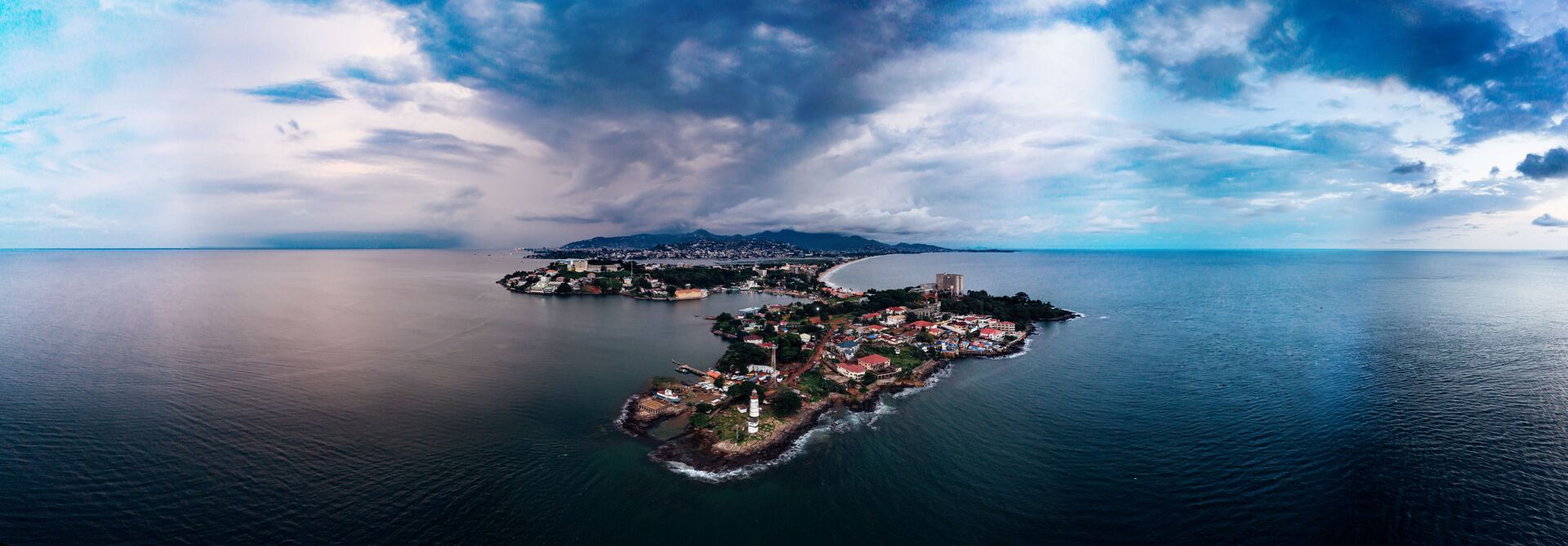
Equatorial Guinea is two things stitched together: Río Muni, a slab of mainland between Cameroon and Gabon, and a set of islands in the Gulf of Guinea, principally Bioko — which the Europeans called Fernando Pó — and the tiny, remote Annobón, some six hundred kilometres out in the Atlantic.
They have different peoples, different histories and different economies. The mainland is Fang. Bioko's indigenous people are the Bubi. Annobón's population descends largely from enslaved Africans brought there by the Portuguese.
Portugal claimed the islands first and handed them to Spain in 1778.
Britain then leased Fernando Pó in the nineteenth century as a base for its anti-slavery naval squadron — which is why there is an old Krio-speaking community on Bioko descended from people freed from slave ships.
Spain took direct control late, and did very little with the mainland until the twentieth century.
What it did develop was cocoa on Bioko — and it did so with imported labour, tens of thousands of workers brought in from Nigeria, and earlier under contracts from Liberia that caused an international scandal in the 1920s and 1930s.
By the 1960s Spanish Guinea was, by the raw numbers, one of the more successful colonies in Africa.
Cocoa and timber gave it one of the highest per-capita incomes on the continent. Spanish missionary schooling had produced what was reported as one of the highest literacy rates in Africa. There were roads, a hospital system, electricity in the towns.
It is worth saying plainly that this is often cited as a defence of Spanish colonialism and it is not one. The prosperity was built on imported contract labour on the cocoa plantations; the Bubi of Bioko had been progressively dispossessed of their land; and political rights for Africans were essentially nil under a Spanish state that was itself a fascist dictatorship under Franco.
But the figures are the figures, and they are what makes what happened next so shocking.
Spain was under sustained pressure at the United Nations to decolonise, and Franco's government moved reluctantly.
A constitution was approved by referendum in August 1968 and elections held in September. Three main candidates stood, and the run-off was won by Francisco Macías Nguema — a Fang from the mainland, a former colonial civil servant who had held minor administrative posts under the Spanish.
On 12 October 1968, Equatorial Guinea became independent.
Macías was sworn in as president.
Five months later, in March 1969, the foreign minister Atanasio Ndongo Miyone — who had been one of the defeated presidential candidates' allies and a nationalist leader in his own right — attempted a coup.
It failed. Ndongo was captured and killed.
Macías blamed Spain. Spanish residents left almost overnight in a mass exodus, taking the technical and commercial class of the country with them.
And Macías used the coup attempt as the licence for everything that followed.
In 1970 he merged all parties into one. In 1972 he declared himself president for life. He gave himself a string of titles including the Unique Miracle, and required that God had created Equatorial Guinea thanks to Macías be included in public liturgy.
Then he set about the destruction of his own country, and there is no other accurate way to describe it.
He killed the educated. Anyone with a foreign degree, anyone who had held office, anyone who could run anything. Estimates suggest that around two-thirds of the members of the National Assembly elected in 1968 were killed, and almost the entire senior civil service.
He closed the schools. Education was suspended. The word intellectual was banned from official use.
He banned fishing and had boats destroyed, to stop people escaping by sea.
He closed the hospitals and expelled the doctors. Medicine was denounced as a foreign contrivance.
He destroyed the economy entirely. The cocoa plantations collapsed when the Nigerian workers were withdrawn by their own government after mass abuses — some thirty thousand of them evacuated in the mid-1970s. Output fell to almost nothing. Currency became worthless. The national treasury was reportedly kept in bags at his compound in the village of Nsangayong.
And on Christmas Eve 1975, according to the accounts that circulate and are widely reported, around 150 opponents were shot in the national stadium in Malabo, while loudspeakers played popular music and some of the soldiers were dressed for the occasion.
He was assisted by advisers from Cuba, the Soviet Union, China and North Korea, and protected by a personal guard. The prison at Black Beach in Malabo became one of the most notorious in Africa.
Equatorial Guinea's population at independence was around 300,000.
Estimates of those killed under Macías run from 50,000 to 80,000. Around 125,000 more fled into Cameroon, Gabon and Spain.
Taken together, somewhere between a third and two-thirds of the entire population was killed or driven out in eleven years.
The country acquired a nickname in the international press of the period, and it is the only African state ever described that way: the Dachau of Africa.
Almost nobody outside the region noticed at the time. Equatorial Guinea had no strategic value in 1975, no minerals anybody wanted, and a population smaller than a mid-sized European city.
He was overthrown by his nephew.
Lieutenant-Colonel Teodoro Obiang Nguema Mbasogo had been Macías's minister of defence — and, before that, the commander of Black Beach prison.
The fighting lasted two weeks and killed around four hundred people. Macías fled toward Cameroon and was captured on 18 August.
He was tried by a military tribunal and convicted of genocide, mass murder, embezzlement and violations of human rights.
He was executed by firing squad on 29 September 1979.
There is a detail about that execution which says a great deal about the country he had made. Equatoguinean soldiers were reportedly unwilling to shoot him, fearing his supposed supernatural powers. Moroccan troops carried out the sentence.
Set it against every other page on this website.
Lumumba: no conviction. Um Nyobè: no conviction. Olympio: no conviction. Boganda: no inquiry. Rwagasore: no inquiry. Sankara: thirty-five years to a verdict in absentia. The Ikiza in Burundi: nobody charged. Habré: twenty-five years and a court that had to be invented.
Equatorial Guinea tried and executed its dictator for genocide within two months.
It is by a very long way the fastest reckoning in this entire series.
And it was carried out by the man who had run his prison — who has now governed for forty-six years.
Teodoro Obiang Nguema Mbasogo has been in power since August 1979.
He is, excluding monarchs, the longest-serving head of state in the world.
The comparison with Macías is the one his government invites, and it is fair as far as it goes. Schools reopened. Some hospitals and roads were restored. The mass killing stopped. Nobody seriously argues that Obiang's Equatorial Guinea is Macías's Equatorial Guinea.
But it is a family state, and it is a closed one.
Elections since 1991 have been contested only nominally; he was returned in 2022 with 94.9 per cent for a sixth term. Opposition figures have been imprisoned and exiled. Black Beach is still there. In 2003, state radio announced that the president was like God in heaven, that he had power over men and things, and that he could decide to kill without being called to account.
He says he has survived at least ten coup and assassination attempts, and the fear of them is structural: his bodyguard is drawn from his own clan, and foreign personnel have been employed to guard the palace.
The United Nations has documented at least twelve mercenary-involved coup attempts in Equatorial Guinea since 1979.
In 1995 the Zafiro field came in, and everything changed.
Equatorial Guinea became one of the largest oil producers in sub-Saharan Africa. Between the mid-1990s and the late 2000s, its GDP rose by more than 5,000 per cent. By GDP per capita it became, on paper, one of the richest countries in Africa — comparable in that single measure to parts of Europe.
Living standards for its people did not substantially improve.
Human Rights Watch's investigation into the boom was titled, accurately, Well Oiled, and its finding was that the oil revenues had been used to entrench and enrich the ruling family rather than to develop the country. Large parts of the population remained without reliable clean water or electricity, in a state with one of the highest per-capita incomes on the continent.
Malabo acquired conference centres and a presidential complex. A new capital, Ciudad de la Paz, was begun in the rainforest.
Teodoro Nguema Obiang Mangue — Teodorín — is the president's eldest son. He was born in 1969, was made First Vice-President in 2016, became defence minister in 2018, and is the heir apparent.
He is also, by some distance, the most comprehensively convicted African official of his generation.
In 2017 the Paris Criminal Court found him guilty of laundering embezzled public funds, misuse of corporate assets, breach of trust and corruption. The Court of Appeal increased the sentence in February 2020, and on 28 July 2021 France's highest court, the Cour de Cassation, upheld the conviction: a three-year suspended prison sentence, a €30 million fine, and the confiscation of around €150 million in assets — which, under French law, are to be returned to the people of Equatorial Guinea.
The assets included a 101-room mansion on Avenue Foch in Paris valued at over €100 million, with a cinema, a spa and gold-leaf taps; a seventy-six-metre yacht; a fleet of supercars seized in Geneva; and a collection of Michael Jackson memorabilia.
The United States and Britain have pursued their own forfeitures. Spain has investigated eleven family members and associates. Equatorial Guinea took France to the International Court of Justice over the seizure of the Avenue Foch building.
His personal wealth has been estimated at around six hundred million dollars.
And in 2022 he was made head of Equatorial Guinea's national anti-corruption commission, established to satisfy conditions attached to an International Monetary Fund loan.
Analysts have described that commission as having become an instrument for purging rivals.
A man convicted of corruption in France runs the anti-corruption commission of the country he was convicted of stealing from.
An investigation published by the ICIJ in May 2025 traced further millions routed to a company he owned, as the oil revenues declined.
In March 2004 a Boeing 727 carrying around seventy men landed at Harare to collect weapons.
They were arrested. They were mercenaries, mostly South African, led by the British former SAS officer Simon Mann, and they were on their way to Malabo to overthrow Obiang and install an exiled opposition figure.
The financing and backing became a long-running scandal in Britain. Mark Thatcher, son of the former prime minister, pleaded guilty in South Africa to unwittingly helping to fund a helicopter for the operation. The Lebanese-British oil trader Ely Calil was repeatedly named and denied involvement; he died in 2020.
Participants were reportedly promised $1.8 million up front, plus oil concessions.
Mann was jailed in Zimbabwe, extradited to Equatorial Guinea, held at Black Beach, and pardoned in 2009.
It became known as the Wonga Coup — wonga being British slang for money — and it is the most complete modern illustration of a fact this website keeps encountering: that a small African state sitting on oil attracts men with aircraft.
The 2004 plotters were not liberators and nobody should pretend otherwise. They were being paid, and the payment included oil rights. Equatorial Guinea's people were not consulted about their own coup.
But the government's use of that episode has been its own kind of dishonesty. Every subsequent crackdown, every mass arrest, every claim of a foreign plot has been justified by reference to 2004 — and the fear of coups has become the governing logic of the state.
There is also a claim about Obiang that circulates widely and which this page will not repeat as fact: that he practises cannibalism. It appears in critical press coverage, it is presented as what critics say rather than as anything established, and it belongs in exactly the same category as the cannibalism stories told about Idi Amin.
The documented record — a family that has ruled for forty-six years, an oil boom that enriched that family while its people went without water, a son convicted in three jurisdictions — is damning enough. A regime does not need a monster story, and printing one is how you hand it a defence.
And there is the Spanish question. Spain has never seriously reckoned with its role here. It held the colony under a fascist dictatorship, decolonised in haste and without preparing anyone to govern, and then watched from across the water while a third of the population it had ruled was killed or driven out. There has been no Spanish inquiry and no Spanish apology.
Macías was Equatoguinean, and what he did was his. The state he did it to was handed over in 1968 by a European dictatorship that had never permitted a single African to hold real power in it.
Because it is the clearest demonstration on the continent that the transfer of a flag to a state nobody has been prepared to run is not a neutral act.
Equatorial Guinea had money, schools, a literacy rate other African countries envied, and a functioning economy. Within eleven years it had lost between a third and two-thirds of its population, and every institution in it.
And because it is the only country in this entire series where a dictator was convicted of genocide against his own people and shot within two months — and the country is no more free for it, because the man who did the shooting has been in power ever since and is preparing to hand it to his son.
The fastest justice in African history produced forty-six years of one family.
There is a prison at Black Beach in Malabo, whose former commander has governed the country since 1979.
There is a mansion on Avenue Foch in Paris with a hundred and one rooms, confiscated by a French court, whose value is supposed to be returned to the people it was taken from.
There is an anti-corruption commission chaired by a man convicted of corruption.
There is a new capital being cut into the rainforest for a country of under two million people.
There is a stadium in Malabo where, on Christmas Eve 1975, opponents of the government were shot to music.
There is a national literacy rate that was once among the highest in Africa, and a generation that lost its schooling entirely between 1968 and 1979.
And there is oil, now in decline, which arrived in 1995 and made one family extraordinarily rich.
Updated and fact-checked: 11 September 2026.
How this page was checked. Dates and events were verified against the sources listed above. Independence from Spain on 12 October 1968 under Francisco Macías Nguema, the failed coup attempt by foreign minister Atanasio Ndongo Miyone in 1969 and the subsequent exodus of Spanish residents, the establishment of one-party rule in 1970 and the declaration of a life presidency in 1972, the coup of 3 August 1979 led by Teodoro Obiang Nguema Mbasogo, Macías's capture on 18 August and his execution by firing squad on 29 September 1979 following conviction for genocide, the discovery and development of offshore oil from the mid-1990s, the interception of the 2004 coup attempt in Harare, Teodorín's appointment as First Vice-President in 2016 and as head of the national anti-corruption commission in 2022, his conviction in Paris in 2017, the increase of sentence on appeal in February 2020 and its confirmation by the Cour de Cassation on 28 July 2021 with confiscation of assets valued at around €150 million, and Obiang's re-election in 2022 with 94.9 per cent are as recorded. Casualty and population figures are estimates and are given as ranges: deaths under Macías are variously estimated at between 50,000 and 80,000 out of a population of around 300,000, with a further 125,000 reported to have fled; around 400 are reported killed in the 1979 coup. No official count exists for any of these figures. The reported mass execution at the Malabo stadium on Christmas Eve 1975, including the details of its staging, is widely reported and is presented here as reported rather than as independently established. This page does not repeat allegations of cannibalism made against President Obiang by critics, because they are not established; they are noted only as an example of a category of claim this site declines to print. Assets confiscated by French courts are, under French law, to be returned for the benefit of the people of Equatorial Guinea; the mechanism for doing so remains a matter of ongoing process. Equatorial Guinea brought proceedings against France before the International Court of Justice concerning the seizure of the Avenue Foch property. This page makes no allegation against any living person beyond convictions already on the public record.
Written and researched by Remo Kurka · africanindependence.com
We strive to unify diverse narratives from across Africa, showcasing the continent's shared heritage and unique stories.
Our mission is to honor and preserve the history of African cultures and independence movements for future generations.
We provide a platform for innovative exchange of ideas, resources, and insights, understanding that knowledge should be accessible to all.