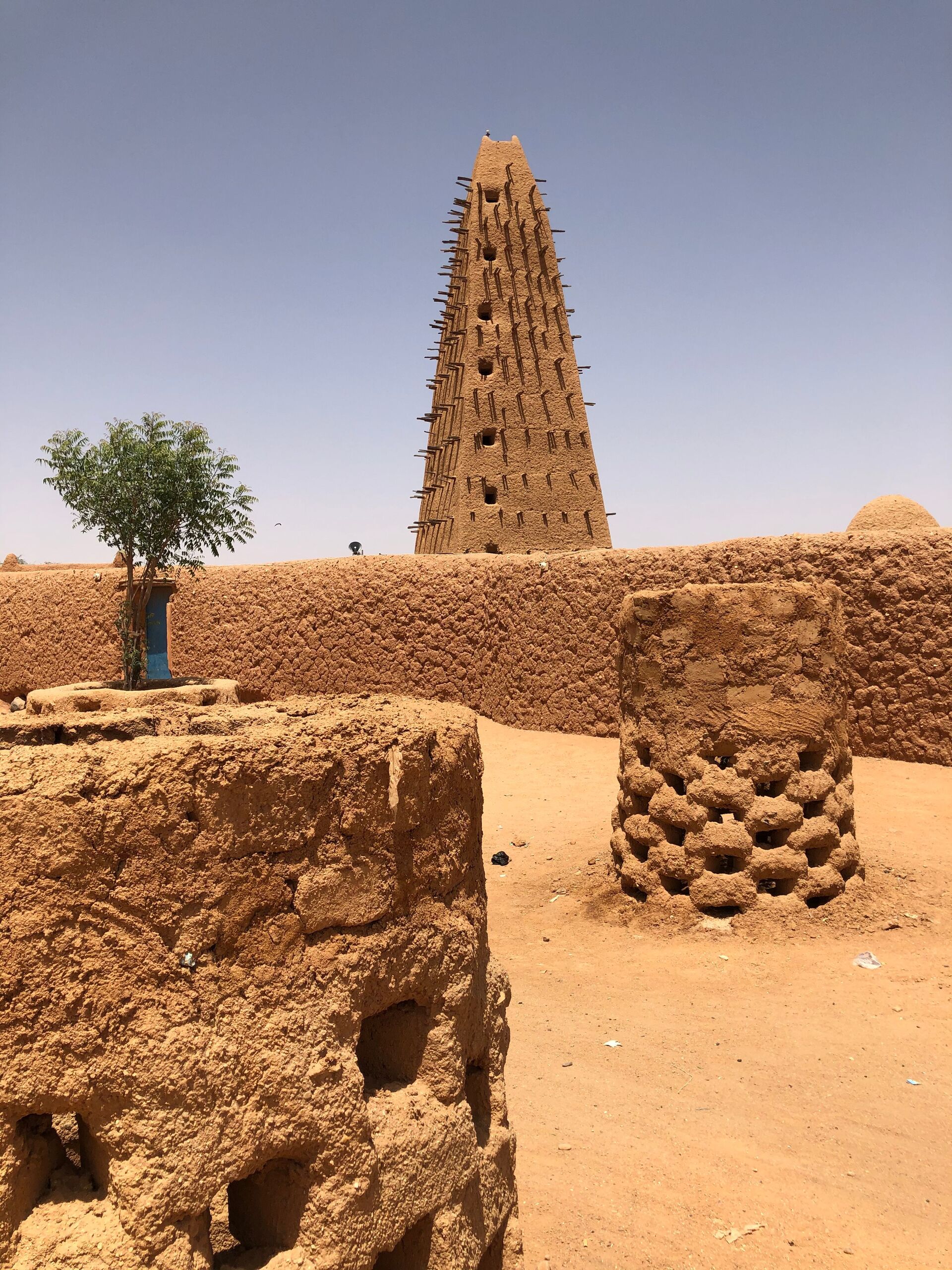
Mali, the historic Agadez mosque
Independence Day: 22 September 1960. The country took its name from a medieval empire that was, by several measures, the richest state on earth — one whose ruler gave away so much gold crossing Egypt on pilgrimage in 1324 that the price in Cairo is recorded as having stayed depressed for years afterwards. Today Mali is the third-largest gold producer in Africa. Since September 2025 its capital has been under an economic blockade, imposed not by a state but by an armed group that simply burns the tankers on the roads in.
Mali is where the two stories this website tells collide hardest.
The first is the story Europe erased: that West Africa had literate, wealthy, administratively sophisticated empires when much of Europe did not. Mali is the best evidence there is. Timbuktu was a university city. The manuscripts exist, they can be read, and there are hundreds of thousands of them.
The second is the story that is happening now: a country that was held up as West Africa's democratic model for twenty years, and which has since had four coups, lost most of its territory to armed groups, expelled the French, expelled the United Nations, hired the Russians, watched the Russians pull back, and is now being strangled by a blockade of its own fuel supply.
And the hinge between the two is 2012 — the year the weapons came south from Libya. Read the Libya page on this site first if you have not. What happened in Mali is the most direct consequence of that intervention anywhere, and almost nobody in Europe connects the two.
Mali, the historic Agadez mosque
Three great states rose in succession on the bend of the Niger.
Ghana — no relation to the modern country, which took the name deliberately — controlled the trans-Saharan gold trade from roughly the eighth century.
Mali succeeded it. Sundiata Keita founded it around 1235; the Epic of Sundiata is still performed by griots today and is one of the great works of world oral literature. At its height the empire ran from the Atlantic to beyond the Niger bend.
In 1324, Mansa Musa made the pilgrimage to Mecca with a caravan that Arab chroniclers described in astonished detail: thousands of people, and gold distributed at every stop. The economic consequence is the detail that has travelled furthest — the value of gold in Cairo is recorded as having fallen and stayed low for years after he passed through.
Fifty years later, the Catalan Atlas of 1375 drew him on the map of the world, seated, holding a gold nugget. A West African emperor was, in the European imagination of the fourteenth century, the richest man alive.
Then Songhai, under Askia Muhammad from 1493 — a state with a professional army, a river navy, provincial governors, and a legal and educational establishment.
And Timbuktu. The Sankore mosque and its associated scholarly networks made it one of the significant centres of learning in the Islamic world, teaching law, theology, astronomy, mathematics and medicine. Books were a major import and a major industry.
The manuscripts survived. Tens of thousands of them, and by some counts hundreds of thousands, held in family libraries and passed down for centuries: works of jurisprudence, astronomy, correspondence, poetry, commercial records.
Remember them. They come back into this story in 2012.
Songhai was destroyed in 1591 by a Moroccan army equipped with firearms, and the region fragmented.
France took the Niger valley in a long campaign through the 1880s and 1890s, against Umar Tall's Toucouleur empire and, further west, against Samori Touré, whose twenty-year resistance is described on the Guinea page of this site.
It became French Sudan, part of French West Africa, and was administered as what it looked like on a map from Paris: a large, dry, poor interior with no coast.
The one major colonial project was the Office du Niger, begun in the 1930s — a vast irrigation scheme in the inland delta intended to grow cotton for French mills. It was built substantially with forced labour, resettled tens of thousands of people, and never came close to its production targets.
Independence arrived twice, and quickly.
In January 1959, French Sudan and Senegal joined as the Mali Federation, which became independent from France in June 1960. It lasted about two months. Political and personal differences between Dakar and Bamako broke it in August 1960.
On 22 September 1960 the Republic of Mali declared its own independence, keeping the name of the empire, with Modibo Keïta as president.
Keïta took the radical route. He built a one-party state, aligned with the Eastern bloc, nationalised widely, and — most consequentially — left the franc zone in 1962 and issued a Malian franc. It was a genuine assertion of sovereignty, and it produced an inconvertible currency, shortages and smuggling. By 1967 he was negotiating his way back towards the franc.
On 19 November 1968 the army removed him. He died in detention in 1977.
Moussa Traoré ruled from 1968 to 1991. A single party from 1979, detention of opponents, and — as the defining experience of two generations — drought.
The Sahel droughts of 1968–74 and 1983–85 devastated the north. Herds died, wells failed, and the pastoral economy of the Tuareg, Fulani and Moorish north was broken. Hundreds of thousands moved south or left the country entirely.
A great many young Tuareg men went to Libya, where Gaddafi recruited them into his Islamic Legion and his armed forces. They were trained, armed and paid. That is a direct causal line from a drought in 1973 to a rebellion in 2012, and it runs through Tripoli.
26 March 1991. After months of student and trade union protest, security forces fired on demonstrators in Bamako; the dead ran into the hundreds. Within days Lieutenant Colonel Amadou Toumani Touré removed Traoré.
And then he handed power to civilians. A national conference, a new constitution, and elections in 1992 won by Alpha Oumar Konaré. Touré went back to barracks and later retired.
That was, at the time, almost unheard of, and it is why Mali spent the next twenty years as the West African country donors pointed to.
Konaré served two terms and stepped down in 2002. Touré returned as an elected civilian president and served until 2012.
On paper: multiparty elections, a free press, a decentralisation programme, and a famous cultural life — the Festival au Désert, Ali Farka Touré, Salif Keïta, Tinariwen, Toumani Diabaté, the Rail Band.
Underneath: an army that was corrupt and under-equipped, a political class that governed by consensus in a way that left no real opposition, an administration that had effectively withdrawn from the north, and a growing trade in cocaine and cigarettes across the Sahara in which officials and armed groups both took a share.
The Tuareg question was never settled, only postponed. There had been risings in 1963, in 1990–95 and in 2006, each ending in an agreement about development and integration that was largely not implemented.
Everything arrived at once.
Gaddafi fell, and the Malian and Nigerien Tuareg who had served in his forces came home — with vehicles, heavy weapons and experience.
In January 2012 they launched a rebellion as the MNLA. On 6 April 2012 they declared the independent state of Azawad, covering the northern two-thirds of Mali.
But by then they had lost control of their own rebellion. Ansar Dine, AQIM and MUJAO — Islamist groups with money, weapons and foreign fighters — pushed the MNLA aside and took the northern cities: Kidal, Gao, Timbuktu.
And in the south, on 22 March 2012, a group of soldiers led by Captain Amadou Sanogo overthrew the government — three weeks before a presidential election in which the incumbent was not standing.
A coup to fix a war, three weeks before a vote, which then lost the north entirely.
In the occupied north, the armed groups imposed a legal order of their own: amputations, floggings, forced marriages, executions.
And in Timbuktu they began destroying the tombs.
The city's mausoleums of Sufi saints — some of them centuries old, integral to how the city is lived in and worshipped in, and inscribed as World Heritage — were attacked with pickaxes and bulldozers in mid-2012. The door of the Sidi Yahya mosque, which local tradition held should stay shut until the end of the world, was broken open.
And then the librarians moved.
Abdel Kader Haidara and a network of families, archivists and drivers organised the evacuation of the manuscripts. They were packed into footlockers, trunks and rice sacks and moved out of Timbuktu — by road past checkpoints, and by boat down the Niger — to Bamako. Something in the order of 350,000 manuscripts were saved. Some were lost; a smaller number were burned in the final days of the occupation.
In 2016 the International Criminal Court convicted Ahmad al-Faqi al-Mahdi of the war crime of intentionally directing attacks against historic monuments and buildings dedicated to religion, and sentenced him to nine years. He pleaded guilty and apologised.
It was the first conviction in the history of international criminal law for the destruction of cultural heritage, and the Court later issued a reparations order on behalf of the people of Timbuktu.
That precedent matters far beyond Mali, and this network has said so before: heritage destruction is now, in law, a prosecutable war crime with a named defendant, a sentence and a reparations order. It took a Malian city and a Malian prosecution team to establish it.
France intervened in January 2013 — Operation Serval — when the Islamist columns moved south towards Bamako. It was militarily successful and genuinely welcomed; there were French flags in the streets of Timbuktu.
Serval became Barkhane, a regional counter-terrorism operation across five countries, and it stayed for nine years.
The United Nations deployed MINUSMA in 2013. It became the deadliest peacekeeping mission in UN history, with over three hundred personnel killed.
The Algiers Accord of 2015 was signed with the northern armed groups. Its core provisions on decentralisation and integration were never substantially implemented.
And the war spread. Out of the north it moved into central Mali, where it stopped being about Azawad and became communal — armed groups recruiting among Fulani herders, self-defence militias forming among Dogon and Bambara farmers, and massacres in both directions. At Ogossagou in March 2019, around 160 Fulani villagers, including women and children, were killed in a single morning.
By 2020 Malians had concluded, not unreasonably, that eight years of French and UN presence had produced more territory outside government control, not less.
18 August 2020: after months of mass protests led by the M5-RFP movement and the influential imam Mahmoud Dicko, officers removed President Ibrahim Boubacar Keïta. The crowds cheered.
24 May 2021: the same officers removed the civilian transitional president and prime minister they had installed. Colonel Assimi Goïta took the presidency himself.
December 2021: Russian Wagner Group personnel arrived.
March 2022: Moura. A UN human rights investigation found that Malian armed forces and foreign military personnel killed at least 500 people over five days in the village of Moura in central Mali, and that most were unlawfully executed. The government rejected the findings and called it a successful operation against terrorists.
August 2022: France completed its withdrawal, expelled.
2023: Mali demanded the departure of MINUSMA, and the mission left by the end of the year — after ten years and hundreds of dead.
November 2023: Malian forces with Wagner support took Kidal, the northern town that had been outside state control for eleven years. It was presented as the vindication of the whole strategy.
July 2024: Tinzaouaten. A Malian and Wagner column was ambushed near the Algerian border by Tuareg fighters and JNIM. It was one of the worst defeats either force had suffered, with dozens of Russians and Malians killed.
September 2023: Mali, Burkina Faso and Niger formed the Alliance of Sahel States. In January 2024 they announced their withdrawal from ECOWAS, which took effect in January 2025 — the first departures in the bloc's history.
May 2025: all political parties were dissolved by decree. July 2025: a law granted Goïta a five-year presidential mandate, renewable, without election.
June 2025: Wagner announced its departure and was replaced by Africa Corps, the Russian defence ministry's own formation.
On 3 September 2025, JNIM announced an economic blockade of Mali's main cities, including Bamako.
The method is simple and it does not require taking a city. Mali is landlocked and imports roughly 95 per cent of its fuel by road, from Senegal and Côte d'Ivoire. JNIM attacks the tankers.
More than 300 tankers have been burned.
The effects arrived within weeks: rationing, with military and government use prioritised; queues at filling stations; a capital visibly darker at night as generators went unfed. Schools and universities in Bamako were closed between October and November 2025. In late October the United States and Britain told their nationals to leave the country and drew down their embassies.
In January 2026 the government appointed a general to lead the response. Convoys now move under armed escort, and are attacked anyway — in early February 2026, at least fifteen people were killed in an attack on a convoy near the Senegalese border.
JNIM is not trying to storm Bamako. It is applying economic pressure to a government that cannot protect the roads, and it has also learned to fly: recorded armed drone strikes by the group rose from fewer than ten in 2024 to around eighty in 2025.
And then the blockade became an offensive.
In April 2026, JNIM and the Front de Libération de l'Azawad launched the largest coordinated operation since the 2012 rebellion, striking Bamako itself, the garrison town of Kati, and Gao, Sévaré and Mopti.
Mali's Defence Minister, Sadio Camara, was killed. He was one of the core officers of the 2020 and 2021 coups and the architect of the Russian relationship. President Goïta responded by appointing himself Defence Minister.
On 26 April 2026 Kidal fell — thirty months after it had been retaken. Through May, Russian Africa Corps forces were reported to have pulled out of the northern positions entirely: Kidal, Tessalit, Aguelhok.
Africa Corps was reported to have reinforced with around a thousand additional personnel from June 2026, and the junta has been reported to be turning towards Turkish drones and to be in discussions with Ankara, Tehran and Beijing.
Whatever else is true, the security model Mali bought in 2021 has not delivered what was promised, and every African government weighing the same arrangement is watching what happens in Bamako.
Here is the part that should be unbearable to read.
Mali is one of Africa's largest gold producers. Loulo-Gounkoto, Syama, Fekola, Morila — industrial mines run by foreign operators, alongside an enormous artisanal sector employing hundreds of thousands of people.
In 2023 the junta introduced a new mining code raising the state's share. The dispute that followed with Barrick, the operator of the Loulo-Gounkoto complex, ran through 2025: employees detained, gold stock seized, the complex placed under state-appointed administration, and international arbitration.
So the position is this. Mali exports gold. It cannot refine it at home. It cannot get the fuel in to run the country. Its capital is dark at night. Its treasury is fighting its largest taxpayer in an arbitration tribunal. And the mines themselves have so far been spared only because they sit in the south-west, away from where the fighting is — an accident of geology, not of policy.
Seven hundred years after Mansa Musa moved the gold price in Cairo, Mali is a gold exporter queueing for diesel.
Three reasons.
Because Mali refutes the oldest lie about Africa. There were universities here, and libraries, and legal scholarship, and a currency, and a bureaucracy, at a time when European visitors were impressed. The manuscripts are not a theory. They are in boxes in Bamako, and there are hundreds of thousands of them, because Malians carried them out by river in 2012 while men with pickaxes were destroying the tombs.
Because Mali is where the Libya intervention came to rest. The weapons and the fighters that crossed the Sahara after 2011 turned a manageable Tuareg grievance into a war that has now consumed three countries. The UK parliamentary committee that examined the Libyan intervention said the same thing, and this is what it looks like on the ground.
And because Mali is the test case for what comes after the West. France was invited in and then expelled. The UN was demanded and then evicted. The Russians were hired and are pulling back from the north. ECOWAS was left. The elections have been abolished by decree.
The state has tried every available external patron in fourteen years, and the roads into its capital are still cut. Anyone who believes the Sahel's problem is simply the wrong foreign partner has to explain Bamako in 2026.
The 2020 coup was genuinely popular and it followed months of peaceful mass protest against an elected government widely seen as corrupt and incapable. Dismissing it as a mere seizure of power ignores why people were in the street.
The French intervention of 2013 was requested, was necessary, and saved Bamako. Malians welcomed it at the time. What it could not do was build a state, and by 2022 it had become the thing Malians blamed. Both of those are true, and the resentment is not irrational: nine years of foreign forces, and more territory lost.
The Tuareg grievance is real and predates everything. Northern Mali was neglected by Bamako for fifty years, and the risings of 1963, 1990 and 2006 were each settled with promises that were not kept. It is also true that the 2012 declaration of Azawad was made by a minority faction, that the region is ethnically mixed, and that the MNLA lost control of its own rebellion within weeks.
The Malian army has committed mass atrocities, at Moura and elsewhere, documented by the United Nations and disputed by the government. Those killings recruit for JNIM more effectively than any sermon.
And Malians are not spectators in their own country. The griots, the librarians, the musicians who kept playing when music was banned in the north, the trade unions that brought down Traoré, the officers who handed power back in 1992 — this is a society with enormous capacity. It is currently governed by decree, with no parties, no elections, and a fuel queue.
Two things are true. Mali carries one of the greatest intellectual inheritances on the continent, and saved it, by hand, under occupation. And its capital has been under siege for a year.
There is an epic about a boy who could not walk, sung by griots who memorised it for eight hundred years.
There is an emperor drawn on a European map in 1375, holding a piece of gold, because he was the richest man anyone could name.
There is a note in the Egyptian chronicles that the price of gold in Cairo did not recover for years after he passed through.
There is a mosque at Sankore that taught law and astronomy while Europe was arguing about whether to.
There is an irrigation scheme in the inland delta built with forced labour to grow cotton for Lyon.
There is a federation with Senegal that lasted two months.
There is a currency issued in 1962 to prove that independence was real, and abandoned because it did not work.
There are herds that died in 1973, and the young men who went to Libya to be paid to carry a rifle.
There are tombs in Timbuktu broken with pickaxes in 2012, and a mosque door opened that was meant to stay shut.
There are three hundred and fifty thousand manuscripts that went out of that city in trunks and rice sacks, past checkpoints and down a river.
There is a judgment of the International Criminal Court in 2016, the first anywhere for destroying a people's heritage.
There is a village called Moura, and five days in March 2022, and at least five hundred people.
There is a defence minister killed in April 2026, and a president who took the job himself.
There is a town called Kidal that was lost, retaken after eleven years, and lost again after thirty months.
And there are more than three hundred burned tankers on the roads from Dakar and Abidjan, and a capital that goes dark at night, in a country that exports gold.
Updated and fact-checked: 14 September 2026.
How this page was checked. Recent developments were verified against the sources listed above; the earlier history was checked against standard reference works on the Sahelian empires, French West Africa and modern Mali. The succession of the Ghana, Mali and Songhai empires, Mansa Musa's pilgrimage of 1324 and its recorded effect on gold prices in Cairo, his depiction in the Catalan Atlas of 1375, the scholarly role of Timbuktu and Djenné, the Moroccan destruction of Songhai in 1591, the French conquest and the creation of French Sudan, the Office du Niger, the Mali Federation with Senegal and its collapse, independence on 22 September 1960, the departure from the franc zone in 1962, the coup of 19 November 1968 and the death of Modibo Keïta in detention in 1977, the Sahel droughts, the killings of 26 March 1991 and the handover to civilian rule in 1992, the Tuareg risings of 1963, 1990–95 and 2006, the MNLA rebellion and the declaration of Azawad on 6 April 2012, the coup of 22 March 2012, the destruction of the Timbuktu mausoleums and the evacuation of the manuscripts, Operation Serval and the deployment and later expulsion of MINUSMA, the 2015 Algiers Accord, the killings at Ogossagou in March 2019, the conviction of Ahmad al-Faqi al-Mahdi by the International Criminal Court in 2016, the coups of August 2020 and May 2021, the arrival of Wagner personnel in December 2021 and their replacement by Africa Corps in 2025, the events at Moura in March 2022, the formation of the Alliance of Sahel States and the withdrawal from ECOWAS, the dissolution of political parties in May 2025 and the granting of a five-year renewable mandate in July 2025, the JNIM blockade declared on 3 September 2025, and the April 2026 offensive including the death of Defence Minister Sadio Camara are as recorded. Figures are estimates and are disputed where indicated: the number of manuscripts evacuated from Timbuktu is generally given as around 350,000; the dead of 26 March 1991 are estimated in the hundreds; the killings at Moura were put by a United Nations human rights investigation at at least 500, a finding rejected by the Malian authorities, and both positions are recorded here; casualty figures for the April 2026 offensive and for the blockade attacks are as reported and have not been independently verified. Reports of the withdrawal of Russian Africa Corps forces from northern positions in April and May 2026 are drawn from open-source security reporting and have not been officially confirmed. The dispute between the Malian state and Barrick concerning the Loulo-Gounkoto complex is the subject of international arbitration and has not been determined; nothing here should be read as a finding against either party. This page makes no allegation against any living person beyond matters already on the public record.
Written and researched by Remo Kurka · africanindependence.com
We strive to unify diverse narratives from across Africa, showcasing the continent's shared heritage and unique stories.
Our mission is to honor and preserve the history of African cultures and independence movements for future generations.
We provide a platform for innovative exchange of ideas, resources, and insights, understanding that knowledge should be accessible to all.