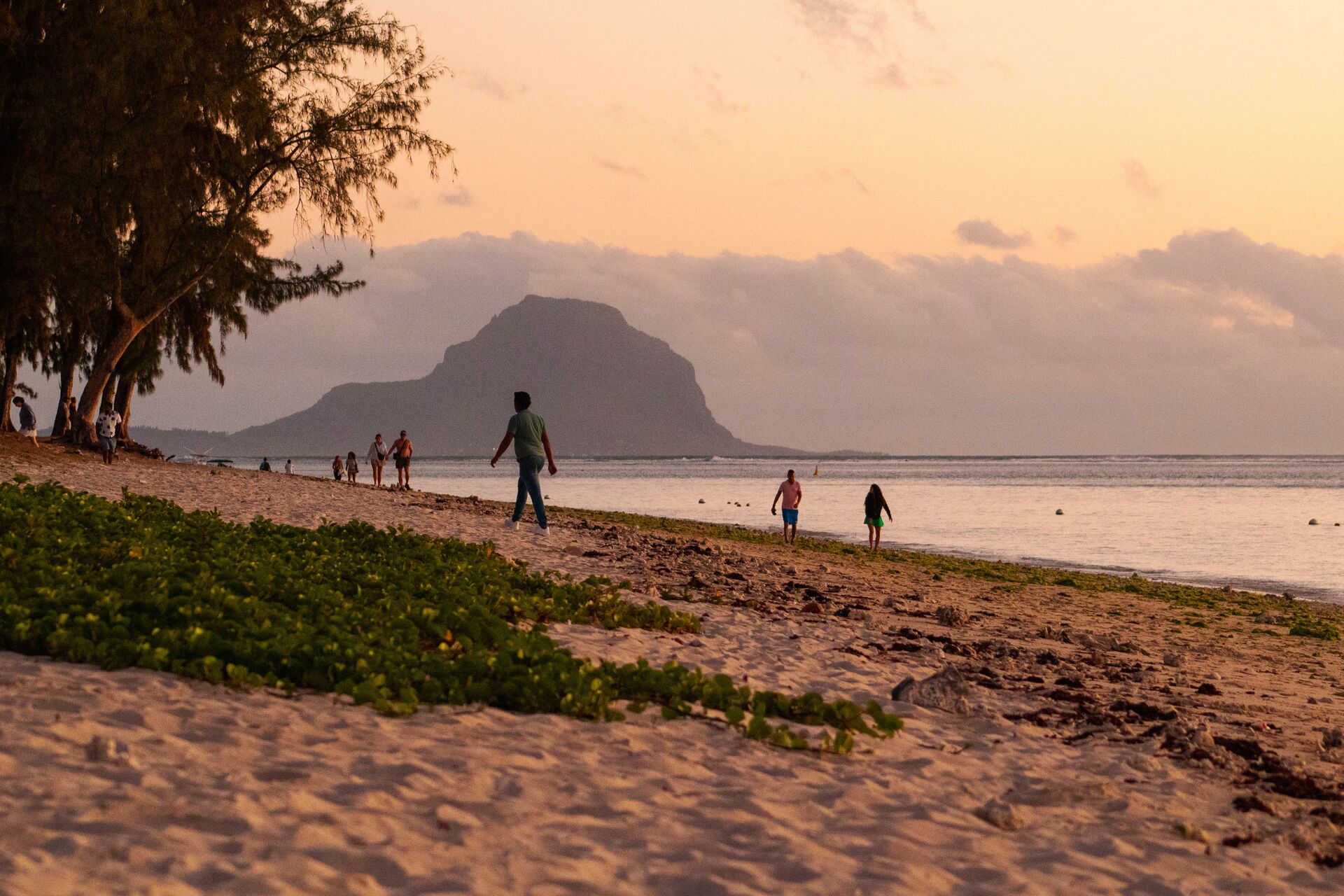
Mauritius and le Morne Brabant at background
Independence Day: 12 March 1968. Nobody lived on Mauritius until Europeans arrived — there is no indigenous population, because there never was one. Everyone on the island is descended from someone who was brought there, enslaved or indentured or in search of work. In 1961 a future Nobel laureate in economics examined the place and concluded it was heading for disaster. It became the wealthiest functioning democracy in Africa. And three years before independence, Britain cut off a third of its territory, deported the people living on it, and leased the largest island to the United States in exchange for a discount on missiles.
Two things, and they are opposites.
Mauritius is the single clearest African success story on this website. No coup, ever. Twelve general elections since independence, with governments regularly voted out. A free press, an independent judiciary, universal free education and health care, and a transition from a one-crop colonial economy to a diversified one that carried the country into the World Bank's high-income category.
And Mauritius is the site of an unfinished colonial crime that is still being litigated in 2026 — a population deported to make room for a military base, who have spent fifty years in the slums of Port Louis and in Crawley, and who were not at the table when the deal about their homeland was finally signed.
The country that did everything right, and the archipelago that proves being right is not enough.
Mauritius and le Morne Brabant at background
This is the fact that changes everything else.
Mauritius had no human population when Europeans arrived. Arab and Malay sailors knew of it; nobody settled. It was forest, and it held animals that had never met a predator — including a large flightless pigeon that the Dutch called the dodo.
The Dutch held it from 1598, named it after Maurice of Nassau, cut the ebony, introduced sugarcane, deer, pigs and rats, extinguished the dodo, and left in 1710 because the place was too difficult.
The French came in 1715, called it Île de France, and built it properly: Port Louis, a naval base, roads, and above all sugar plantations — worked by enslaved people brought from Madagascar, Mozambique and East and West Africa. Under Mahé de La Bourdonnais it became the strategic key to the Indian Ocean, and French privateers operating from it were a serious problem for British shipping.
The British took it in 1810 and kept it at the peace. And here they did something unusual: they left the French language, the French civil law and the French planter class in place. That is why a British colony for 158 years is still culturally French, speaks a French-based Creole, and runs a legal system that is a hybrid of the Code Napoléon and English common law.
Slavery was abolished in the British Empire in 1834–35. In Mauritius, as everywhere, compensation was paid — to the owners. Around two million pounds went to Mauritian slaveholders for the loss of their property. The people who had been that property received nothing at all.
Most of them walked off the estates immediately and refused to go back, which is what the planters had feared.
Le Morne Brabant, the basalt mountain on the south-western tip, is a UNESCO World Heritage site because it was the refuge of the maroons — those who had escaped the plantations and lived in its caves and on its overhangs. Mauritian tradition holds that when a party came to the mountain in 1835 to announce that slavery had ended, the maroons assumed they had come to recapture them and threw themselves from the cliff. Historians note that there is no documentary proof of the event. It is what the nation chose to remember, and the mountain is named for the sorrow.
Then came the replacement.
Mauritius was the laboratory for the entire global system of indentured labour. From 1834 the British called it the Great Experiment: a test of whether contract workers from India could replace enslaved Africans on a sugar colony.
Over roughly seventy-five years, around 450,000 indentured labourers landed in Mauritius, mostly from India, and the depot they passed through in Port Louis — the Aapravasi Ghat — is a World Heritage site as the origin point of a system that eventually moved some two million people to Fiji, Trinidad, Guyana, South Africa, Malaya and beyond.
Conditions were harsh, contracts were commonly broken, and a pass system restricted movement. It was not slavery, and the difference mattered to those living it; it was also not free labour in any sense a modern reader would recognise.
Roughly two-thirds of Mauritians today are of Indian descent. The Creole population, descended largely from the enslaved, is around a quarter. There are Sino-Mauritians descended from nineteenth-century traders, and a small Franco-Mauritian elite descended from the planters — who still hold a strikingly large share of the land and the sugar industry.
Every one of those groups arrived on a ship. Mauritius is the one African country where the entire population is, in a literal sense, diaspora.
The road to independence was not smooth, and it is important that this page says so.
A very large minority of Mauritians did not want it. The 1967 election functioned as a referendum: Seewoosagur Ramgoolam's independence coalition won, but the opposition — drawing on Creole, Franco-Mauritian and much Muslim support, and campaigning on the fear of Hindu majority rule — took around 44 per cent.
In January 1968, communal rioting in Port Louis between Creole and Muslim communities killed around twenty-five people and British troops were deployed. Independence arrived seven weeks later under a state of emergency.
Mauritius became independent on 12 March 1968, a constitutional monarchy under the Queen, with Ramgoolam as prime minister. It became a republic in 1992, keeping its parliamentary system.
The constitution contained a device that has been criticised ever since and has probably held the country together: the best loser system, under which a number of additional seats are allocated after each election to ensure representation for communities that would otherwise be underrepresented. It requires candidates to declare a community, which offends modern sensibilities, and it has meant that no group has ever been shut out of parliament.
In 1961, the British economist James Meade — who would win the Nobel Prize in Economics in 1977 — led a study of Mauritius for the colonial government.
His conclusion was bleak. A single crop. A population growing fast after malaria was eradicated. Land that could not absorb the labour. A society divided on communal lines, in which competition for scarce resources would harden into conflict.
The report is quoted to this day as one of the most confidently wrong pieces of development economics ever written. But it was not a foolish forecast. It was the obvious one, and for most sugar islands it turned out to be right.
Mauritius went from a sugar monoculture to a four-pillar economy: sugar, textiles, tourism, and financial services, with information technology added later.
The instrument was the Export Processing Zone, created in 1970: duty-free import of inputs, tax holidays, and exports of manufactured goods — above all clothing. Within two decades Mauritius was one of the world's larger exporters of knitwear, employing tens of thousands of women who had not previously worked for wages.
GDP per head rose from a few hundred dollars at independence to a level that put Mauritius in the World Bank's high-income group in 2020. Life expectancy, literacy, infant mortality all moved to European levels. Education and health were free, and remain so.
And the politics stayed open. Governments have been voted out repeatedly. The press is genuinely free. Mauritius ranks at or near the top of African indices for democracy, governance, press freedom and economic freedom, year after year.
So why did it work? The honest answer has four parts, and only two of them are credit.
Policy. Mauritius invested in education and health early and heavily, kept the sugar sector taxed but alive rather than nationalising it, built the EPZ as a second economy alongside the first rather than replacing it, and consistently chose consensus over confrontation between communities. That was a choice, and it was made repeatedly.
Institutions. An independent judiciary, an electoral system that guaranteed minorities a voice, a civil service that functioned, and a political class that — for all its faults — accepted election results.
Preferences. This is the part usually left out. Mauritius sold sugar into Europe at guaranteed prices well above world levels under the Sugar Protocol, for decades. And its textile exports were built on quotas under the Multi-Fibre Arrangement, which effectively reserved a share of the American and European market for small producers. Both of those advantages were gifts of the international trading system, and both have since ended.
Luck. Hong Kong and Taiwanese capital arrived looking for a quota-friendly base, and again in the run-up to 1997. Malaria was eradicated. The island is small, densely settled and easy to administer.
Mauritius is a real achievement and it was not a miracle. Saying so is not a diminishment; it is the only version from which other countries can learn anything.
The offshore sector. Mauritius built a large financial services industry largely on a double taxation treaty with India that made it the preferred conduit for investment into the Indian market — including, critics argued, for Indian money going out and coming back in. The treaty was renegotiated from 2016. Mauritius was greylisted by the Financial Action Task Force in 2020 and removed in 2021, and the European Union blacklisted it in the same period. The sector survived and cleaned up, but the model was always more fragile than the brochures suggested.
The dynasties. Mauritian politics is dominated by a small number of families that alternate in power: the Ramgoolams, the Jugnauths, the Bérengers, the Duvals. The current prime minister is the son of the first prime minister. His predecessor was the son of a previous prime minister. Independent assessments describe the arrangement plainly as oligarchic, and Mauritians say so more bluntly.
And the malaise créole. This is the unresolved wound.
The descendants of the enslaved are at the bottom of Mauritian society by almost every measure — income, education, housing, employment, incarceration — while the descendants of the indentured hold the state and the descendants of the planters hold much of the land.
Compensation in 1835 went to owners. Indenture gave the next arrivals contracts, wages, remittances and, eventually, numbers. The freed had none of those things, and the gap opened then and has never closed. A Truth and Justice Commission reported on it in 2011 and recommended land reparations and reforms; implementation has been partial at best.
It is the same structure this website has traced from Kenya to Liberia, appearing in a country that otherwise did everything right: who was compensated, when the wrong ended.
And now the part that makes Mauritius a page on this website rather than an entry in a development textbook.
In 1965, three years before independence, Britain detached the Chagos Archipelago from the colony of Mauritius and created the British Indian Ocean Territory. Mauritian leaders agreed at Lancaster House in circumstances Mauritius has always described as coercion — the sum involved was £3 million, and independence was on the table in the same conversation.
In 1966 Britain leased Diego Garcia to the United States. The price the archives record is a discount of around $14 million on Polaris missiles.
Between 1967 and 1973 the entire population was removed — around 1,500 to 2,000 people, the Chagossians or Ilois, whose families had lived and worked on the coconut plantations for generations. Those who travelled to Mauritius for medical treatment were simply not allowed back. Supplies to the islands were cut off. The pet dogs of Diego Garcia were killed, in accounts by those present, by being gassed, to make the position unmistakable.
They were landed on the docks at Port Louis with nothing. Many ended up in the poorest quarters of the capital and in Britain, principally in Crawley. The Creole word Chagossians use for what followed is sagren — a grief that kills, and several of the first generation died of it.
They have been litigating ever since. In British courts, in the European Court of Human Rights, at the United Nations, for fifty years.
In February 2019 the International Court of Justice gave an advisory opinion: the detachment of Chagos in 1965 was not based on the free and genuine expression of the people's will, Mauritius's decolonisation was therefore not lawfully completed, and Britain was obliged to end its administration as rapidly as possible.
In May 2019 the UN General Assembly endorsed it by 116 votes to 6. Britain refused to comply.
And then, five years later, it changed its mind — because the legal position had become untenable and because the base's operating security depended on resolving it.
On 3 October 2024 the two governments announced agreement, and on 22 May 2025 they signed a treaty.
Its terms:
Implementing legislation — the Diego Garcia Military Base and British Indian Ocean Territory Bill — was introduced at Westminster on 15 July 2025, and the treaty requires ratification in both parliaments.
Navin Ramgoolam called it the completion of a decolonisation that began in 1968. On the law, he is right, and it is a genuine victory — one of very few cases anywhere in which a colonial power has conceded sovereignty because a court said so.
Now the objections, which are serious.
The Chagossians were not parties to the negotiation. It was settled between London and Port Louis, as 1965 was. Chagossian organisations are divided — some welcome the sovereignty transfer, others have said they were used twice — and some brought legal challenges in Britain in 2025. The people whose removal made the whole thing unlawful were again not in the room.
Resettlement excludes the only island with an airstrip, a port, jobs and infrastructure. Returning to the outer islands means returning to atolls with nothing on them.
Ninety-nine years is longer than the time since the deportation. Most of those born on Chagos will not live to see the base leave.
The Maldives has raised a formal objection, reviving a maritime boundary dispute. The American position under the current administration has been reported as less clear than it was. And India has become the principal external backer: a $680 million economic package for Mauritius announced in September 2025, with Indian assistance for marine protection and surveillance of the archipelago.
And the money has not arrived. Mauritius budgeted 10 billion rupees of Chagos-related revenue into its 2025–26 accounts. It did not come. Without that gap, the budget deficit would have fallen below target.
A country has put an unratified treaty into its national accounts. That is how much it is relying on this, and how exposed it is if Westminster stalls.
The government that signed it came to power in a landslide.
The general election of 10 November 2024 — the twelfth since independence, on a turnout of 79.3 per cent — swept out Pravind Jugnauth and returned Navin Ramgoolam, son of the first prime minister, for a fourth non-consecutive term.
What destroyed the incumbents was the Missie Moustass affair: a series of secret recordings released in the weeks before the vote, containing allegations of mass surveillance, political espionage and abuse of power. Jugnauth was arrested in February 2025.
Then came the audit. In December 2024 Ramgoolam announced that the previous government had misstated the national accounts — calling it voodoo economics. The 2023/24 budget deficit had been 5.7 per cent of GDP, not 3.9; public sector debt in June 2024 had been above 83 per cent, not 77.
The repair has been real and painful. The 2025–26 budget cut the deficit from 9.3 per cent of GDP to 6, mainly through higher taxes rather than spending cuts, and Moody's described it as a strong fiscal adjustment. Public debt still stood at around 87.8 per cent of GDP in June 2026. The rupee is weak, foreign exchange is tight, and the budget presented on 19 June 2026 was framed around avoiding stagflation.
And the cleaning has reached the institutions: the governor of the Bank of Mauritius, appointed by the new government in November 2024, resigned in September 2025 amid a scandal involving the central bank and the state investment vehicle.
Mauritius in 2026 is a well-run country discovering that it was less well-run than it had been told, while waiting for a payment from a treaty that has not yet been ratified.
Because Mauritius answers the question everyone asks after reading the other fifty-three pages: can it be done?
Yes. Here it was. Without minerals, without oil, without land, with a population assembled from three continents by force, and with an economist's prediction of failure on the record.
And because Chagos proves that doing everything right does not protect you.
Mauritius was the model colony and the model democracy. It still had a third of its territory cut away on the eve of independence, its people deported, and its islands leased for a discount on a weapons contract. It took an advisory opinion of the International Court of Justice, a General Assembly vote of 116 to 6, and fifty years of litigation before Britain moved.
That is the most important thing on this page, and it is why it belongs alongside Kenya, Madagascar and Mali rather than in a separate category. The mechanism that finally worked was the same one this network has documented everywhere: a forum with jurisdiction, and claimants who would not stop.
And the same failure appeared too. The Chagossians won the argument and were not invited to the settlement. The freed of 1835 won their freedom and their owners got the money.
Twice on one island, the people at the centre of the wrong were the ones left out of the remedy.
Mauritius benefited from trade preferences that no longer exist, and its success cannot simply be copied by a country facing today's rules. Anyone holding it up as proof that policy alone explains development is misusing it.
The Franco-Mauritian minority still owns a very large share of the land and the sugar industry, two hundred years after the British took the island and one hundred and ninety after abolition. Nothing has ever redistributed it.
The best loser system requires citizens to declare a community, and Mauritius has been arguing about whether to abolish it for decades. It is illiberal on its face. It may also be the reason the communal violence of January 1968 never repeated.
The dynasties are real. Four families. Twelve elections. The current prime minister is the son of the man who stood on the podium in 1968.
And Mauritius accepted the Chagos treaty on terms that leave a foreign military base on its sovereign territory for ninety-nine years, with a clause restricting which powers it may deal with on its own outer islands. That is a real constraint on sovereignty, freely signed, in exchange for money the country needs and a legal recognition it has wanted since 1965. Mauritians argue about whether that was the best available deal. It was certainly the only one on the table.
Two things are true. Mauritius is the proof that an African country can build a prosperous democracy from nothing at all. And its greatest diplomatic victory was negotiated over the heads of the people it was supposed to be for.
There is a bird that had no reason to fear anything, and did not last a century after the ships came.
There is a sugar island where every single person is descended from someone who was brought.
There is two million pounds paid in 1835 to the people who had owned other people.
There is a mountain named for sorrow, and a story the nation chose to keep whether or not it happened.
There is a depot on the Port Louis waterfront through which four hundred and fifty thousand people walked into a system that would move two million.
There is a report from 1961 by a future Nobel laureate explaining why this place had no future.
There is a clause from 1965 detaching an archipelago from a colony, and a payment of three million pounds.
There is a discount of fourteen million dollars on a missile contract, and a population of fifteen hundred people who were removed to make it possible.
There are dogs killed on Diego Garcia in 1971 so that the point would be understood.
There is a Creole word, sagren, for a grief that kills you.
There is an opinion of the International Court of Justice from February 2019, and a General Assembly vote of 116 to 6.
There is a treaty signed on 22 May 2025 returning the islands, with a lease of ninety-nine years on the only one worth living on.
There is a line in the Mauritian budget for ten billion rupees that did not arrive.
And there are Chagossians in Port Louis and in Crawley who have now been told twice, fifty-seven years apart, what was decided about their islands.
Updated and fact-checked: 15 September 2026.
How this page was checked. Recent political, fiscal and treaty developments were verified against the sources listed above; the earlier history was checked against standard reference works on Mauritius, indentured labour and the Chagos Archipelago. The Dutch, French and British periods, the abolition of slavery in 1834–35 and the payment of compensation to slave owners, the indentured labour system and the Aapravasi Ghat, the UNESCO inscriptions of the Aapravasi Ghat and Le Morne Brabant, the 1961 Meade report, the detachment of the Chagos Archipelago in 1965 and the payment of £3 million, the 1966 lease of Diego Garcia to the United States in connection with a reported discount on Polaris missiles, the removal of the Chagossian population between 1967 and 1973, the communal violence of January 1968, independence on 12 March 1968, the creation of the Export Processing Zone in 1970, the republic of 1992, the FATF greylisting in 2020 and delisting in 2021, the International Court of Justice advisory opinion of February 2019 and the UN General Assembly vote of May 2019, the joint statement of 3 October 2024, the treaty signed on 22 May 2025 and the implementing legislation introduced on 15 July 2025, the general election of 10 November 2024, the audit findings announced in December 2024, the arrest of Pravind Jugnauth in February 2025, the resignation of the Bank of Mauritius governor in September 2025, and the budget figures for 2025–26 and 2026–27 are as recorded. Figures are estimates or official series as indicated: the Chagossian population removed is generally given as between 1,500 and 2,000; the number of indentured labourers arriving in Mauritius is generally given as around 450,000; annual payments under the Chagos treaty are reported as approximately £100 million and the precise figures are set out in the treaty documents. The tradition that maroons at Le Morne Brabant died on hearing of abolition in 1835 is a national memory for which no documentary evidence exists, and is recorded here as such. Accounts of the killing of dogs on Diego Garcia in 1971 derive from testimony by people present and from subsequent published research. The Chagos treaty had not completed ratification in both parliaments at the time of writing, and readers should check its current status. Chagossian organisations are divided on the agreement, and legal challenges have been brought in the United Kingdom; those proceedings had not been concluded at the time of writing. Pravind Jugnauth has not been convicted of any offence arising from the matters described, and nothing here should be read as asserting otherwise. This page makes no allegation against any living person beyond matters already on the public record.
Written and researched by Remo Kurka · africanindependence.com
We strive to unify diverse narratives from across Africa, showcasing the continent's shared heritage and unique stories.
Our mission is to honor and preserve the history of African cultures and independence movements for future generations.
We provide a platform for innovative exchange of ideas, resources, and insights, understanding that knowledge should be accessible to all.