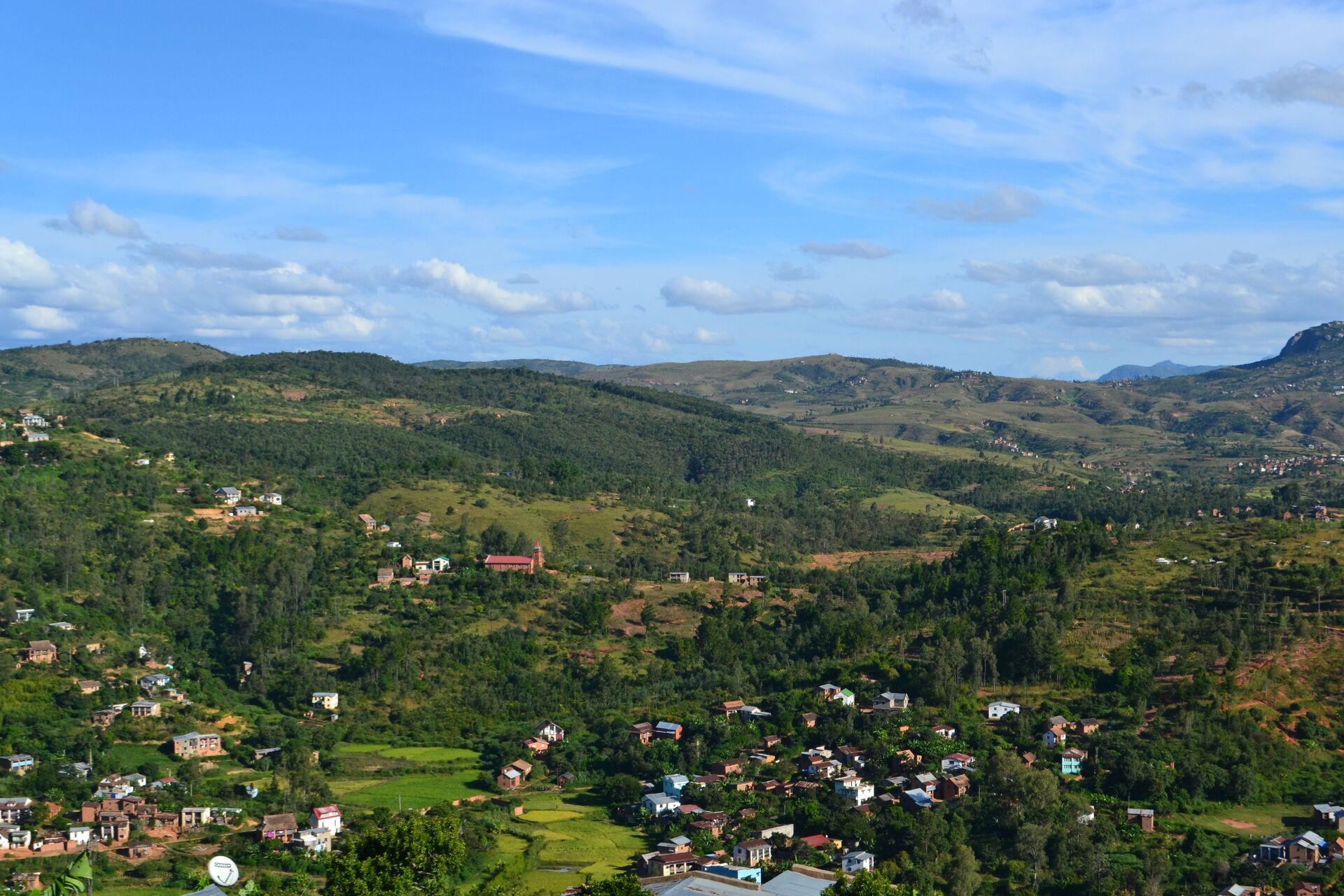
Highlands of Madagascar
Independence Day: 26 June 1960. Madagascar is the fourth-largest island on earth, it broke away from the rest of the landmass roughly eighty-eight million years ago, and most of the people who live on it are descended from voyagers who crossed seven thousand kilometres of open Indian Ocean from Borneo.
In 1947 they rose against French rule, and the repression that followed killed tens of thousands of people in about eighteen months. Almost nobody in Europe has heard of it.
And in October 2025, for the fourth time since independence, a Malagasy government was brought down in the street — and, for the fourth time, the people who made it happen were not the people who took over.
Madagascar is only partly an African story, and that matters.
The Malagasy language is not African. It belongs to the Austronesian family, and its closest living relatives are spoken in southern Borneo, some seven thousand kilometres away across open water. Between roughly the fifth and tenth centuries, people from maritime Southeast Asia reached this island in outrigger canoes and settled it — one of the longest and least-celebrated migrations in human history.
They were joined by, and mixed with, Bantu-speaking East Africans from the Mozambique Channel. Malagasy culture is what came out of that: rice terraces and outrigger design from Asia, zebu cattle and much of the vocabulary of pastoralism from Africa, ancestor veneration and the reburial ceremony of famadihana that is like nothing else anywhere.
So a page about Madagascar has to resist two errors at once: treating it as simply another African country, and treating it as an exotic exception that does not belong on this website. It belongs here. Its colonial history is French, its independence date is 1960, its politics run the same course as its mainland neighbours — and its founding population came by sea from Asia.
And it holds the single most successful piece of restitution in recent African history, which is why this page matters to the rest of this network.
Highlands of Madagascar
Before the French arrived there were several Malagasy states. The largest was the Merina kingdom of the central highlands.
Andrianampoinimerina unified Imerina around the turn of the nineteenth century. His son Radama I expanded it over most of the island, brought in British missionaries, and had the Malagasy language written in Latin script in the 1820s — so Madagascar had literacy, printing and a written administration decades before most of the continent.
Queen Ranavalona I (1828–61) expelled the Europeans, banned Christianity, and kept the kingdom independent through thirty-three years when every comparable state was being taken. European accounts painted her as a monster, and Malagasy accounts as the ruler who preserved the country. Both readings are alive today.
By the 1880s the kingdom had a constitution, a prime minister, a codified legal system and foreign embassies.
And in 1890 Britain traded it away. In the Anglo-French agreement of that year, Britain recognised a French protectorate over Madagascar in exchange for French recognition of a British protectorate over Zanzibar. Two islands, swapped between two European capitals, neither of which asked anybody who lived on them.
France invaded in 1894–95, and in 1896 annexed Madagascar as a colony. General Joseph Gallieni abolished the monarchy, exiled Queen Ranavalona III to Réunion and then to Algiers, where she died in 1917.
The conquest of the coast was worse than the taking of the capital.
In August 1897, at Ambiky, French forces attacked the Sakalava of the Menabe. Their king, Toera, had come to negotiate. He was killed along with a large number of his people, and his head was taken.
The skull, with those of two others of his court, went to Paris and sat in the collection of the Muséum national d'Histoire naturelle for almost 130 years.
On 26 August 2025, at a ceremony at the French culture ministry, they were formally handed back.
It was the first restitution carried out under France's new law, passed to speed up the return of human remains held in French public collections — a law that exists because Malagasy and other claimants kept asking, for decades, and because the previous system required a separate act of parliament for every single object.
One detail on this page deserves to be recorded exactly, because it is the kind of thing that usually gets edited out of European accounts. DNA testing was inconclusive — there was no scientific proof that the skull was King Toera's. The identification was made by a Sakalava spirit medium, and the Malagasy delegation accepted it.
France returned the remains anyway.
For everyone working on restitution — including on the Ghanaian and Dagbon material this network documents — that is the precedent worth having. It establishes that a claim can succeed on the claimant community's own terms of proof, under a general law rather than a special favour. It took 128 years.
What France built in Madagascar was the standard apparatus: the indigénat, the head tax, and forced labour — most notoriously through the SMOTIG from 1926, a scheme that conscripted men for public works under the legal fiction of military service.
Malagasy soldiers fought for France in both world wars. Many of the men who came home from the second one in 1945 had spent years being told they were fighting for liberty.
This is the event this page exists for.
On the night of 29 March 1947, a coordinated insurrection broke out in the east of the island. Attacks were made on a military camp, on plantations and on administrative posts. It spread quickly across roughly a third of the country, and it held territory for months.
France's response was total.
Troops were brought in, including Senegalese tirailleurs and units from the recently ended war. Villages were burned. Whole populations were moved. There were mass executions.
Two episodes carry the memory. In May 1947 at Moramanga, Malagasy prisoners held in railway wagons were machine-gunned inside them. And there are the accounts — persistent, and documented in French military and eyewitness sources — of prisoners being thrown alive from aircraft over rebel areas, to terrorise the villages below.
The insurrection was crushed by the end of 1948.
The figure the French authorities themselves put on the dead at the time was 89,000. Later historians have argued it down — most modern estimates cluster around thirty to forty thousand, with some going higher. The uncertainty exists because a large proportion died not by execution but of hunger and disease after being driven into the forest, and nobody counted them.
Take even the lowest credible figure and this is one of the deadliest colonial repressions anywhere in Africa in the twentieth century.
The three Malagasy deputies of the MDRM — Joseph Raseta, Joseph Ravoahangy and the poet Jacques Rabemananjara — sat in the French National Assembly in Paris. Their parliamentary immunity was lifted; they were tried, convicted of instigating the rebellion on evidence obtained under torture, and sentenced. Their party was dissolved.
And in France it is close to unknown. Setif and Madagascar are the two great erased episodes of the immediate post-war French empire. President Chirac described the repression as unacceptable during a visit in 2005, and President Macron has acknowledged it in general terms. There has been no formal apology, no reparations settlement, and no place in the French school curriculum.
29 March is a national day of mourning in Madagascar. Ask a French school-leaver what happened on it.
Independence came peacefully thirteen years later, under Philibert Tsiranana — a teacher from the coast, backed by France, leading a party France was comfortable with.
The package was the familiar francophone one: cooperation agreements, French advisers throughout the administration, the franc zone, French companies in place, and a French naval base at Diego Suarez.
Tsiranana governed for twelve years, increasingly narrowly, and the charge against him from the beginning was that independence had changed the letterhead. The men who had led 1947 were amnestied but the party of 1947 was gone, and its politics had nowhere to go.
1972 — the rotaka. Students struck over an education system still teaching a French curriculum in French. It spread to workers and to the unemployed of the capital. Security forces fired; the dead ran into the dozens. Tsiranana handed power to the army.
General Ramanantsoa took over, broke the military accords with France and closed the base. In February 1975 his successor, Colonel Richard Ratsimandrava, was assassinated in the street six days after taking office.
1975–1993 — Ratsiraka. Admiral Didier Ratsiraka built the Second Republic on a Boky Mena, a Red Book, and a doctrine of Christian Marxism. Banks, insurance and foreign trade were nationalised. Soviet and North Korean relations were opened.
The economy collapsed. By the late 1980s Madagascar was poorer per head than it had been at independence — one of the very few countries on earth that can be said of — and structural adjustment followed.
1991. Months of mass demonstrations — the Hetsika ho an'ny Fanavaozana — culminated on 10 August when a march of hundreds of thousands moved on the presidential palace at Iavoloha and the guard opened fire. Estimates of the dead run into the dozens and beyond. Ratsiraka's power was broken; Albert Zafy won the 1993 election.
Zafy was impeached in 1996. Ratsiraka won the next election and came back.
2001–02. A disputed presidential election between Ratsiraka and Marc Ravalomanana, the mayor of Antananarivo and a self-made dairy magnate, produced two rival presidents, two capitals, blown-up bridges and a blockade of the highlands. Several hundred people died. Ratsiraka went into exile in France.
2002–2009 — Ravalomanana. Growth returned, roads were built, and so did the old habits: his own company benefited from his own government, and the press narrowed.
The thing that broke him is worth recording on this website. In 2008 it emerged that the government had agreed to lease around 1.3 million hectares — an area comparable to half of Belgium — to the South Korean conglomerate Daewoo, on a 99-year lease, to grow maize and palm oil for export. In a country where people were hungry. The outrage was enormous, and the deal is one of the founding scandals of the entire global land-grab debate.
2009. Andry Rajoelina, the 34-year-old mayor of Antananarivo and a former disc jockey, led the protests against him. On 7 February 2009 the presidential guard fired on a march at the palace; around thirty people were killed. The army unit CAPSAT mutinied and swung behind Rajoelina. Ravalomanana handed power to the military, which handed it to Rajoelina.
The African Union suspended Madagascar. The transition lasted four years, the aid was cut, and the country got poorer.
2013: Hery Rajaonarimampianina elected. 2018: Rajoelina returned, this time by ballot. December 2023: re-elected, on the lowest turnout in Malagasy history — 46.35 per cent — after an opposition boycott and a controversy over the fact that he had quietly acquired French citizenship in 2014, which under Malagasy law should have cost him his Malagasy nationality.
The protests began on 25 September 2025, and they began over water and electricity.
Power cuts in Antananarivo were running for hours every day. Taps were dry. The utility was broke. And the country had spent years absorbing droughts, floods and cyclones with almost no state response.
The movement called itself Gen Z Madagascar. It was young, organised online, and it started with a demand about the electricity supply and ended with a demand for the president to go.
Rajoelina sacked his energy minister, then dissolved his government, then refused to resign. At least twenty-two people were killed, according to the United Nations.
On 11 October, Colonel Michael Randrianirina recorded a video calling on the security forces to refuse orders to fire on protesters. Soldiers of CAPSAT — the same unit that had put Rajoelina in power in 2009 — joined the demonstrations. The gendarmerie and police followed.
On 12–14 October the military took over. Rajoelina fled the country, reportedly evacuated by France. From an undisclosed location he ordered parliament dissolved; parliament ignored him and impeached him 130 votes to one.
On 17 October 2025, Colonel Randrianirina was sworn in as interim president, confirmed by a High Constitutional Court which he then suspended along with the Senate and the electoral commission. He denies that it was a coup. He has said elections may take up to two years. He has said Madagascar intends to seek BRICS membership.
He is 51, was governor of the southern Androy region, and was jailed in November 2023 for inciting a mutiny against Rajoelina — charged, tried and imprisoned on the same day — before being released on a suspended sentence in February 2024.
And the young people who brought the government down were not included in what followed. They have said so publicly. It is the same pattern seen in Bangladesh and Nepal in the same period: the street removes a government, and an existing institution collects the result.
Madagascar is among the poorest countries in the world. Something in the region of three-quarters of the population lives below the national poverty line, and GDP per head is lower today than it was at independence in 1960 — a distinction shared with very few countries anywhere.
Vanilla. Madagascar produces the large majority of the world's natural vanilla, almost all of it from the SAVA region in the northeast, grown by smallholders and pollinated by hand, flower by flower, because the insect that does the job in Mexico does not exist here. The price has swung from a few dollars a kilo to over six hundred and back, with cyclones, speculation and theft in between — and villages where farmers now sleep in their own plantations to guard the pods.
Cloves, lychees, coffee, cocoa. Ambatovy nickel and cobalt, and Rio Tinto's QMM ilmenite mine near Fort Dauphin, both of which have long-running disputes with the communities around them. Sapphires, largely dug and traded informally.
And the forest is going. Slash-and-burn agriculture, charcoal, and the trafficking of rosewood — much of it to China, much of it through export bans that were not enforced — have taken a very large share of the original forest cover.
The Grand Sud. In 2020–21 the deep south suffered a drought and famine — the kere — that the World Food Programme described at the time as possibly the first famine anywhere driven primarily by climate change rather than by conflict. Over a million people needed emergency food.
Because of the eighty-eight million years.
Roughly ninety per cent of Madagascar's wildlife exists nowhere else on earth. All of the world's lemurs — more than a hundred species and subspecies — live here and only here, and they are the most threatened group of mammals on the planet. Six of the world's nine baobab species are Malagasy. So are the chameleons, the tomato frogs, the fossa, and the tsingy limestone forests of Bemaraha, which are a landscape from another planet.
Until humans arrived there were also elephant birds — three metres tall, half a tonne, laying the largest eggs of any animal that has ever lived — and giant lemurs the size of gorillas. They went extinct after settlement. Madagascar's environmental crisis did not begin with the French, and Malagasy accounts say so.
The tourism is world-class and the infrastructure is not. Andasibe, Ranomafana, Masoala, the Avenue of the Baobabs, Nosy Be, Île Sainte-Marie and the humpback whales. For an island this size with this level of endemism, the visitor numbers are a fraction of what Kenya or Tanzania receive.
Two reasons, and they pull against each other.
First, 1947 is the great erased massacre of the French empire in Africa, and this website exists partly to stop that kind of erasure. Tens of thousands of people were killed in a French colony two years after France was liberated from occupation, by an army that had just been on the receiving end of exactly that. There is no French apology, no reparations agreement, and no chapter in the textbook. When people say Africa should stop talking about colonialism, ask them what happened at Moramanga in May 1947.
Second, Madagascar is the clearest demonstration in this series that removing a government is not the same as changing a country.
Count them: 1972, 1991, 2002, 2009, 2025. Five times the Malagasy street has forced out or unseated a government. Every single time, what followed was assembled by people who were already in the room — an army unit, a mayor with backing, a colonel with a barracks. The crowd supplies the legitimacy and somebody else supplies the president.
And the through-line is that the same military unit, CAPSAT, installed Rajoelina in 2009 and removed him in 2025, in both cases to popular applause.
The people who were in the street in September 2025 were right about the water and right about the electricity and right about the corruption. Whether they get anything out of it is a different question, and on the evidence of fifty years, the answer is usually no.
The Merina kingdom was itself an empire. It conquered the Sakalava, the Betsimisaraka and others, and it ran a system of forced labour, fanompoana, along with a substantial internal slave trade. The highland–coastal division in Malagasy politics — ambaniandro and côtier — is not a French invention. France exploited it; it did not create it.
Queen Ranavalona I kept the country independent and killed a great many of her own subjects doing it. Both are in the record.
The 2009 coup was popular. So was the 2025 coup. Writing them off as military seizures misses why crowds cheered. So does pretending that popularity makes them constitutional.
Rajoelina holds French citizenship, acquired in 2014 while positioning himself to return to power in a country whose law does not permit dual nationality — and was evacuated to France when he fell. Draw whatever conclusion you like; Malagasy voters drew theirs, and the turnout in 2023 was the lowest ever recorded.
And the deforestation is being done by Malagasy people, because charcoal is what there is to cook with and tavy is what there is to farm with, in a country where three-quarters of people are poor. Conservation that does not answer that is decoration.
Two things are true. Madagascar is one of the most extraordinary places on earth, with a civilisation built by people who crossed an ocean, and a colonial wound that Europe has never dressed. And it has been governed, for sixty-six years, by a short list of men who keep replacing each other while the island gets poorer.
There is an outrigger canoe that crossed seven thousand kilometres of open water, and a language in the highlands whose nearest relative is spoken in Borneo.
There is a bird three metres tall that laid the largest egg in the history of life, and it is gone.
There is a kingdom with a constitution and a prime minister, traded to France in 1890 in exchange for Zanzibar.
There is a queen who died in Algiers in 1917, a long way from Antananarivo.
There is a king who came to negotiate at Ambiky in 1897 and whose head went to Paris, and came home on 26 August 2025 — identified not by DNA, which failed, but by a Sakalava spirit medium, and accepted on that basis by the French state.
There are railway wagons at Moramanga in May 1947, and men inside them.
There are people thrown from aircraft over the eastern forest.
There is a number — 89,000 — that France itself published, and a French school curriculum that does not contain it.
There are three deputies of the French National Assembly who were tried for what their constituents did.
There is a lease of 1.3 million hectares to a foreign company, in a country where people were hungry.
There is a palace gate at Iavoloha in August 1991, and another at Ambohitsorohitra in February 2009.
There is a colonel who recorded a video in October 2025 telling soldiers not to shoot at their own people, and who now runs the country.
And there are young people who brought down a government over the electricity supply, and were not invited to what came next.
Updated and fact-checked: 14 September 2026.
How this page was checked. Recent events were verified against the sources listed above; the earlier history was checked against standard reference works on Madagascar and the French empire. The Austronesian and East African settlement of the island, the unification of Imerina and the expansion of the Merina kingdom, the Anglo-French agreement of 1890 exchanging recognition over Madagascar and Zanzibar, the French invasion of 1894–95 and annexation in 1896, the abolition of the monarchy and the exile of Queen Ranavalona III, the killing of King Toera at Ambiky in 1897 and the removal of his head to France, the SMOTIG forced labour scheme from 1926, the insurrection of 29 March 1947 and the repression that followed including the killings at Moramanga in May 1947, the trial of the three MDRM deputies, independence on 26 June 1960, the events of 1972, the assassination of Colonel Ratsimandrava in February 1975, the Ratsiraka period and the shootings at Iavoloha on 10 August 1991, the 2001–02 crisis, the 2008 Daewoo land agreement, the events of February 2009 and the African Union's suspension of Madagascar, the December 2023 election and its record-low turnout, the protests beginning on 25 September 2025, the return of King Toera's remains on 26 August 2025, and the military takeover of 12–17 October 2025 are as recorded. Casualty figures are estimates, are disputed, and are given as ranges: the dead of the 1947–48 repression were put by the French authorities of the time at 89,000, while most later historians give figures commonly ranging from around 30,000 to 40,000 and some considerably higher — no reliable count exists, in part because many deaths resulted from displacement, hunger and disease rather than direct killing; deaths in 1972, in August 1991, in 2001–02 and in the 2025 protests are similarly estimated, with the United Nations reporting at least 22 killed in September and October 2025. Accounts of prisoners being thrown from aircraft during the 1947 repression rest on contemporary testimony and French military sources and are recorded here as such. On the restitution of August 2025: DNA testing on the remains was inconclusive, and the identification of the skull as that of King Toera was made by a Sakalava spirit medium and accepted by the Malagasy delegation; this is recorded exactly as it occurred. Andry Rajoelina has not been convicted of any offence. The current authorities describe the events of October 2025 as a constitutional transfer rather than a coup; the characterisation is contested, and both positions are recorded. This page makes no allegation against any living person beyond matters already on the public record.
Written and researched by Remo Kurka · africanindependence.com
We strive to unify diverse narratives from across Africa, showcasing the continent's shared heritage and unique stories.
Our mission is to honor and preserve the history of African cultures and independence movements for future generations.
We provide a platform for innovative exchange of ideas, resources, and insights, understanding that knowledge should be accessible to all.