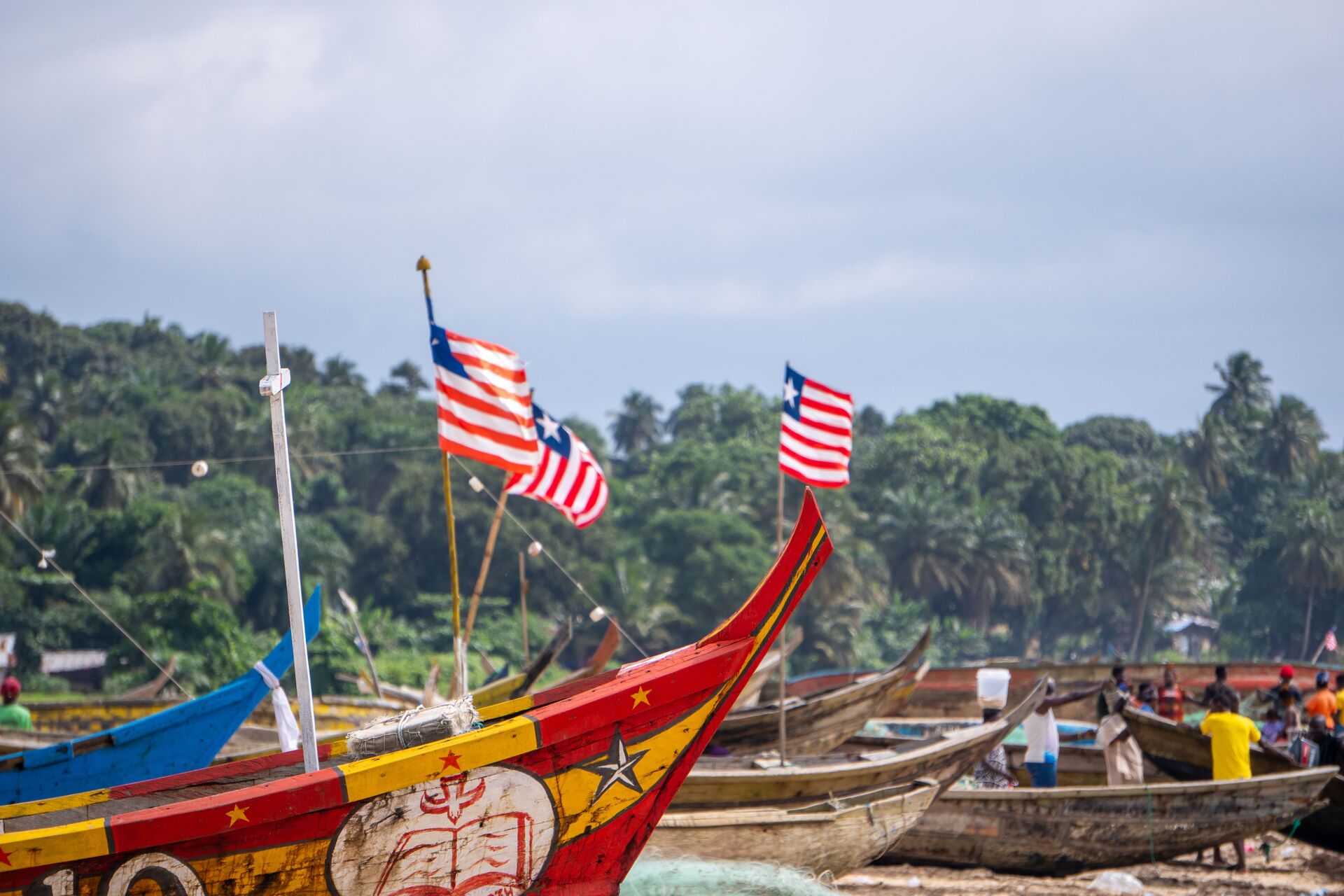
Liberia fishing boats at beach
Independence Day: 26 July 1847. Liberia is the oldest republic in Africa and the second-oldest Black republic on earth after Haiti. It was never a European colony. It was founded by Black Americans, most of them formerly enslaved or the children of the enslaved, who crossed the Atlantic in the other direction — and who then spent the next century and a third governing the Africans they found there as a separate and subordinate class. Everything that happened in Liberia after 1980 comes out of that.
Every other page on this website has a European villain.
This one does not, and it is the most uncomfortable page in the series because of it.
Liberia was not conquered, partitioned, occupied or administered by any European power. It never appeared on the maps of the Scramble for Africa in any colour but its own. It sent delegates to the League of Nations and was a founding member of the United Nations while most of this continent was still under colonial rule.
And it produced a settler society, a racial caste system, a forced labour scandal serious enough to bring down its own president, a one-party state lasting over a century, two civil wars, and roughly a quarter of a million dead.
The settlers were Black. The people they ruled were Black. The structure was colonial anyway.
That fact is used dishonestly by people who want to argue that colonialism was incidental to Africa's problems. It does not show that. What it shows is something narrower and more useful: that a settler state produces settler politics regardless of who the settlers are — and that people fleeing one hierarchy can build another on arrival, with the vocabulary intact.
Liberia fishing boats at beach
Because they get erased in every telling, start with them.
The territory held Kpelle, Bassa, Gio (Dan), Mano, Kru, Grebo, Krahn, Vai, Gola, Mandingo and others — sixteen recognised groups, with their own states, trade networks and institutions, connected to the Mali and Songhai worlds inland and to Atlantic trade on the coast.
The Kru were among the most skilled mariners in West Africa, hired by European ships across the whole coast for generations.
And the Vai invented a writing system — a syllabary, developed around the 1830s, one of very few indigenous scripts created anywhere in Africa and still in use. It was devised, in the same decade the American settlers were arriving, by people the settlers would describe as having no civilisation.
The American Colonization Society was founded in 1816, and its membership tells you everything about its motives. It contained genuine abolitionists who believed free Black Americans would never be granted equality and should have a country of their own. It also contained slaveholders — including some very prominent ones — who wanted free Black people removed from the United States precisely because their existence threatened slavery.
Most Black Americans opposed the scheme. Free Black communities in Philadelphia and elsewhere rejected it publicly and repeatedly as a deportation programme dressed as philanthropy. Only a small minority ever went.
The first settlers landed at Providence Island in 1822.
The land was acquired at Cape Mesurado from local rulers in a transaction that Liberians and historians alike describe as coerced — in the standard account, an American naval officer, Lieutenant Robert Stockton, concluded the negotiation with a pistol in his hand.
The settlement was named Monrovia, after the sitting American president, James Monroe.
Twenty-five years later, with the Society unable to fund it and British traders questioning the legal standing of a colony run by a private charity, the settlers declared independence.
The Republic of Liberia was proclaimed on 26 July 1847. The first president, Joseph Jenkins Roberts, had been born free in Virginia.
The constitution was modelled closely on the American one. The flag was the Stars and Stripes with a single star. The capital was named for an American president, the counties for American states and figures, and the ruling party — the True Whig Party — took its name from American politics.
The United States did not recognise Liberia until 1862, because recognising it would have required receiving a Black ambassador in Washington.
Here is the part that Liberians argue about with a bluntness outsiders rarely match.
The settlers and their descendants — Americo-Liberians, roughly five per cent of the population — governed the other ninety-five per cent.
They were a distinct caste with their own churches, their own Masonic lodges, their own dress, their own accents and their own genealogies. They lived on the coast. The interior was the hinterland, administered indirectly through appointed chiefs, taxed, and subject to labour requisition.
Indigenous Liberians were not full citizens. The franchise was tied to property in ways that excluded them; the hinterland was governed under separate law. Meaningful citizenship and voting rights for the interior population did not arrive until the 1940s and were not effective until the 1960s.
The True Whig Party held power without interruption from 1878 to 1980 — a hundred and two years, one of the longest continuous single-party runs in the history of the world.
The settlers used the vocabulary of the society that had enslaved them: they spoke of civilising the natives, of the interior as heathen, of themselves as the civilised element. Some of the earliest settler households held indigenous children in domestic arrangements that contemporaries described as apprenticeship and that looked, from below, like something else.
And then the structure was exposed in a way that could not be managed.
Reports emerged that Liberian officials were recruiting labourers from the interior and shipping them to the Spanish cocoa plantations on Fernando Pó under conditions amounting to forced labour, with government figures taking a cut.
The League of Nations sent an international commission of inquiry — the Christy Commission — in 1930.
It found the allegations substantially true. It found that forced labour existed, that it was organised with official involvement, and that senior figures of the Liberian state, including Vice-President Allen Yancy, were implicated. President Charles D.B. King and Yancy both resigned.
A republic founded by people who had escaped slavery was investigated by an international body for shipping its own citizens into forced labour, and the charge stood.
Read the Equatorial Guinea page on this site for where those men were sent. That plantation economy is the same one.
The other structure was economic, and it was American.
In 1926 the Firestone Tire and Rubber Company obtained a concession of up to one million acres for ninety-nine years at a rent of six cents an acre, along with a loan to the Liberian government that tied Liberian public finances to the company's interests.
It became the largest rubber plantation in the world. For long stretches of the twentieth century, Firestone was the country's largest private employer and a decisive factor in its politics — and the labour used to open it was recruited through the same chiefly requisition system the League had just examined.
The third structure came in 1948: the open registry. With American help, Liberia created the flag of convenience — ships owned anywhere in the world, registered in Monrovia, crewed by anyone, taxed lightly. It remains one of the largest merchant fleets on earth.
Liberia's biggest export industry consists of vessels that never call at a Liberian port.
Under William Tubman, president from 1944 until his death in 1971, Liberia had one of the highest economic growth rates in the world through the 1950s and 60s, on iron ore, rubber and shipping.
Tubman's Open Door Policy brought in foreign capital; his Unification Policy was supposed to end the coast–hinterland divide, and it did extend the franchise and bring some interior figures into government. It did not transfer power. Economists of the period gave the phenomenon a name that stuck: growth without development — the money arrived and left, and almost nothing was built with it.
William Tolbert succeeded him in 1971 and was, by the standards of his class, a reformer. It was too late and too slow.
In April 1979 the government proposed raising the price of rice. Rice is the staple. The proposal was defended as an incentive to local production; critics noted that the president's family had agricultural interests.
Demonstrators marched in Monrovia on 14 April 1979. The security forces fired. Dozens were killed — Liberians usually say far more — and the capital rioted for days.
The Rice Riots ended the Republic.
Seventeen soldiers entered the Executive Mansion and killed President Tolbert in his bed.
Their leader was Master Sergeant Samuel Kanyon Doe, twenty-eight years old, of the Krahn, with limited formal education.
He was the first head of state in Liberian history who was not an Americo-Liberian. For a great many Liberians, that April was liberation, and it is important that this page says so.
Ten days later, thirteen senior officials of the old government were tied to poles on the beach beside the Barclay Training Center and shot, in front of journalists and cameras. The footage went around the world.
A hundred and thirty-three years of settler rule ended in ten days with a public execution on a beach.
He replaced one narrow group with another.
The army and the security services filled with Krahn — a small group from the southeast — in alliance with the Mandingo, and state violence acquired a straightforwardly ethnic character.
In 1985 Doe held an election and declared himself the winner with just over fifty per cent, in a count almost nobody believed.
In November 1985, Thomas Quiwonkpa — a Gio from Nimba County, a co-conspirator of 1980 who had fallen out with Doe — attempted a coup. It failed. Quiwonkpa was killed and his body publicly displayed.
The reprisals fell on Nimba County, on the Gio and Mano peoples as a whole. Villages were attacked, thousands killed.
That is what made the next war possible: an entire region with a grievance, waiting for someone to arm it.
Charles Taylor crossed from Côte d'Ivoire with a small force of the National Patriotic Front of Liberia and entered Nimba.
He was Americo-Liberian, American-educated, a former official of the Doe government who had fled a corruption charge, escaped from a Massachusetts jail in circumstances that have never been adequately explained, and obtained training and backing in Libya.
Nimba rose. The reprisals of 1985 delivered him an army in weeks.
Within months the NPFL split. Prince Yormie Johnson took his own faction and reached Monrovia first.
In September 1990, Johnson's men captured Samuel Doe. He was tortured over hours — his ear cut off while he was questioned — and killed. It was filmed, on Johnson's instructions, while he sat drinking a beer, and the video circulated across West Africa for years.
ECOWAS intervened with ECOMOG, a Nigerian-led regional force — the first time an African regional organisation had mounted a peace enforcement operation of that kind anywhere. It kept Monrovia from total collapse. It also took sides, was accused of abuses of its own, and could not end the war.
The first civil war ran from 1989 to 1997, with seven or more factions, massacres including the Lutheran church massacre in Monrovia in July 1990, and the systematic use of child soldiers — boys of ten and twelve, drugged, given a rifle, sent to a checkpoint.
In 1997 Charles Taylor won the presidential election with about seventy-five per cent. Liberians voted for him in the open belief that if he lost he would restart the war. The slogan that circulated is the most quoted line in Liberian political history, and it means exactly what it says: people voted for the man who had killed their parents, so that the killing would stop.
It did not stop. The second civil war ran from 1999 to 2003, with the LURD coming from the north and MODEL from the southeast, ending with Monrovia besieged and shelled.
And Taylor exported it. His backing of the Revolutionary United Front in Sierra Leone, in exchange for diamonds, produced the amputations that defined that war for the world.
Across both wars, somewhere in the region of 200,000 to 250,000 Liberians died, out of a population of around three million. Hundreds of thousands were displaced. Sexual violence was used on a mass scale.
And then the most extraordinary thing in modern Liberian history.
In 2002 and 2003, Christian and Muslim women organised together — the Women of Liberia Mass Action for Peace, led by Leymah Gbowee. They wore white, sat in the fish market on the road the president travelled, prayed and sang, every day, in public, where the fighting was.
They demanded talks. They used a sex strike to force their own husbands into supporting it. When peace talks in Accra stalled, the women blockaded the doors of the negotiating hall with their own bodies and refused to let the delegations out.
The talks concluded. Taylor left for exile in Nigeria in August 2003.
Gbowee received the Nobel Peace Prize in 2011.
Taylor was handed over in 2006, tried by the Special Court for Sierra Leone sitting in The Hague — for the crimes in Sierra Leone, not those in Liberia — and convicted in April 2012 on eleven counts including terrorism, murder, rape, enslavement and the use of child soldiers.
He was sentenced to fifty years, upheld on appeal, and is serving it in a British prison.
He is the first former head of state convicted by an international tribunal since Nuremberg.
And here is Liberia's unfinished business, twenty-three years on.
Liberia's own Truth and Reconciliation Commission reported in 2009. It documented the wars in detail and recommended prosecutions, along with barring around fifty named individuals from public office for thirty years.
One of the fifty was Ellen Johnson Sirleaf, then the sitting president, for early financial support given to Taylor's movement, which she has acknowledged and described as a mistake made on false expectations.
The recommendations were never implemented. Not the prosecutions, not the bar from office.
Sirleaf — Harvard-trained economist, former World Bank official, the first woman elected head of state anywhere in Africa, Nobel laureate in 2011 — governed from 2006 to 2018. She got the debt cancelled, kept the peace, and rebuilt institutions. She did not build the court.
Liberia then endured Ebola in 2014–16, which killed more than 4,800 Liberians and broke a health system that had barely been reassembled.
In 2018, power passed from Sirleaf to George Weah — a footballer of genuine global stature, Ballon d'Or winner, from a Monrovia slum. It was the first transfer between elected presidents in Liberia since 1944.
In 2023 Weah lost narrowly to Joseph Boakai and conceded before the final count was complete. Two peaceful, competitive alternations of power in a country that spent fourteen years at war.
And the warlords stayed in parliament.
Prince Johnson — who had Samuel Doe tortured to death on camera — became a pastor, then senator for Nimba County, sat in the Liberian Senate for eighteen years, and was courted by every presidential candidate including those who won. He died in November 2024, aged 72, a free man, never having been charged with anything.
Boakai signed an executive order in May 2024 establishing the Office of the War and Economic Crimes Court, and renewed it in May 2026 with tighter oversight and a mandate to prepare handover to an actual court by March 2027. The legislature passed a resolution in April 2024. The legislation that would actually create the court has still not been enacted.
In 2026 Liberia sits on the United Nations Security Council, and takes the presidency of the Council in December 2026 — and Liberian civil society organisations have said publicly that a country cannot credibly chair the Security Council on rule of law while its own war crimes court exists only as an office preparing for a court.
The defendants are in their sixties and seventies. They are dying faster than the legislation is moving.
Meanwhile foreign courts have done what Monrovia has not: former commanders have been tried and convicted in the United States, Switzerland, Finland, France and Belgium under universal jurisdiction and immigration-fraud statutes — the same mechanism described on the Gambia page of this site.
Because Liberia is the control case, and it cuts in a direction nobody finds comfortable.
If European colonialism explains everything, Liberia should be fine. It was never colonised by Europe. It had a republican constitution in 1847, a century before Ghana. It was sovereign throughout.
It is not fine, and the reason is structural, not racial. A minority arrived from overseas, took the coast, claimed the land, governed the interior indirectly through appointed chiefs, extracted labour from it, monopolised citizenship and held power for a hundred and thirty-three years. That is the architecture of a settler colony. It produced what settler colonies produce: a violent reckoning, and then a long inability to build anything stable on the ruins.
The lesson is not that colonialism did not matter. It is that the form is what does the damage — and the form was available to anyone, including to people whose own grandparents had been property.
And there is a second reason. Liberia is the place where accountability has come closest and stalled longest. Charles Taylor is in a British prison for what he did in Sierra Leone. Nobody has ever been tried in Liberia for what was done in Liberia. Prince Johnson served eighteen years in the Senate and died in a hospital bed.
That gap — between a conviction in The Hague and an empty courtroom in Monrovia — is the subject of a third of the pages on this website.
The settlers were refugees. They were fleeing a country that had enslaved them and would not have them as equals. Many died of fever within a year of landing. Judging them by the standards of people who were never chased across an ocean is cheap, and Liberians of settler descent say so.
And Liberia was a real achievement. It stayed independent through the entire Scramble — surrounded by French and British territory, repeatedly losing land to both, and never absorbed. It was a founding member of the United Nations. It gave African Americans, for over a century, the one thing no other place offered: a country where they were the state.
The 1980 coup was liberation and it was a catastrophe, and the same people can hold both views. The caste system ended. So did the country.
Doe was a monster and he was also the first head of state most Liberians could identify with. Taylor was a monster and he won an election with three-quarters of the vote.
Foreign hands are real but not decisive. Libya trained Taylor; Côte d'Ivoire and Burkina Faso let him through; American policy protected Doe for a decade because he voted the right way at the UN and hosted useful facilities; Firestone kept operating through the war and its arrangements with the factions have been examined in court and in journalism. None of that made Liberians kill each other.
Two things are true. Liberia is the oldest republic in Africa, has held two peaceful transfers of power in the last eight years, and is about to chair the United Nations Security Council. And it has never tried a single person for a war that killed a quarter of a million of its people.
There is an island at the mouth of a river where the first ship landed in 1822.
There is a deed to Cape Mesurado, signed with a pistol on the table.
There is a capital named after an American president, and counties named after American states.
There is a syllabary invented by Vai scholars in the 1830s, in a country whose rulers said the people had no writing.
There is a League of Nations report from 1930 that brought down a president of Africa's first republic for forced labour.
There is a concession of a million acres for ninety-nine years at six cents an acre.
There is a merchant fleet, among the largest in the world, that has never seen Liberia.
There are dead demonstrators from 14 April 1979, killed over the price of rice.
There is a beach beside the Barclay Training Center, and thirteen poles.
There is a videotape of a president being tortured to death while the man who ordered it drinks a beer.
There are children of ten at checkpoints with rifles.
There are women in white sitting in a fish market in the rain, every day, until the men agreed to talk.
There is a conviction in The Hague, and fifty years in an English prison, for crimes committed in a different country.
There is a Truth and Reconciliation report from 2009 with fifty names in it, and not one of them was ever prosecuted.
There is a Senate seat in Nimba County that was held for eighteen years by the man who filmed the killing of a head of state.
And there is an office in Monrovia, preparing for a court that the legislature has not yet created.
Updated and fact-checked: 14 September 2026.
How this page was checked. Recent economic events were verified against the sources listed above; the earlier history was checked against standard reference works on Lesotho and southern Africa. The formation of the Basotho nation under Moshoeshoe I at Thaba Bosiu in the 1820s, the wars with the Orange Free State and the loss of the land west of the Caledon by 1868, the establishment of the British protectorate in 1868, annexation to the Cape Colony in 1871, the Gun War of 1880–81, the return to direct British rule in 1884, the provision in the South Africa Act of 1910 for transfer of the High Commission Territories and its non-execution, independence on 4 October 1966, the annulment of the January 1970 election by Leabua Jonathan, the South African raid on Maseru on 9 December 1982, the border blockade of January 1986 and the coup of 20 January 1986, the deposition of Moshoeshoe II in 1990 and his restoration in 1995, his death in January 1996, the 1993 election in which the BCP won all 65 seats, the palace coup of 1994, the disputed election and SADC intervention of September 1998, the introduction of mixed member proportional representation in 2002, the events of August 2014, the killing of Lieutenant General Maaparankoe Mahao in June 2015, the murder of Lipolelo Thabane in June 2017, the killing of army commander Khoantle Motsomotso in September 2017, the resignation of Tom Thabane in 2020, the 2022 election won by Sam Matekane, the United States tariff of 2 April 2025, the national state of disaster declared on 10 July 2025, and the lapsing of the replacement duties on 29 July 2026 are as recorded. Figures are estimates or official series as indicated: the 1987 remittance figure of approximately 236 per cent of GDP and the current figure of around a fifth of GDP are as reported in the sources above; garment employment is given variously as approximately 35,000 to 40,000; deaths in the September 1998 intervention are estimated from around fifty to over one hundred and were never definitively counted. Tom Thabane and 'Maesaiah Thabane were charged in connection with the murder of Lipolelo Thabane; the charges were subsequently withdrawn and neither has been convicted of any offence, and nothing here should be read as asserting otherwise. Findings concerning the killing of Lieutenant General Mahao are those of the SADC commission of inquiry. This page makes no allegation against any living person beyond matters already on the public record.
Written and researched by Remo Kurka · africanindependence.com
We strive to unify diverse narratives from across Africa, showcasing the continent's shared heritage and unique stories.
Our mission is to honor and preserve the history of African cultures and independence movements for future generations.
We provide a platform for innovative exchange of ideas, resources, and insights, understanding that knowledge should be accessible to all.