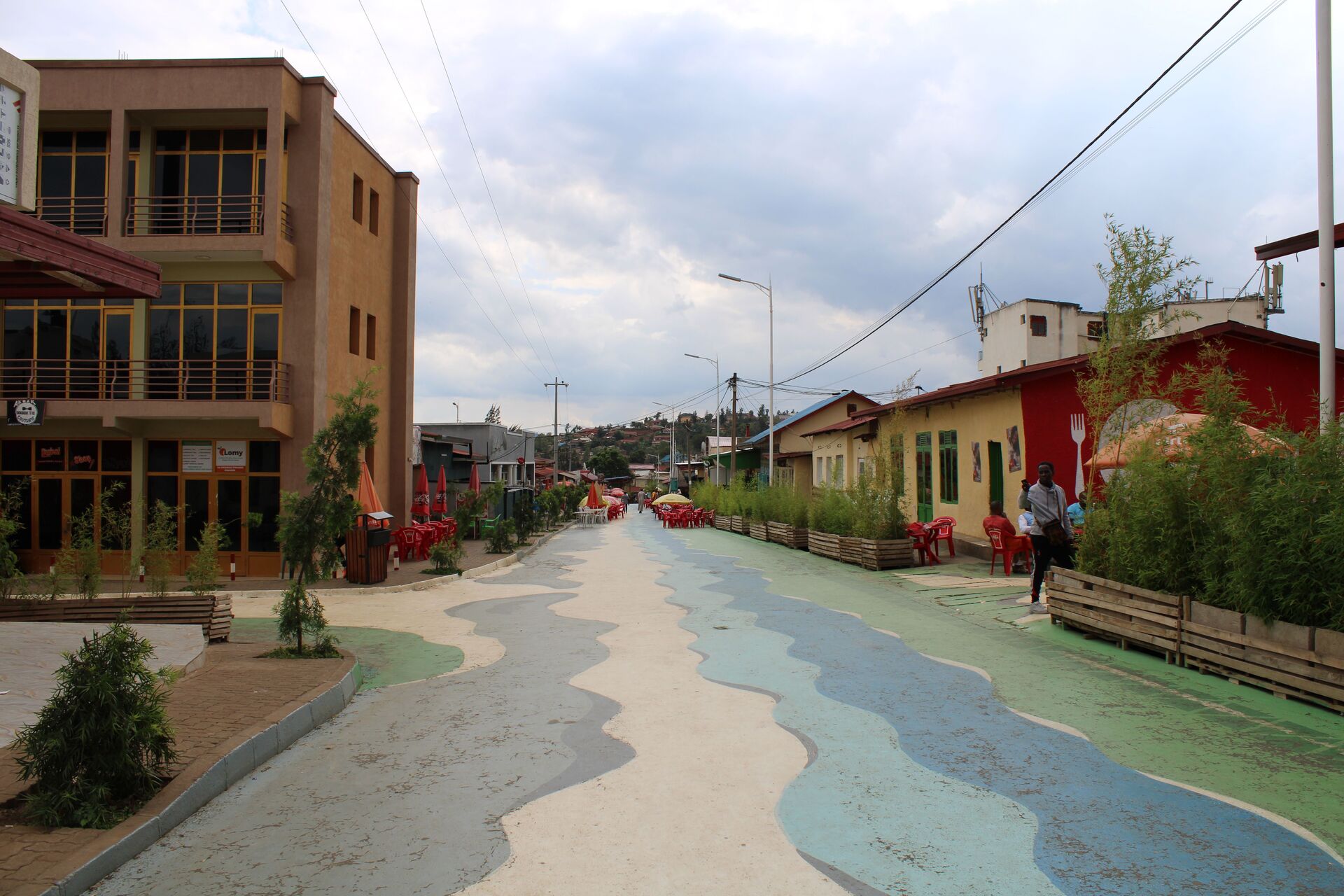
Rwanda, Kigali
Independence Day: 1 July 1962. Capital: Kigali. Rwanda is a country the size of Wales with fourteen million people, no minerals worth the name, no coastline, and the most efficient state administration on the African continent. It is also a country in which, over one hundred days in 1994, something in the order of eight hundred thousand to a million people were murdered by their neighbours while the world watched and declined to use the word. And it is, according to the United Nations, the European Union and the United States government, currently running a war in the Democratic Republic of the Congo that has displaced around seven million people.
Every judgement about Rwanda is true and incomplete at the same time, and the country is organised so that you have to choose one.
Rwanda has the lowest corruption score in the region, near-universal health insurance, an under-five mortality rate that fell faster than almost anywhere in recorded history, the highest proportion of women in any parliament in the world, streets in Kigali cleaner than most European capitals, and two decades of growth around seven per cent — achieved from the wreckage of a genocide, with no oil, no gold, no port and almost no arable surplus.
And there is no meaningful opposition, no independent domestic press, a president in office since 1994 who has won elections with over ninety-nine per cent, critics who have been shot dead abroad, and an army that Washington sanctioned as an institution on 2 March 2026.
Both of those paragraphs are fully documented. Anybody who can only recite one of them is not describing Rwanda; they are describing their own position on it.
Rwanda, Kigali
The kingdom of Rwanda under the Nyiginya dynasty was a genuine state, centralised and expanding, and by the reign of Rwabugiri in the late nineteenth century it controlled most of the present territory with a court, an army, a ritual calendar and a system of clientship over cattle.
Hutu, Tutsi and Twa existed before the Europeans. The categories were real and they carried status — broadly cattle-owning elite, cultivators, and a small forest-origin minority. They were also not fixed: people moved between them through wealth, marriage and royal favour, the boundary shifted by region, and everyone spoke the same language, held the same religion and lived in the same hills. There were no separate territories and no separate languages.
Then Europe arrived and hardened it into biology.
Germany took Rwanda as part of German East Africa in 1897 and governed through the king. Belgium took it in 1916 and ran it under mandate.
The Belgians applied the Hamitic hypothesis — the pseudo-scientific belief that the Tutsi were a superior race of Nilotic or Near Eastern origin who had come from elsewhere to rule the "Bantu" Hutu. Missionaries taught it. Administrators believed it. Tutsi were favoured for schooling, chieftaincy and clerical employment.
And in 1933 Belgium issued identity cards recording ethnicity.
That single administrative act is the mechanical precondition of 1994. At a roadblock in April 1994, the killers did not have to guess. They asked for the card.
By the late 1950s the Tutsi elite was demanding independence, and Belgium switched sides — backing Hutu political emancipation as a way of retaining influence.
In November 1959 the "social revolution" began. Hutu political violence against the Tutsi establishment spread across the hills. Thousands were killed. The monarchy was abolished by referendum in 1961.
Rwanda became independent on 1 July 1962, with Grégoire Kayibanda as president of a state explicitly defined as a Hutu republic.
Hundreds of thousands of Tutsi fled — to Uganda, Burundi, Tanzania and the Congo — and further waves followed the massacres of 1963–64 and 1973. Their children grew up stateless.
In Uganda, many of those children joined Yoweri Museveni's guerrilla army. When Museveni took Kampala in 1986, Rwandan Tutsi held senior positions in his forces — among them a young intelligence officer named Paul Kagame.
In 1973 Juvénal Habyarimana took power in a coup and ruled for twenty-one years through a single party, with a quota system capping Tutsi access to education and employment at roughly their share of the population.
On 1 October 1990 the Rwandan Patriotic Front invaded from Uganda — the children of the 1959 refugees, coming home with rifles. France deployed troops to support the Habyarimana government. A civil war ran for three years.
The Arusha Accords of August 1993 provided for power-sharing, a merged army and the return of refugees. Hutu Power extremists regarded them as a surrender, and prepared.
They prepared openly. Militia — the Interahamwe — were armed and trained. Machetes were imported in quantities that had no agricultural explanation. Radio Télévision Libre des Mille Collines broadcast lists of names and described Tutsi as inyenzi, cockroaches. Lists were compiled.
In January 1994 the UNAMIR force commander, Canadian General Roméo Dallaire, sent a cable to New York reporting an informant's account of the arms caches and the plan, and requesting authority to seize them. He was refused and told to inform the Rwandan government — which contained the people organising it.
On the evening of 6 April 1994, the aircraft carrying President Habyarimana and the president of Burundi was shot down on approach to Kigali. Everyone aboard was killed.
Responsibility has never been established. A French judicial investigation issued warrants against RPF figures in 2006; the same French judiciary dropped the case in 2018, with expert evidence pointing away from RPF positions. Rwandan and other investigations point to Hutu Power extremists within the regime. It remains genuinely unresolved, and this page will not pretend otherwise.
The killing began within hours, which is itself the evidence that it was planned. Roadblocks went up across Kigali that night. The prime minister, Agathe Uwilingiyimana, was murdered the next morning along with ten Belgian peacekeepers guarding her — which achieved exactly what it was designed to achieve: Belgium withdrew its contingent, and the Security Council cut UNAMIR from 2,500 to a few hundred.
Over roughly one hundred days, between 800,000 and over a million Tutsi, and Hutu who refused to take part or who were politically opposed, were murdered. Most were killed with machetes and clubs, by neighbours, at roadblocks, in churches where they had gathered for safety, and in their homes. Sexual violence was used systematically on a scale later recognised in law as genocidal.
The United States government instructed its officials to avoid the word "genocide", because using it would have triggered obligations under the 1948 Convention. The Security Council debated. Nobody came.
France's Opération Turquoise, launched in June under UN authority, established a zone in the south-west. It saved lives. It also, according to a substantial body of investigation including France's own Duclert Commission report of 2021, allowed organisers of the genocide to leave for Zaire. The Duclert report concluded that France bore heavy and overwhelming responsibilities, while finding no evidence of complicity in the killing itself.
The RPF stopped the genocide militarily, in July 1994, without outside help. That is a fact, and it is the source of every claim the current Rwandan state makes about itself.
Around two million Hutu fled into eastern Zaire, including the army and the militia that had carried out the killing, who took over the refugee camps and used them as bases. A cholera epidemic at Goma killed tens of thousands within weeks, and it was that catastrophe — not the genocide — which finally mobilised Western aid.
The RPF also killed. Investigations, including by the UN, documented reprisal killings of Hutu civilians during and after the advance. At Kibeho in April 1995, Rwandan troops fired on a camp of displaced people; Australian peacekeepers present recorded a death toll far higher than the government's figure, and the estimates run to several thousand.
In 1996 Rwanda invaded Zaire to destroy the camps, and kept going — installing Laurent-Désiré Kabila in Kinshasa in 1997, then invading again in 1998 when he turned against them. The Second Congo War drew in nine countries and killed, by the most-cited estimate, some five million people, overwhelmingly from disease and hunger.
The UN Mapping Report of 2010, covering the DRC between 1993 and 2003, catalogued hundreds of incidents and stated that some of the attacks by Rwandan and allied forces against Hutu refugees, if proven before a competent court, could be characterised as crimes of genocide. Rwanda rejected it furiously and threatened to withdraw its peacekeepers from UN missions. No court has ever examined the question.
The International Criminal Tribunal for Rwanda sat in Arusha from 1994 to 2015. It indicted 93 people and convicted 62, established in the Akayesu judgment that rape can constitute an act of genocide, and convicted the RTLM broadcasters.
It never indicted a single member of the RPF. Chief Prosecutor Carla Del Ponte pursued investigations into RPF crimes and was removed from the Rwanda portfolio in 2003; she has stated publicly that Rwandan and American pressure was the reason. Her successors did not pursue it.
And a point of fact, since it is widely misstated: Paul Kagame has never been indicted by the International Criminal Court, and never could be for 1994. The ICC's jurisdiction begins in 2002 and Rwanda is not a party to the Rome Statute.
What exists is different and still significant. In 2006 the French judge Jean-Louis Bruguière issued arrest warrants against nine of Kagame's close associates over the aircraft; Rwanda broke off relations with France. In 2008 the Spanish judge Fernando Andreu indicted forty RPF officers over killings of Hutu civilians and of Spanish citizens; Kagame was named in the reasoning and excluded only because a serving head of state has immunity. The Spanish case was largely curtailed when Spain narrowed its universal jurisdiction law in 2014.
Inside Rwanda, the caseload was impossible — over a hundred thousand people in prison. The gacaca courts, adapted from a traditional dispute mechanism, sat from 2002 to 2012: around twelve thousand community tribunals, roughly 1.9 million cases heard. They cleared the backlog, they produced a public record, and they were repeatedly criticised for the absence of defence counsel, for false accusations used to settle land disputes, and for excluding RPF crimes entirely from their jurisdiction.
And this is the part that people who dislike the Rwandan government consistently underrate.
Rwanda in 1994 had no functioning anything. No treasury, no courts, no police, no water system, a third of the population dead or in exile, and two million people in camps across the border.
What was built from that:
Health. A community-based insurance scheme, Mutuelle de Santé, covering the large majority of the population for a few dollars a year. Child mortality fell by roughly two-thirds in a decade. Life expectancy rose from the twenties during the genocide to the high sixties.
Administration. Imihigo performance contracts, signed publicly by officials at every level against measurable targets. Umuganda, a compulsory monthly community work morning, in which the entire country — including ministers — cleans, builds and repairs. Plastic bags banned in 2008, earlier than almost anywhere on earth.
Women. Rwanda has had the highest proportion of women in parliament of any country in the world since 2008, currently above sixty per cent, together with legal reform on land inheritance and property that transformed rural women's position.
Business. Consistently among the easiest places in Africa to register a company, with almost no petty corruption — a police force you do not bribe, a licence you do not pay for twice.
And ethnicity was abolished. Identity cards no longer record it. The categories are not used in official language. The national doctrine, Ndi Umunyarwanda, is that there are only Rwandans.
That last decision is the most consequential and the most contested thing the government has done. Its defenders say a country where a card at a roadblock decided who lived cannot afford the categories. Its critics say abolishing the words does not abolish the reality, and that in practice it makes it illegal to observe that the state is run by a minority.
There is no opposition in Rwanda in any meaningful sense.
Victoire Ingabire returned from exile to contest the 2010 election and was imprisoned; released by presidential pardon in 2018, she has been barred from standing and has faced further proceedings. Diane Rwigara was disqualified in 2017 and prosecuted. Paul Rusesabagina, whose actions at the Hôtel des Mille Collines became the film Hotel Rwanda, was lured onto an aircraft in 2020, arrived in Kigali in handcuffs, and was sentenced to twenty-five years; he was released in 2023 after American diplomatic intervention.
Critics abroad have not been safe. Patrick Karegeya, the former head of external intelligence, was strangled in a Johannesburg hotel room on New Year's Eve 2013; a South African inquest in 2019 found that Rwandan state agents were responsible. Kayumba Nyamwasa, the former army chief of staff, survived being shot in Johannesburg in 2010. Journalists and YouTubers inside Rwanda have been imprisoned or have disappeared.
Genocide ideology and sectarianism laws are drawn broadly enough that criticism of the government can be, and has been, prosecuted under them.
Elections have returned Kagame with 95 per cent in 2010, 99 per cent in 2017 and 99 per cent in 2024. A 2015 constitutional amendment, approved by referendum at 98 per cent, permits him to remain in office until 2034.
In 2023 the United Kingdom Supreme Court ruled unanimously that Rwanda was not a safe third country to which asylum seekers could lawfully be removed, citing the risk of refoulement and shortcomings in its asylum system. The British government's scheme was abandoned in 2024.
Which brings us to the present, and to the question of whose interests are being served.
M23 re-emerged in 2021 and, in a rapid offensive, captured Goma in January 2025 and Bukavu in February 2025 — the provincial capitals of North and South Kivu, cities of over a million people. It has since run parallel administrations in the territory it holds.
The documentation of Rwandan involvement is no longer in dispute anywhere except Kigali.
The UN Group of Experts has repeatedly found direct Rwanda Defence Force intervention — troops, weapons, ammunition, uniforms, training, intelligence, command and control. UN Security Council Resolutions 2773 of February 2025 and 2808 of December 2025 condemned the offensives and RDF support and demanded the withdrawal of all foreign forces. At the Security Council in early 2026 the United States representative stated that Rwanda had between 5,000 and 7,000 troops inside eastern Congo, with drones, artillery, air defence systems and GPS jamming equipment.
Kigali denies it, and frames its presence as defence against the FDLR — the remnant of the forces that carried out the 1994 genocide, still present in eastern Congo, and a genuine and unresolved threat that no Congolese government has ever eliminated.
That argument is not empty. It is also, by 2026, doing a great deal of work it cannot carry, because the territory being held is not a buffer strip. It is the mining districts.
In December 2025, Presidents Tshisekedi and Kagame signed the Washington Accords at the White House.
Within days, M23 captured Uvira, on the Burundian border. It withdrew under diplomatic pressure.
On 2 March 2026 the United States Treasury sanctioned the Rwanda Defence Force as an institution and four of its senior officers, citing blatant violations of the accords. In January 2026 it had already sanctioned James Kabarebe, a presidential adviser, stating that he orchestrates RDF support for M23 and manages revenue from Congolese minerals.
The European Union sanctioned nine individuals and an entity — three RDF commanders, five M23 leaders, the chief executive of Rwanda's Mines, Petroleum and Gas Board, and the Gasabo Gold Refinery, for importing gold illicitly from M23-controlled areas.
Kagame's public response was that Rwanda's forces were obliged to act defensively and that he was not afraid of sanctions.
Meanwhile the Doha Framework Agreement of November 2025, mediated by Qatar, produced terms of reference for ceasefire monitoring on 2 February 2026. The fighting has continued. Around seven million people are displaced, including some three and a half million children — one of the largest humanitarian crises in the world.
When you ask the question, and there is now an evidenced answer rather than a speculative one.
Minerals. Eastern Congo holds coltan, tin, tungsten, gold. The Rubaya coltan complex, under M23 control, is one of the world's largest tantalum sources. Rwanda has for years exported quantities of coltan and gold substantially in excess of what its own geology plausibly produces, and the EU sanctions on a Rwandan state mining official and a Kigali refinery are a formal statement of where investigators think the difference comes from.
And here is the part that indicts the West rather than Kigali. Critics of the Washington process — including the Oakland Institute, whose analysis is cited below — argue that American sanctions are symbolic because Washington simultaneously supports Rwanda as a processing and re-export hub for critical minerals and has pursued minerals agreements with companies tied to the Rwandan government. Congolese civil society voices in the Doha process have said the same thing more bluntly: that the negotiations exist to secure economic and geopolitical positions, and that what attracts outside powers is strategic minerals, not displaced families.
There is also a debt. For thirty years Western governments have given Rwanda an extraordinary latitude, and the reason is 1994. Nobody came, everybody knows it, and the guilt has been a diplomatic asset ever since. Add to that the practical uses: Rwanda is among the largest troop contributors to United Nations peacekeeping, and its soldiers are deployed in Cabo Delgado in Mozambique — as the Mozambique page on this site records, part-funded by the European Union.
A country whose army the EU helps pay for in one place is sanctioned by the EU for what that army does in another. That is not a conspiracy. It is a policy, and it is being conducted in public.
Rwanda's tourism is small, expensive and extremely well run.
Volcanoes National Park, on the Virunga chain, holds a substantial share of the world's remaining mountain gorillas — a population that has, almost uniquely among great apes, been increasing. A trekking permit costs $1,500, a figure set deliberately to limit numbers and maximise revenue, with a share paid into surrounding communities.
Nyungwe is one of the largest montane rainforests in Africa. Akagera was stripped almost bare in the 1990s and has been restored under a management partnership, with lions and rhino reintroduced and the full complement of large mammals back.
Kigali has become a conference city — the African Union, the Commonwealth summit, the headquarters of African institutions — and the strategy is explicit: a country with no resources sells reliability.
Because Rwanda breaks the frame this website has been using for thirty-nine countries, and it should.
The colonial contribution here is exact and traceable. Belgium did not invent Hutu and Tutsi, but it turned a fluid social order into a racial one, wrote it on a card in 1933, taught it in schools, and then switched which race it favoured on the way out. Sixty-one years later, the card at the roadblock decided who died. Very few colonial acts anywhere have a causal chain that short and that documented.
And the post-colonial responsibility is equally exact. Rwandans planned it, Rwandans broadcast it, Rwandans did it, and Rwandans stopped it.
Then there is the third thing, which is the hardest. The government that stopped the genocide has built the most effective state in Africa and is, according to the United Nations and its own principal Western backers, running a war of conquest in a neighbouring country over minerals, having sanctioned its own army's commanders and been sanctioned in return.
Rwanda is therefore the strongest possible argument for the proposition this series keeps testing: that competence and legitimacy are separate questions, and that a state can deliver almost everything a population needs and still be something nobody should copy.
The genocide was real, it was planned, and revisionism about it is not a legitimate position. The figure of roughly 800,000 to a million is established, the organisation is documented in tribunal judgments, and there is no serious scholarly dispute about it. Anyone who arrives at this page looking for that argument should leave.
The RPF also committed large-scale killings, in Rwanda in 1994–95 and in Congo from 1996, and no court anywhere has examined them. That is a failure of international justice, not a Rwandan claim.
The world's non-response in 1994 is why Rwanda does what it likes. A state that was abandoned to a genocide by the Security Council draws a permanent conclusion about the value of international protection, and every Rwandan official will say so if asked.
The FDLR is real. The men who organised 1994 went across the border and their organisation is still there. No Congolese government in thirty years has dealt with it. Rwanda's security argument has a genuine foundation, and it has been stretched far past it.
Congo is not a passive victim. Kinshasa has armed and used militias including the FDLR, and eastern Congo's misgovernment predates and outlasts every Rwandan incursion.
And Rwandans are not living in a dictatorship they merely endure. A great many of them regard the settlement — no politics, no ethnicity, no disorder, in exchange for schools, clinics, safety and a functioning state — as a fair exchange after what happened. Foreigners who have not lived through a hundred days of that should be careful about how confidently they price it.
Two things are true. Rwanda has built, from the worst starting point of any country in this series, the most capable state on the continent. And it is doing to Congo, for minerals, something that the people who pay for its budget describe in their own official documents as a violation.
There is a kingdom with a court and a calendar that Europe found and did not understand.
There is a theory about where the Tutsi came from, taught by missionaries, that was nonsense.
There is an identity card issued in 1933 with a line for ethnicity.
There are the hundreds of thousands who left in 1959 and the children they raised stateless in Uganda.
There is a cable sent from Kigali to New York in January 1994 asking permission to seize the machetes, and a reply telling the sender to inform the government.
There is a radio station that read out names.
There are ten Belgian peacekeepers murdered on 7 April so that Belgium would leave, and Belgium left.
There is a Security Council that reduced its force to a few hundred while it was happening.
There is a memorandum instructing American officials not to say the word.
There are churches where people went because churches had always been safe.
There is a hundred days, and a number nobody can fix more precisely than between eight hundred thousand and a million.
There is an army that stopped it without help, and the entire moral authority of a state built on that fact.
There are two million people who crossed into Zaire, and the men who had organised the killing among them.
There is a UN report from 2010 with a sentence about what a competent court might find, and no competent court.
There is a tribunal that sat for twenty years and indicted nobody from one side.
There is a hotel room in Johannesburg on New Year's Eve 2013.
There is a parliament that is more than sixty per cent women, and a president with ninety-nine per cent.
There is a coltan mine at Rubaya and a refinery in Kigali on a European sanctions list.
There is a signing ceremony at the White House in December 2025, and a city captured days later.
And there are seven million people who are not at home.
Updated and fact-checked: 15 September 2026.
How this page was checked. Events since 2021 were verified against the sources listed above, including official United States and European Union sanctions notices; the earlier history was checked against standard scholarly works on Rwanda, the judgments of the International Criminal Tribunal for Rwanda, and the published reports of the United Nations. The Nyiginya kingdom, the German and Belgian colonial administrations, the introduction of identity cards recording ethnicity in 1933, the events of November 1959 and the abolition of the monarchy in 1961, independence on 1 July 1962, the massacres and refugee waves of 1963–64 and 1973, the coup of 1973, the RPF invasion of 1 October 1990, the Arusha Accords of August 1993, General Dallaire's January 1994 cable and the response to it, the shooting down of the presidential aircraft on 6 April 1994, the murder of Prime Minister Uwilingiyimana and ten Belgian peacekeepers and the subsequent reduction of UNAMIR, the genocide against the Tutsi between April and July 1994, Opération Turquoise, the RPF capture of Kigali, the flight of some two million people into Zaire, the events at Kibeho in April 1995, the Congo wars of 1996–97 and 1998–2003, the UN Mapping Report of 2010, the work and closure of the ICTR, the gacaca process, the French warrants of 2006 and Spanish indictments of 2008, the 2015 constitutional referendum, the murder of Patrick Karegeya in December 2013 and the 2019 South African inquest finding, the rendition and later release of Paul Rusesabagina, the Duclert Commission report of 2021, the UK Supreme Court ruling of November 2023, the capture of Goma and Bukavu in early 2025, the Washington Accords of 4 December 2025 and the Doha Framework Agreement of November 2025 are as recorded. Casualty figures are estimates and are given as ranges: the dead of the 1994 genocide are generally estimated at between 800,000 and over one million; deaths at Kibeho in 1995 are disputed between official Rwandan figures and the far higher counts recorded by peacekeepers present; deaths in the Second Congo War are most commonly estimated at around five million, overwhelmingly from disease and hunger, and that figure is itself contested. Responsibility for the shooting down of the presidential aircraft on 6 April 1994 has never been established; a French judicial investigation issued warrants against RPF figures in 2006 and the same judiciary dropped the case in 2018. Both positions are recorded and neither is endorsed. Paul Kagame has never been indicted by the International Criminal Court, which has no jurisdiction over events in 1994 and to which Rwanda is not a party; claims to the contrary are inaccurate. The Spanish indictments of 2008 named him in their reasoning but excluded him on grounds of head-of-state immunity, and the case was subsequently curtailed. The Government of Rwanda denies supporting M23 and denies the presence of its forces in the Democratic Republic of the Congo; the findings of the UN Group of Experts, the UN Security Council, the United States Treasury and Department of State, and the Council of the European Union are to the contrary, and both positions are recorded here. Sanctions designations are administrative measures and are not criminal convictions. The situation in eastern DRC is changing rapidly and readers should check current reporting before relying on the most recent entries. This page makes no allegation against any living person beyond matters already on the public record.
Written and researched by Remo Kurka · africanindependence.com
We strive to unify diverse narratives from across Africa, showcasing the continent's shared heritage and unique stories.
Our mission is to honor and preserve the history of African cultures and independence movements for future generations.
We provide a platform for innovative exchange of ideas, resources, and insights, understanding that knowledge should be accessible to all.