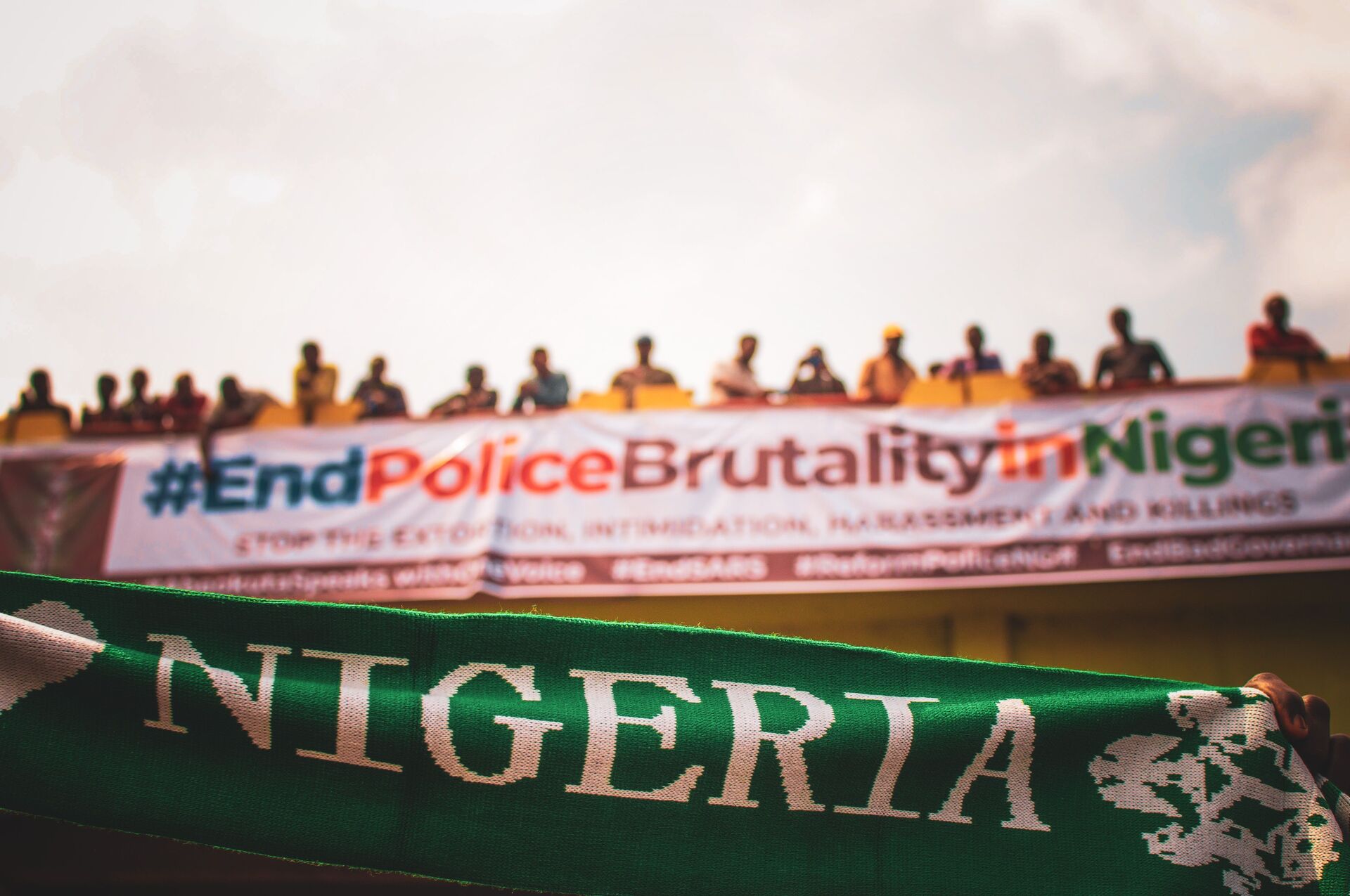
Nigeria, end police brutality demonstration
Independence Day: 1 October 1960. Capital: Abuja. Nigeria contains roughly one in every six people on the African continent, inside a border that a British colonial governor drew in 1914 because running two territories cost more than running one. It has produced bronze casting that European experts refused to believe was African, the largest Islamic state of nineteenth-century Africa, the second-largest film industry on earth, the music the world is currently dancing to — and a civil war that killed more than a million people, a writer hanged for defending his own river, and a type of fraud so widespread it is named after a section of the criminal code.
Scale.
Nigeria has well over 200 million people — more than any other African country, more than Russia, more than Japan. Around one in six Africans is Nigerian. By the middle of this century it is projected to be the third most populous country in the world.
It also contains more than 250 ethnic groups and around 500 languages, and it was assembled by one European administrator in one administrative act.
Everything about Nigeria is therefore an argument about whether it should exist at all — an argument Nigerians have been having since before independence, which they fought a war over between 1967 and 1970, and which has never been settled, only postponed.
And Nigeria is the country where the two things this website keeps separating are hardest to separate: what was done to Africa, and what Africans have done to each other. The Bight of Benin and the Bight of Biafra were the largest single source region of the transatlantic slave trade. The oil in the Delta is stolen by international companies and by Nigerian networks simultaneously. The 419 letter is a Nigerian invention that preys on foreign greed.
You cannot write an honest page about Nigeria and keep the categories clean. That is why it matters.
Nigeria, end police brutality demonstration
This is the part that should be taught everywhere and is not.
The Nok culture of the central plateau produced terracotta sculpture and worked iron from around 1500 BC — among the earliest ironworking anywhere in sub-Saharan Africa.
Ife, from the twelfth century, produced brass and copper-alloy heads of such naturalism and technical sophistication that when Leo Frobenius encountered them in 1910 he concluded they must be evidence of a lost Atlantic civilisation, because he could not accept that Africans had made them. They had, using the lost-wax method, centuries before Europeans arrived.
The Kingdom of Benin — no relation to the modern republic — built a city that Portuguese and Dutch visitors described as rivalling European capitals, with wide streets, a palace complex, street lighting by oil lamps, and earthworks that are among the largest earth structures ever built by human beings. Its court art in brass and ivory is the Benin Bronzes.
The Oyo Empire of the Yoruba, with its cavalry and its constitutional check on the Alaafin. The Hausa city-states — Kano, Katsina, Zaria — walled commercial centres on the trans-Saharan routes, with Kano's walls and dye pits still there. Kanem-Bornu in the north-east, a state that lasted a thousand years.
And in 1804 Usman dan Fodio launched a jihad that produced the Sokoto Caliphate — the largest state in nineteenth-century Africa, with an administration, a legal system, a substantial literary output in Arabic, Hausa and Fulfulde, and an economy that ran on a very large population of enslaved people.
That last clause belongs there. The Caliphate was one of the largest slaveholding societies in the world in its time, and Nigerian historians say so plainly.
In the south-east, the Igbo built densely populated, decentralised societies with no kings at all in most places — village republics governed by assemblies, age grades and title societies. British administrators could not find a chief to rule through, so they invented one, and the consequences appear below.
The Bight of Benin and the Bight of Biafra were, together, the largest single source region of the transatlantic slave trade. Something in the order of three and a half million people were shipped from this coast.
And the trade was operated at the coast by African states and merchants. Oyo, Benin, the Aro network of the south-east, the Efik and Ijaw traders of Calabar and Bonny — these were the suppliers, and they grew rich on it. The Europeans stayed on the ships and in the forts and bought.
Both of those sentences are true, and this site has argued elsewhere that leaving out either one damages the case for reparations rather than strengthening it. The claim in international law runs against the states that legislated, taxed, insured and protected the system and whose legal successors still exist. But an account that describes the Bight of Biafra without the Aro is not history, and it will be pulled apart the first time it is used in public.
Lagos was annexed in 1861. The Royal Niger Company was chartered in 1886 and governed the river trade as a private business until its charter was revoked in 1899.
In 1897 a British punitive expedition sacked Benin City, burned the palace, deposed the Oba, and removed somewhere between four and five thousand objects — the Benin Bronzes — which were auctioned in London to defray the cost of the expedition and are now in museums across Europe and North America. Germany transferred ownership of over a thousand of them to Nigeria in 2022, a case this network has examined in detail elsewhere.
In 1900 Britain created the Protectorates of Northern and Southern Nigeria.
And on 1 January 1914, Sir Frederick Lugard amalgamated them. The reason was fiscal: the North ran a deficit and the South a surplus, and merging them meant Lagos customs revenue could pay for northern administration without a subsidy from London.
A country of over two hundred million people exists because of a budget line. Nigerians call it the mistake of 1914, and they have been arguing about it for a hundred and twelve years.
Lugard governed through indirect rule — perfect for the emirates of the north, which had exactly the hierarchy he needed; workable in Yorubaland; and a disaster in the south-east, where he appointed warrant chiefs over societies that had never had chiefs. In 1929 the women of Aba and the surrounding region rose against them in what the British called the Aba Women's Riots and Nigerians call the Women's War — tens of thousands of women, organised through market networks, and dozens shot dead.
The north was also largely sealed off from Christian missions and therefore from mission schooling, which is why at independence the educational gap between north and south was enormous, and why it still is.
Independence came by negotiation, with Abubakar Tafawa Balewa as prime minister and Nnamdi Azikiwe as governor-general, then president of a republic from 1963.
The structure was federal, and the federation had three regions — Northern, Western, Eastern — of which the North was larger than the other two combined. Every election was therefore a demographic argument, and the census became the most violent subject in Nigerian politics: the 1962–63 count collapsed in mutual accusations of fraud, because the numbers determined who governed.
The 1964 federal election and the 1965 Western Region election were both disputed, both violent, and by the end of 1965 the Western Region was effectively ungoverned.
15 January 1966. A group of majors seized power. They killed the prime minister, the premier of the North Ahmadu Bello, the premier of the West, and senior northern officers. Most of the plotters were Igbo, and almost none of the dead were.
Major General Aguiyi-Ironsi, an Igbo, took over and in May abolished the federal structure in favour of a unitary state — which the North read as confirmation of an Igbo takeover.
Between May and September 1966, pogroms against Igbo communities across the North killed somewhere between eight and thirty thousand people, and more than a million fled east.
In July 1966 northern officers carried out a counter-coup, killed Ironsi, and installed Lieutenant Colonel Yakubu Gowon.
On 30 May 1967, Lieutenant Colonel Odumegwu Ojukwu declared the independent Republic of Biafra.
The war ran from July 1967 to 15 January 1970.
Biafra was recognised by five states — Tanzania, Gabon, Côte d'Ivoire, Zambia and Haiti. France supplied covert support; Britain and the Soviet Union armed Nigeria, in one of the very few episodes of the Cold War where both blocs backed the same side.
The decisive weapon was the blockade. Biafra was landlocked within weeks and cut off from food imports. What followed was the first famine in history to be broadcast live into European and American living rooms: photographs of children with the swollen bellies and reddened hair of kwashiorkor, a word most Europeans learned in 1968.
Estimates of the dead run from around one million to three million, the overwhelming majority children who starved.
Two things came out of it that changed the world. Médecins Sans Frontières was founded in 1971 by French doctors who had served in Biafra with the Red Cross and who concluded that neutrality and silence were not enough.
And the Biafran airlift — nightly unlit flights into a jungle strip at Uli — became, for a period, one of the largest civilian air operations since Berlin.
Gowon's peace was genuinely magnanimous in its language: "No victor, no vanquished." There were no mass reprisals, no war crimes trials, and a rapid reintegration of Biafran officers.
And then there was the twenty-pound rule. Igbo bank accounts in the former Biafran territory were settled at a flat £20 each, regardless of the balance held before the war. A trader with ten thousand pounds and a clerk with fifty received the same. Combined with the Abandoned Property provisions in Port Harcourt and elsewhere, under which Igbo owners largely did not recover homes and businesses, and with an indigenisation decree that required capital most Igbo families no longer had, it amounted to a transfer.
The Igbo rebuilt anyway, from nothing, and the commercial recovery of the south-east is one of the great economic stories of post-war Africa. But the twenty pounds is not forgotten, and it is the single most cited grievance behind the separatist movements that exist today.
Oil was found at Oloibiri in the Niger Delta in 1956. The 1973 price shock turned Nigeria into a rich state almost overnight, and Gowon is remembered for saying that money was not Nigeria's problem but how to spend it.
What followed is the classic resource curse, at continental scale. Agriculture — groundnuts in the north, palm oil in the east, cocoa in the west, all of them major exports at independence — collapsed as the currency strengthened and attention moved. Nigeria went from feeding itself and exporting to importing food. Politics became a contest for the allocation of oil revenue rather than for the production of anything.
And the coups continued. 1975, removing Gowon; Murtala Mohammed, who began the move of the capital to Abuja and was assassinated in February 1976; Olusegun Obasanjo, who handed power to an elected civilian, Shehu Shagari, in 1979 — the first such transfer in Nigerian history.
1983: Shagari is removed by Muhammadu Buhari. 1985: Buhari is removed by Ibrahim Babangida, who rules for eight years, introduces structural adjustment, and runs an endless transition programme.
12 June 1993 was, by broad consensus, the freest election Nigeria has ever held. Moshood Abiola won it. Babangida annulled it.
Sani Abacha took power in November 1993 and ruled until his death in June 1998. Abiola died in custody a month later, on the day he was due to be released.
And in that period the Delta produced the case that made Nigerian oil a global scandal.
Ken Saro-Wiwa — writer, television producer, businessman — led the Movement for the Survival of the Ogoni People, which demanded a share of the revenue from the oil taken from Ogoniland, and an end to the flaring and the spills that had wrecked its farmland and creeks. In January 1993 three hundred thousand Ogoni marched peacefully. Shell withdrew from Ogoniland the same year and has never returned to production there.
On 10 November 1995, Saro-Wiwa and eight others were hanged, after a military tribunal that international observers condemned as a fabrication.
Nigeria was suspended from the Commonwealth the same day, in the middle of a heads of government meeting. A civil case brought against Shell in New York by the families was settled in 2009 for $15.5 million, with the company denying liability. A further case brought by widows in the Netherlands ran for years and ended in 2022 without a finding against the company on the core allegations.
Nobody has ever been prosecuted for the hangings.
The Niger Delta is one of the largest wetlands on earth and one of the most polluted places in the world.
The United Nations Environment Programme's 2011 assessment of Ogoniland — an area that is a fraction of the Delta — found drinking water contaminated with benzene at many times the permitted level, soil contamination down to five metres, and mangrove destroyed. It recommended a clean-up costing at least a billion dollars and lasting twenty-five to thirty years. The Nigerian clean-up body, HYPREP, was created in 2012, funded from 2018, and its progress has been repeatedly criticised as slow and in places substandard.
The pollution has three sources, and honest accounting requires all three. Operator spills from ageing, badly maintained pipelines. Sabotage and theft — illegal tapping and artisanal refining, which is now enormous and which destroys mangrove on its own account. And decades of gas flaring, which Nigeria has been formally banning since 1984 and which still happens.
The cases have moved. In 2015 Shell settled with the community of Bodo for £55 million over two spills. In 2021 a Dutch appeal court held Shell's Nigerian subsidiary liable for spills and ordered compensation.
In 2025 the UK Supreme Court cleared the way for claims by the Ogale and Bille communities against Shell to proceed in the English courts — a decision that follows the same logic as the Kenyan and Malawian cases described elsewhere on this network: sue where the parent company is.
And Shell has been selling. Its onshore Nigerian subsidiary was sold in 2024–25, along with similar divestments by other majors. The unresolved question is whether the liability for a century of contamination travels with the assets or stays with the sellers.
Section 419 of the Nigerian Criminal Code Act creates the offence of obtaining property by false pretences.
By the 1980s, in the wreckage of the oil bust and structural adjustment, the section number had become the name of the crime itself: 419. It began with paper letters and faxes on official-looking letterhead, offering a share of a fortune trapped in a Nigerian account if the recipient would advance a modest fee.
It is worth being precise about what the fraud is, because it is routinely misdescribed. The letter does not steal from an innocent. It offers the recipient a share in moving money that the letter itself describes as improperly obtained. The mark has to be willing to participate in something crooked for it to work.
Nigeria did not invent advance-fee fraud — the Spanish Prisoner letter is a nineteenth-century European scheme with the same architecture. Nigeria industrialised it, and it became the single most damaging thing to the country's reputation in the world, which Nigerians resent with total justification: a nation of over two hundred million known abroad for a paragraph number.
The successor is the "Yahoo boy" era of romance and business-email fraud, now prosecuted by the EFCC, which does secure convictions, and which is also regularly accused of being selective about whom it pursues.
This belongs on the page because it is a Nigerian story and a Ghanaian one, and because both countries remember only their own half.
In November 1969 Ghana issued the Aliens Compliance Order, and within weeks something in the order of two hundred thousand West Africans — the great majority of them Nigerians — were expelled from Ghana, losing homes, businesses and schooling. It is described in full on this site's Ghana page.
In January 1983 Nigeria expelled around one to two million West Africans, the great majority of them Ghanaians, in a matter of weeks, during the collapse of the oil boom. A further expulsion followed in 1985.
They carried their possessions in cheap chequered plaid bags, and the whole of West Africa has called that bag "Ghana Must Go" ever since.
Fourteen years apart, in opposite directions, by roughly the same method, for roughly the same reason. Ghanaians remember 1983. Nigerians remember 1969. Almost nobody remembers both, and the bag is sold in markets from Accra to Lagos to this day.
Abacha died in 1998 and the generals handed over. Olusegun Obasanjo was elected in 1999, and Nigeria has held elections every four years since — the longest continuous period of civilian rule in its history.
Umaru Yar'Adua in 2007; his death in 2010 produced a constitutional crisis resolved by the doctrine of necessity and the succession of Goodluck Jonathan.
And in 2015 something happened that had never happened before: an incumbent Nigerian president lost an election and conceded. Jonathan telephoned Muhammadu Buhari before the final results were announced. In a country with Nigeria's record, that phone call was worth more than any policy.
Bola Ahmed Tinubu was elected in 2023.
The capital moved because Lagos was congested, coastal, and — decisively — Yoruba. A neutral, purpose-built capital in the geographic centre was intended to belong to nobody and therefore to everybody.
Construction began in 1980 on empty savannah beneath Aso Rock. The capital formally moved on 12 December 1991.
Abuja is now a city of several million, and it works in ways much of Nigeria does not: planned districts, wide roads, reliable water in most areas, and — after years of failure — the Abuja light rail, which links the international airport to the city centre and to Kubwa, was relaunched in May 2024 after four years out of service, with rides made free to rebuild ridership.
It is the only urban rail system in Nigeria outside Lagos, and it is the only one in West Africa serving an airport. Whether it stays free is a budget question, and the fare position should be checked before quoting it.
The other side of Abuja is the ring of unplanned settlements around it housing the people who build and service the city, periodically demolished, and a cost of living that puts the capital out of reach of most Nigerians.
The economy is the largest or second largest in Africa, depending on the exchange rate used on the day — a caveat that tells you everything about the last three years.
Tinubu's reforms were the most aggressive any African government has attempted recently. The fuel subsidy, which had consumed enormous sums and enriched a small import cartel, was removed on his first day in office in May 2023. The multiple exchange rates were unified and the naira floated, devaluing by more than half.
The macroeconomic effect was what economists predicted and the household effect was brutal. Inflation reached about 34.8 per cent by the end of 2024. The index was rebased in early 2025, and headline inflation has fallen steadily since — 14.45 per cent in November 2025, and around 15.4 per cent in July 2026. Reserves stood at $45.4 billion at the end of 2025, the stock market rose 48 per cent in 2025, and growth is above four per cent.
And public debt reached about 159 trillion naira by March 2026, more than twelve times the 2015 figure, and around eighty per cent of Nigerians told pollsters in 2026 that the country is going in the wrong direction.
Security is the other half. Boko Haram's insurgency began in 2009 and became a regional war; the abduction of 276 schoolgirls from Chibok in April 2014 made it global, and many of those girls have never come home. The UN Development Programme estimated in 2021 that the conflict had caused around 350,000 deaths when indirect deaths were counted, most of them children. ISWAP now controls territory around Lake Chad.
Alongside it: mass kidnapping for ransom in the north-west, farmer–herder violence across the Middle Belt, separatist violence and enforced "sit-at-home" orders in the south-east, and oil theft in the Delta. Amnesty International recorded at least 10,217 people killed by gunmen in the first two years of the current administration.
The general election is due in early 2027, campaigning began in August 2026, and the contest is between Tinubu and Peter Obi of the Labour Party, with inflation and insecurity as the two issues.
Because a page that stops there is a lie.
Nollywood produces more films per year than almost anywhere on earth, in English, Yoruba, Igbo and Hausa, watched across the continent and throughout the diaspora, and it built itself with no state support and no foreign investment.
Afrobeats is currently the most exported cultural product Africa has. Its ancestor is Fela Anikulapo Kuti, whose Afrobeat was political enough that soldiers burned down his compound in 1977 and threw his mother from a window. Its present is Burna Boy, Wizkid, Davido, Tems and Rema, filling arenas from London to São Paulo.
Nigerian writing — Achebe, Soyinka, Adichie, Okri, Emecheta — is among the most consequential bodies of literature produced anywhere in the twentieth century.
And Lagos is the technology capital of Africa, with the payments companies, the fintech valuations and the engineering talent to match.
The country is also, for travellers, almost entirely undiscovered. Gashaka-Gumti is the largest national park in Nigeria, montane forest on the Cameroon border with chimpanzees and some of the richest birdlife in West Africa. Yankari has the largest elephant population in the country and warm springs you can swim in. Cross River is rainforest holding the last Cross River gorillas. The Osun-Osogbo Sacred Grove and the Sukur Cultural Landscape are UNESCO World Heritage sites. Idanre, the Mambilla plateau, Erin-Ijesha, the Argungu fishing festival, Durbar in Kano, the Eyo festival in Lagos.
This network covers that side of Nigeria at nigerianradio.com, with the parks, the festivals and the destinations at explore.nigerianradio.com.
Because Nigeria is the largest single test of whether the colonial state can be made to work.
Nothing about the container was designed for the contents. The border was drawn to balance a budget in 1914. The federation had three units in which one outweighed the other two. The north was administered through emirs and the east through invented chiefs. The education gap was built deliberately and has never closed. The oil arrived in one corner and the revenue is fought over by everyone.
Nigeria then did the hardest thing available: it fought a war over whether to stay together, it stayed together, and it did not conduct reprisals afterwards. Read the Sudan and Ethiopia pages on this site and note what usually happens instead.
And it has not solved the underlying question, which is why one in six Africans lives in a state whose legitimacy its own citizens argue about daily, and why the separatist movements of the south-east and the grievances of the Delta and the middle belt are all, at bottom, arguments about 1914.
The scale is the point. If Nigeria works, the case that African states are unworkable colonial artefacts collapses. If Nigeria fails, it fails with two hundred and thirty million people inside it, and every neighbour on this continent will feel it.
The slave trade on this coast was run at the coast by Africans. The Aro, the Efik, the Ijaw houses, Oyo, Benin. Naming them does not exonerate Europe; leaving them out destroys the credibility of the argument the moment it is tested in public.
The Sokoto Caliphate was a great state and a slaveholding one, on a scale Nigerians discuss more honestly than foreigners do.
The 1966 coup was carried out mostly by Igbo officers and killed almost no Igbo leaders, and the pogroms that followed killed tens of thousands of Igbo civilians. Both facts are true and each community remembers the one that indicts the other.
Biafra's leadership used the famine. The blockade was Nigeria's, and the decision to refuse relief corridors on terms that would have fed people sooner was, in part, Biafra's — because the images were the only weapon it had left. Nigerian and Igbo historians both make this argument, and it is unbearable in either direction.
The twenty pounds happened, and "no victor, no vanquished" was policy at the level of rhetoric and not at the level of bank balances.
The Delta is poisoned by international companies and by Nigerians. Shell's pipelines leak and Nigerian networks tap them; the refineries in the creeks are run by Nigerians and the crude they steal is bought by international traders. Both.
And Nigeria is the reason this website can exist. Nigerian writers, filmmakers, musicians and scholars have done more to make African self-representation normal than any state programme anywhere.
Two things are true. Nigeria is a colonial container that was never designed to hold what it holds. And it is the most culturally consequential country on this continent, by a distance.
There are terracotta heads from the Nok plateau made before Rome was a republic.
There are brass heads from Ife that a German ethnologist could not believe Africans had cast.
There are earthworks around Benin City that are among the largest structures ever built by hand.
There is a punitive expedition in 1897 and an auction in London to cover its costs.
There is an amalgamation dated 1 January 1914, agreed because one half ran a deficit.
There are warrant chiefs imposed on people who had never had chiefs, and the women of Aba who went to war over them in 1929.
There is a census that nobody could agree on, because the numbers decided who governed.
There are pogroms in the North in 1966 with no agreed toll.
There is a declaration made on 30 May 1967 and a surrender on 15 January 1970.
There is a word, kwashiorkor, that Europe learned from a photograph.
There is an organisation of doctors founded in 1971 because some of them had been there.
There is a bank rule that paid twenty pounds to everybody, whatever they had.
There is an oil well at Oloibiri from 1956 and a creek you would not drink from.
There is a gallows at Port Harcourt on 10 November 1995, and eight other men.
There is a UNEP report from 2011 giving a clean-up a thirty-year timetable, and a body created in 2012 still being criticised.
There is a section number in a criminal code that became a global insult.
There is a chequered plaid bag sold in every market in West Africa, named after an expulsion in 1983, which was itself an answer to one in 1969.
There is a telephone call in March 2015 from a sitting president conceding an election.
There is a light railway from Abuja airport that stopped for four years and started again in May 2024.
And there are two hundred and thirty million people inside a line drawn to balance a colonial budget.
Updated and fact-checked: 15 September 2026.
How this page was checked. Recent economic, political and security developments were verified against the sources listed above; the earlier history was checked against standard reference works on Nigeria, the Biafran war and the Niger Delta. The Nok culture, the Ife castings, the Kingdom of Benin and its earthworks, the Oyo Empire, the Hausa city-states, Kanem-Bornu, the Sokoto Caliphate founded in 1804, the annexation of Lagos in 1861, the Royal Niger Company charter, the punitive expedition against Benin City in 1897 and the dispersal of the looted objects, the creation of the two protectorates in 1900 and their amalgamation on 1 January 1914, indirect rule and the warrant chief system, the Women's War of 1929, independence on 1 October 1960, the republic of 1963, the census and election crises of 1962–65, the coups of January and July 1966, the pogroms of 1966, the declaration of Biafra on 30 May 1967 and its surrender on 15 January 1970, the post-war measures including the flat £20 bank settlement and the abandoned property provisions, the discovery of oil at Oloibiri in 1956, the coups and transitions of 1975, 1979, 1983, 1985 and 1993, the annulment of the 12 June 1993 election, the execution of Ken Saro-Wiwa and eight others on 10 November 1995 and Nigeria's suspension from the Commonwealth, the transfer of the federal capital to Abuja on 12 December 1991, the Fourth Republic from 1999, the 2009 New York settlement, the 2011 UNEP assessment of Ogoniland, the Chibok abductions of April 2014, the 2015 concession by Goodluck Jonathan, the Bodo settlement of 2015, the Dutch appeal court ruling of 2021 and the UK Supreme Court decision of 2025, the removal of the fuel subsidy in May 2023 and the floating of the naira, and the relaunch of the Abuja light rail in May 2024 are as recorded. Casualty figures are estimates, are heavily contested, and are given as ranges: deaths in the 1966 pogroms are estimated from around eight thousand to thirty thousand; deaths in the civil war from around one million to three million, the great majority from starvation; deaths in the Boko Haram conflict were estimated by the United Nations Development Programme in 2021 at around 350,000 including indirect deaths; Amnesty International recorded at least 10,217 people killed by gunmen between May 2023 and May 2025. No independent count exists for any of these. Shell has denied liability in the Saro-Wiwa proceedings, which were settled without admission, and contests the characterisation of its operations in the Niger Delta; the Dutch and English proceedings concern its Nigerian subsidiary and are recorded here as litigation outcomes, not as findings against the parent company beyond what those courts decided. Responsibility for oil pollution in the Delta is attributed by different parties to operator spills, to sabotage and illegal refining, and to gas flaring; all three are recorded here. The fare status of the Abuja light rail has changed since its relaunch and should be verified before being relied upon. Population figures for Nigeria are estimates; the last completed national census was held in 2006 and its results remain disputed. This page makes no allegation against any living person beyond matters already on the public record.
Written and researched by Remo Kurka · africanindependence.com
We strive to unify diverse narratives from across Africa, showcasing the continent's shared heritage and unique stories.
Our mission is to honor and preserve the history of African cultures and independence movements for future generations.
We provide a platform for innovative exchange of ideas, resources, and insights, understanding that knowledge should be accessible to all.