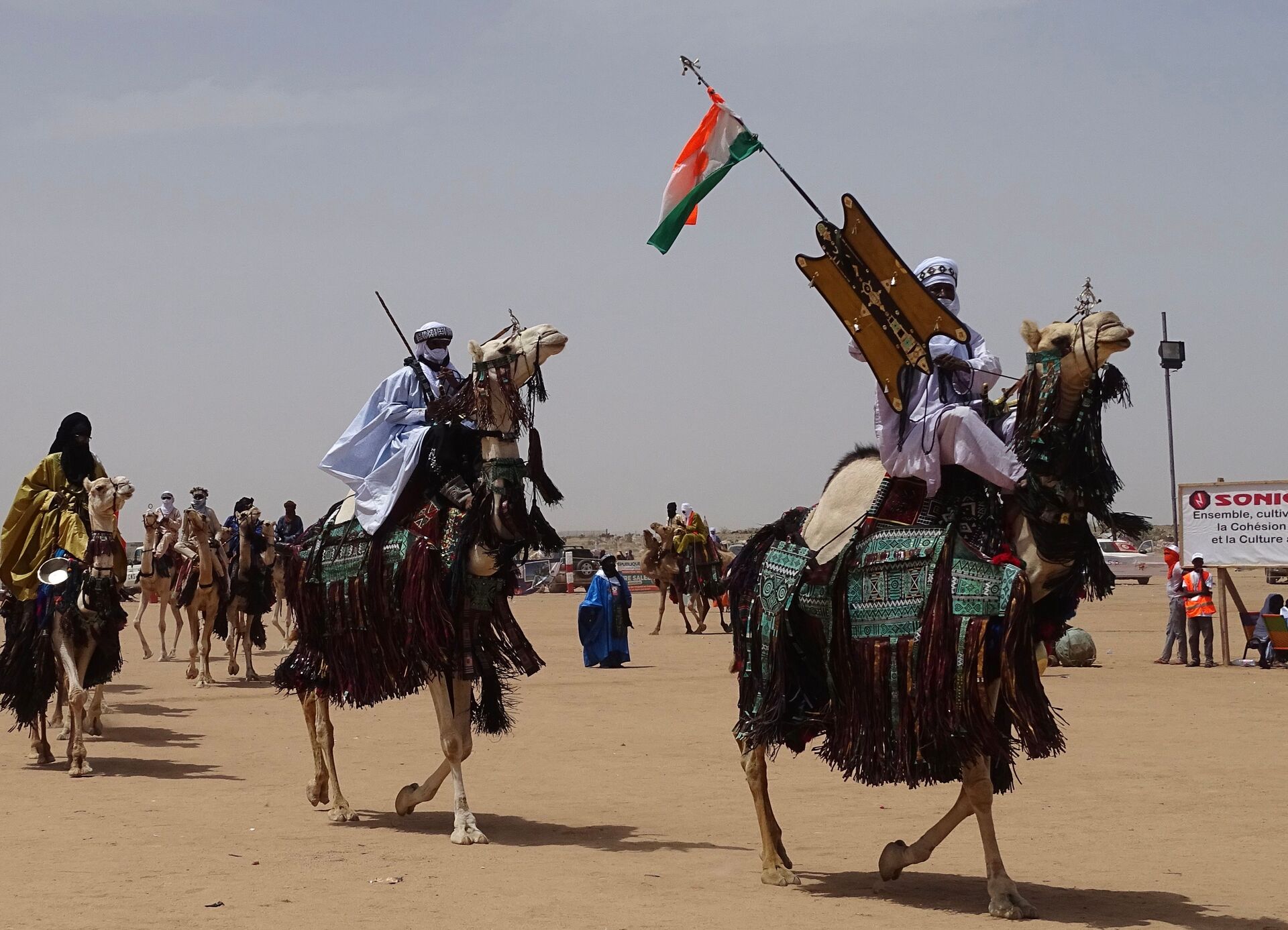
Niger, traditional fetival in Ingall
Independence Day: 3 August 1960. Capital: Niamey. Since July 2023 Niger has removed, in sequence: the French troops, the American drone base, its membership of ECOWAS, the migration law Europe paid it to pass, and the French company that had mined its uranium since 1971. Almost nobody on this website has cleared the board so completely. Niger is also among the poorest countries on earth, has the highest birth rate in the world, is fighting insurgencies on two fronts, is holding its elected president in detention after three years — and on 29 August 2026 there was gunfire near the presidency in Niamey, from its own soldiers.
Most pages in this series ask what independence changed. Niger is running the experiment in public, right now, at maximum speed.
The argument of the men who took power in 2023 is simple and it is not stupid: sixty-three years of French partnership, French troops, French currency, French uranium contracts and Western security assistance produced a country at the bottom of every development index with an insurgency it could not contain.
So remove all of it and see what happens.
Three years in, the results are in and they are not good. The attacks have got worse, not better. There is now a second front in the north that did not exist before. The capital has been attacked twice this year by two different jihadist organisations, and once in August by the army itself.
But the counter-question has not gone away either, and this page will put it as honestly as the first one: the French and American presence did not stop the insurgency in the ten years before 2023. Nigeriens noticed that too.
Niger, traditional fetival in Ingall
Niger is one of the largest countries in Africa and roughly eighty per cent of it is the Sahara. Almost the entire population lives in a strip along the southern border and along the river that gives the country its name.
Niamey, the capital, sits on that river in the far south-west — a city that was a modest settlement chosen by the French for administrative convenience in 1926, and which now holds well over a million people.
Further north lies Agadez, the old Tuareg sultanate founded in the fifteenth century, with a mud-brick minaret that is among the tallest earthen structures in the world and a UNESCO World Heritage site. Beyond it, the Aïr and Ténéré Natural Reserves — the largest protected area in Africa, also UNESCO-listed — and the dunes where the Tree of Ténéré once stood: the most isolated tree on earth, hundreds of kilometres from any other, used as a navigation mark, and destroyed in 1973 when a driver hit it.
In the south-east, the Kanem-Bornu empire, one of the longest-lived states in African history, ran for a thousand years around Lake Chad. In the centre-south, the Hausa city-states of Zinder and Maradi. In the west, the Songhai and Zarma. And at Gadoufaoua in the Ténéré, one of the richest dinosaur fossil beds on the planet.
This is not an empty country. It is a country whose emptiness is the sand.
France's conquest of Niger produced one of the worst episodes of the entire Scramble, and it is almost unknown outside specialist history.
In 1898 France sent a column east from Senegal under Captain Paul Voulet and Captain Julien Chanoine to link up French territories across the Sahel.
The column burned and massacred its way across what is now Niger. Villages that resisted were destroyed and their inhabitants killed; villages that complied were looted anyway; porters were executed for lagging. At Birni-N'Konni in May 1899 the column massacred the population of the town — estimates run into the hundreds and higher.
Reports reached Paris, and a senior officer, Lieutenant Colonel Klobb, was sent to relieve Voulet of command.
Voulet had him shot.
He then declared to his own men that he was no longer a French officer and would carve out his own empire. Within days he and Chanoine were killed by their own African soldiers.
France conducted no proper public reckoning. The official line was that two officers had gone mad in the heat — a formula that made the atrocity individual rather than systemic. Historians have since shown that the column's methods differed from other French columns in degree rather than in kind.
Niger was then folded into French West Africa and governed as one of the poorest and most neglected of its territories. Then came the famines: 1931, and the great Sahel drought of 1968 to 1974, which killed livestock, emptied the north, and brought down the government.
Independence came peacefully, with Hamani Diori as president — a teacher, a founding francophone statesman, and a close ally of Paris.
Diori built a one-party state, accepted the standard French package of cooperation and defence agreements and the CFA franc, and hosted the French uranium industry from 1971 when mining began at Arlit.
He was also, by the early 1970s, pressing Paris for a better uranium price — and in April 1974, in the middle of the famine, the army removed him, in a coup led by Lieutenant Colonel Seyni Kountché. Diori's wife was killed in the assault on the presidency.
The coincidence of the uranium negotiation and the coup has been remarked on ever since, and has never been demonstrated. It is recorded here as what it is.
Kountché ruled until his death in 1987. Ali Saibou followed, and a national conference in 1991 opened the system. Multiparty elections came in 1993.
And then Niger began collecting coups. 1996, by Colonel Ibrahim Baré Maïnassara, who was then assassinated by his own guard at an airfield in 1999. A transition. Mamadou Tandja from 1999, who in 2009 rewrote the constitution to stay on and was removed by the army in 2010. Mahamadou Issoufou from 2011.
In 2021 Issoufou stood down at the end of his second term and handed power to Mohamed Bazoum, who had won the election. It was the first transfer of power between two elected presidents in the history of Niger.
It lasted two years and four months.
Bazoum was seized by the Presidential Guard — the unit whose commander for the previous twelve years had been General Abdourahamane Tiani.
Tiani announced himself head of a National Council for the Safeguard of the Homeland. ECOWAS suspended Niger, imposed severe sanctions, closed the borders and threatened military intervention.
It did not intervene. The threat was made, Nigeria led it, and it collapsed — partly because Nigerian opinion and the Nigerian senate would not support a war against a neighbour, partly because Mali and Burkina Faso declared that an attack on Niger would be an attack on them.
That failure changed West Africa. ECOWAS had removed Yahya Jammeh from The Gambia in 2017 by exactly this method, as the Gambia page on this site describes. In 2023 the same instrument was raised and did not work, and every soldier in the region saw it.
December 2023: the French army left. Around 1,500 troops, withdrawn after Niamey terminated the military agreements. The French ambassador had already been withdrawn after a siege of his residence.
2024: the Americans left. The United States had built Air Base 201 at Agadez — a drone base costing something in the order of $100 million, the centrepiece of American surveillance across the Sahel. Niger terminated the status-of-forces agreement, and the withdrawal was completed in September 2024.
January 2025: ECOWAS. Niger, Mali and Burkina Faso, having formed the Alliance of Sahel States in September 2023, withdrew from ECOWAS. The departures took effect in January 2025 — the first in the bloc's fifty-year history.
November 2023: the migration law. Under sustained European pressure, Niger had passed Law 2015-36, criminalising the transport of migrants northwards. Agadez had been the crossroads of trans-Saharan movement for centuries; the law criminalised an economy that had been legal since before France existed, and it was enforced with EU money. Drivers were jailed and vehicles confiscated, and routes moved to more dangerous ground where more people died.
The junta repealed it, released those convicted under it, and said that Niger would not police Europe's borders.
June 2024 onwards: the uranium. The operating licence of the French company Orano at Imouraren was revoked and the deposit declared to have returned to the state's public domain. SOMAIR, the operating company at Arlit, was taken over, and a new state company — TSUMCO — was created to replace it. In August 2026 permits formerly held by Orano and by the Canadian firm GoviEx were reallocated to state-backed companies.
Orano had relied on Niger for roughly fifteen per cent of its uranium supply at full capacity.
And here the page has to correct a story that circulates everywhere, because getting it wrong weakens the real argument.
It is often said that Niger's uranium powers France's nuclear reactors while Nigeriens sit in the dark. The second half is true: only a small minority of Nigeriens have mains electricity, and Niger imports much of what it uses from Nigeria. The first half is overstated. France has sourced its uranium from several countries — Kazakhstan, Australia, Canada, Namibia, Uzbekistan — and Niger's share of French supply has been significant but never dominant.
The real scandal is not the share. It is the terms. For decades Niger received a small fraction of the value of what came out of Arlit, on contracts renegotiated rarely and on French terms; the mines left behind radioactive waste and contaminated water around Arlit and Akokan that independent researchers have documented and that has never been properly remediated; and the surrounding towns are among the poorest places in one of the poorest countries.
You do not need to exaggerate the tonnage to make that case. It is bad enough at the true numbers.
Niger is fighting at least three separate conflicts.
In the south-west, in Tillabéri — the "three borders" area where Niger, Mali and Burkina Faso meet — the Islamic State in the Greater Sahara and the al-Qaeda-linked JNIM operate more or less freely outside the towns. This is where the worst massacres of civilians have occurred and where much of the army's casualties come from.
In the south-east, around Diffa and Lake Chad, Boko Haram and the Islamic State West Africa Province have been fighting since 2015.
And since 2026 there is a third front in the north. Armed groups including the CFLN and its component MPLJ attacked Nigerien positions at Séguédine near the Libyan border on 15 August 2026, looting and burning camps and taking prisoners, three weeks after a show of force at Ahahi in the Niger–Libya–Chad triangle with around a hundred fighters and eighteen vehicles.
There are claims of logistical support from the Haftar family in eastern Libya. Those claims have not been independently verified and should be treated with caution.
The effect is that the army is now split across two theatres a thousand kilometres apart.
And the capital is no longer safe. Islamic State Sahel Province attacked the airport and airbase at Niamey in January 2026. JNIM attacked the same site in June 2026.
And then, early on a Saturday morning, sustained gunfire and explosions were heard across several districts of Niamey, including at the airport and near the presidency.
Four sources described it as an attack by mutinous soldiers. State television and radio went off air. The government urged calm and said the security forces were responding. The attempt failed, and Russia and Algeria issued statements of support for the government.
The reported grievance is instructive: the gap in pay, equipment and status between the Presidential Guard — Tiani's own unit for twelve years — and the ordinary formations of the armed forces doing the dying in Tillabéri.
That is exactly the fault line that produced 26 July 2023, and it has not been closed. It has been inherited.
Mohamed Bazoum has been detained with his wife since 26 July 2023 — more than three years — reportedly without access to lawyers or family visits and with limited medical care.
His presidential immunity has been lifted and the authorities have said they will try him for high treason, a charge that can carry the death penalty.
On 12 March 2026 the European Parliament passed a resolution by 524 votes to 2 condemning the detention as arbitrary and demanding his release and that of others held since the coup.
He remains in detention.
Niger has one of the lowest human development rankings in the world and the highest fertility rate on earth — around six and a half children per woman, with a population that is doubling roughly every twenty years in a country that is four-fifths desert and losing arable land to it.
The economy rests on subsistence agriculture and livestock, on uranium, on gold, and since 2024 on oil: a 2,000-kilometre Chinese-built pipeline to the port of Sèmè in Benin, which began exporting crude and immediately became hostage to the diplomatic quarrel between Niamey and Cotonou over the closed border.
The government has turned to Russia for security cooperation and, increasingly, to Turkey: Tiani visited Ankara on 4 June 2026 and signed four agreements covering trade, health and defence, with a protocol in force since April allowing Turkish instructors into the Nigerien armed forces. Turkish-made equipment, particularly drones, has become central to the counter-insurgency.
Because Niger is the live test of the argument that runs under every page of this website.
The argument is that formal independence in francophone Africa left the substance in place — the currency, the garrison, the mining concession, the defence agreement — and that until those go, nothing changes. Read the Gabon page on this site, where French paratroopers reversed a Gabonese coup in 1964, and the Guinea page, where a country voted no in 1958 and was punished for it.
Niger has now removed all of it. The garrison, the base, the mining company, the bloc, the migration law. Nobody in francophone Africa has ever gone this far this fast.
And the insurgency is worse, the north has opened up, the capital has been attacked three times in eight months, and the elected president is in a cell.
That does not prove the argument wrong. Three years is nothing, the problems long predate 2023, and the French and American presence had not solved them either. But it does dispose of the simpler version — the idea that the foreign presence was the cause rather than one factor among several.
What Niger demonstrates is the thing this series keeps finding: that removing the external structure is necessary and is not sufficient, and that a state which cannot pay its soldiers or reach its own territory is not made sovereign by the departure of foreigners.
The grievances that produced 2023 were real. Ten years of Western security partnership, a French garrison, an American drone base and hundreds of millions in assistance, and the insurgency spread. Nigeriens were entitled to conclude the arrangement was not working.
And Bazoum was elected, and the transfer of power in 2021 was the only one in the country's history. Whatever the failures of his government, it was removed by his own bodyguard, and he is in prison.
The uranium argument is strong on terms and weak on tonnage, and people who overstate it hand the other side an easy win.
The migration law repeal is defensible and its consequences are complicated. Criminalising a trade that predates the border was a European imposition. Repealing it also restored an industry in which people die in the desert, and Agadez is again the crossroads it has been for six hundred years.
ECOWAS discredited itself. It threatened force it could not use, imposed sanctions that hurt Nigerien civilians and not the junta, and then watched three member states leave. The bloc that removed Yahya Jammeh in 2017 could do nothing in 2023.
And the Presidential Guard problem is unresolved. The unit that made Tiani president is the unit the rest of the army resents, and on 29 August 2026 that resentment came out with rifles.
Two things are true. Niger has taken back more of its own sovereignty in three years than any francophone African state has managed in sixty. And it is less secure, less free and less able to govern its own territory than it was when it started.
There is a tree that stood alone for three hundred kilometres in every direction, and a driver who hit it in 1973.
There is a mud-brick minaret at Agadez that has stood since the sixteenth century.
There is a French column that burned its way east in 1899, and a colonel sent to stop it who was shot by the man he came to arrest.
There is a town called Birni-N'Konni with no agreed number.
There is an explanation from Paris that two officers went mad in the heat.
There is a famine from 1968 to 1974 that emptied the north and brought down a government.
There is a uranium mine at Arlit that opened in 1971, and water around it that people have been told for fifty years is fine.
There is a president handed power by ballot in 2021, the first time it ever happened, and the same man in a cell since July 2023.
There is a threat of military intervention made by ECOWAS in August 2023 that was never carried out, and three member states who left because of it.
There is a drone base at Agadez that cost a hundred million dollars and was handed back.
There is a law Europe paid for, criminalising a trade six hundred years older than the border, and a repeal in November 2023.
There is a French company that mined here for fifty-three years and a state company created to replace it.
There is an airport in Niamey attacked by Islamic State in January 2026 and by al-Qaeda in June 2026.
And there is gunfire near the presidency on the morning of 29 August 2026, from soldiers of the same army, over the difference between the guard and everybody else.
Updated and fact-checked: 15 September 2026.
How this page was checked. Recent events were verified against the sources listed above; the earlier history was checked against standard reference works on Niger, French West Africa and the Sahel. The Sultanate of Agadez, the Kanem-Bornu and Hausa states, the Voulet–Chanoine mission of 1898–99 and the killing of Lieutenant Colonel Klobb, the incorporation of Niger into French West Africa and the designation of Niamey as capital in 1926, the famines of 1931 and 1968–74, independence on 3 August 1960 under Hamani Diori, the start of uranium mining at Arlit in 1971, the coup of April 1974 and the rule of Seyni Kountché, the national conference of 1991 and the elections of 1993, the coups and transitions of 1996, 1999 and 2010, the transfer of power to Mohamed Bazoum in 2021, the coup of 26 July 2023, the ECOWAS threat of intervention and its abandonment, the formation of the Alliance of Sahel States in September 2023 and the withdrawal from ECOWAS effective January 2025, the repeal of the 2015 migration law in November 2023, the French withdrawal of December 2023 and the American withdrawal from Air Base 201 completed in September 2024, the revocation of Orano's Imouraren licence in June 2024 and the subsequent reallocation of uranium permits, the attacks on Niamey airport in January and June 2026, the European Parliament resolution of 12 March 2026, the agreements signed in Ankara on 4 June 2026, the attacks at Ahahi and Séguédine in July and August 2026, and the mutiny of 29 August 2026 are as recorded. Casualty figures for the Voulet–Chanoine mission, including at Birni-N'Konni in May 1899, are contemporary estimates and have never been established. The suggestion that the 1974 coup was connected to Hamani Diori's uranium price negotiations with France is a long-standing claim that has never been demonstrated, and is recorded here as such. Claims of logistical support from the Haftar family in eastern Libya for armed groups operating on Niger's northern border have not been independently verified and are reported here as unverified allegations. Figures on Orano's dependence on Nigerien uranium are as reported and vary by year and by capacity assumption; claims that Niger's uranium supplies the majority of French electricity are not supported by the trade data and are not made here. Mohamed Bazoum has not been tried or convicted of any offence; his continued detention is described as arbitrary by the European Parliament and by international human rights organisations, and the Nigerien authorities dispute that characterisation. Both positions are recorded. The situation in Niger is changing rapidly and readers should check current reporting before relying on the most recent entries. This page makes no allegation against any living person beyond matters already on the public record.
Written and researched by Remo Kurka · africanindependence.com
We strive to unify diverse narratives from across Africa, showcasing the continent's shared heritage and unique stories.
Our mission is to honor and preserve the history of African cultures and independence movements for future generations.
We provide a platform for innovative exchange of ideas, resources, and insights, understanding that knowledge should be accessible to all.