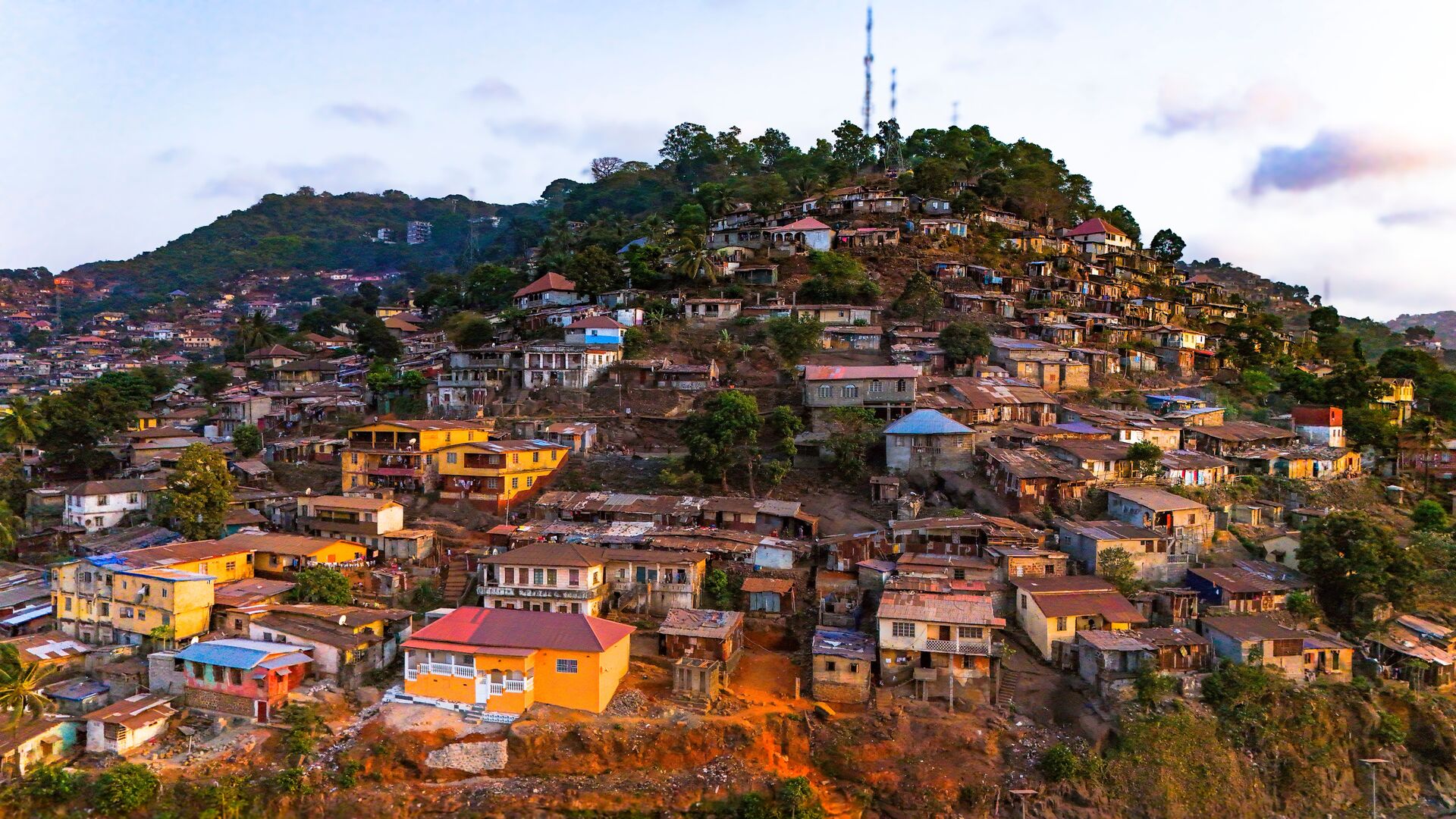
Sierra Leone, Freetown city, and houses build on hills
Independence Day: 27 April 1961. Capital: Freetown — and the name is not decorative. The city was founded in 1792 by more than a thousand Black Loyalists who had fought for Britain in the American Revolution, been promised freedom, and been shipped from Nova Scotia to the West African coast to claim it. Over the following sixty years the Royal Navy landed roughly ninety-nine thousand more Africans on that same shore, taken off slave ships it had intercepted at sea. Almost the entire coastal population of this country descends from people who were freed and put ashore. Two hundred years later, that country fought a war in which its own children were made to cut off its people's hands.
Sierra Leone is the mirror image of Liberia, and the two should always be read together.
Liberia, described elsewhere on this site, was founded by an American society that wanted free Black people removed from the United States; its settlers arrived as a colonising class and governed the people they found for a hundred and thirty-three years.
Sierra Leone was founded by Britain out of an abolitionist impulse that was genuine, self-interested and clumsy in roughly equal measure — and the settlers who arrived were not conquerors. They were the formerly enslaved, the rescued, and the discharged: Black Loyalists from Nova Scotia, Jamaican Maroons deported for rebelling, the Black Poor of London, and then tens of thousands of people lifted off slaving vessels by the anti-slavery squadron.
They also, over time, became a separate and privileged class over the peoples of the interior — and that division, between Colony and Protectorate, is the single thread that runs from 1808 through the war of the 1990s to the politics of 2026.
And Sierra Leone is where the phrase "blood diamonds" was made real enough to change international law.
Sierra Leone, Freetown city, and houses build on hills
The land was not empty and its peoples are still there.
The Temne in the north and around the estuary, the Mende in the south and east, the Limba, the Sherbro and Bullom on the coast, the Susu, Fula, Kono, Loko, Kissi and others.
Portuguese navigator Pedro de Sintra charted the peninsula in 1462 and named it Serra Lyoa — the lion mountains, for the shape of the hills above the harbour, or the sound of the thunder in them.
That harbour is the point. The estuary of the Rocke is the largest natural deep-water harbour in West Africa and one of the largest in the world, which is why the British wanted it, why the Royal Navy based its West Africa Squadron there, and why Freetown mattered in two world wars.
Society in the interior was organised in part through Poro for men and Sande or Bundu for women — initiation societies that carried law, medicine, education and political authority, and which still function. They are one reason the British could not govern the interior the way they governed the coast.
In 1787 an abolitionist committee in London landed around four hundred people at the estuary — the "Black Poor" of London, many of them formerly enslaved, together with some white women, on land obtained from a Temne ruler in a transaction neither side understood the same way.
Most of them were dead within three years, of fever, hunger and a local war.
The Sierra Leone Company took over in 1791, and then came the settlement that actually held.
In 1792, 1,196 Black Loyalists sailed from Nova Scotia. They had escaped slavery in the American colonies by joining the British side in the Revolution on the promise of freedom and land. Britain evacuated them to Nova Scotia and then failed to give them the land. Thomas Peters, a former slave from North Carolina who had fought in the Black Pioneers, travelled to London to demand redress; the abolitionist John Clarkson organised the fleet.
They landed on 11 March 1792, marched ashore singing a hymn, and named the place Freetown.
In 1800 came the Jamaican Maroons — fighters deported from Jamaica after the Second Maroon War, sent first to Nova Scotia and then here. They arrived in time to help the Company put down a rebellion by the Nova Scotians, who had concluded that the Company was no better a landlord than anybody else. That is the founding irony of Sierra Leone and it is not a small one.
In 1808 Freetown became a Crown Colony, and its purpose changed.
Britain had abolished the slave trade in 1807, and the Royal Navy's West Africa Squadron spent the next sixty years intercepting slave ships. Freetown became its base, and the site of the Vice-Admiralty and later Mixed Commission courts that condemned the captured vessels.
The people aboard had to be put somewhere. They were put ashore at Freetown — something in the order of ninety-nine thousand of them, from more than a hundred different peoples, across the whole of West and Central Africa.
They were called Liberated Africans, or recaptives. They were settled in villages around the peninsula that still carry the names the missionaries gave them: Waterloo, Wellington, Regent, Kissy, Gloucester, Leicester, Hastings, Bathurst.
They had nothing in common except that they had been on a ship. No shared language, no shared home, no route back.
So they built one. Out of Yoruba, Igbo, Akan and dozens of other languages, plus the English of the Nova Scotians and the Jamaican patois of the Maroons, came Krio — an English-based creole that is now the lingua franca of the whole country.
And they became the Krio people: Christian, literate, commercial, and disproportionately influential far beyond Sierra Leone.
Fourah Bay College was founded in 1827. It is the oldest Western-style university in sub-Saharan Africa, and for a century it educated the clergy, teachers, lawyers, doctors and civil servants of the whole of British West Africa.
Samuel Ajayi Crowther — taken as a boy from a Yoruba town, freed at sea by the Royal Navy, landed at Freetown, educated at Fourah Bay, and consecrated in 1864 as the first African Anglican bishop — translated the Bible into Yoruba. Krio families moved to Lagos, Calabar, Accra, Banjul and Fernando Pó as traders, missionaries and clerks.
Freetown was called the Athens of West Africa, and the Gold Coast elite that produced Ghana's independence generation was substantially educated in its orbit. That link is a direct one, and this site's Ghana page is the other half of it.
In 1896 Britain declared a Protectorate over the hinterland — and in doing so created two legally different kinds of person in the same territory.
Colony residents — largely Krio — were British subjects, with British rights and British courts. Protectorate residents were British protected persons, governed indirectly through chiefs, under a separate legal system.
In 1898 Britain imposed a tax on houses, five shillings a year, in a region with almost no cash economy.
The Hut Tax War followed. In the north, Bai Bureh, a Temne war chief in his fifties, fought a guerrilla campaign for ten months against a far better armed British force and was captured only after a long pursuit; he was exiled to the Gold Coast and allowed home in 1905. He is on the currency.
In the south it went differently. The Mende rising attacked not only British officials but Krio traders, missionaries and their families, hundreds of whom were killed.
That is the wound. The settlers, descendants of the freed, had by then become the visible face of the colonial order in the interior — collecting, trading, preaching and administering. The 1898 killings made Colony and Protectorate into two political nations, and the parties that fought every election after independence grew directly out of it.
Diamonds were found in Kono in the 1930s, and by the 1950s illicit digging had become a mass phenomenon that no administration ever fully controlled.
Independence came peacefully. Sierra Leone became independent on 27 April 1961 under Sir Milton Margai of the Sierra Leone People's Party, a doctor and a cautious conciliator, who died in 1964 and was succeeded by his brother Albert Margai.
In 1967 the All People's Congress of Siaka Stevens won the election. The army promptly seized power, there was a counter-coup, and after a year of confusion Stevens was installed in 1968.
He ruled for seventeen years, and he took the state apart.
A one-party state from 1978. Opponents hanged after treason trials. The diamond industry effectively removed from public accounting and run as a personal network. Fourah Bay, the schools, the roads, the hospitals — all of it starved while the country's principal export left through channels that appeared in no budget.
By the time Stevens handed over to Joseph Momoh in 1985, Sierra Leone had a government that could not pay teachers, an army that could not be paid, and an interior full of unemployed young men who had been to school and had nothing.
That is the fuel. The match arrived from Liberia.
The Revolutionary United Front crossed the border from Liberia — a small force under Foday Sankoh, a cashiered army corporal and photographer, armed, trained and sent by Charles Taylor, whose own war is described on this site's Liberia page.
The war lasted almost eleven years.
It had no coherent ideology, and the RUF's political programme never amounted to more than a pamphlet. What it had was diamonds. The RUF took the Kono fields, dug them with forced labour, and traded the stones through Liberia for weapons.
And it had children. Boys and girls were abducted in enormous numbers, drugged, initiated by being made to kill someone from their own village so that they could never go home, and sent to fight.
Its signature was amputation. Hands and arms were cut off civilians — including small children — with the choice offered between "long sleeve" and "short sleeve" depending on where the cut was made. It was done to terrorise, and in 1996 specifically to stop people voting.
The state fell apart in parallel. In 1992 a group of young officers took power — Captain Valentine Strasser, aged twenty-five, the youngest head of state in the world. He was overthrown in 1996 by his own deputy, Brigadier Julius Maada Bio, who held elections and handed power to Ahmad Tejan Kabbah — an act that should be remembered, because Bio is the president of Sierra Leone today.
In 1997 the army mutinied, invited the RUF into Freetown, and governed jointly with it. Nigerian-led ECOMOG forces drove them out in 1998 and restored Kabbah.
And in January 1999 the RUF and their allies came back for Freetown. The assault was called "Operation No Living Thing." Over a few weeks something in the order of six thousand people were killed in the city; districts were burned, thousands of women and girls were raped, and thousands more were mutilated or abducted.
Across the whole war, estimates of the dead run to around fifty thousand and higher, and roughly 2.6 million people — well over half the population — were displaced.
This is where the war entered international law.
Campaigners and journalists traced the RUF's stones through Liberia into the legitimate trade, and the phrase conflict diamonds entered the language. The UN Security Council embargoed Sierra Leonean diamonds in 2000 and Liberian ones the year after.
The Kimberley Process Certification Scheme was created in 2003, largely because of Sierra Leone and Angola: a system under which rough diamonds cross borders with a certificate of origin.
It is imperfect and it has been criticised ever since — for certifying stones from states whose own security forces commit abuses, for the Zimbabwe fields, for not covering cutting and polishing, and for the ease with which stones can be laundered across a land border.
And it is still the only global mechanism of its kind. A commodity chain was redesigned because of what happened in Kono. That precedent belongs beside the al-Mahdi conviction on this site's Mali page and the tobacco litigation on the Malawi page: supply chains can be made legally accountable, and it takes a catastrophe to do it.
Britain intervened in May 2000. Operation Palliser began as an evacuation of foreign nationals and became something else: British forces secured Lungi airport and Freetown, stiffened the UN mission, and made it clear that the capital would not fall again.
In September 2000 British special forces mounted Operation Barras to rescue soldiers held by a militia called the West Side Boys — an operation that effectively broke the remaining irregular forces around the capital.
Sankoh was captured in May 2000 after his guards fired on a demonstration outside his house. The war was declared over on 18 January 2002.
The Special Court for Sierra Leone sat from 2002 to 2013 — a hybrid tribunal, created by agreement between the United Nations and the government, sitting in Freetown rather than abroad, with Sierra Leonean and international judges.
Its record matters far beyond Sierra Leone.
It was the first international court to convict anyone for the recruitment and use of child soldiers, in the AFRC judgment of 2007. It was the first to recognise forced marriage as a crime against humanity. It convicted RUF, AFRC and pro-government CDF commanders — both sides.
And in 2012 it convicted Charles Taylor, former president of Liberia, of aiding and abetting crimes against humanity and war crimes, and sentenced him to fifty years — the first former head of state convicted by an international tribunal since Nuremberg. He is serving it in Britain.
Foday Sankoh died in custody in 2003 before judgment.
A Truth and Reconciliation Commission reported in 2004, and its recommendations on reparations have been implemented only in part.
Which is the genuinely surprising thing.
Kabbah won the 2002 election. In 2007 he was term-limited out and the opposition APC under Ernest Bai Koroma won — a peaceful change of party five years after the war ended. Koroma served two terms and handed over in 2018 to Julius Maada Bio — the officer who had taken power in 1996 and given it back.
Two alternations, both accepted, in a country that had been at war within living memory.
The 2023 election, which returned Bio, was different: the opposition rejected the result and boycotted parliament, and international observers raised serious questions about the tallying. Mediation by ECOWAS, the AU and the Commonwealth produced an Agreement for National Unity and a cross-party review of the electoral system.
And in the early hours of 26 November 2023, armed men attacked the Wilberforce military barracks and Pademba Road Prison in Freetown, releasing prisoners. It was put down; dozens were later convicted.
Former president Ernest Bai Koroma has been on trial in connection with those events. In 2026 the High Court permitted him to travel to Abuja for up to three months, which has been widely read as an ECOWAS-brokered arrangement to defuse the case.
Two things happened in between that shaped the decade.
The Ebola epidemic of 2014–16 killed around four thousand people in Sierra Leone out of roughly fourteen thousand cases — among the worst-affected countries, alongside Liberia and Guinea. It killed a large share of the country's small number of doctors and nurses. Schools closed for nine months. The health system it destroyed had only just been rebuilt after the war.
And on 14 August 2017, after days of rain, part of Sugar Loaf mountain above Regent collapsed. A mudslide and flood killed something over a thousand people in a few minutes, many of them never recovered.
Regent is one of the villages the Liberated Africans were settled in, in the hills above Freetown. Two centuries later the hillsides had been stripped of forest by a city with nowhere else to build.
Sierra Leone is one of the poorest countries in the world, and the economy is minerals.
More than seventy-six per cent of export receipts came from minerals in 2024. Iron ore from Marampa and Tonkolili is the biggest earner, with capacity expanding in 2026. There is bauxite, gold, diamonds — and rutile, of which Sierra Leone holds among the largest natural deposits on earth.
And look at the royalty rates, reported in April 2025: 3.5 per cent on iron ore, 3 per cent on bauxite, 5 per cent on gold, 3 to 5 per cent on diamonds — and 0.5 per cent on rutile.
Half of one per cent, on the mineral the country has more of than almost anybody. A government has created a Mineral Wealth Fund and renegotiated concessions to capture more value, and that single figure shows how much value there was to capture.
Growth was around five per cent in 2025 and is forecast to slow to about four per cent in 2026, with fuel and fertiliser costs rising on the back of the Middle East conflict. Inflation is forecast to rise from about 7.6 per cent to around 9.3 per cent, with a year-end figure near 11.6. There is an IMF programme, and the Fund's board approved new climate financing in June 2026.
And there is kush.
A cheap synthetic drug of uncertain and variable composition, kush swept through Freetown's poorest districts from around 2022 — quick, cheap, devastating, and taken by very large numbers of young men with no work. The government declared it a national emergency in 2024, combining enforcement with treatment centres. It has since spread into Liberia, Guinea, Guinea-Bissau and The Gambia.
It is doing to this generation what the war did to the last one, and it is being reported abroad as a curiosity.
There is a better story running alongside it.
Bio chaired ECOWAS from mid-2025, and on 19 July 2026 Sierra Leone hosted the 69th ECOWAS summit at a newly built conference centre outside Freetown, together with a new regional logistics depot. Member states signed an agreement there backing the proposed African Atlantic Gas Pipeline from Nigeria to Morocco.
On 21 July 2026, Bio handed the ECOWAS chairmanship to President Bassirou Diomaye Faye of Senegal, whose own country's page on this site sits immediately before this one.
For a country that the region rescued with troops in 1998, hosting the summit and chairing the bloc is not a small reversal.
And there is an embarrassment running in parallel. The Netherlands has been seeking the extradition of a convicted Dutch drug trafficker, Jos Leijdekkers, who was reportedly identified in photographs taken in Sierra Leone in circumstances suggesting proximity to the president's family. The Dutch justice ministry has demanded extradition; Freetown has said it has not located him. The matter is unresolved, the allegations are reported rather than established, and it sits awkwardly beside a national emergency on narcotics.
Because Sierra Leone is where the abolitionist century actually landed.
Everywhere else on this website, the abolition of the slave trade is a date in a British or French statute book. Here it is a shoreline with ninety-nine thousand people on it, and the villages they were put in still have the names the missionaries chose, and their descendants speak a language they invented because they had no other.
And it is the strongest evidence that liberation does not settle anything by itself. The freed built a literate, commercial, Christian society, founded the first university in sub-Saharan Africa, sent bishops and lawyers across West Africa — and became, to the peoples of the interior, the visible edge of a colonial order that taxed their houses and burned their villages. In 1898 the interior killed them for it. That division was never repaired, and every government since independence has been an argument about it.
And the war is the thing the world learned from and then forgot. It produced the Kimberley Process, the first convictions anywhere for using child soldiers, the first recognition of forced marriage as a crime against humanity, and the first conviction of a former head of state since Nuremberg. Sierra Leone paid for all of that with fifty thousand lives, and got a hybrid tribunal, a partial reparations scheme, and a generation on kush.
Britain's abolitionism here was real and it was also imperial. The Squadron did free people; the colony it created became the base from which Britain took the interior, and the Liberated Africans became instruments of that.
The Nova Scotians rebelled against the Sierra Leone Company, and the Maroons helped put them down. The founding population was never one thing.
The Krio became a privileged minority, and Sierra Leoneans from the interior say so plainly. The Colony–Protectorate divide was drawn by Britain and it was also lived and defended.
The RUF was a Sierra Leonean organisation. Charles Taylor armed it and Libya trained some of its founders, but the men who took the hands off were from here, and the child soldiers who did much of it were abducted from here. Blaming Monrovia alone is a Sierra Leonean fiction as much as a foreign one.
The pro-government militias also committed atrocities, and the Special Court convicted CDF commanders too, which was controversial in Sierra Leone precisely because they were regarded as defenders.
Diamonds did not cause the war. A collapsed state, a looted treasury, an unpayable army and thirty years of Siaka Stevens caused the war. Diamonds paid for it and kept it running for a decade.
And the country's best-known export after minerals is a story about mutilation, which Sierra Leoneans are tired of being asked about by people who have read nothing else.
Two things are true. Sierra Leone gave the world several of the legal instruments that now exist to prosecute atrocity. And it is still poor enough that half a per cent is what it gets for its rutile.
There are hills a Portuguese sailor called the lion mountains in 1462.
There is the largest natural harbour in West Africa, which is why everybody wanted it.
There are four hundred people landed in 1787 who were nearly all dead within three years.
There are 1,196 Black Loyalists who came ashore on 11 March 1792 singing a hymn, having fought for Britain and been promised land twice.
There are Jamaican Maroons deported for rebelling, who arrived in time to put down somebody else's rebellion.
There are villages in the hills called Waterloo, Wellington, Regent and Hastings, named by missionaries for the people who were put in them.
There are ninety-nine thousand people taken off ships and set down on a beach with nothing in common but the ship.
There is a language they built out of everything they had between them.
There is a college founded in 1827 that taught West Africa's first generation of lawyers, clergy and nationalists.
There is a boy taken from a Yoruba town, freed at sea, and consecrated a bishop in 1864.
There is a tax of five shillings on a house, in a country with no cash.
There is a war chief who fought the British for ten months in 1898 and is on the banknotes.
There are Krio traders and missionaries killed in the south the same year by people who had decided what they were.
There is a diamond field at Kono that never appeared in a budget.
There is a corporal who crossed from Liberia on 23 March 1991.
There are two words, long sleeve and short sleeve, that mean where the cut is made.
There are six thousand people killed in Freetown in a few weeks in January 1999.
There is a certification scheme that exists because of this country.
There is a court in Freetown that convicted a president of the country next door.
There are four thousand dead of Ebola and a thousand under a hillside at Regent.
There is a royalty rate of half of one per cent on rutile.
And there is a drug called kush, in the districts where the recaptives were settled.
Updated and fact-checked: 17 September 2026.
How this page was checked. Recent political and economic developments were verified against the sources listed above; the earlier history was checked against standard reference works on the Seychelles, the Indian Ocean slave trade and British imperial exile. The French possession of 1756 and first settlement in 1770, the British capture and the Treaty of Paris of 1814, administration as a dependency of Mauritius until the separate Crown Colony of 1903, the abolition of slavery in 1834–35 and the subsequent landing of Liberated Africans taken from slaving dhows, the use of the islands as a place of imperial exile including the deportation of Asantehene Prempeh I in 1900 and of Yaa Asantewaa in 1901, the death of Yaa Asantewaa on 17 October 1921 and the return of Prempeh I in 1924, the exile of Archbishop Makarios III in 1956–57, the detachment of Aldabra, Farquhar and Desroches into the British Indian Ocean Territory in the 1960s and their return at independence, the opening of the international airport in 1971, independence on 29 June 1976, the coup of 5 June 1977 and the one-party state that followed, the mercenary landing of 25 November 1981 and the hijacking of an Air India aircraft to Durban, the restoration of multiparty politics in 1991 and the constitution of 1993, the transfers of office in 2004 and 2016, the debt-for-nature swap of 2015 and the sovereign blue bond of 2018, the work of the Truth, Reconciliation and National Unity Commission from 2018 and its final report in 2023, the opposition victory of 25 October 2020, and the general election of September and October 2025 are as recorded. Figures are estimates or official series as indicated: the number of Liberated Africans landed in the Seychelles in the 1860s and 1870s is generally given as around two to three thousand; the number of giant tortoises on Aldabra is generally given as around one hundred thousand; income per head, poverty rate, arrivals, tourism receipts and debt ratios are as reported in the sources above and vary between GDP and GNI measures. The estimate that around ten per cent of the working-age population uses heroin is widely cited in Seychellois political debate and international reporting; it is an estimate and no definitive survey establishes it. A United Nations commission of inquiry found South African involvement in the 1981 mercenary operation; the South African government of the day disputed the extent of that involvement. Patrick Herminie was arrested in 2023 in connection with an alleged plot; the charges were dropped and he has not been convicted of any offence, and nothing here should be read as asserting otherwise. Allegations concerning the financing of the 2025 election campaign were made during that campaign and have not been established. The findings of the Truth, Reconciliation and National Unity Commission are the Commission's own; its recommendations on reparations have not been implemented. This page makes no allegation against any living person beyond matters already on the public record.
Written and researched by Remo Kurka · africanindependence.com
We strive to unify diverse narratives from across Africa, showcasing the continent's shared heritage and unique stories.
Our mission is to honor and preserve the history of African cultures and independence movements for future generations.
We provide a platform for innovative exchange of ideas, resources, and insights, understanding that knowledge should be accessible to all.